
 100% FREE ACCESS
12th Standard CBSE Syllabus & Materials
12th Standard CBSE
CBSE 12th Economics Government Budget and the Economy Previous year Question Papers Study Material - QB365 Set A
NEW12th Standard CBSE
CBSE 12th Computer Science Interface Python with MySQL - New Previous year Question Papers Study Material - QB365 Set A
NEW12th Standard CBSE
CBSE 12th Computer Science Database Concept - New Previous year Question Papers Study Material - QB365 Set A
NEW12th Standard CBSE
CBSE 12th Computer Science Data Communication - New Previous year Question Papers Study Material - QB365 Set A
NEW12th Standard CBSE
CBSE 12th Computer Science Data Structures - New Previous year Question Papers Study Material - QB365 Set A
NEW12th Standard CBSE
CBSE 12th Computer Science Functions - New Previous year Question Papers Study Material - QB365 Set A

Published on: 25/10/2025
Download CBSE Class 12th Standard CBSE Biology question papers, sample papers, important questions, and previous year solved papers in PDF format. Get free study materials, NCERT solutions, and exam preparation resources for Class 12th Standard CBSE Biology
Questions + Answers key
Take MCQ Biology Test
1.
What is meant by monosporic development of female gametophyte?
2.
How many eggs do you think were released by the ovary of a female dog which gave birth to 6 puppies?
3.
What is parturition? Which hormones are involved in induction of parturition?
4.
What is apomixis and what is its importance?
5.
Define spermiogenesis and spermiation
6.
What is fruit production without fertilisation called?
7.
How many embryo sacs are formed in an ovule?
8.
Why do you think that the zygote is dormant for sometime in a fertilised ovule?
9.
Name the parts of an angiosperm flower in which development of male and female gametophyte takes place.
10.
What are the major functions of male accessory ducts and glands?
11.
Name the hormones involved in the regulation of spermatogenesis.
12.
Differentiate between:
(i) Hypocotyl and epicotyl.
(ii) coleoptile and coleorhiza.
(iii) integument and testa.
(iv) perisperm and pericarp
13.
(a) Humans reproduce ____________.(asexually / sexually)
(b) Humans are ____________.(oviparous, viviparous, ovoviviparous)
(c) Fertilisation is ____________.in humans. (external/internal)
(d) Male and female gametes are ____________. (diploid/haploid)
(e) Zygote is ____________. (diploid/haploid)
(f) The process of release of ovum from mature follicle is called ____________.
(g) Ovulation is induced by a hormone called ____________.
(h) The fusion of male and female gametes is called ____________.
(i) Fertilisation takes place in ____________.
(j) Zygote divides to form ____________. which is implanted in uterus.
(k) The structure which provides vascular connection between foetus and uterus is called ____________.
14.
Identify True/False statements. Correct each false statement to make it true:
(a) Androgens are produced by Sertoli cells. (True/False)
(b) Spermatozoa get nutrition from Sertoli cells. (True/False)
(c) Leydig cells are found in ovary. (True/False)
(d) Leydig cells synthesise androgens. (True/False)
(e) Oogenesis takes place in corpus luteum. (True/False)
(f) Menstrual cycle ceases during pregnancy. (True/False)
(g) Presence or absence of hymen is not a reliable indicator of virginity or sexual experience. (True/False)
15.
With a neat, labelled diagram, describe the parts of a typical angiosperm ovule.
16.
Differentiate between microsporogenesis and megasporogenesis. Which type of cell division occurs during these events? Name the structures formed at the end of these two events.
17.
Embryo sac is to ovule __________ is to an anther
Stamen
Filament
Pollen grain
Androecium
18.
In a mature embryo sac the central cell is
Single nucleate
Binucleate
Four nucleate
Eight nucleate
19.
Select the correct order of endosperm types
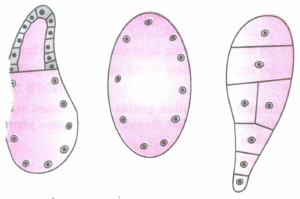
cellular, helobial, free nuclear
cellular, free nuclear, helobial
helobial, free nuclear, cellular
free nuclear, cellular, helobial
free nuclear, helobial, cellular
20.
A type angiosperm embryo sac at maturity is
4 nucleate - 2 celled
8 nucleate - 7 celled
4 nucleate - 4 celled
8 nucleate - 4 celled
2 nucleate - 1 celled
21.
Which type of association is found in between entomophilous flower and pollinating agent?
Mutualism
Commensalism
Cooperation
Coevolution
22.
Intraspecific incompatibility can be overcome by
Wetting of anthers
Mixed pollination
Intraovarian fertilization
Intraspecific competition
23.
Egg apparatus consists of
egg
egg and polar nuclei
Egg and synergids
Egg and antipodal cells
24.
25.
26.
27.
28.
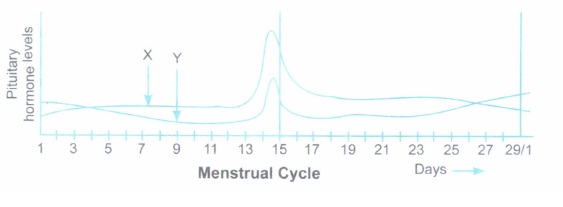
(a) Identify the pituitary hormones 'X' and 'Y' shown in the graph.
(b) Mention two functions each of X and Y in human females.
1.
An embryo sac is called monosporic because it develops from one of the four megaspores formed from the division of megaspore mother cell.
2.
Six eggs
3.
Partiruition refers to the process of delivery if the fully-developed foetus,i.e.,childbirth.
Relaxin and oxytocin are the hormones involved in the process.
4.
1. Apomixis is a form of asexual reproduction that mimics sexual reproduction and seeds are formed without fertilisation.
2. Apomictic embryos are genetically identical to the female parent.
3. If hybrid seeds can be made apomictic, the desirable characters can be maintained in the progeny.
4. It is often associated with polyembrony.
5.
(i) Spermiogenesis is the process of transformation of spermatids into flagellated spermatozoa.
(ii) Spermiation is the process of release of spermatozoa from the seminiferous tubules.
6.
Parthenocarpy.
7.
One
8.
There is an adaptation in angiospermic plants to provide assured nutrition to the developing embryo. Most zygotes divide only after certain amount of endosperm is formed. Therefore, zygote remains dormant for sometime in a fertilised ovule.
9.
1. Male gametophyte - In the Anther (microsporangia) and later on the stigma and style.
2. Female gametophyte - inside the ovule.
10.
The male accessory ducts are rete testis, vasa efferentia, epididymis and vas deferens.These ducts store and transport the sperms from the testes to the outside through the urethra. The male accessory glands are paired seminal vesicles, prostate gland and paired Bulbourethral glands. The secretion of these glands forms seminal plasma, which is rich in fructose, calcium and certain enzymes. The secretion of Bulbourethral glands lubricates the glans penis.
11.
Hormones controlling spermatogenesis.
Spermatogenesis is initiated by an increase in the secretion of GnRH (gonadotropin-releasing hormone) by the hypothalamus, at the age of puberty.
The increased levels of GnRH act on the anterior pituitary and stimulate it to secrete two gonaditropins namely:
(i) Follicle Stimulating Hormone (FSH) and
(ii) Luteinizing Hormone (LH).
LH acts o the Leydig cells and stimulates them to secrete testosterone.
FSH acts on Sertoli cells and stimulates them to secrete some factors which help in spermiogenesis.
12.
(i)
| Hypocotyl | Epicotyl |
| Hypocotyl is the region of embryonal axis between the radicle and the point of attachment of cotyledons | Epicotyl is the region of embryonal axis between the plumule and the point of attachment of cotyledons |
(ii)
|
Coleoptile |
Coleorhiza |
| Coleoptile is the foliaceous sheath that covers the plumule in the embryo of cereals. | Coleorhiza is the covering of the radicle in the embryo of cereals |
(iii)
| Integument | Testa |
| It is the protective covering of the ovule. It develops into the seed coat |
Testa is the outer layer of the seed coat. It develops from the outer integument. |
(iv)
| Perisperm | Pericarp |
| Peri sperm is the residual, persistent nucellus (of ovule) in the seed. It is a part of the seed and nutritive in function |
Peri carp is the wall of fruit formed by the ovary wall. It is a part of the fruit and protective in function. |
13.
(a) sexually
(b) viviparous
(c) internal
(d) haploid
(e) diploid
(f) ovulation
(g) luteinising hormone
(h) syngamy
(i) ampullary-isthmic junction
(j) blastula
(k) umbilical cord.
14.
(a) False
Androgens are formed by Leydig cells.
(b) True.
(c) False
Oogenesis takes place in the ovarian follicles.
(d) True
(e) False
Oogenesis occurs in the female embryo before birth but does not complete until puberty.
(f) True.
(g) True.
15.
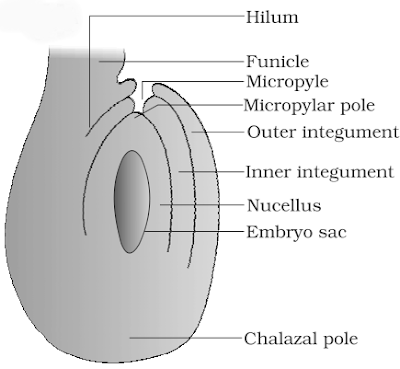
1. The ovule is attached to the placenta by a short stalk called funiculus.
2. The junction between the funiculus and the ovule, is called hilum.
3. The primordium of the ovule grows into a mass of cells, forming the nucellus, the main body of the ovule.
4. It becomes surrounded by two protective envelopes called integuments, which leave a small opening called micropyle, at the tip of the ovule.
5. The basal part of the ovule (opposite to the micropyle) is called chalaza. Cells of the nucellus are rich in reserve food materials.
6. There is a single embryo sac/female gametophyte in the nucellus; it has developed from a megaspore.
7. The embryo sac contains the following cells:
(i) Three antipodal cells at the chalazal end.
(ii) Three cells at the micropylar end, forming egg apparatus, which consists of two synergids and a female gamete.
(iii) Two nuclei in the central cell, called polar nuclei, which fuse to form a diploid secondary nucleus.
16.
|
Microsporogenesis |
Megasporogenesis |
|
It occurs inside the microsporangia of anther. |
It occurs in the nucellus of the ovule/megasporangium. |
Meiosis occurs during sporogenesis.
The structure formed at the end are microspores and megaspores respectively.
17.
(c)
Pollen grain
18.
(b)
Binucleate
19.
(c)
helobial, free nuclear, cellular
20.
(b)
8 nucleate - 7 celled
21.
(a)
Mutualism
22.
(b)
Mixed pollination
23.
(c)
Egg and synergids
24.
25.
26.
27.
28.
(a) X is luteinizing hormone (LH).
Y is follicle-stimulating hormone (FSH).
(b) Functions of X
(i) The LH-surge causes rupture of Graafian follicle and release of ovum, in the process, called ovulation.
(ii) It influences the formation of corpus luteum from the remaining parts of the Graafian follicle and secretion of progesterone from it.
Functions of Y
(i) It stimulates the growth of a primary follicleinto a Graafian follicle and thus, influences oogenesis.
(ii) It stimulates the cells of the developing follicle to secrete estrogens.

12th Standard CBSE Syllabus & Materials
12th Standard CBSE
CBSE 12th Computer Science Python Revision Tour I - New Previous year Question Papers Study Material - QB365 Set A
NEW12th Standard CBSE
CBSE 12th Business Studies Planning Important Questions And Answers Study Material - QB365 Set A
NEW12th Standard CBSE
CBSE 12th Business Studies Business Environment Important Questions And Answers Study Material - QB365 Set A
NEW12th Standard CBSE
CBSE 12th Business Studies Principles of Management Important Questions And Answers Study Material - QB365 Set A



NCERT Books

Syllabus

Exam Pattern

Sample Question Papers

Previous year Question Papers

Important Notes

MCQ Practice test

NCERT Exemplers

Case study Questions

Image Based Questions

Passage based Questions

HOT Questions

Value Based Questions

Model Questions Papers
NCERT ( Book Back ) Questions

Assertion and Reason
Important Questions And Answers

CBSE 12th Standard CBSE Subjects
CBSE Standards








