
 100% FREE ACCESS
12th Standard CBSE Syllabus & Materials
12th Standard CBSE
CBSE 12th Economics Government Budget and the Economy Previous year Question Papers Study Material - QB365 Set A
NEW12th Standard CBSE
CBSE 12th Computer Science Interface Python with MySQL - New Previous year Question Papers Study Material - QB365 Set A
NEW12th Standard CBSE
CBSE 12th Computer Science Database Concept - New Previous year Question Papers Study Material - QB365 Set A
NEW12th Standard CBSE
CBSE 12th Computer Science Data Communication - New Previous year Question Papers Study Material - QB365 Set A
NEW12th Standard CBSE
CBSE 12th Computer Science Data Structures - New Previous year Question Papers Study Material - QB365 Set A
NEW12th Standard CBSE
CBSE 12th Computer Science Functions - New Previous year Question Papers Study Material - QB365 Set A

Published on: 25/10/2025
Download CBSE Class 12th Standard CBSE Biology question papers, sample papers, important questions, and previous year solved papers in PDF format. Get free study materials, NCERT solutions, and exam preparation resources for Class 12th Standard CBSE Biology
Questions + Answers key
Take MCQ Biology Test
1.
Case below is followed by 6 questions (i to vi).Attempt any 5.
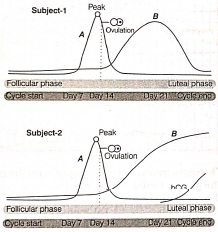
(i) The peak observed in subjects 1 and 2 is due to
| (a) oestrogen | (b) progesterone |
| (c) Luteinizing hormone | (d) follicle stimulating hormone |
(ii) Subject 2 has higher level of hormone B, which is
| (a) oestrogen | (b) progesterone |
| (c) Luteinizing hormone | (d) follicle stimulating hormone |
(iii) If the peak of hormone A does not appear in a study for subject 1, which of the following statemnent is true?
(a) Peak of hormone B will be observed at a higher point in the graph
(b) Peak of hormone B will be observed at a point lower than what is given in the graph
(c) There will be no observed data for hormone B
(d) The graph for hormone B will be a sharp rise followed by a plateau
(iv) Which structure in the ovary wiill remain functional in subject 2?
| (a) Corpus luteum | (b) Tertiary folicle |
| (c) Graafian follicle | (d) Primary follicle |
(v) For subject 2, it is observed that the peak for hormone B has reached the plateau stage. After approximately, how much time will be the curve for hormone B descend?
| (a) 28 days | (b) 42 days |
| (c) 180 days | (d) 280 days |
(vi) Which of the following statements is true about the subjects?
(a) Subject 1 is pregnant
(b) Subject 2 is pregnant
(c) Both subjects 1 and 2 are pregnant
(d) Both subjects 1 and 2 are not pregnant
2.
Read the following and answer any four questions from (i) to (v) given below:
In testis, the immature male germ cells produce sperms by spermatogenesis that begins at puberty. It occurs in the seminifer.o•. us tubules of the testes. Seminiferous tubules are lined by germinal epithelium. Study the schematic representation of spermatogenesis and answer the following questions.
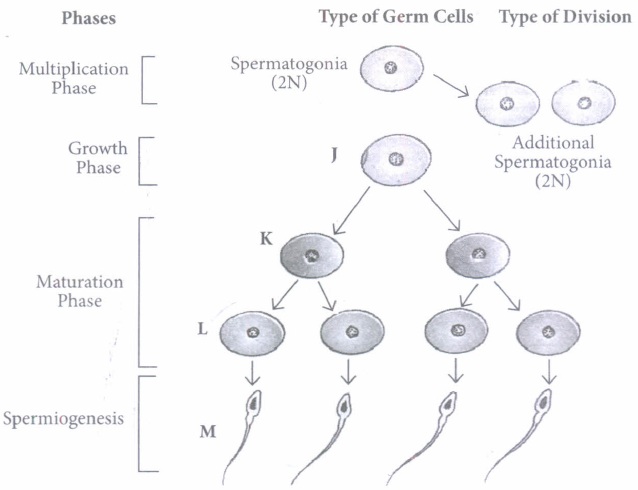
(i) Which cell division occurs during multiplication phase?
| (a) Mitosis | (b) Meiosis I | (c) Meiosis II | (d) Both (b) and (c) |
(ii) How many chromosomes are present in secondary spermatocyte and spermatid respectively?
| (a) 46,23 | (b) 46,46 | (c) 23,23 | (d) 23, XY |
(iii) Transformation of L into M is known as
| (a) spermiation | (b) spermateliosis | (c) spermatogenesis | (d) none of these |
(iv) Select the correct option
| (a) Type A spermatogonia grows to larger primary spermatocyte. | (b) One spermatogonium forms two spermatids. | (c) Spermiation is the release of sperms from seminiferous tubules. | (d) Primary spermatocyte undergoes mitosis to form secondary spermatocytes. |
(v) Which hormone acts on spermatogonia to stimulate sperm production?
| (a) LH | (b) GnRE | (c) ABP | (d) FSH |
3.
Read the following and answer any four questions from (i) to (v) given below:
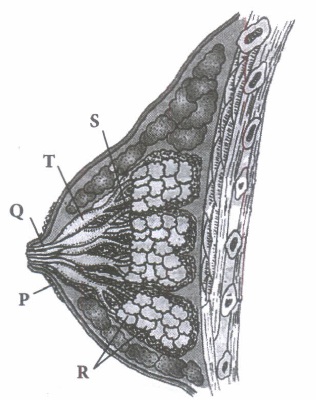
A functional mammary gland is characteristic of all female mammals. Mammary glands are paired structures that contain glandular tissue and variable amount of fat. Refer to the given figure of a mammary gland and answer the following questions.
(i) Mammary glands are modified
| (a) sweat glands | (b) sebaceous glands | (c) sudoriferous glands | (d) lacrimal glands. |
(ii) Identify the incorrectly matched pair.
| (a) P - Areola | (b) Q - Lactiferous duct | (c) S - Mammary duct | (d) T - Mammary alveoli |
(iii) Mammary ducts expand to form
| (a) mammary alveoli | (b) mammary ampullae | (c) lactiferous ducts | (d) mammary tubules. |
(iv) What is areola?
| (a) Grape-like clusters of milk secreting structures | (b) Fatty tissue between the mammary lobes | (c) Circular pigmented area of skin around nipple | (d) Connective tissue that supports the alveoli and ducts |
(v) Assertion: The size of breast depends on the amount of adipose tissue.
Reason: The adipose tissue supports the alveoli and the ducts.
(a) Both assertion and reason are true and reason is the correct explanation of assertion.
(b) Both assertion and reason are true but reason is not the correct explanation of assertion.
(c) Assertion is true but reason is false.
(d) Both assertion and reason are false.
4.
Read the following and answer any four questions from (i) to (v) given below:
Human male reproductive system comprises of a pair of testes, primary sex organs associated with formation of gametes and production of sex hormone. Study the given figure of human male reproductive system and answer the following questions.
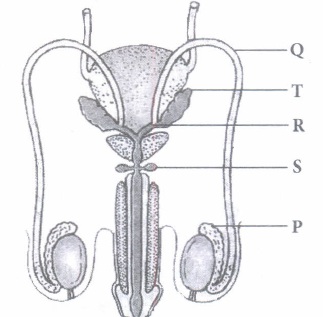
(i) Which of the following is correct for labelled part P?
| (a) P is rete testis which transports sperms to outside. | (b) P is epididymis which secretes fluid that nourish the sperms | (c) P is epididymis that carry sperms and secretion of seminal vesicles | (d) P is rete testis which lies along inner side of each testis and stores the sperms |
(ii) Identify the correctly matched pair.
| (a) Q - Vasa efferentia | (b) R - Ejaculatory duct | (c) S - Seminal vesicle | (d) T - Cowper's gland |
(iii) Which statement is incorrect for Q?
| (a) It carries spermatozoa from epididymis to ejaculatory duct | (b) Q are only 2 in number. | (c) It arises from rete testis. | (d) It constitutes male sex accessory duct |
(iv) Which structure passes through the prostate gland and carries sperms and secretion of seminal vesicle?
| (a) P | (b) T | (c) S | (d) R |
(v) Assertion: Mucus present in secretion of bulbourethral gland decreases the number of sperms damaged during ejaculation
Reason: Mucus lubricates the end of penis and lining of the urethra.
(a) Both assertion and reason are true and reason is the correct explanation of assertion.
(b) Both assertion and reason are true but reason is not the correct explanation of assertion.
(c) Assertion is true but reason is false.
(d) Both assertion and reason are false .
5.
Read the following and answer any four questions from (i) to (v) given below:
The endosperm makes the main source of food for the embryo. Generally the endosperm nucleus divides after the division of the oospore, but in several cases the endosperm is formed to a great extent even before the first division of the oospore. There are three general types of endosperm formation: (a) nuclear type, (b) cellular type and (c) helobial type. The endosperm is usually triploid but haploid endosperm is also found. Endosperm may either be completely consumed by the developing embryo before seed maturation or it may persist in the mature seed.
(i) Haploid endosperm is found in
| (a) Pinus | (b) cauliflower | (c) sunflower | (d) pea |
(ii) Persistent endosperm is found in
P. Pea Q. Castor R. Bean S. Coconut T. Groundnut
| (a) Q and S | (b) P and T | (c) R, S and T | (d) P, S and T |
(iii) Milk of tender coconut represents.(i) and the surrounding white coconut meal represents (ii).
| (I) | (ii) |
| (a) cellular endosperm | free-nuclear endosperm |
| (b) free-nuclear endosperm | cellular endosperm |
| (c) helobial endosperm | cellular endosperm |
| (d) free-nuclear endosperm | helobial endosperm |
(iv) If an endosperm cell of a gymnosperm contains 12 chromosomes, the number of chromosomes in each cell of the root will be
| a) 4 | (b) 24 | (c) 16 | (d) 6 |
(v) In angiosperms, normally after fertilisation
| (a) the zygote divides earlier than the primary endosperm nucleus | (b) the primary endosperm nucleus divides earlier than the zygote | (c) both the zygote and primary endosperm nucleus divide simultaneously | (d) both the zygote and primary endosperm nucleus undergo a resting period. |
6.
Read the following and answer any four questions from (i) to (v) given below:
The anther is a four-sided structure consisting of four microsporangia located at the corners two in each lobe. The microsporangia develop further and become pollen sacs. In a transverse section, a typical microsporangium appears near circular in outline. It is generally surrounded by four wall layers-the epidermis, endothecium, middle layers and the tapetum.
(i) A dithecous anther consists of (A) microsporangia, (B) in each lobe. Select the option that correctly fills the blanks
| A | B |
| (a) four | two |
| (b) two | one |
| (c) two | two |
| (d) four | one |
(ii) The given diagram shows microsporangium of a mature anther. Identify A, Band C.
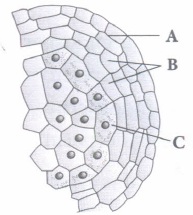
| (a) A-Middle layer | B-Endothecium | C-Tapetum |
| (b) A-Endothecium | B-Tapetum | C- Middle layer |
| (c) A-Endothecium | B-Middle layer | C-Tapetum |
| (d) A-Tapetum | B-Middle layer | C- Endothecium |
(iii) The function oflabelled part X is
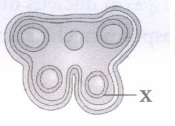
| (a) dehiscence | (b) mechanical | (c) nutrition | (d) protection |
(iv) Select the incorrect statement
(a) Microsporangium is generally surrounded by four wall layers-epidermis, endothecium, middle layers and tapetum
(b) Outer three layers perform functions of protection and dehiscence of anthers.
(c) Cells of tapetum possess dense cytoplasm and generally have more than one nucleus.
(d) Cells of tapetum undergo meiosis and produce microspore tetrads.
(v) Which function of tapetum is correct?
(a) Helps in pollen wall formation
(b) Transportation of nutrients to inner side of anther.
(c) Synthesis of callase enzyme for separation of microspore tetrads.
(d) All of these
7.
Read the following and answer any four questions from (i) to (v) given below:
Pollen-pistil interaction is the group of events that occur from the time of pollen deposition over the stigma to the time of pollen tube entry into ovule. It is a dynamic process which has checks at several places for promotion or inhibition of pollen growth. Pollen-pistil interaction is a safety measure to ensure that illegitimate crossings do not occur. Compatibility and incompatibility of the pollen-pistil is determined by special proteins. The compatible pollens are able to absorb water and nutrients from the surface of the stigma. They germinate and produce pollen tubes. Pollen tubes grow into the style. Their growth and path through the style are also determined by specific chemicals.
(i) Which of the following parts of gynoecium determines the compatible nature of pollen?
| (a) Stigma | (b) Style | (c) Ovary | (d) Thalamus |
(ii) In Trifolium, which type of self-incompatibility is found?
| (a) Gametophytic self-incompatibility (GSI) | (b) Sporophytic self-incompatibility (SSI) | (c) Both GSI and SSI | (d) None of these |
(iii) Select the incorrect statement.·
(a) In Asteraceae, incompatibility is due to the genotype of the sporophytic stigmatic tissues
(b) In members of Brassicaceae, incompatibility is due to the genotype of the pollen
(c) Nature has imposed self-incompatibility to avoid highly homozygous individuals which have a very low survival value
(d) None of these
(iv) Which of the following are examples of self incompatibility?
| (a) Tobacco | (b) Potato | (c) Crucifers | (d) All of these |
(v) Given figures show the pollen-stigma interaction, where pollen wall proteins are released onto the pellicle of stigmatic papillae, where recognition reaction occurs.
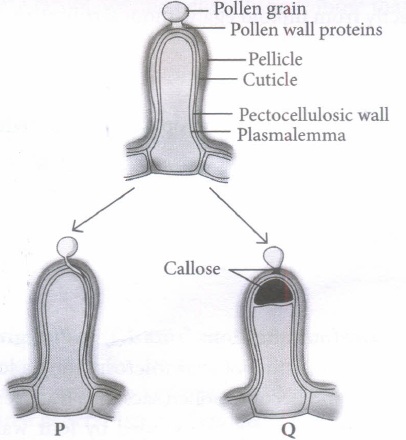
Which of the following statements drawn from given figures is incorrect?
(a) P indicates compatible reaction in which the pollen tube penetrates the cuticle and grows down the papilla.
(b) Development of callose plug between the plasma membrane and pectocellulosic layer of stigmatic papillae results in the incompatibility reaction in Q.
(c) A callose plug which appears at the tip of pollen in Q, is dissolved by callase enzyme secreted by stigma resulting in compatibility reaction.
(d) Deposition of callose can be employed as a reliable bioassay to detect compatibility or incompatibility reactions of pollen and stigma
8.
Read the following and answer any four questions from (i) to (v) given below:
Many adaptations are found in flowers to achieve certain kind of pollination. The pollination achieved by insects is known as entomophily. The given diagram shows the cross-section of an anther of an insect pollinated flower.
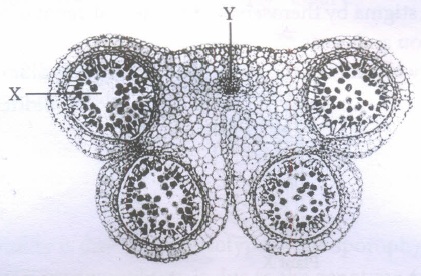
(i) Which of the following is/are the function(s) of structure Y?
A. To carry waste products away from the anther.
B. To supply oxygen to the cells of the anther.
C. To transport food and mineral salts to the anther.
D. To supply water to the anther.
| (a) C only | (b) C and D only | (c) A, Band D only | (d) A,B,C and D |
(ii) Which of the following most accurately describes the structures found in compartment X?
(a) They contain two haploid nuclei resulting from meiosis
(b) They contain two haploid nuclei resulting from mitosis
(c) They contain two haploid male gametes resulting from mitosis
(d) They contain a vegetative nucleus and pollen tube nucleus
(iii) Which of the following is a distinctive characteristic of insect-pollinated flower?
(a) All of them have nectar guides on their flowers
(b) They produce sugary fruit
(c) Their pollen grains tend to have rough surfaces
(d) They produce abundant quantities of pollen to
make up for pollen grains that might be removed by the wind
(iv) Which of the following are likely characteristics of the structures found in X and stamens of this plant?
| Structure of X | Stamens |
| (a) Abundant and light | Pendulous |
| (b) Rough surfaces | Non-pendulous |
| (c) Light and sticky | Pendulous |
| (d) Coarse and sticky | Protrude outside the flower |
(v) Spiny or sticky pollen grains and large, attractively coloured flowers are associated with
| (a) hydrophily | (b) entomophily | (c) ornithophily | (d) anemophily |
9.
Read the following and answer any four questions from (i) to (v) given below:
Cross pollination is the transfer-of pollen grains from the anther of a one flower to the stigma of a genetically different flower. It is performed with the help of an external agency which may be abiotic (e.g., wind, water) or biotic (e.g., insects, birds, bats, snails). The diagram shows the carpel of an insect pollinated flower.
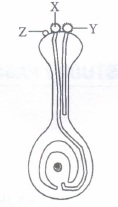
(i) What is the most likely reason for non germination of pollen grain Z?
(a) Pollen grains X and Y were brought to the stigma earlier, therefore, their germination inhibited the germination of pollen grain Z.
(b) Pollen grain Z was brought to the flower by wind, while pollen grains X and Y were broughtto the flower by insect
(c) Pollen grain Z lacks protrusions that allow it to adhere properly onto the stigma surface
(d) Pollen grain Z comes from a flower of an incompatible species
(ii) Which of the following best describes the function of the pollen tube?
(a) It acts as a conduit to transport male gametes from the anther to the ovule
(b) It acts as a conduit to transport male gametes from the stigma to the ovule.
(c) It contains key nutrients that serve to nourish the newly-formed zygote
(d) It digests the tissues of the stigma, style and ovary.
(iii) Pollination of a flower in which the pollen is carried by an insect is called
| (a) anemophily | (b) ornithophily | (c) entomophily | (d) malacophily. |
(iv) Refer to the given characteristics of some flowers:
| A. The stamens hang out of the flower, exposing the anthers to the wind. | B. The pollen grains are tiny and light | C. The flower has a sweet scent. | D. The flower petals are brightly coloured. |
How many of the above characteristics are of insect-pollinated flower?
| (a) One | (b) Two | (c) Three | (d) Four |
(v) Pollenkitt is generally found in
| (a) anemophilous flowers | (b) entomophilous flowers | (c) ornithophilous flowers | (d) malacophilous flowers. |
10.
Read the following and answer any four questions from (i) to (v) given below:
The pollen grains or microspores are the male reproductive bodies of a flower and are contained in the pollen sac or microsporangia. Each pollen grain consists of a single microscopic cell, possessing two coats : the exine and the intine. The exine of a pollen grain is made of chemically stable material. Because of this, pollen grains are often very well preserved for thousands of years in soil and sediments.
(i) One of the most resistant biological material present in the exine of pollen grain is
| (a) pectocellulose | (b) sporopollenin | (c) suberin | (d) cellulose |
(ii) The exine possesses one or more thin places known as
| (a) raphe | (b) germ pores | (c) hilum | (d) endothecium |
(iii) What is the function of germ pore?
| (a) Emergence of radicle | (b) Absorption of water for seed germination | (c) Initiation of pollen tube | (d) All of these. |
(iv) What is the key advantage to the plant for having such strong pollen grain walls?
(a) It protects the vital genetic material in the pollen grain
(b) It allows pollen to serve as a valuable fossil record for the study of ancient plants.
(c) It prevents the pollen tube from growing out before the pollen grain reaches the stigma of a compatible species.
(d) It gives weight to the pollen grain, allowing it to cling better to the body surfaces of insect pollinators..
(v) The number of germ pores in dicots and mono cots respectively are
| (a) one and three | (b) three and two | (c) two and three | (d) three and one |
11.
Hybrid varieties of several of our food crops are being extensively cultivated. Cultivation of hybrids has increased the crop production tremendously. But, the problem of hybrids is that the hybrid seeds have to be produced every year.
(a) Name and explain the mechanism by which seeds from hybrid plants are developed that are able to retain the desired hybrid characters in the progeny.
(b) What is polyembryony?
12.
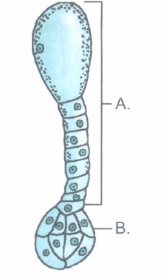
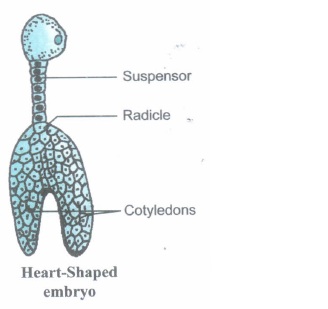
(a) Identify the parts A and B.
(b) Name (i) the initial cell from which it has developed and (ii) stage of embryo prior to this.
(c) Draw a labelled diagram ofthe stage of embryo succeding this.
13.
A flower of a tomato plant produced 200 viable seeds after sexual reproduction. Answer the following questions giving reason for each.
(a) How many ovules must have been there in the ovary?
(b) How many megaspore mother cells were involved?
(c) How many male gametes have been required in the production of 200 viable seeds?
14.
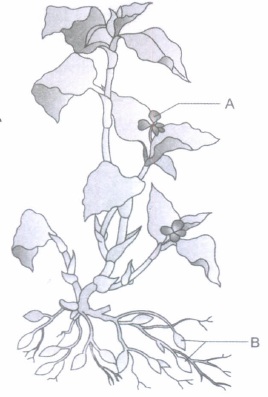
Identify the types of flowers A and B on the Commelina plant shown above.
(b) Mention the type(s) of pollination that can occur in each of them.
15.
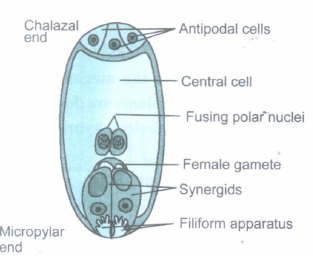
A fully developed embryo sac
A fully-developed and mature embryo sac is shown above.
(a) Name the cell from which it has developed.
(b) What is the ploidy level of its nuclei?
(c) What is filiform apparatus? Mention its significance.
16.
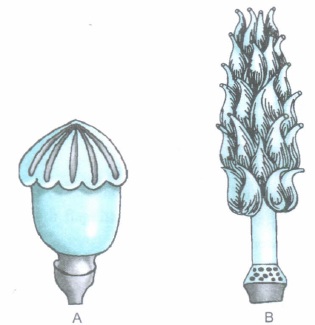
These pictures show the gynoecium of A. Papaver and B. Michelia.
(a) Write one similarity and one difference between the two.
(b) Name the three parts of a pistil.
17.
The pollen grains may be shed at the two-celled stage (as in 60 per cent of angiosperms) or in the three-celled stage (as in the remaining species). When once shed, the pollen grains must land on the correct type of stigma before they lose viability, to effect fertilisation.
(a) The period for which the pollen grains remain viable is highly variable depending on the species. Substantiate the statement with two examples.
(b) Mention two environmental factors, which affect the pollen viability.
1.
(i) (c)
(ii) (b)
(ii) (c)
(iv) (a)
(v) (d)
(vi) (b)
2.
(i) (a): In multiplication phase, the undifferentiated primordial germ cells divide several times by mitosis to produce large number of spermatogonia
(ii) (c)
(iii) (b) : Transformation of spermatids (L) into spermatozoa (M) is known as spermiogenesis or spermateliosis
(iv) (c)
(v) (d) : FSH acts on spermatogonia to stimulate sperm production
3.
(i) (a)
(ii) (d) : T is mammary ampulla and R is mammary alveoli.
(iii) (b) : Near the nipple, mammary ducts expand to form mammary ampullae where some milk may be stored before going to lactiferous ducts.
(iv) (c)
(v) (c) : The fibrous (connective) tissue supports the alveoli and the ducts.
4.
(i) (b) : P is an epididymis that stores the sperms and secretes a fluid which is considered to nourish the sperms
(ii) (b) : Q - Vas deferens, R - Ejaculatory duct S - Bulbourethral gland, T - Seminal vesicle
(iii) (c) :Q (vas deferens) arises from cauda epididymis
(iv) (d)
(v) (a)
5.
(i) (a) : In gymnosperms, the endosperm is haploid (n) and forms a continuation of the female gametophyte.
(ii) (a) : In some seeds, the endosperm persists in the seed as food storage tissue. Such seeds are called endospermic or albuminous, e.g., castor, maize, wheat, barley, rubber and coconut.
(iii) (b): In coconut (Cocos nucifera), the surrounding white kernel called coconut meal is cellular endosperm and the coconut water (also called coconut milk) in the centre is free nuclear endosperm made up of thousands of nuclei.
(iv) (b) : The endosperm of a gymnosperm is haploid (n), while the cells of the root are diploid (2n). So, the number of chromosomes in the root will be 24.
(v) (b)
6.
(i) (a) : A typical angiosperm anther is bilobed with each lobe having two theca, i.e., dithecous and a dithecous anther is tetrasporangiate having four microsporangia, two in each lobe.
ii) (c)
(iii) (c) : The tapetal layer is of great physiological significance as all the food material entering into the sporogenous tissue diffuses through this layer. Ultimately the cells of tapetal layer disorganise. Thus, tapetum makes a nutritive layer for the developing microspores or pollen grains.
(iv) (d)
(v) (d) : Tapetum secretes Ubisch bodies which get covered with sporopollenin and so increase thickness of exine of pollen grain wall. Tapetum provides nourishment to developing microspores. It also secretes callase enzyme which dissolves callose substances by which four pollens of a pollen tetrad are united, hence separating microspores or pollens of a tetrad.
7.
(i) (a) : Stigma is the terminal receptive part of the pistil which functions as landing platform for the pollen grains. It also determines the compatibility of the pollen grains.
(ii) (a)
(iii) (b) : In members of Brassicaceae, incompatibility is due to the genotype of the sporophytic stigmatic tissues.
(iv) (d)
(v) (c): The most distinct response of the stigma to an incompatible pollen is the development of callose plug between the plasma membrane and pectocellulosic layer of the stigmatic papillae, just below the point of contact with the pollen; a callose plug also appears at the tip of the pollen tube. With the appearance of the callose-plug, the growth of the pollen tube ceases. The deposition of callose in the stigmatic cells can be employed as a reliable bioassay to detect incompatible pollen particularly where the rejection occurs on the stigma. This bioassay has served as a useful aid in providing direct evidence for the involvement of exine-borne proteins in incompatibility reaction.
8.
(i) (b): Y is a vascular bundle comprising xylem that transports water and mineral salts to the anther, and phloem that transports sugars to the anther.
(ii) (b): X contains pollen grains. Pollen grain contains two haploid nuclei resulting from mitosis, a generative nucleus and pollen tube/vegetative nucleus.
(iii) (c): Rough surfaces on pollen grains help them to cling onto the surface of insect pollinators.
(iv) (b): Insect-pollinated plants tend to have pollen with rough surfaces to allow them to cling more readily onto the body of insect pollinators. Their stamens are unlikely to be pendulous nor protrude outside the flower, since the pollen is not intended to be released into the air and carried away by the wind.
(v) (b): Entomophily type of pollination takes place through the agency of insects. The entomophilous flowers are brightly coloured and fragmented to attract the insects. Their pollen grains are sticky or spiny to easily get attached with the body of pollinators. When the insects visit the flowers, their body gets dusted with pollen grains, and when they fly and visit other flowers, they brush against the stigma which being sticky, at once receives the pollen grains from their body. Thus, cross-pollination is achieved.
9.
(i) (d): Pollen grains can only germinate if the pollen grain and style tissues are compatible, i.e., of the same or closely related species. Pollen grains X and Y must have come from a compatible species.
(ii) (b)
(iii) (c) : Entomophily is the type of pollination that takes place through the agency of insects. The insectloving flower possesses various adaptations by which they attract insects and use them as carrier of pollen grains for the purpose of cross pollination.
(iv) (b) : Insect-pollinated flowers produce nectar, which attract the pollinators for feeding. Some flowers produce edible pollen grains. Flowers are fragrant and emit scent and odour. These are brightly coloured. The pollen grains are spiny, heavy and surrounded by a yellow sticky substance called pollenkitt.
(v) (b) : Insect-pollinated flowers produce nectar, which attract the pollinators for feeding. Some flowers produce edible pollen grains. Flowers are fragrant and emit scent and odour. These are brightly coloured. The pollen grains are spiny, heavy and surrounded by a yellow sticky substance called pollenkitt.
10.
(i) (b): Outer layer (exine) of pollen grain is made of a highly resistant substance called sporopollenin. It is not degraded by any enzyme and not affected by high temperature, strong acid or strong alkali.
(ii) (b)
(iii) (c) : One or more thin areas present in the exine of pollen grains are known as germ pores. The germ pores are apertures in the exine layer of the pollen grain where the sporopollenin is absent. The germ pore helps in the formation of the pollen tube and the release of the male gametes during fertilisation. There are usually three germ pores in dicots (tricolpate) and one in mono cots (monocolpate).
(iv) (a) : The pollen grain wall helps to protect the male gametes from drying up or chemical attack, thus protecting the DNA in the male gametes. This helps to maintain the integrity of genetic material that would be inherited by subsequent generations.
(v) (c) : One or more thin areas present in the exine of pollen grains are known as germ pores. The germ pores are apertures in the exine layer of the pollen grain where the sporopollenin is absent. The germ pore helps in the formation of the pollen tube and the release of the male gametes during fertilisation. There are usually three germ pores in dicots (tricolpate) and one in mono cots (monocolpate).
11.
(a) (i) Apomixis is the mechanism.
(ii) It refers to the form of asexual reproduction that mimics sexual reproduction and seeds are formed without fertilisation.
(iii) Since there will be no segregation of the hybrid characters in the progeny plants, they will be maintained for a number of generations.
(b) Polyembryony refers to the occurrence of more than one embryo in a seed.
12.
(a) A - Suspensor
B - Globular embryo
(b) (i) Zygote
(ii) Proembryo
13.
(a) 200 ovules - each ovule becomes a seed after fertilisation; hence, 200 ovules will become 200 seeds.
(b) 200 megaspore mother cells- Though each megaspore mother cell forms four megaspores by meiosis, only one megaspore is functional and forms an embryo sac in an ovule.
(c) 400 male gametes - each ovule requires two male gametes for double fertilisation.
14.
(a) A - Chasmogamous flower
B - Cleistogamous flower
(b) A - Autogamy, geitonogamy and xenogamy
B - Autogamy only.
15.
(a) Megaspore
(b) Haploid
(c) (i) Filiform apparatus refers to the special cellular thickenings in the synergids, towards micropylar tip.
(ii) They play an important role in guiding the pollen tube to enter one of the synergids.
16.
(a) Similarity
(i) Both are multicarpellary.
Difference
(i) A. Papaver is syncarpous - all the carpels have fused together.
(ii) B. Michelia is apocarpous - the carpels are free.
(b) Ovary, style and stigma are the three parts of a pistil.
17.
(a) (i) Pollen grains of cereals (rice, wheat, etc.) lose viability within 30 minutes after release.
(ii) Pollen grains of members of Leguminosae, Rosaceae and Solanaceae remain viable for many months.
(b) Humidity and temperature.

12th Standard CBSE Syllabus & Materials
12th Standard CBSE
CBSE 12th Computer Science Python Revision Tour I - New Previous year Question Papers Study Material - QB365 Set A
NEW12th Standard CBSE
CBSE 12th Business Studies Planning Important Questions And Answers Study Material - QB365 Set A
NEW12th Standard CBSE
CBSE 12th Business Studies Business Environment Important Questions And Answers Study Material - QB365 Set A
NEW12th Standard CBSE
CBSE 12th Business Studies Principles of Management Important Questions And Answers Study Material - QB365 Set A



NCERT Books

Syllabus

Exam Pattern

Sample Question Papers

Previous year Question Papers

Important Notes

MCQ Practice test

NCERT Exemplers

Case study Questions

Image Based Questions

Passage based Questions

HOT Questions

Value Based Questions

Model Questions Papers
NCERT ( Book Back ) Questions

Assertion and Reason
Important Questions And Answers

CBSE 12th Standard CBSE Subjects
CBSE Standards








