
 100% FREE ACCESS
12th Standard CBSE Syllabus & Materials
12th Standard CBSE
CBSE 12th Economics Government Budget and the Economy Previous year Question Papers Study Material - QB365 Set A
NEW12th Standard CBSE
CBSE 12th Computer Science Interface Python with MySQL - New Previous year Question Papers Study Material - QB365 Set A
NEW12th Standard CBSE
CBSE 12th Computer Science Database Concept - New Previous year Question Papers Study Material - QB365 Set A
NEW12th Standard CBSE
CBSE 12th Computer Science Data Communication - New Previous year Question Papers Study Material - QB365 Set A
NEW12th Standard CBSE
CBSE 12th Computer Science Data Structures - New Previous year Question Papers Study Material - QB365 Set A
NEW12th Standard CBSE
CBSE 12th Computer Science Functions - New Previous year Question Papers Study Material - QB365 Set A

Published on: 17/10/2025
Download CBSE Class 12th Standard CBSE Biology question papers, sample papers, important questions, and previous year solved papers in PDF format. Get free study materials, NCERT solutions, and exam preparation resources for Class 12th Standard CBSE Biology
Questions + Answers key
Take MCQ Biology Test
1.
Aneuploidy is which type of mutation? How is it different from polyploidy?
2.
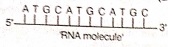
Construct and label a transcription unit from which the RNA segment given below has been transcribed.
Write the complete name of the enzyme that transcrìbed this RNA.
3.
(a)Name the genetic disorder in a human female having 44 + XO karyotype. Mention the diagnostic features of the disorder
(b)Explain the cause of such chromosomal disorder.
4.
Explain the events in a normal woman during her menstrual cycle on the following days:
(a) Ovarian event from 13-15 days
(b) Ovarian hormones level from 16 to 23 days
(c) Uterine events from 24 to 29 days
5.
Given below is a schematic representation of a lac operon.
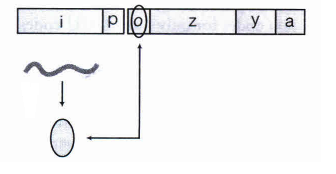
(i) Identify i and p.
(ii) Name the inducer for this operon and explain its function.
6.
Differentiate between chemical evolution and organic evolution.
7.
Mention the advantages of recombinant therapeutics. How many of them have been approved world over for human buse and how many are marketed in India?
8.
Describe the duct system of human male reproductive system.
9.
List any four properties of a molecule to be able to act as a genetic material.
10.
Define lethal genes and pleiotropic genes.
11.
Describe importance of cloning site in a vector. Illustrate with an example.
12.
Mention two uses of cloned genes in molecular diagnostics.
13.
Explain the dual function of AUG codon.Give the sequence of basis it is transcribed from and its anticodon.
14.
How do histones acquire positive charge?
15.
Write the symptoms of haemophilia and sickle-cell anaemia in humans. Explain how the inheritance pattern of the two diseases differs from each other?
16.
(i) Identify the parts labelled A, Band C in the diagram given.
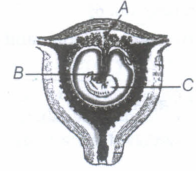
(ii) Draw a labelled diagram of a human blastocyst.
(iii) What is parturition and is it induced at the end of pregnancy in a human female ?
17.
The biology teacher was explaining about restriction enzymes and came to a point explaining that these enzymes are extracted from bacteria and are called as molecular scissors. Varun, a student got curious and asked some questions for more clarity on the concept to his teacher.
(i) From which part of microorganisms are restriction enzymes derived?
(ii) Why are restriction enzymes called molecular scissors?
(iii) What if some strands are needed to be cut from within. would that lead to wastage of DNA?
(iv) What value are shown by varun?
18.
A group of scientists are working on creating transgenic cows to produce milk with medicinal properties.
But there are adverse side effects seen on the cows due to this procedure. Their life span shortened; they became prone to diseases and died very early.
(i) What do you mean by transgenic animals?
(ii) Should the scientists continue with the production of transgenic cows? Give reason.
(iii) Is there any law to regulate such acts?
(iv) What values did scientists lack?
19.
(a)Who proposed the concept of lac operon?
(b)Draw a labelled schematic representation of a lac operon.
(c)Explain how this operon gets switched 'on' and 'off'
20.
Answer the following questions based on Meselson and Stahl's experiment.
(a)Why did the scientists use 15NH4Cl and 14NH4Cl as source of nitrogen in the culture medium for growing E.Coli?
(b)Name the molecule(s) that 15N got incorporated into.
(c)How did they distinguish between 15N labelled molecules from 14N ones?
(d)Mention the significance of taking the E.coli samples at definite time intervals for observations.
(e)Write the observations made by them from the samples taken at the end of 20 minutes and 40 minutes respectively.
(f)Write the conclusion drawn by them at the end of their experiment.
21.
Which among the following statements does not stand true for DNA replication?
Replication initiates randomly at any place in DNA by DNA polymerase
In eukaryotes, DNA replication takes place at S-phase of cell cycle
Failure of cell division after DNA replication results in polyploidy
The model for semiconservative DNA replication was given by Watson and Crick
22.
The unequivocal proof of DNA as the genetic material came from the studies on a
bacterium
fungus
viroid
bacterial virus
23.
Which one of the following conditions of the zygote would lead to the birth of a normal human female child?
two X chromosomes
only one Y chromosome
only one X chromosome
one X and one Y chromosome
24.
The main aim of human genome project is
to develop better techniques for comparing two different human DNA samples
to remove disease causing genes from human DNA
to introduce new genes into humans
to identify the sequence of all the genes present in human DNA
25.
Which one of the following conditions in humans is correctly matched with its chromosomal abnormality/linkage?
Erythroblastosis foetails-X-linked
Down's syndrome-44 autosomes + XO
Klinefelter's syndrome-44 autosomes + XXY
Colour blindness-Y linked
26.
Balbiani rings are found in
Polytene chromosome
dicot stems
lambrush chromosome
all chromosomes
27.
Anticodon site is located on
DNA
tRNA
rRNA
mRNA
28.
Lack of independent assortment of two genes A and B in fruit fly Drosophila is due to
Recombination
Linkage
crossing over
Repulsion
29.
Temin and Baltimore are associated with the discovery of
RNA synthesis
Transcription
Reverse transcription
photorespiration
30.
Male heterogamy is found in
Drosophila
Humans
Grasshopper
All of these
31.
32.
33.
34.
Assertion: Cry gene expressing crop is resistant to a group of insects.
Reason: Cry proteins produced from Bacillus thuringiensis are toxic to larvae of certain insects.
Codes:
(a) If both Assertion and Reason are true and Reason is the correct explanation of Assertion.
(b) If both Assertion and Reason are true but Reason is not the correct explanation of Assertion.
(c) If Assertion is true but Reason is false.
(d) If both Assertion and Reason are false.
35.
Assertion (A) : ELISA has been used to detect mutations in gene of suspected cancer patients.
Reason (R) : Very low concentration of bacteria or virus (at a time when the symptoms of the disease are not yet visible) can be detected by amplification of their nucleic acid by PCR.
(a) If both A and R are true and R is the correct explanation of A
(b) If both A and R are true,but R isnot the correct explanation of A
(c) IfA is true, but R is false
(d) If A is false, but R is true
36.
Assertion: The insertion of DNA fragment into pBR 322 plasmid using enzyme Pst I or Pvu I make ampicillin resistant gene non functional.
Reason: Bacterial cells containing recombinant pBR322 is unable to grow in the presence of ampicillin.
Codes:
(a) Both assertion and reason are true and reason is the correct explanation of assertion.
(b) Both assertion and reason are true but reason is not the correct explanation of assertion.
(c) Assertion is true but reason is false.
(d) Both assertion and reason are false.
37.
Refer to the following flow diagram and answer the questions that follows
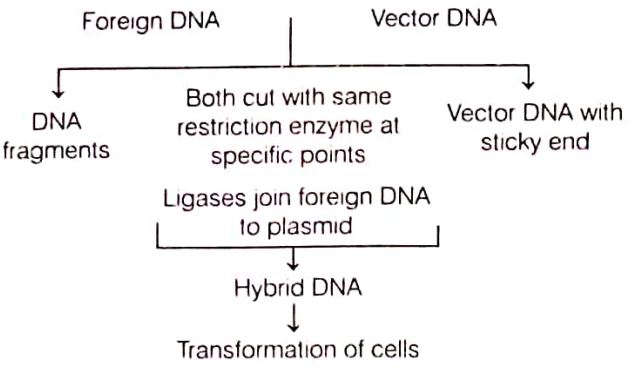
(i) A plasmid DNA and a linear DNA (both of same size) have one site for a restriction endonuclease. When cut and separated on agarose gel electrophoresis, plasmid shows one DNA band, while linear DNA shows two fragments. Justify.
(ii) How are transformed cells selected?
38.
Read the following passage and answer the questions given below.
In court, a woman of AB blood group claims that a man of O blood group is the father of her son having O blood group. The judge orders to take the help of a geneticist to solve the problem Finally, it was concluded that man of O blood group was not the father of woman's son.
(i) Which of the following phenomenon is seen in blood group inheritance in humans?
| (a) Pleiotropy | (b) Polygenic inheritance |
| (c) Codominance | (d) Epistasis |
(ii) A person with blood group A can show genotype
| (a) IAIA | (b) IAIB |
| (c) IBIA | (d) IBIB |
(iii) ABO blood group system is seen in human which is controlled by
| (a) b-gene | (b) c-gene |
| (c) i-gene | (d) n-gene |
(iv) Out of the three alleles of gene I, the sugar polymers on the plasma membrane of RBCs is controlled by how many alleles?
| (a) All three | (b) One |
| (c) Two | (d) Zero |
(v) Four children belonging to the same parents have the following blood groups A, B, AB. and Hence, the genotypes of the two parents are
(a) parents are homozygous for 'A' group
(b) one parent is homozygous for 'A' and another parent is homozygous for 'B'
(C) one parent is heterozygous for A' and another parent is heterozygous for 'B'
(d) parents are homozygous for 'B' group
1.
Aneuploidy is the condition used to describe a chromosomal aberration or alteration that is caused by an addition or deletion of one or a few chromosomes. It results in genetic disorders. It differs from polyploidy which is the addition of one or more complete sets of chromosome in the genome.
2.
The RNA molecule given in question should be
.jpg)
As RNA have uracil in the place of thymíne, for given RNA, the transcription unit will be
.jpg)
Transcription is catalysed by 'DNA-dependent RNA polymerase
3.
(a)(i) Turner's syndrome.
(ii) 44 with XO chromosomes - such females are sterile as ovaries are rudimentary. Other features include lack of other secondary sexual characters, short stature and under developed feminine characters.
(b) Such a disorder is caused due to the absence of one of X chromosomes
4.
(a) Rupture of Graafian follicleleads to ovulation! release of ovum.
(b) Estrogen level islow.
(c) Disintegtation of endometrium and menstrual cycle begins again.
5.
(i) i-Regulatory gene, p - Promotor gene.
(ii) Inducer is lactose.
Functions
(a) Enters the cell and binds to the repressor and inactivates it.
(b) As a result, repressor cannot bind to the operator .This allows RNA polymerase to have access to the promotor and transactions proceeds.
6.
| Chemical evolution | Organic evolution: |
| 1. It deals with formation of first living organism on earth by chemo synthesis. | 1. It deals with grradual changes which began after the origin of life on earth. |
| 2. It occurred about 4000-3600 million years ago. |
2. It is a continuous process and constant changes have been occurring since the lift originated. |
| 3. It involved the formation of complex organic molecules, which aggregated to form coacervates, eobionts and later on First cells. |
3. It results in the formation of new species from the preexisting ones. |
7.
Recombinant Therapeutics
The recombinant therapeutics do not induce unwanted immunological responses like similar products of non-human origin.
About 30 recombinant therapeutics have been approved world over.
12 of them are being marketed in India.
8.
Duct System of male Reproductive System.
The intratesticular duct system starts with tubuli recti,which are the short,straight end segments of the seminiferous tubules ;these tubules connect the seminiferous tubules to the cuboidal epithelium-lined channels,called rete testis.
Form the rete testis arise 10-20 fine tubules,called vasa efferentia that leave the testis and open into the epididymis.
Epididymis is a single convoluted tubule that is located along the posterior surface of the testis.
The epididymis continues as the vas-deferens,that ascends into the abdominal cavity through inguinal canal.
It loops over the urinary bladder and receives a duct from the seminal vesicle of its side to form ejaculatory duct that runs through the prostate and opens into the prostatic urethra,just after its emergence from the urinary bladder.
The urethra receives the ducts of prostate gland and bulbourethral glands,a little ahead and runs through the penis to its openning called urethral meatus,to the outside.
9.
Properties of Genetic Material
(i)The genetic material should be able to generate its replica so that one can be transmitted to the daughter cell/next generation.
(ii) It should be chemically and structurally stable.
(iii) It should provide scope for slow changes (mutation) that are necessary for evolution. (iv) It should be able to express itself in the form of Mendelian characters.
10.
Lethal genes. These genes kill the organisms when they are able to express their effect.Dominant homozygous recessive, e.g., sickle cell anemia, For colour in mice (first studied by Cuenot in 1905).
Pleiotropic genes. These genes have multiple effects because they influence number of traits simultaneously.
11.
Cloning site is necessary in order to link the alien DNA to the vector.
The vector should have preferably a single recognition site, for the commonly used restriction enzyme.
1. In E.coli the ligation of alien DNA is carried out at one of two antibiotic resistance genes.
2. A foreign DNA can be ligated at the Bam H I site of tetracycline resistance gene in the vector pBR 322.
3. The recombinant plasmid will lose the tetracycline resistance, but can grow on ampicillin-containing medium.
4. When they are transferred to tetracycline containing medium, the recombinant cannot grow while the non-recombinants will grow on both ampicillin and tetracycline containing medium. Thus cloning sites help in the selection of recombinants.
12.
(i) Cloned genes, when expressed to produce recombinant proteins, help in developing sensitive diagnostic techniques.
(ii) Cloned genes are used as probes to detect the presence of its complementary DNA strand; mutated genes will not hybridise with the probe and hence do not appear on the photographic film.
13.
Dual function of AUG codon
1. It codes for amino acid,methionine
2. It functions as the initiation codon
3. It is transcribed by TAC on DNA
4. Its anticodon is UAC.
14.
A protein acquires a charge depending on the abundance of amino acids residues that have positively charged groups in their side chains. Histones are rich in basic amino acids residues-lysines and arginine both of these amino acids carry positive charges in their side chains,.Hense, histones are positively charged molecules.
15.
Haemophilia- It is the condition in which blood cannot clot if a person is injured because of the absence of the clotting factor VIII.
Symptoms of haemophilia-
Excessive bleeding from even a small cut.
Large and deep bruises.
Pain, swelling, or tightness in the joints.
Nosebleed without a normal cause.
Blood in urine and stool.
Differences between haemophilia and sickle-cell anaemnia are
| Haemophilia | Sickle-cell anaemia |
| It occurs due to a defective recessive allele present on the X-chromosomes. | It occurs due to point mutation, i.e. a single base pair change leads to a change in amino acid. |
| The defective allele produces non-functional protein, which later forms a non-functional cascade of proteins involving in blood clotting. | In this, glutamic (Glu) acid is replaced by valine (Val) at sixth position of beta globin chain of haemoglobin molecule. |
| It is a sex-linked recessive disorder. | It is an autosomal linked recessive disorder. |
| More males are affected than females. | Both males and females are affected equally. |
16.
(i) A. Placental villi
B. Umbilical cord with its vessels
C. Embryo
17.
(i) Restriction enzymes are derived from a defence unit called restriction modification system which protects the microorganisms from harm.
(ii) They are called as molecular scissors because they cut DNA molecules at specified location indicated by presence of specific recognition sequence.
(iii) No, the strands cut from within are joined by another enzyme called DNA ligase. This joining is either with self or with another different strand.
(iv) Varun is curious, has scientific temperament and ask quick and intelligent questions.
18.
(i) Animals that have had their DNA manipulated to possess and express an extra foreign gene are known as transgenic animals.
(ii) No, each cow would produce only a limited amount of medicinal milk before it dies. This means lives of many cows would be compromised for the production of substantial amount of medicinal milk, for the advantage of humans.
(iii) Some laws have been passed by the Government and agencies monitoring the genetic engineering researches to maintain ethics of life, and to regulate such acts.
(iv) Sympathy towards animals, ethics, respect for living organisms.
19.
(a) Jacob and Monod proposed the concept of lac operon.
(c) The regulatory
(i) gene codes for repressor protein, which is synthesised constitutively all the time.
(ii) It binds to the operator and prevents the RNA polymerase from transcribing the operon; so the operon is 'switched off'.
(iii) When lactose is present in the cell, it functions as inducer.
(iv) When it binds to the repressor and inactivates it, the repressor does not bind to the operator.
(v) This allows RNA polymerase access to the promoter and transcription proceeds, i.e. the operon is 'switched on'.
20.
(a) They used \(^{ 15 }{ { NH }_{ 4 }Cl }\) and \(^{ 14 }{ { NH }_{ 4 }Cl }\) to grow E.coli, because the density of DNA of E.coli grown on these media can be distinguished based on their densities.
(b) lsN was incorporated into the nitrogenous bases (adenine, guanine, cytosine and thymine) of DNA.
(c) The \(^{ 15 }{ N }-DNA\) can be distinguished from the \(^{ 14 }{ N }-DNA\) by centrifugation in cesium chloride density gradient; \(^{ 15 }{ N }-DNA\) is heavier than \(^{ 14 }{ N }-DNA\).
(d) They took samples at definite intervals as the cells multiplied and extracted the DNA that remained as double stranded elices.
(e) At the end of 20 minutes, the DNA of E.coli had a hybrid or intermediate density.
At the end of 40 minutes, the DNA extracted from the cells contained equal quantities of hybrid DNA and light DNA.
(f) They concluded that DNA replication is semi-conservative.
21.
(a)
Replication initiates randomly at any place in DNA by DNA polymerase
22.
(d)
bacterial virus
23.
(a)
two X chromosomes
24.
(d)
to identify the sequence of all the genes present in human DNA
25.
(c)
Klinefelter's syndrome-44 autosomes + XXY
26.
(a)
Polytene chromosome
27.
(b)
tRNA
28.
(b)
Linkage
29.
(c)
Reverse transcription
30.
(d)
All of these
31.
32.
33.
34.
(b) If both Assertion and Reason are true but Reason is not the correct explanation of Assertion.
Explanation:
A soil bacterium Bacillus thuringiensis (Bt) produces a Cry protein (crystal protein). This protein is toxic to the larvae of certain insects. There are several kinds of Cry proteins, which are is toxic to a different group of insects. The gene encoding Cry protein, that is cry gene has been isolated and transferred into several crops. A crop expressing a cry gene is usually resistant to the groups of insects.
35.
(d) If A is false, but R is true
36.
(b) Both assertion and reason are true but reason is not the correct explanation of assertion.
Explanation:
Plasmid pBR322 has a variety of unique restriction sites for restriction endonucleases. Two unique sites, Pst I and Pvu I are located within the amp' gene and BamHI, Sal I etc. are within tet1 gene. The presence of restriction sites within the marker tet' and amp' permits an easy selection for cell transformed with the recombinant pBR322. Insertion of the DNA fragment into the plasmid using enzyme Pst I and Pvu I places the DNA insert within the gene amp' and make it non functional.
37.
(i) Plasmid is a circular DNA molecule. When cut with enzyme, it becomes linear but does not get fragmented. Whereas, a linear DNA molecule gets cut into two fragments. Hence, a single DNA band is observed for plasmid, while two DNA bands are observed for linear DNA in agarose gel.
(ii) The genes called selectable marker help in selecting those host cells, which contain the foreign gene (transformants) and eliminate non-transformants.
38.
(i) (c)
(ii) (a)
(iii) (c)
(iv) (a)
(v) (c)

12th Standard CBSE Syllabus & Materials
12th Standard CBSE
CBSE 12th Computer Science Python Revision Tour I - New Previous year Question Papers Study Material - QB365 Set A
NEW12th Standard CBSE
CBSE 12th Business Studies Planning Important Questions And Answers Study Material - QB365 Set A
NEW12th Standard CBSE
CBSE 12th Business Studies Business Environment Important Questions And Answers Study Material - QB365 Set A
NEW12th Standard CBSE
CBSE 12th Business Studies Principles of Management Important Questions And Answers Study Material - QB365 Set A



NCERT Books

Syllabus

Exam Pattern

Sample Question Papers

Previous year Question Papers

Important Notes

MCQ Practice test

NCERT Exemplers

Case study Questions

Image Based Questions

Passage based Questions

HOT Questions

Value Based Questions

Model Questions Papers
NCERT ( Book Back ) Questions

Assertion and Reason
Important Questions And Answers

CBSE 12th Standard CBSE Subjects
CBSE Standards








