
 100% FREE ACCESS
12th Standard CBSE Syllabus & Materials
12th Standard CBSE
CBSE 12th Economics Government Budget and the Economy Previous year Question Papers Study Material - QB365 Set A
NEW12th Standard CBSE
CBSE 12th Computer Science Interface Python with MySQL - New Previous year Question Papers Study Material - QB365 Set A
NEW12th Standard CBSE
CBSE 12th Computer Science Database Concept - New Previous year Question Papers Study Material - QB365 Set A
NEW12th Standard CBSE
CBSE 12th Computer Science Data Communication - New Previous year Question Papers Study Material - QB365 Set A
NEW12th Standard CBSE
CBSE 12th Computer Science Data Structures - New Previous year Question Papers Study Material - QB365 Set A
NEW12th Standard CBSE
CBSE 12th Computer Science Functions - New Previous year Question Papers Study Material - QB365 Set A

Published on: 25/10/2025
Download CBSE Class 12th Standard CBSE Biology question papers, sample papers, important questions, and previous year solved papers in PDF format. Get free study materials, NCERT solutions, and exam preparation resources for Class 12th Standard CBSE Biology
Questions + Answers key
Take MCQ Biology Test
1.
A student as a part of his project visited a software company and was surprised to see a sewage treatment plant set up there. He wonders at the role of microbes in one of its steps and specifies it in his project.
(a)How would he ave described the role of microbes in sewage treat ent plants?
(b) What would he say was the intention of such a set up?
(c)What value would he have imbibed from there
2.
(i) Name the category of microbes occurring naturally in sewage and making it less polluted during the treatment.
(ii) Explain the different steps involved in the secondary treatment of sewage.
3.
Draw labelled sketch of a typical biogas plant.
4.
Protein is an important constituent of our food and its deficiency leads to many health problems.A large population of developing countries can not afford pulses.Ramesh learnt that many so he thought of culturing these microorganisms to provide a cheap source of proteins.
Read the above passage and answer the following questions:
(i) What are single cell protein (SCP)?
(ii) Name two microorganisms which provide SCP.
(iii) Why did Ramesh want to culture microorganisms?
5.
Rahul was not getting a good yield from the fields but his neighbours used to apply fertilizers to get higher yields of different crops.He consulted an agricultural scientist, living in the neighbouring town, to suggest some cheap and eco-friendly method to boost crop production.The scientist suggested him to use biofertilizers.
(i) What are bio fertilisers?
(ii) Name two examples of bio fertilisers.
(iii) Why did scientist advise Rahul to use bio fertilisers?
6.
Explain biological control of pests and plant pathogens with examples.
7.
Which type of food would contain lactic acid bacteria? Discuss their useful application.
8.
(a) Discuss about the major programs that the Ministry of Environment and Forests, Government of India, has initiated for saving major Indian rivers from pollution.
9.
Why is aerobic degradation more important than anaerobic degradation for the treatment of large volumes of waste water in organic matter. Discuss.
10.
Arrange the following in the decreasing order (most important first) of their importance for the welfare of human society. Give reasons for your answer. Biogas, citric acid, Penicillin and curd.
1.
(a) Secondary treatment of sewage be explained in detail.
(b) Purification of water before dumping it into the source in order to avoid water from being more polluted.
(c) Values-Not to disturb nature's balance, self sufficiency, develop confidence, concern about the environment.
2.
(i) Aerobic microbes
The primary effluent is passed into large aeration tanks where it is constantly agitated mechanically and air is pumped into it. This allows vigorous growth of useful aerobic microbes into flocs (masses of bacteria associated with fungal filaments to form mesh like structures). While growing, these microbes consume the major part of the organic matter in the effluent. This significantly reduces the BOD (biochemical oxygen demand) of the effluent. The sewage water is treated till the BOD is reduced. Once the BOD of sewage or waste water is reduced significantly, the effluent is then passed into a settling tank where the bacterial 'flocs' are allowed to sediment.
ii). This sediment is called activated sludge. A small part of the activated sludge is pumped back into the aeration tank to serve as the inoculum. The remaining major part of the sludge is pumped into large tanks called anaerobic sludge digesters. Here, other kinds of bacteria, which grow anaerobically, digest the bacteria and the fungi in the sludge. During this digestion, bacteria produce a mixture of gases such as methane, hydrogen sulphide and carbon dioxide. These gases form biogas and can be used as source of energy as it is inflammable. The effluent from the secondary treatment plant is generally released into natural water bodies like rivers and streams.
3.
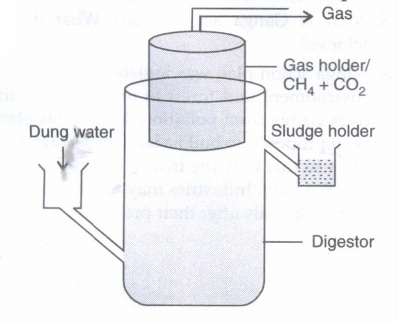
4.
(i) SCP refers to the large-scale production of protein obtained from unicellular or filamentous microorganisms.
(ii) Spirulina, Chlorella.
(iii) He was concerned about the welfare of the society.
5.
(i) Biofertilisers are the microorganisms which bring about soil nutrient enrichment, maximise ecological benefits and minimise environmental hazards.
(ii) Nostoc, Anabaena.
(iii) The scientist was concerned about the clean environment and, therefore, he suggested Rahul to use the ecofriendly technique.
6.
1. The very familiar beetle with red and black markings- the Ladybird, and Dragonflies are useful to get rid of aphids and mosquitoes, respectively.
2. Role of Bacillus thuringinesis.
(i) But coming to microbial biocontrol agents, that can be introduced in order to control butterfly caterpillars is the bacteria Bacillus thuringiensis (often 'Written as Bt.)
(ii) These re available in sachets of dried spores which are mixed with, water and sprayed onto vulnerable plants such as brassicas and fruit trees, where these are eaten by the insect larvae.
(iii) In the gut of the larvae, the toxin is released and the larvae get killed.
(iv) The bacterial disease will kill the caterpillars, but leave other insects unharmed.
(v) Because of the development of the methods of genetic engineering in the last decade or so, the scientists have introduced B. thuringiensis toxin genes into plants.
(vi) Such plants are resistant to attack by insect pests. Bt.-cotton is one such example which is being cultivated in some states of our country.
3. Biological control of Plant pathogens. A biological control developed for use in the treatment of plant disease is the fungus Trichoderma. Trichoderma spp. are free living fungi that are very common in soil and root ecosystems. They are effective biocontrol agents of several plant pathogens.
4. Baculoviruses are pathogens that attack insects and other arthropods. The majority of baculoviruses used as biological control agents are in the genus Nucleopolyhedrovirus. These viruses are excellent candidates for species-specific, narrow spectrum insecticidal applications. They have been shown to have no negative impacts on plants, mammals, birds, fish, or even on non-target insects. This is especially desirable when beneficial insects are being conserved to aid in an overall IPM (Integrated Pest Management) programme, or when an ecologically sensitive area is being treated.
7.
1. Aeration to prevent alcohol formation.
2. Optimum pH = 5.
3. Ammonium phosphate that stimulates then growth of yeast.
8.
MOEF of Government of India has initiated the Yamuna Action Plan and Ganga Action plan for saving Yamuna and Ganga rivers respectively.
Ganga Action Plan:
1.Due to increased urbanisation and industrialisation there is a huge quantity of sewage produced; but there are not enough sewage treatments plants and hence the untreated sewage is let into major rivers.
2. The government has planned to build a number of sewage treatment plants, because the sewage and effluents from the areas nearby Ganga rivers can be treated before they are let into the river.
3. The objective of Ganga Action Plan is to save the river from pollution.
Yamuna Action plan :
In order to protect the major rivers of India from sewage pollution, the Ministry of Environment and Forests has initiated development of sewage treatment plants under the National River Conservation Authority, e.g., Ganga Action Plan and Yamuna Action Plan. Industries contribute chemical effluents to the river's pollution load and the toxicity kills aquatic animals in large sections of the river.
9.
During aerobic condition, the decomposing bacteria multiply very rapidly and associate with fungal filaments to form flocs. The aerobic bacteria decompose large amount of organic wastes of wastewater in the presence of oxygen produced by algae. But during anaerobic degradation, some toxic gases are produced which kill the bacteria and fungi.
10.
(i) Curd is a common food item that supplies nutrients like calcium,vitamin A,B phosphours, etc
(ii) Biogas is used as energy source
(iii) Penicillin is an antibiotic, used to control several diseases.
(iv) Citric acid is used as a preservative in fruit juices, squashes, etc.

12th Standard CBSE Syllabus & Materials
12th Standard CBSE
CBSE 12th Computer Science Python Revision Tour I - New Previous year Question Papers Study Material - QB365 Set A
NEW12th Standard CBSE
CBSE 12th Business Studies Planning Important Questions And Answers Study Material - QB365 Set A
NEW12th Standard CBSE
CBSE 12th Business Studies Business Environment Important Questions And Answers Study Material - QB365 Set A
NEW12th Standard CBSE
CBSE 12th Business Studies Principles of Management Important Questions And Answers Study Material - QB365 Set A



NCERT Books

Syllabus

Exam Pattern

Sample Question Papers

Previous year Question Papers

Important Notes

MCQ Practice test

NCERT Exemplers

Case study Questions

Image Based Questions

Passage based Questions

HOT Questions

Value Based Questions

Model Questions Papers
NCERT ( Book Back ) Questions

Assertion and Reason
Important Questions And Answers

CBSE 12th Standard CBSE Subjects
CBSE Standards








