
 100% FREE ACCESS
12th Standard CBSE Syllabus & Materials
12th Standard CBSE
CBSE 12th Economics Government Budget and the Economy Previous year Question Papers Study Material - QB365 Set A
NEW12th Standard CBSE
CBSE 12th Computer Science Interface Python with MySQL - New Previous year Question Papers Study Material - QB365 Set A
NEW12th Standard CBSE
CBSE 12th Computer Science Database Concept - New Previous year Question Papers Study Material - QB365 Set A
NEW12th Standard CBSE
CBSE 12th Computer Science Data Communication - New Previous year Question Papers Study Material - QB365 Set A
NEW12th Standard CBSE
CBSE 12th Computer Science Data Structures - New Previous year Question Papers Study Material - QB365 Set A
NEW12th Standard CBSE
CBSE 12th Computer Science Functions - New Previous year Question Papers Study Material - QB365 Set A

Published on: 25/10/2025
Download CBSE Class 12th Standard CBSE Biology question papers, sample papers, important questions, and previous year solved papers in PDF format. Get free study materials, NCERT solutions, and exam preparation resources for Class 12th Standard CBSE Biology
Questions + Answers key
Take MCQ Biology Test
1.
If a double-stranded DNA has 20% of cytosine, calculate the percentage of adenine in the DNA.
2.
If following is the sequence ofnucleotides in mRNA, predict the sequence of amino acids coded by it (take help of the checkerboard).
AUGUUUUUCUUCUUUUUUUUC
Now try the opposite. Following is the sequence of amino acids coded by the mRNA. Predict the sequence of nucleotides in the RNA.
Met-Phe-Phe-Phe-Phe-Phe-Phe.
Do you face any difficulty in predicting the opposite?
Can you now correlate which two properties of genetic code you have learnt?
3.
A hypothetical sequence from a transcription unit is represented below:
3'-ATGCATGCATGCATGCATGCATGC-5' - Template Strand
5'-TACGTACGTACGTACGTACGTACG-3' - Coding Strand
Can you now write the sequence ofRNA transcribed from the above DNA?
4.
If the length of E.coli DNA is 1.36 mm, then can you calculate the number of base pairs in E.coli?
5.
Differentiate between the genetic codes given below
(i) Unambiguous and universal
(ii) Degenerate and initiator
6.
Briefly describe transcription.
7.
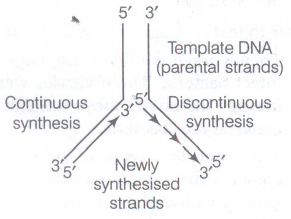
Show DNA replication with the help of a diagram only.
8.
Describe the structure of a nucleosome.
9.
What is aminoacylation ? State its significance
10.
A template strand is given below. Write down the corresponding coding strand and the mRNA strand that can be formed along with their polarity.
3' ATGCATGCATGCATGCATGCATGC 5'
11.
Explain the role of enzyme nucleases and ligases
12.
Write the functions of RNA polymerase-I and RNA-polymerase-III
13.
Pick out the untranslated regions from the following mRNA and mention their location.
5' - ACGUCAUGGCGUUUUAGGAGGAA -3'
14.
What is a promoter in a transcription unit? Where is it located in DNA with reference to the structural gene(s)?
15.
Give two reasons why both the strands of DNA are not copied during transcription
16.
Write two chemical difference between DNA and RNA.
17.
What are 5'-end and 3'-end of a poly-nucleotide chain?
18.
Differentiate between Reprtitive DNA and Satellite DNA
19.
Write two possible uses of single nucleotide polymorphism.
20.
Explain the dual function of AUG codon.Give the sequence of basis it is transcribed from and its anticodon.
21.
How is the translation of mRNA terminated?
22.
Mention the role of ribosomes in peptide bond formation. How does ATP facilitate it?
23.
Write the full form of VNTR.How is VNTR different from 'probe'?
24.
State the dual role of deoxyribonucleoside triphosphates during DNA replication
25.
How do histones acquire positive charge?
26.
(a) Given below is a single stranded DNA molecule. Frame and label its sense and antisense RNA molecule.
5' ATGGGGCTC3' sense
(b) How the RNA molecules made from above DNA strand help in silencing of the specific RNA molecules?
27.
Given below is a schematic representation of a lac operon.
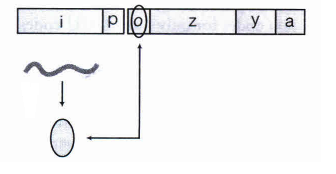
(i) Identify i and p.
(ii) Name the inducer for this operon and explain its function.
28.
Identify by giving reasons, the salient features of genetic code by studying the following nucleotide sequence of mRNA strand and the polypeptide translated from it.
(AUG UUU UCU UUU UUU UCU UAG)
(Met - Phe - Ser-Phe - Phe - Ser)
29.
Calculate the total number of thymine-based present in the double strand DNA if it transcribes a mRNA which reads as follows:
5'-AUGCAUGCAUGCAUGCAGG-3'
30.
Given below is a part of the template strand of a structural gene
\(\overline { TAC\quad CAT\quad TAG\quad GAT } \)
(a)Write its transcribed mRNA strand with its polarity
(b)Explain the mechanism involved in initiation of the transcription of this strand.
31.
Write short notes on RNA polymerases of eukaryotic cells.
32.
Explain the idea expressed in the following representation:
DNA \(\rightleftharpoons \)RNA \(\longrightarrow \)Protein
33.
Explain the role of 35S and 32P in the experiments conducted by Hershey and Chase.
34.
A typical mammalian cell has 2.2m long DNA molecule,Whereas the nucleus in which it is packed measures about 10-6m.Explain how such a long DNA molecule is packed within a tiny nucleous in the cell.
35.
Expand 'BAC' and 'YAC'.Explain how they were used in sequencing o human genome.ss
36.
The base sequence in one of the strands of DNA is TAGCATGAT
(i)Give the base sequence of its complementry strand.
(ii)How are these base pairs held together in a DNA molecule?
(iii)Explain the base complementarity rule.Name the scientist who framed this rule.
37.
What is hnRNA?Explain the changes hnRNA undergoes during the processing to from mRNA
1.
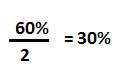
Given, Cytosine = 20%
Percentage of Guanine = 20%
Now according to Chargafl's rule,
A + T = 100 - (G +C)
A + T = 100 - 40
Percentage of Thymine = Percenlage of Adenine
2.
(i) The sequence of amino acids is Met-Phe-Phe-Phe- Phe-Phe-Phe.
(ii) The sequence of nucleotides can be:
(i) AUG UUU UUU UUU UUU UUU UUU
(or)
(ii) AUG UUC UUC UUC UUC UUC UUC
(or)
(iii) AUG UUU UUU UUU UUC UUC UUC
(iii) Yes, there is difficulty in predicting the sequence of nucleotides, as many more combinations are possible; this difficulty is because amino acid, phenylalanine is coded by two codons, UUU and UUC.
(iv) The two properties of genetic code that can be applied to this are:
(i) Genetic code is unambiguous and specific, i.e. one codon codes for only one particular amino acid, e.g. AUG codes for methionine, UUU codes for phenylalanine, UUC codes for phenylalanine.
(ii) Genetic code is degenerate, i.e. one amino acid is coded by more than one codon, e.g. Phenylalanine is coded by two codons, UUU and UUC.
3.
5'-UACGUACGUACGUACGUACGUACG-3'.
4.
Given, length of E.coli DNA =1.36 mm = 1.36x 10⁻³ m.
Distance between two consecutive base pairs =0.34 nm = 0.34 x 10⁻⁹m
Hence, for E.coli total number of base pairs = \(\frac{1.36 \times 10^{-3}}{0.34 \times 10^{-9}}\) = 4 x 10⁶ bp
5.
The differences between unambiguous and universal genetic codes are as follows
| Unambiguous | Universal |
| In genetic code, one codon codes for only one amino acid hence, it is unambiguous | The genetic code is universal.i.e. each codon codes for same amino acid in all organisms |
(ii) The differences between degenerate and initiator codes are as follows
| Degenerate | Initiator |
| Some amino acids are coded by more than one codon, hence the code is degenerate, e.g. serine, leucine, arginine are encoded by 6 codons. | These codons act as start signal for translation. e.g. AUG acts as initiator codon and it codes for methionine |
6.
a) Transcription is the process in which RNA is synthesized from DNA.
Transcription is a 3 step process-
1) Initiation- RNA polymerase binds to DNA sequence called the promoter and providing the single-stranded template for transcription process.
2) Elongation- RNA polymerase reads the template strand and adds bases leading to elongation of the chain.
3) Termination- In this step terminator sequences mark the end of transcription.
7.
The replication fork of DNA formed during DNA replication.
8.
Structure of a nucleosome
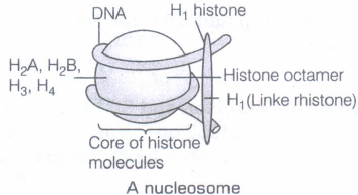
A nucleosome is found in the nucleus of the cell.
9.
Amino acids are activated in the presence of ATP and linked to (cognate) t-RNA.
Carries amino acid to the site synthesis/reaches amino acids to the respective codon.
10.
Codingstrand-5'
TACGTACGTACGTACGTACGTACG 3'
mRNAstrand-5'
UACGUACGUACGUACGUACGUACG 3'
11.
Nucleases remove unwanted nucleotides while ligases rejoin useful of nucleic acid (RNA)
12.
RNA polymerase I and III catalyse the transcription of r-RNA and t-RNA respectively
13.
1. AUGUCG - at the 5' end before the initiation codon.
2. GAGGAA-at the 3' end after the termination codon.
3. They are normally located in front of the initiation codon at the 5' end and behind the termination codon at the 3' end of the coding strand of DNA.
14.
1.It is a DNA sequence that provides the binding site for RNA polymerase for transcription.
2.It is located towards the 5' end (upstream) of the structural gene (of the coding strand).
15.
Both the strands of DNA are not copied during transcription for the following reasons:
(i) If both the strands of DNA are copied, two different RNAs (complementary to each other) and hence two different polypeptides would be formed; if a segment of DNA produces two polypeptides, the genetic information machinery becomes complicated.
(ii) The two complementary RNA molecules (produced simultaneously) would form a double-stranded RNA rather than getting translated into polypetides.
(iii) RNA polymerase carries out polymerisation in the 5' ~ 3' direction and hence the DNA strand with 3' ~ 5' polarity acts as the template strand.
16.
| DNA | RNA |
|
It has thymine and cytosine as pyrimidine bases. |
It has uracil and cytosine as pyrimidine bases. |
17.
1. The polynucleotide chain has at the 5th position of the pentose sugar, a free phosphate moiety;This end is called 5' end.
2. The 3rd position of the pentose of the sugar has a OH-group attached; this is called the 3' end.
18.
| Repetitive DNA | Satellite DNA |
| Repetitive DNA refers to the sequences of DNA when a small stretch ]of DNA is repeated many times;They code for proteins. | Satellite DNA refers to those repetitive DNA sequences which do not code for any protein but form a large portion of the gene. |
19.
Single nucleotide polymorphism helps in
(i) finding the chromosomal locations of disease-associated genes or sequences of DNA and
(ii) tracing human history
20.
Dual function of AUG codon
1. It codes for amino acid,methionine
2. It functions as the initiation codon
3. It is transcribed by TAC on DNA
4. Its anticodon is UAC.
21.
1. When one of the termination codons (UAA, UAG, UGA) comes at the A-site, it does not code for any amino acid and there is no tRNA molecule for it.
2. As a result, the polypeptide synthesis (or elongation of polypeptide) stops.
3. The polypeptide synthesised is released from the ribosome, catalysed by a 'release factor'.
22.
Role of Ribosomes
(i) Ribosomes are the main cellular factory of protein synthesis the large subunit has two sites (P and A) for binding of amino acids,so that they are close to each other for formation of peptide bond.
(ii)They also act as catalyst (23s rRNA)in prokaryotes for formation of peptide bonds.ATP provides energy for the activation of amino acids.
23.
| VNTR | Probe |
| It is a class of satellite DNA where a small sequence is arranged tandemly in many copy numbers. | Probe is a labelled (with radioactivity) VNTR used for hybridisation with DNA segments in question. |
24.
(i) The deoxyribonucleoside triphosphates are the building blocks for the DNA-strand(polynucleotide chain), as substrate.
(ii) These also serve as energy source in the form of ATP and GTP from there two terminal phosphates.
25.
A protein acquires a charge depending on the abundance of amino acids residues that have positively charged groups in their side chains. Histones are rich in basic amino acids residues-lysines and arginine both of these amino acids carry positive charges in their side chains,.Hense, histones are positively charged molecules.
26.
(a) 5' ATGGGGCTC 3' sense
3' TACCCCGAG 5' antisense
RNA 5' AUGGGGCUC 3' sense
3' UACCCCGAG 5' antisense
(b) The two strands of RNA (i.e. sense and antisense) being complementary will bind with each other and form double stranded RNA. As a result its translation and protein expression would be inhibited.
27.
(i) i-Regulatory gene, p - Promotor gene.
(ii) Inducer is lactose.
Functions
(a) Enters the cell and binds to the repressor and inactivates it.
(b) As a result, repressor cannot bind to the operator .This allows RNA polymerase to have access to the promotor and transactions proceeds.
28.
| Salient Feature of Genetic Code | Reason |
| The codon is triplet | AUG,UUU,etc.,are triplets. |
| One codon codes for only one amino, so it is unambiguous and specific. |
UUU codes for serine, AUGcodes for methionine, etc. |
| AUG has dual function as it codes fo r methionine and if also acts as initiator codon. |
AUG is seen at the beginning of the polypeptide chain. |
| UAG act as a stop codon. | No amino acid is coded by UAG in the polypeptide chain given. |
29.
The template strand as 3'-TACGTAGTACGTTAGTCC-5' and the coding strand reads as 5'-ATGCATGCATGCAATCAGG-3' Therefore,the total number of Thymine are=10.
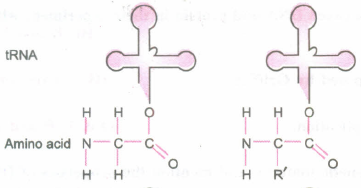
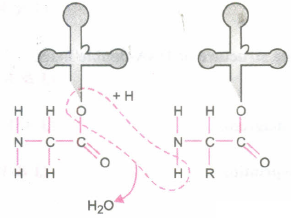
The Carboxyl group(-COOH) of one amino acids reacts with an amino group(-NH2)of other amino acid to form a peptide bond(-CO-NH).Make a peptide bond between the two amino acids by removing water molecule in the given figure
30.
(a)
\(\\ \overline { ^{ 3' }TAC\quad CAT\quad TAG\quad GAT\\ _{ 5' }\underline { AUG\quad GUA\quad AUC\quad CUA } _{ mRNA } } ^{ 5' }\)
31.
In eukaryotes, there are three RNApolymerases.
(i) RNA-polymerase I catalyses transcription of rRNAs (28 S, 18 Sand 5.8 S).
(ii) RNA- polymerase II catalyses transcription of precursor of mRNA; it is called hnRNA.
(iii) RNA- polymerase III catalyses tRNA, 5srRNA and snRNAs.
32.
1. Central Dogma of molecular biology
2. It is the present day representation of the central dogma of molecular biology.
3. RNA is made from DNA by the process of transcription.
4. With the discovery of retroviruses, there is reverse transcription, i.e. the synthesis of DNA on RNA template, catalysed by the enzyme reverse transcriptase
5. RNA is translated into a polypeptide, making use of amino acids, ribosomes and enzymes.
33.
1. The viruses/bacteriophages grown on radioactive sulphur \(\left( ^{ 35 }{ S } \right) \) contained radioactive protein but not radioactive DNA, because DNA does not contain sulphur.
2.When these viruses were allowed to infect bacteria, the bacteria did not contain radioactivity, because proteins did not enter the bacteria; hence protein is not the genetic material.
3. The viruses grown on radioactive phosphorus \(\left( ^{ 32 }{ P } \right) \) contained radioactive DNA, becauseDNA contains phosphorus and not proteins.
4. When these viruses were allowed to infect the bacteria, the bacteria were radioactive, indicating that DNA is the genetic material that has passed from the virus into bacteria.
34.
1. In the mammalian cells (or eukaryotes) there is a set of positively-charged basic proteins, called histones.
2. Histones are organised to form a unit of eight molecules, called histone octamer.
3. The negatively charged DNA is wrapped around the positively charged histone octamer to form a structure, called nucleosome.
4. A typical nucleosome contains 200 bp of DNA helix.
5. The nucleosomes constitute the repeating units of chromatin, which appear as beads-on-string structure under an electron microscope.
6. These are further packaged to form the chromatin fibres, which condense to form chromosomes.
7. The packaging of chromatin at higher levels requires additional set of proteins called non-histone chromosomal (NHC) proteins.
35.
(i) 'BAC' - Bacterial Artificial Chromosome.
'YAC' - Yeast Artificial Chromosome.
(ii) They are the commonly used vectors for cloning the DNA fragments in the hosts like bacteria and yeast.
(iii) The cloning results into amplification of each fragment of DNA, so that they could be sequenced with ease.
36.
(i) ATCGTACTA.
(ii) Base pairs are held together by weak hydroyen bodsin a DNA molecule. Adenine pairs with thymine by two H-bonds and guanine pairs with cytosine by three H-bonds.
(iii) According to basc complementarity rule proposed by Erwin Chargalf for a double-stranded DNA, the ratios between adenine-thymine and guanine-cytosine are constant and equal to one.
37.
In Eukaryotes:
1. The structural genes are split. They have coding sequences (exons) interspersed with non-coding sequences (introns).
2. The primary transcript of RNA undergoes a process called splicing, by which the introns are removed and the exons are joined together.
3. The hnRNA (precursor of mRNA) undergoes capping and tailing to become mRNA.
4. In capping, methyl guanosine triphosphate is added to the 5' end of hnRNA.
5. In tailing, adenylate residues (about 200-300) are added at the 3' end.
6. The fully processed mRNA is released from the nucleus into the cytoplasm.

12th Standard CBSE Syllabus & Materials
12th Standard CBSE
CBSE 12th Computer Science Python Revision Tour I - New Previous year Question Papers Study Material - QB365 Set A
NEW12th Standard CBSE
CBSE 12th Business Studies Planning Important Questions And Answers Study Material - QB365 Set A
NEW12th Standard CBSE
CBSE 12th Business Studies Business Environment Important Questions And Answers Study Material - QB365 Set A
NEW12th Standard CBSE
CBSE 12th Business Studies Principles of Management Important Questions And Answers Study Material - QB365 Set A



NCERT Books

Syllabus

Exam Pattern

Sample Question Papers

Previous year Question Papers

Important Notes

MCQ Practice test

NCERT Exemplers

Case study Questions

Image Based Questions

Passage based Questions

HOT Questions

Value Based Questions

Model Questions Papers
NCERT ( Book Back ) Questions

Assertion and Reason
Important Questions And Answers

CBSE 12th Standard CBSE Subjects
CBSE Standards








