
 100% FREE ACCESS
12th Standard CBSE Syllabus & Materials
12th Standard CBSE
CBSE 12th Economics Government Budget and the Economy Previous year Question Papers Study Material - QB365 Set A
NEW12th Standard CBSE
CBSE 12th Computer Science Interface Python with MySQL - New Previous year Question Papers Study Material - QB365 Set A
NEW12th Standard CBSE
CBSE 12th Computer Science Database Concept - New Previous year Question Papers Study Material - QB365 Set A
NEW12th Standard CBSE
CBSE 12th Computer Science Data Communication - New Previous year Question Papers Study Material - QB365 Set A
NEW12th Standard CBSE
CBSE 12th Computer Science Data Structures - New Previous year Question Papers Study Material - QB365 Set A
NEW12th Standard CBSE
CBSE 12th Computer Science Functions - New Previous year Question Papers Study Material - QB365 Set A

Published on: 25/10/2025
Download CBSE Class 12th Standard CBSE Biology question papers, sample papers, important questions, and previous year solved papers in PDF format. Get free study materials, NCERT solutions, and exam preparation resources for Class 12th Standard CBSE Biology
Questions + Answers key
Take MCQ Biology Test
1.
Name and describe the technique that will help in solving a case of paternity dispute over the custody of a child by two different families.
2.
Who proposed that DNA replication is semicoservative? How did Meselson and Stahl prove it experimentally?
3.
Who proposed that DNA replication is semiconservative? How was it experimentally proved by Meselson and Stahl?
4.
Enumarate the salient features of human genome.
5.
(a)Name two types of satellite DNA.Mention the basis for such a classification.
(ii)Show only diagrammatically the process of transcription in bacteria
6.
Describe the steps involved in the sequencing of genome of an organism.
7.
What is genetic code?Name the scientists and their contribution in deciphering the genetic code
8.
(i)What are the three types of RNA?
(ii)Which one of these has the shape of a clover leaf in two-dimentional structure?
(iii)How is each RNA related in the information during protein synthesis?Explain.
9.
Describe the process of DNA replication.
10.
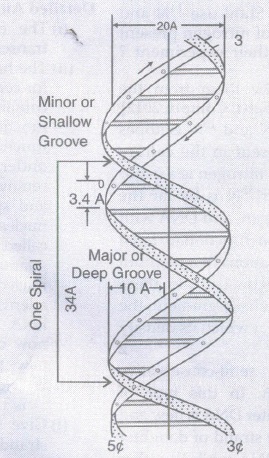
Enlist the salient features o the double helix strucutre of DNA.
1.
DNA-Fingerprinting
The steps/procedure in DNA-fingerprinting include the following.
(i) Extraction. DNA is extracted from the cells in a high-speed, refrigerated centrifuge.
(ii) Amplification. Many copies of the extracted DNA are made by polymerase chain reaction.
(iii) Restriction Digestion. DNA is cut into fragments with restriction enzymes into precise reproducible sequences.
(iv) Separation of DNA sequences restriction fragments. The cut DNA fragments are introduced and passed through electrophoresis set-up containing agarose polymer gel; the separated fragments can be visualised by staining them with a dye that shows fluorescence under ultraviolet radiation.
(v) Southern Blotting. The separated DNA sequences are transferred on to a nitrocellulose or nylon membrane.
(vi) Hybridisation. The nylon membrane is immersed in a bath and radioactive probes (DNA segments of known sequence) are added; these probes target a specific nucleotide sequence that is complementary to them.
(vii) Autoradiography. The nylon membrane is pressed on an X-ray film and dark bands develop at the probe sites.
The bands form a characteristic pattern, which varies from individual to individual.
2.
1. It was to show that DNA replication is semi conservative.
2. After completion of replication, each new/daughter molecule of DNA has one parental strand and one newly synthesised strand; this is called semiconservative replication of DNA.
3. Experiment
Mathew Meselson and Franklin Stahl performed the experiment.
4. They grew E.coli. in a medium containing \(^{ 15 }{ { NH }_{ 4 } }Cl,\) until \(^{ 15 }N\) was incorporated in the two strands of newly formed E.coli cells; this 'heavy' DNA can be separated from the normal \(^{ 14 }N-DNA\) by centrifugation in cesium chloride (CsCI) density gradient.
5. Then they transferred the cells into a medium with normal \(^{ 14 }{ { NH }_{ 4 } }Cl\) and took out samples at various time intervals.
6. They extracted the DNA and centrifuged it to measure the densities.
7. The DNA extracted from cells after one generation after transfer from the \(^{ 15 }{ { N } }\) medium to \(^{ 14 }{ { N } }\) medium (i.e. after about 20 minutes), had an intermediate/hybrid density.
8. The DNA extracted after two generations (i.e. after 40 minutes) consisted of equal amounts of 'light' DNA and 'hybrid' DNA.
This proves that after replication, each DNA molecule has one parental strand and one newly synthesised strand, i.e. replication is semiconservative.
3.
1. It was to show that DNA replication is semi conservative.
2. After completion of replication, each new/daughter molecule of DNA has one parental strand and one newly synthesised strand; this is called semiconservative replication of DNA.
3. Experiment
Mathew Meselson and Franklin Stahl performed the experiment.
4. They grew E.coli. in a medium containing \(^{ 15 }{ { NH }_{ 4 } }Cl,\) until \(^{ 15 }N\) was incorporated in the two strands of newly formed E.coli cells; this 'heavy' DNA can be separated from the normal \(^{ 14 }N-DNA\) by centrifugation in cesium chloride (CsCI) density gradient.
5. Then they transferred the cells into a medium with normal \(^{ 14 }{ { NH }_{ 4 } }Cl\) and took out samples at various time intervals.
6. They extracted the DNA and centrifuged it to measure the densities.
7. The DNA extracted from cells after one generation after transfer from the \(^{ 15 }{ { N } }\) medium to \(^{ 14 }{ { N } }\) medium (i.e. after about 20 minutes), had an intermediate/hybrid density.
8. The DNA extracted after two generations (i.e. after 40 minutes) consisted of equal amounts of 'light' DNA and 'hybrid' DNA.
This proves that after replication, each DNA molecule has one parental strand and one newly synthesised strand, i.e. replication is semiconservative.
4.
Salient features of Human Genome
(i) The human genome contains 3164.7 million nucleotides (base pairs).
(ii) The size of the genes varies; an average gene consists of 3000 bases, while the largest gene, dystrophin consists of 2.4 million bases.
(iii) The totaI number of genes is estimated to be 30000 and 99.9% of the nucleotides are the same in all humans.
(iv) The functions of over 50% of the discovered genes are not known.
(v) Only less than 2% of the genome codes for proteins.
5.
(a) Minisatellites and microsatellites
They are classified on the basis of:
(i) base composition, i.e. A- T rich or G-C rich.
(ii) length of the segment.
(iii) number of repetitive units.
6.
Sequencing of a Genome
1. The methods involve two major approaches:
(i) One approach called Expressed Sequence Tags (ESTs), focuses on identifying all the genes that are expressed as RNAs.
(ii) Second approach called Sequence Annotation, is to simply sequence the whole set of genome, that includes all the coding and non-coding sequences and then assigning functions to different regions in the sequence.
2. The total DNA from the cell is isolated and converted into random fragments of relatively smaller sizes.
3. These fragments are then cloned in These fragments are then cloned in suitable hosts using specialised vectors; the commonly used hosts are bacteria and yeast and the vectors are bacterial artificial chromosomes (BAC) and yeast artificial chromosomes (YAC).
4. The fragments are then sequenced using automated DNA sequences.
5. The sequences are then arranged on the basis of certain overlapping regions present in them; this requires the generation of overlapping fragments for sequencing.
6. Specialised computer programmes are developed for alignment of the sequences.
7. These sequences are annotated and assigned to the respective chromosomes.
7.
Genetic Code
Genetic code refers to the relationship between the sequence of nucleotides on mRNA and the amino acids in the polypeptide.
It was George Gamow, who suggested that the code must be made of three bases, in order to code for the twenty different amino acids, with only four bases; this would generate \(\left( { 4 }^{ 3 } \right) \) or (4 x 4 x 4) = 64 triplet codons.
Har Gobihd Khorana could synthesize RNA molecules with definite combinations of bases (homo polymers and copolymers).
Marshal Nirenberg made a cell-free system for protein synthesis, that helped in deciphering the code.
Ochoa discovered enzyme polynucleotide phosphorylase, that could polymerise RNA with definite sequence in template-independent manner.
8.
(i) The three types of RNA are
(a) Messenger RNA (mRNA)
(b) Transfer RNA (tRNA)
(c) Ribosomal RNA (rRNA)
(ii) Transfer RNA has the shape of clover leaf in two dimensional structure.
(iii) Functions of RNAs
(a) Messenger RNA (mRNA)
It brings the genetic information of DNA transcribed on it, to ribosomes for protein synthesis.
It decides the sequence of amino acids in a polypeptide chain.
(b) Transfer RNA (tRNA)
It acts as an adapter molecule, that reads the code on mRNA on one hand and binds to a specific amino acid on the other hand.
By its anticodon, it recognises the codon and, leaves the amino acid coded by the mRNA at the site of protein synthesis.
(c) Ribosomal RNA (rRNA)
It forms the structure of ribosomes.
It also plays a catalytic role in the formation of peptide bond; 23S rRNA is ribozyme.
9.
Synthesis of DNA
1. During replication of DNA, the two strands unwind upto a point and a replication fork is formed.
2. Since the unwinding cannot take place for the entire length, replica ion starts from the replication fork.
3. Both the strands act as templates for DNA synthesis.
4. DNA polymerase is the enzyme that polymerises the bases/nucleotides into a strand of DNA.
Since this enzyme polymerises the nucleotides in \({ 5 }^{ ' }\longrightarrow { 3 }^{ ' }\) direction only, on one of the template strands (with \({ 3 }^{ ' }\longrightarrow { 5 }^{ ' }\)polarity), the new strand is synthesised as a continuous stretch (leading strand); it is called continuous synthesis.
5. On the other template strand, (with \({ 5 }^{ ' }\longrightarrow { 3 }^{ ' }\) polarity), DNA strand is synthesised as short stretches (using primers), called Okazaki fragments; this is called discontinuous synthesis. Later, these short stretches are joined by DNA-ligase (lagging strand).
10.
(i) In translation, a particular amino acid becomes activated and attached to the 3' end of a specific tRNA molecule.
(ii) The reaction is catalysed by the enzyme amino-acyl-tRNA synthetase.
\(Amino\quad acid\left( AA \right) +ATP\xrightarrow { Enzyme } AA-AMP-Enz+{ PP }_{ i }\\ AA-AMP-Enz+tRNA\longrightarrow AA-tRNA+AMP+{ PP }_{ i }\)
(iii) Initiation of protein synthesis
(iv) The ribosome, in its inactive state exits as two subunits - a large subunit and a small subunit.
(v) When the small subunit encounters the mRNA, translation begins.
(vi) The mRNA binds to the small subunit of ribosome, following base pair rule, between the bases of mRNA and those on rRNA; it is catalysed by certain 'initiation factors'.
(vii) There are two sites on the larger subunit, the P-site and the A-site.
(viii) The small subunit (with the tRNA) attaches to the large subunit in such. a way that the initiation codon (AUG) comes on the P-site.
The initiator tRNA (methionyl tRNA) binds to the P-site.
(ix) Elongation of polypeptide chain
(x) A second tRNA charged with an appropriate amino acid binds to the A-site of the ribosome.
(xi) A peptide bond is formed between the carboxyl group of methionine and the amino group of the second amino acid; this reaction is catalysed by the enzyme peptidyl transferase.
(xii) The ribosome moves from one codon to the next along the mRNA in the \({ 5 }^{ ' }\longrightarrow { 3 }^{ ' }\) direction.
(xiii) Amino acids are added 'one by one in the sequence of the codons and become joined together.
Termination of polypeptide synthesis
(i) When one of the termination codons (UAA, UAG, UGA) comes at the A-site, it does not code for any amino acid and there is no tRNA molecule for it.
(ii) As a result, the polypeptide synthesis (or elongation of polypeptide) stops.
The polypeptide synthesised is released from the ribosome, catalysed by a 'release factor'.

12th Standard CBSE Syllabus & Materials
12th Standard CBSE
CBSE 12th Computer Science Python Revision Tour I - New Previous year Question Papers Study Material - QB365 Set A
NEW12th Standard CBSE
CBSE 12th Business Studies Planning Important Questions And Answers Study Material - QB365 Set A
NEW12th Standard CBSE
CBSE 12th Business Studies Business Environment Important Questions And Answers Study Material - QB365 Set A
NEW12th Standard CBSE
CBSE 12th Business Studies Principles of Management Important Questions And Answers Study Material - QB365 Set A



NCERT Books

Syllabus

Exam Pattern

Sample Question Papers

Previous year Question Papers

Important Notes

MCQ Practice test

NCERT Exemplers

Case study Questions

Image Based Questions

Passage based Questions

HOT Questions

Value Based Questions

Model Questions Papers
NCERT ( Book Back ) Questions

Assertion and Reason
Important Questions And Answers

CBSE 12th Standard CBSE Subjects
CBSE Standards








