
 100% FREE ACCESS
12th Standard CBSE Syllabus & Materials
12th Standard CBSE
CBSE 12th Economics Government Budget and the Economy Previous year Question Papers Study Material - QB365 Set A
NEW12th Standard CBSE
CBSE 12th Computer Science Interface Python with MySQL - New Previous year Question Papers Study Material - QB365 Set A
NEW12th Standard CBSE
CBSE 12th Computer Science Database Concept - New Previous year Question Papers Study Material - QB365 Set A
NEW12th Standard CBSE
CBSE 12th Computer Science Data Communication - New Previous year Question Papers Study Material - QB365 Set A
NEW12th Standard CBSE
CBSE 12th Computer Science Data Structures - New Previous year Question Papers Study Material - QB365 Set A
NEW12th Standard CBSE
CBSE 12th Computer Science Functions - New Previous year Question Papers Study Material - QB365 Set A

Published on: 25/10/2025
Download CBSE Class 12th Standard CBSE Biology question papers, sample papers, important questions, and previous year solved papers in PDF format. Get free study materials, NCERT solutions, and exam preparation resources for Class 12th Standard CBSE Biology
Questions + Answers key
Take MCQ Biology Test
1.
What is the difference in the amino-acid sequence in the B-chain of hemoglobin in a normal person and a sickle-cellanaemia person?
2.
Why does hnRNA need to undergo splicing ? Where does splicing occur in the cell ?
3.
Write the two specific codons that a translational unit of m-RNA is flanked by one on either sides
4.
Name one autosomal dominant and one autosomal recessive Medelian disorder in humans.
5.
Mention any species which came into existence in the recent past.
6.
Name the RNA that carries information about the sequence of amino acids in a polypeptide.
7.
Name the enzyme involved in the continuous replication of DNA strand Mention the polarity of the template strand.
8.
Where does peptide bond formation occur in a bacterial ribosome and how?
9.
In Snapdragon, a cross between true-breeding red-flowered (RR) plants and true-breeding white-flowered (rr) plants showed a progeny of plants with all pink flowers.
(a) The appearance of pink flowers is not known as blending. Why?
(b) What is this phenomenon known as?
10.
Why Drosophila has been used extensively for genetical studies?
11.
What does the comparison between the eyes of Octopus and those of mammals say about their ancestry and evolution?
12.
(a) Differentiate between template strand and coding strand of DNA.
(b) Name the source of energy for the replication of DNA.
13.
How do histones acquire positive charge?
14.
In a cross between two tall pea plants, some of the offspring produced were dwarf. Show with the help of a Punnet square, how this is possible.
15.
If these is a history of hemophilia in the family, the chances of male members becoming hemophilic are more than that of the female.
(a) Why is it so ?
(b) Write the symptoms of the disease
16.
Describe the initial process of transcription in bacteria.
17.
How are the structural genes activated in the lac operon in E.coli?
18.
(i) Why are grasshopper and Drosophila said to show male heterogamety? Explain.
(ii) Explain female heterogamety with the help of an example.
19.
Why are human females rarely haemophilic? Explain. How do haemophilic patients suffer?
20.
Name the three kinds of selection. Show the three kinds with the help of figure.
21.
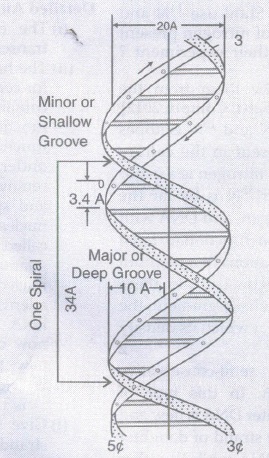
Enlist the salient features o the double helix strucutre of DNA.
22.
Crick, one of the discoverer of DNA double helical structure, was the man of
Physics
Chemistry
Zoology
Botany
23.
A test cross is carried out to
determine the genotype of a plant at F2
predict whether two traits are linked
assess the number of alleles of a gene
determine whether two species or varieties will breed successfully
24.
Which one of the following is not a part of a transcription unit in DNA?
The inducer
A terminator
A promoter
The structural gene
25.
The golden age of reptiles is
Palaeozoic
Mesozoic
Cenozoic
Proterozoic
26.
A living connecting link which provides evidences for organic evolution is
Sphenodon between reptile and bird
lung fishes between pisces and reptile
Archaeopteryx between reptile and bird
duck-billed platypus between reptiles and mammals
27.
De Vries gave his mutation theory on organic evolution while working on
pisum sativum
Drosophila melanogaster
Oenothera lamarckiana
Althea rosea
28.
tRNA consisting of three unpaired bases constitute
Codon
Anticodon
Clover-leaf model
Acceptor loop
29.
The phenomenon of a single gene regulating several phenotypes is called
Multiple allelism
Epistasis
Incomplete dominance
Pleiotropism
Co-dominance
30.
The plant in which hugo de vries introduced the concept of multation
Oenothera lamarkiana
Pisum sativum
Allium cepa
Mirabilis jalapa
31.
During splicing, the exons are joined and the enzyme which catalyzes this reaction is
RNA ligase
RNA catalase
RNA permease
RNA polymerase
32.
Initiator (starting) codon in eukaryotes is
AUG
AAG
CCU
GGC
33.
Jumping genes given by Barbara Mclintock are also called
Transposons
Mutons
Cistrons
Vectors
1.
()
In a person suffering from sickle-cell anaemia, the amino acid glutamine present at the sixth position, is replaced by the valine.
2.
hnRNA undergoes splicing to remove introns and join exons.Splicing occurs in the nucleus of the cell.
3.
()
Start codon -AUG
Stop codon - UAA/UGA/UAG
4.
()
Autosomal dominant disorder - Huntington's disease
Autosomal recessive disorder - Thalassemia
5.
()
Melanic moth, Biston carbonaria.
6.
()
mRNA
7.
Enzyme involved in continuous replication of DNA strand is DNA-dependent DNA polymerase. Template strand has 3'⟶ 5' polarity.
8.
Between the two amino acids (found on charged tRNA), bound to the two sites of the large sub units of bacterial ribosomes, when two 2harged tRNAs are brought close enough, peptide bond is formed with the help of ribozyme.
9.
(i) Blending is the mixing of two colours,but in this example red and white colours are appearing independently at cellular level. Thus, no blending of characters occurs in this case. Also, red and white colours reappear in F2 - generation.
(ii) This phenomenon is known as incomplete dominance.
10.
Advantages of using Drosophila as genetic material
Drosophila is a very useful organism for genetical experiments because:
(i) Very large number of offsprings are produced after each mating.
(ii) It can be cultured in large number in laboratory and animals can be easily examined under a handlens
(iii) Its life cycle is very short and is completed in 10-12 days. A new generation can be obtained every two week.
(iv) It has four pairs of chromosomes all different in size and easily distinguishable.
(v) They produce numerous variants.
(vi) It has heteromorphic (XY) chromosomes in the male.
(vii) Female Drosophila files can be easily differentiated from the males by the large body size and presence of ovipositor in the abdomen.
11.
Eyes of Octopus and those of mammals are analogous structures, which have resulted from convergent evolution.
They have not evolved from common ancestors.
12.
| Template strand | Coding strand |
|
(i)This is the strand of DNA with 3o->5opolarity |
(i)This is the strand DNA with 5o>3o polarity |
| (ii) it functions as the template for transcription and codes for RNA |
(ii) It does not code for any region of RNA during transcription. |
13.
A protein acquires a charge depending on the abundance of amino acids residues that have positively charged groups in their side chains. Histones are rich in basic amino acids residues-lysines and arginine both of these amino acids carry positive charges in their side chains,.Hense, histones are positively charged molecules.
14.
Since dwarfness (recessive trait) has appeared in the progeny, the tall pea plant must be heterozygous for tallness, i.e. its genotype is Tt
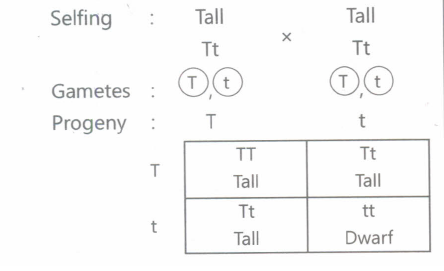
The phenotypic ratio is 3 Tall : 1 dwarf.
Since tallness is dominant over dwarfness, the homozygotes (TT) as well as the heterozygotes (Tt) are tall.
The recessive trait is expressed only under homozygous condition (tt) and hence appears only in one-fourth of the progeny.
15.
(a)Defective gene is on X chromosome, in case the carrier female (mother) passes Xh to the son he suffers, if she passes Xh to the daughter, she has the other X (from father) to make it heterozygous so the daughters escape as carriers.
(b)The blood does not clot in the affected person after an injury or a small cut.
16.
Initial process of transcription in bacteria:
1) The process of copying genetic information from antisense or template strand of DNA into RNA is called transcription.
2) The segment of DNA that takes part in transcription is called transcription unit, It has three components
(i) A promoter
(ii) The structural gene
(iii) A terminator
3) Structural gene is component of that strand of DNA which has 3'->5' polarity as transcription can occur only in 5'->3' direction
4) Transcription requires a DNA-dependent RNA polymerase and initiation factor
5) Bacteria have only one type of RNA polymerase which transcribes all the three types of RNAs
6) Ribonucleotides of ribose series are activated through phosphorylation (ATP, GTP, CTP, UTP)
7) Transcription begins at initiation site. A promotor has RNA polymerase recognition site and it binds to the specific site.
8)Enzymes required for unwinding of chain are unwindase and single cell binding proteins
9) Nucleotides are added as per base pairing rule
17.
The lac operon consists of
(i) three structural genes (z,y and a) which code for \(\beta \) -galactosidase, permease and transacetylase, respectively.
(ii) an operator; which controls the structural genes as a unit.
(iii) a regulatory gene ti.e., inhibitor gene) and
(iv) a promoter, where the RNA polymerase binds for transcription.
The regulatory gene codes for the repressor protein, all the time (constitutively): the repressor binds to the operator to inactivate the operon.
Lactose enters the cell with the help of permease and the active form of lactose binds to the repressor and prevents it from binding to the operator.
This allows RNA polymerase an access to the promoter and transcription continues, i.e. lac operon is activated.
18.
(a) Male heterogamety
A male grasshopper produces two types of gametes with reference to sex chromosomes, i.e. 50% of them with one X-chromosome and 50% of them with no X-chromosome.
A male Drosophila produces 50% of gametes with one X-chromosome and 50% of them with one V-chromosome.
Since they produce two types of gametes with reference to sex chromosomes, they are said to show male heterogamety.
b)Female heterogamety
It is the phenomenon in which females of a species produce two types of gametes with reference to sex-chromosomes.
It is seen in fowls, where a female has ZW sex chromosomes and produces 50% of ova with one Z-chromosomes and 50% of them with one W-chromosome.
The sex of the offspring is determined by the type of ovum fertilised.
19.
1.The gene for haemophilia is present on the X chromosome, i.e. sex-linked.
2.The disorder is due to a recessive mutant allele; hence a female with XX sex chromosomes, must be homozygous to produce the disease.
3.She must receive one of the defective alleles from her haemophilic father and the other X-chromosome with the defective allele from her mother; who is also haemophilic or at least a carrier (heterozygous for the trait, XXh).
4.The cross is as follows.
20.
Kinds of selections:
1. Stabilising selection
2. Directional selection
3. Disruptive selection.
21.
(i) In translation, a particular amino acid becomes activated and attached to the 3' end of a specific tRNA molecule.
(ii) The reaction is catalysed by the enzyme amino-acyl-tRNA synthetase.
\(Amino\quad acid\left( AA \right) +ATP\xrightarrow { Enzyme } AA-AMP-Enz+{ PP }_{ i }\\ AA-AMP-Enz+tRNA\longrightarrow AA-tRNA+AMP+{ PP }_{ i }\)
(iii) Initiation of protein synthesis
(iv) The ribosome, in its inactive state exits as two subunits - a large subunit and a small subunit.
(v) When the small subunit encounters the mRNA, translation begins.
(vi) The mRNA binds to the small subunit of ribosome, following base pair rule, between the bases of mRNA and those on rRNA; it is catalysed by certain 'initiation factors'.
(vii) There are two sites on the larger subunit, the P-site and the A-site.
(viii) The small subunit (with the tRNA) attaches to the large subunit in such. a way that the initiation codon (AUG) comes on the P-site.
The initiator tRNA (methionyl tRNA) binds to the P-site.
(ix) Elongation of polypeptide chain
(x) A second tRNA charged with an appropriate amino acid binds to the A-site of the ribosome.
(xi) A peptide bond is formed between the carboxyl group of methionine and the amino group of the second amino acid; this reaction is catalysed by the enzyme peptidyl transferase.
(xii) The ribosome moves from one codon to the next along the mRNA in the \({ 5 }^{ ' }\longrightarrow { 3 }^{ ' }\) direction.
(xiii) Amino acids are added 'one by one in the sequence of the codons and become joined together.
Termination of polypeptide synthesis
(i) When one of the termination codons (UAA, UAG, UGA) comes at the A-site, it does not code for any amino acid and there is no tRNA molecule for it.
(ii) As a result, the polypeptide synthesis (or elongation of polypeptide) stops.
The polypeptide synthesised is released from the ribosome, catalysed by a 'release factor'.
22.
(a)
Physics
23.
(a)
determine the genotype of a plant at F2
24.
(a)
The inducer
25.
(b)
Mesozoic
26.
(d)
duck-billed platypus between reptiles and mammals
27.
(c)
Oenothera lamarckiana
28.
(b)
Anticodon
29.
(d)
Pleiotropism
30.
(a)
Oenothera lamarkiana
31.
(a)
RNA ligase
32.
(a)
AUG
33.
(a)
Transposons

12th Standard CBSE Syllabus & Materials
12th Standard CBSE
CBSE 12th Computer Science Python Revision Tour I - New Previous year Question Papers Study Material - QB365 Set A
NEW12th Standard CBSE
CBSE 12th Business Studies Planning Important Questions And Answers Study Material - QB365 Set A
NEW12th Standard CBSE
CBSE 12th Business Studies Business Environment Important Questions And Answers Study Material - QB365 Set A
NEW12th Standard CBSE
CBSE 12th Business Studies Principles of Management Important Questions And Answers Study Material - QB365 Set A



NCERT Books

Syllabus

Exam Pattern

Sample Question Papers

Previous year Question Papers

Important Notes

MCQ Practice test

NCERT Exemplers

Case study Questions

Image Based Questions

Passage based Questions

HOT Questions

Value Based Questions

Model Questions Papers
NCERT ( Book Back ) Questions

Assertion and Reason
Important Questions And Answers

CBSE 12th Standard CBSE Subjects
CBSE Standards








