
 100% FREE ACCESS
12th Standard CBSE Syllabus & Materials
12th Standard CBSE
CBSE 12th Economics Government Budget and the Economy Previous year Question Papers Study Material - QB365 Set A
NEW12th Standard CBSE
CBSE 12th Computer Science Interface Python with MySQL - New Previous year Question Papers Study Material - QB365 Set A
NEW12th Standard CBSE
CBSE 12th Computer Science Database Concept - New Previous year Question Papers Study Material - QB365 Set A
NEW12th Standard CBSE
CBSE 12th Computer Science Data Communication - New Previous year Question Papers Study Material - QB365 Set A
NEW12th Standard CBSE
CBSE 12th Computer Science Data Structures - New Previous year Question Papers Study Material - QB365 Set A
NEW12th Standard CBSE
CBSE 12th Computer Science Functions - New Previous year Question Papers Study Material - QB365 Set A

Published on: 25/10/2025
Download CBSE Class 12th Standard CBSE Biology question papers, sample papers, important questions, and previous year solved papers in PDF format. Get free study materials, NCERT solutions, and exam preparation resources for Class 12th Standard CBSE Biology
Questions + Answers key
Take MCQ Biology Test
1.
Where does peptide bond formation occur in a bacterial ribosome and how?
2.
One of the salient features of the genetic code is that it is nearly universal from bacteria to humans. Mention two exceptions to this rule. Why are some codes said to be degenerate?
3.
What is aminoacylation ? State its significance
4.
Name the cells HIV (Human Immunodeficiency Virus) gains entry into after infecting the human body. Explain the events that occur in these cells
5.
Following are the features of genetic codes.What does each one indicate ? Stop codon, Unambiguous codon, Degenerate codon, Universal codon.
6.
Differentiate between a cistron and an exon.
7.
Draw a neat labelled sketch of a replicating fork of DNA.
8.
A template strand is given below. Write down the corresponding coding strand and the mRNA strand that can be formed along with their polarity.
3' ATGCATGCATGCATGCATGCATGC 5'
9.
Protein synthesis machinery revolves around RNA but in the course of evolution it was replaced by DNA. Justify
10.
State the functions of Ribozyme and release factor in protein synthesis respectively
11.
Discuss the role the enzyme DNA ligase plays during DNA replication.
12.
Why hnRNA is required to undergo splicing?
13.
State the difference between the structural genes in a transcription unit of prokaryotes and eukaryotes.
14.
Name a few enzymes involved in DNA replication other than DNA polymerase and ligase. Name the key function for each of them.
15.
If a double stranded DNA has 20 percent of cytosine, calculate the percent of adenine in the DNA.
16.
Explain when is a genetic code said to be
(i) Degenerate (ii) Universal
17.
In the medium where E.coli was growing, lactose was added, which induced the lac operon. Then, why does lac operon shut down some time after addition of lactose in the medium?
18.
Different between codons and anticodons.
19.
List two essential roles of ribosomes during translation.
20.
A single base mutation in a gene may not 'always' result in loss or gain of function.Do you think the statement is correct?Define your answer.
21.
Unambiguous, universal and degenerate are some of the terms used for the genetic are some of the terms used for the genetic code.Explain the salient features of each of them.
22.
(i) Name the scientist who suggested that the genetic code should be made of a combination of three nucleotides.
(ii) Explain the basis on which he arrived at this conclusion.
23.
Name the scientists who started the DNA finger printing technique in India.
24.
What do you understand by genome.
25.
Explain the role of enzyme nucleases and ligases
26.
Write the names of various nitrogenous based found in RNA
27.
Write the functions of RNA polymerase-I and RNA-polymerase-III
28.
(i) Accoring to Watson and Crick model,the DNA molecule consists of_____long,parellel strands.The two strands are_______around a common axis in a regular manner to form a____helix.
(ii)These strands are made of ___ units.Each such units consists of_____,_____and_____
(iii)In each chain,nitrogenous base molecules are joined to the sugar molecules by_____bonds and project into the space enclosed in the helix at about____to the long axis of the helix
(iv)The nitrogenous bare may be a 9-membered,double ringed____or a 6-membered single ringed___
(v)The double helix of DNA has a constant diameter of___and one complete spiral (turn) of the helix is ___long and has____base pairs.
(vi)The mode of DNA replication is
(vii)Enzyme___cannot initiate the synthesis of a new DNA strand,although it can catalyze the growth of a DNA chain.Therefore,a short chain of ___is formed on the DNA template at the 5' end.This is called___
(viii)During DNA replication,one new strand formed in continuous stretch in the 5'-3' direction.it is called____strand.Other strand is formed in small fragments called_____Which are later joined to form a continuous strand termed___strand
29.
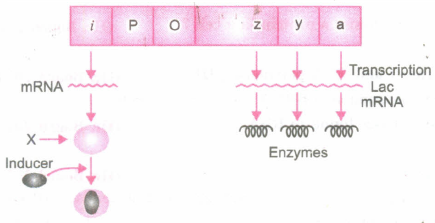
(a) Name the molecule 'X' synthesised by 'i' gene.How does this molecule get inactivated?
(b)Which one of the structural genes code for \(\beta \)-galactosidase?
(c)When will the transcription of this gene stop?
30.
Study the figure below and answer the questions:
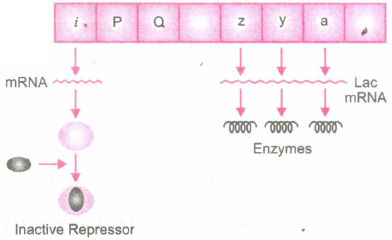
(a)What does the figure express?
(b)When does the transcription of lac mRNA stop?
(c)Name the enzyme transcribed by the gene 'Z'
31.
How can DNA segments, separated by gel electrophoresis, be visualised and located?
32.
What are two functions of DNA polymerase?
33.
What are auxotrophs?
34.
What is transcription unit?
35.
What changes happen during processing of RNA?
36.
how is the first ribonucleotide different from others in the RNA chain?
37.
Give the site and time of occurrence of transcription
38.
A particular strain of Neuropora crassa required citrulline in the medium while the wild type did not.How do you refer to the former?Why is it so called?
39.
What is the function of biological strand of DNA?
40.
How does DNA express its biological information?
41.
Define genetic material
42.
Who coined the term 'genetic code'?What does it mean?
43.
A low level of expression of lac operon occurs at all the time. Can you explain the logic behind this phenomenon?
44.
What are the functions of
(i) methylated guanosine cap and
(ii) poly A-tail in a mature mRNA?
45.
Why does hnRNA need to undergo splicing ? Where does splicing occur in the cell ?
46.
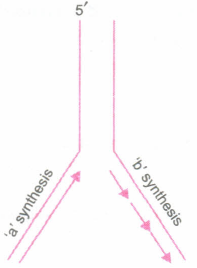
Name the types of synthesis 'a' and 'b' occurring in the replication fork of DNA as shown below:
1.
Between the two amino acids (found on charged tRNA), bound to the two sites of the large sub units of bacterial ribosomes, when two 2harged tRNAs are brought close enough, peptide bond is formed with the help of ribozyme.
2.
(i) Mitochondrial codons
(ii) Some protozoans
Since some amino acids are coded by more than one codon hence it is called as degenerate.
3.
Amino acids are activated in the presence of ATP and linked to (cognate) t-RNA.
Carries amino acid to the site synthesis/reaches amino acids to the respective codon.
4.
Macrophages, (Helper) T-Iymphocytes, viral RNA forms DNA by reverse trancription (reverse transcriptase), directs the infected cells to produce viral particles/increase viral progeny.
5.
The features of genetic code are:
(a) Stop codon: does not code for any amino acid /terminates the synthesis of polypeptide chain.
(b) Unambiguous codon: one codon codes (or one amino acid only.
(c) Degenerate codon: some amino acid are coded by more than one codon.
(d) Universal codon : genetic code is same for all organisms (bacteria to humans).
6.
Difference between cistron and an exon:
1. Cistron : A segment of DNA coding for a polypeptide ,chain; the structural gene in a transcription unit could be said as monocistronic (mostly in eukaryotes) or polycistronic (mostly in bacteria or prokaryotes).
2. Exon : The coding sequences or expressed sequences are defined as exons. Exons are said to be those sequences that appear in mature or processed mRNA.
7.
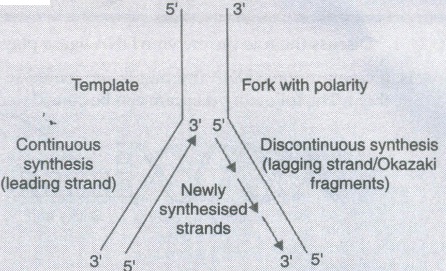
Polarity of the two strands of the fork to be shown and polarity as well as arrow mark of the lagging and leading strands to be shown with correct labellings.
8.
Codingstrand-5'
TACGTACGTACGTACGTACGTACG 3'
mRNAstrand-5'
UACGUACGUACGUACGUACGUACG 3'
9.
Since RNA was unstable and prone to mutations, DNA evolved from RNA with chemical modifications that make it more stable. DNA has double stranded nature and has complementary strands. These further resist changes by evolving a process of repair.
10.
1. Ribozyme-helps in peptide bond formation.
2. Release factor-terminates translation/release polypeptide from ribosome.
11.
DNA ligase facilitates the joining of okazaki fragmente in lagging DNA strands together by catalysing the formation of phosphodiester bond. It also play a role in repairing single-strand breaks in duplex DNA.

12.
hnRNA is required to undergo splicing because of the presence of introns (the non-coding sequences) in it. These need to be removed and the exons (the coding sequences) have to be joined in a specific sequence for translation to take place.
13.
Prokaryotic structural genes are found in continuity without any non-coding region. In contrast, eukaryotic structural genes are divided into exons (coding DNA) and introns (non-coding DNA).
14.
The enzymes involved in DNA replication other than DNA polymerase and ligase are listed below with their functions:
| Helicase | -opens the helix |
| Topoisomerases | -Removes the tension caused due to unwinding |
| DNA ligase | -Joins the cut DNA strands |
15.
Given, cytosine=20%
\(\therefore \) Percentage of Guanine=20%
Now according to Chargaff's rule, A+T=100-(G+C)
=> A+T=100-40
\(\therefore \) Percentage of Thymine=percentage of Adenine
=\(\frac { 60% }{ 2 } \)% = 30%
16.
The differences between unambiguous and universal genetic codes are as follows
| Unambiguous | Universal |
| In genetic code, one codon codes for only one amino acid hence, it is unambiguous | The genetic code is universal.i.e. each codon codes for same amino acid in all organisms |
(ii) The differences between degenerate and initiator codes are as follows
| Degenerate | Initiator |
| Some amino acids are coded by more than one codon, hence the code is degenerate, e.g. serine, leucine, arginine are encoded by 6 codons. | These codons act as start signal for translation. e.g. AUG acts as initiator codon and it codes for methionine |
17.
1. Lac is switched only adding lactose in the medium, as lactose acts as inducer and makes repressor inactive.
2. Due to this, \(\beta \) -galactosidase is formed which converts lactose into glucose and galactose. As soon as lactose is consumed, repressor again becomes active cause switching off of the system.
18.
Difference between codons and anticodons are:
| Codons | Anticodons |
| It is a sequence of three nucleotides, which codes for a particular amino acid. |
An anticodon is a sequence of three nucleotides that is complementary to the codon of a particular amino acid. |
| It is on mRNA decides the sequence of amino acid in a polypeptide. |
It is found on tRNA and recognises the codon |
19.
Two essential roles played by ribosomes during translation are:
(i) One of the ribosomal RNA (rRNA, 23S in prokaryotes)acts as a transferase ribozyme for the formation of peptide bonds.
(ii) The mRNA and changed tRNAs are attached to ribosomal sites.Thus, these provide sites for the attachment during protein synthesis.
20.
The statement is correct.Because of degeneracy codons, mutations at third base of usually do not result into any change in phenotype.On the other hand, if codon is changed in a way that now it specifies another amino acid it may alter the protein function as it happens in case of \(\beta \) - globulin of haemoglobin, protein where a substitution of valine instead of glutamic acid causes changes in its structure and function, and resulting into sickle-cell trait.
21.
Unambiguous code means that one codon codes for only the same amino acid, i.e. AUG codes only for methionine.
Genetic code is universal, as particular codon codes for the same amino acid in all organisms.It is degenerate because some amino acids are coded by more than one codon,e.g UUU and UUC, both code for phenylalanine.
22.
(i) George Gamow suggested that the genetic code should be made up of a combination of three nucleotides.
(ii) He proposed that there are four bases and 20 amino acids.So, there should be atleast 20 different genetic codes for these 20 amino acids.The only possible combinations that would meet the requirement is combinations of 3 bases that will give 64 codons.
23.
Dr.S.P.Rai Chaudhary and Dr.Lalji Singh
24.
A complete set of gene contained in the haloid does of chromosomes and inherited as a unit from one parent is called geome
25.
Nucleases remove unwanted nucleotides while ligases rejoin useful of nucleic acid (RNA)
26.
Adenine,uracil,guanine,cytosine
27.
RNA polymerase I and III catalyse the transcription of r-RNA and t-RNA respectively
28.
(i) two,spirally coiled, double
(ii),phosphate,dexyribose sugar,nitrogenous basedexyirbonucleotide
(iii) glycosidic,900
(iv) purine,pyrimidine
(v)2 nm (20 \(\mathring { A } \)),3.4nm(34 \(\mathring { A } \))
(vi) semiconservative
(vii) DNA polymerase,RNA,RNA primer
(viii) Leading,Okazaki fragments,lagging.
29.
(a)Molecule 'X' synthesised by 'i ' gene is repressor of the Lac operon.The repressor is inactivated by interaction with the inducer(i.e.,lactose)
(b)The gene 'Z' codes for beta-galactosidase
(c)Transcription of this stops as soon as the inducer is usedup i.e in absence of inducer.Once whole of lactose is consumed and there is no inducer present to blind to the repressor,the repressor becomes active and switches off the operon.
30.
(a) In presence of an inducer(such as lactose or allolactose), the repressor is inactivated by intersection with the inducer.
(b) Transcription of lac mRNA stops when the repress of the operon is synthesised from the i gene.The repress protein binds to the operator region of the operon and stops transcription.
(c) The gene 'Z' codes for beta-galactosidase.
31.
DNA segments that have been separated on an agarose gel by electrophoresis are transferred and permanently affixed to a nylon membrane, a process called southern blotting.The DNA bands are invisible to the eye so that they are flagged with some kind of tag that one can visualize.Therefore,a solution containing radioactive probe is spread over the membrance so that they bind to complementry DNA sequence and then can be visualized by autoradiography.
32.
DNA polymerase catalyses synthesis of DNA and help also in proof-reading
33.
Mutant organism that cannot grow in the minimal medium and need additional nutrients
34.
The bases of DNA sense strands from the promoter to the terminator sites from transcription unit
35.
During RNA processing
(i)unwanted nucleotides are removed
(ii)useful regions are rejoined
(iii)certain nucleotides are added
(iv)some nucleotides are modified, and
(v)folding of molecule
36.
First ribonucleotide in RNA chain is triphosphate, monophosphates
37.
Transcription occurs in the nucleus during G1 and G2 phases of cell cycle in eukaryote,in the cytoplasm and almost continuosly in prolaryotes
38.
Auxotroph,because it needed increase nutrision(G.auxano=to increase),it needed citrulline as it lacked the gene for the enzyme that could catalyse the chage of orithine into citrulline.
39.
Missenses strands acts as a template for the synthesis of sense strand during replication
40.
DNA expresses its genetic information by transcribing mRNA and synthesising proteins
41.
A substance which stores biological information,refers it to the next generation,and expresses it in the offspring
42.
Term genetic code was coined by George Gamow.It means that a sequence of 3 successive bases specifies one amino acid in apolypeptide
43.
In the complete absence of expression of lac operon, permease will not be synthesised; hence,lactose cannot be transported into the cells. If lactose cannot be transported into the cell, then it cannot act as an inducer and cannot relieve the lac operon from its repressed state.
44.
(i) The methylated guanosine cap helps in the binding of mRNA to the smaller subunit of ribosome during initiation of translation.
(ii) Poly-A tail has a direct relatioship with the logevity of mRNA.
45.
hnRNA undergoes splicing to remove introns and join exons.Splicing occurs in the nucleus of the cell.
46.
Synthesis 'a' is continuous(3'--->5') and synthesis 'b' is discontinuous(5'--->3')

12th Standard CBSE Syllabus & Materials
12th Standard CBSE
CBSE 12th Computer Science Python Revision Tour I - New Previous year Question Papers Study Material - QB365 Set A
NEW12th Standard CBSE
CBSE 12th Business Studies Planning Important Questions And Answers Study Material - QB365 Set A
NEW12th Standard CBSE
CBSE 12th Business Studies Business Environment Important Questions And Answers Study Material - QB365 Set A
NEW12th Standard CBSE
CBSE 12th Business Studies Principles of Management Important Questions And Answers Study Material - QB365 Set A



NCERT Books

Syllabus

Exam Pattern

Sample Question Papers

Previous year Question Papers

Important Notes

MCQ Practice test

NCERT Exemplers

Case study Questions

Image Based Questions

Passage based Questions

HOT Questions

Value Based Questions

Model Questions Papers
NCERT ( Book Back ) Questions

Assertion and Reason
Important Questions And Answers

CBSE 12th Standard CBSE Subjects
CBSE Standards








