
 100% FREE ACCESS
12th Standard CBSE Syllabus & Materials
12th Standard CBSE
CBSE 12th Economics Government Budget and the Economy Previous year Question Papers Study Material - QB365 Set A
NEW12th Standard CBSE
CBSE 12th Computer Science Interface Python with MySQL - New Previous year Question Papers Study Material - QB365 Set A
NEW12th Standard CBSE
CBSE 12th Computer Science Database Concept - New Previous year Question Papers Study Material - QB365 Set A
NEW12th Standard CBSE
CBSE 12th Computer Science Data Communication - New Previous year Question Papers Study Material - QB365 Set A
NEW12th Standard CBSE
CBSE 12th Computer Science Data Structures - New Previous year Question Papers Study Material - QB365 Set A
NEW12th Standard CBSE
CBSE 12th Computer Science Functions - New Previous year Question Papers Study Material - QB365 Set A

Published on: 25/10/2025
Download CBSE Class 12th Standard CBSE Biology question papers, sample papers, important questions, and previous year solved papers in PDF format. Get free study materials, NCERT solutions, and exam preparation resources for Class 12th Standard CBSE Biology
Questions + Answers key
Take MCQ Biology Test
1.
What is it that forms the basis of DNA fingerprinting?
The relative proportions of purines and pyrimidines in DNA
The relative difference in the DNA occurrence in blood, skin and saliva
The relative amount of DNA in the ridge and grooves of the fingerprints
Satellite DNA occurring as highly repeated short DNA segments
2.
In humans, the oocyte is maintained in a state of meiotic arrest by secretion of
granulosa cells
zona pellucida
cumulus oophorus
theca
3.
The early stage human embryo distinctly possesses:
Gills
Gill slits
External ear (pinna)
Eyebrows
4.
The codon AUG is
Ochre
Amber
Initiation codon
Termination codon
5.
Gel electrophoresis is used for
Construction of recombinant DNA by joining with cloning vectors
Isolation of DNA molecules
Cutting of DNA into fragments
Separation of DNA fragments according to their size
6.
In a type of apomixis known as adventive embryology, embryos develop directly from the
Nucellus or integuments
Zygote
Synergids or antipodals in an embryo sac
Accessory embryo sacs in the ovule
7.
In protoplast fusion the enzymes required
Celluase,hemicellulase,pectinase
Pectinase
Ligase,hemicellulase
Hemicellulase
8.
Out of the total 64 codons, 61 codons code for 20 amino acids, this suggest
Degeneracy of codons
Overlapping of codons
Redundancy of codons
Ambiguous nature of codons
9.
The correct surgical procedure as a contraceptive method is:
Ovariectomy
Hysterectomy
Vasectomy
Castration
10.
In malaria, the product released by mosquito into blood that causes chill and fever is called
Haematin
Schuffner's dots
Haemozoin
Haemotoxin
11.
"One gene-one enzyme" hypothesis state that
One gene codes for one enzyme
One gene codes for one polypeptide
One gene codes for many enzymes
One gene regulates all enzymes
12.
The varieties of plants produced by
Introduction and selection
Mutation and selection
Selection and hybridization
Introduction and Mutation
13.
In a flowering plant, archesporium gives rise to
only the wall of the sporangium
both wall and the sporogenous cells
wall and the tapetum
Only tapetum and sporogenous cells
14.
Which of the following combinations of risk are associated with genetically modified food?
I. Toxicity
II. Allergic reaction
III. Antibiotic resistance in micro-organisms present in the alimentary canal.
I and II
I, II and III
I and III
II and III
15.
Which of the following is maintained for optimum production of vinegar?
Anaerobic condition
Temperature of \(65^{ \circ }C\)
Aerobic condition
Microaerophilic condition
16.
Which is used in molecular genetic engineering?
Tomato
Tobacco
Carrot
Arabidopsis
17.
Which of the following statements is true of ginger?
Germinating bud appears from the eye of the stem tuber.
Germinating bud appears from the node of the rhizome
Germinating bud appears from the notch of the leaf margin.
18.
Which of the following statements is true of yeast?
The cell divides by binary fission. One of them develops into a bud.
The cell divides unequally. The smaller cell develops into a bud.
The cell produces conidia, which develop into a bud.
19.
Explain how surrogacy is helpful in case of infertile women.
20.
what was pangaea? When did it exist?
21.
How do the oral pills help in birth control? Name common pills used.
22.
In Snapdragon, a cross between true-breeding red-flowered (RR) plants and true-breeding white-flowered (rr) plants showed a progeny of plants with all pink flowers.
(a) The appearance of pink flowers is not known as blending. Why?
(b) What is this phenomenon known as?
23.
Why is 'Saheli' cosidered an effective contraceptive for womem to space children?
24.
State one advantage and one disadvantage of cleistogamy.
25.
(a) State the difference between meiocyte and gamete with respect to chromosome number.
(b) Why is a whiptail lizard referred to as parthenogenetic?
26.
(a) How is apomixis different from parthenocarpy ?
(b) Describe any two modes by which apomictic seeds can be produced.
27.
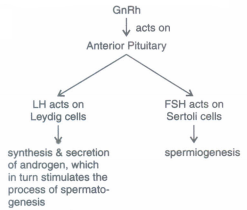
Explain the hormonal control of spermatogenesis in humans.
28.
(a) Name the causative agent of typhoid in humans.
(b) Name the test administered to confirm the disease.
(c) How does the pathogen gain entry into the human body?Write the diagnostic symptoms and mention the body organ that gets affected in severe cases.
29.
(a) Explain how to overcoe inbreeding depression in cattle.
(b) List three advantages of inbreeding in cattle.
(c) Name an improved breed of cattle.
30.
How are the structural genes activated in the lac operon in E.coli?
31.
Why are human females rarely haemophilic? Explain. How do haemophilic patients suffer?
32.
Give one word
(i) Supply of alternative resources to industries In the form of starches fuels & pharmaceuticals.
(ii) New strategy adopted to protect the tobacco Plant infestation by Meloidogyne incognitia.
(iii) Technique based on the principle of antigen antibody interaction
(iv) Uses of bioresources by multinational companies /other organization Without proper authorization from the concerned parties.
(v) Decision making organization regardingvalidity of G.M. resources & the safety of introducing G.M. crops
33.
Give an account of following diseases
(i) Ascariasis
(ii) Filariasis
(iii) Ringworms
34.
Name the three kinds of selection. Show the three kinds with the help of figure.
1.
(d)
Satellite DNA occurring as highly repeated short DNA segments
2.
(a)
granulosa cells
3.
(b)
Gill slits
4.
(c)
Initiation codon
5.
(d)
Separation of DNA fragments according to their size
6.
(a)
Nucellus or integuments
7.
(a)
Celluase,hemicellulase,pectinase
8.
(a)
Degeneracy of codons
9.
(c)
Vasectomy
10.
(c)
Haemozoin
11.
(b)
One gene codes for one polypeptide
12.
(c)
Selection and hybridization
13.
(b)
both wall and the sporogenous cells
14.
(b)
I, II and III
15.
(a)
Anaerobic condition
16.
(d)
Arabidopsis
17.
(b)
Germinating bud appears from the node of the rhizome
18.
(b)
The cell divides unequally. The smaller cell develops into a bud.
19.
Surrogacy is a practice in which a woman ( a surrogate mother ) bears a child for a couple unable to produce children; usually, because the wife is infertile or unable to carry a pregnancy to full term.
The surrogate mother is impregnated with the use of artificial insemination or through the implantation of the embryo produced by in vitro fertilization.
20.
Pangaea was a large, irregular land mass which later broke up into various continents. It existed around Carboniferous period (some 345 million yeas back) or a little earlier.
21.
Oral pills contain progrestins and estrogen which check ovulation; Combined pill, Mala D and Saheli.
22.
(i) Blending is the mixing of two colours,but in this example red and white colours are appearing independently at cellular level. Thus, no blending of characters occurs in this case. Also, red and white colours reappear in F2 - generation.
(ii) This phenomenon is known as incomplete dominance.
23.
(i) It is a non-steroidal preparation.
(ii) It is a 'once' a week' pill.
(iii) It has high contraceptive value.
(iv) It has fewer side effects than other oral contraceptives.
24.
Advantage
1. Since cleistogamous flowers are autogamous, there is an assured seed-set.
Disadvantage
1. Continued self-pollination leads to inbreeding depression.
25.
(a) A meiocyte is diploid cell, while a gamete is haploid.
(b) A whiptail lizard develops from the female gamete, without fertilisation; hence it is parthenognetic.
26.
(a) Parthenocarpy: The formation of fruit without the act of fertilization is called parthenocarpy and the fruits so developed are called as parthenocarpic fruits. These fruits are seedless. e.g., banana. While apomixis is a special type of sexual reproduction which does not involve meiosis and syngamy. In fact it is a form of asexual reproduction that mimics the sexual reproduction in which the seeds are produced without fertilization
(b) Apomictic seeds can be produced by any of the following methods.
(i) Apospory: It is the formation of diploid embryo sac directly from a cell of nucellus
(ii) Diplospory or generative apospory: It is the formation of diploid embryo sac from the megaspore mother cell without meiosis.
The diploid egg of the diploid embryo sac develops into embryo without syngamy i.e., parthenogenetically.
Apogamy : The synergids or antipodals of the diploid embryo sac may develop into embryo parthenogenetically.
27.
Spermatogenesis is under the control of endocrine hormones. In human male reproductive system, spermatogenesis starts at the age of puberty due to significant increase in the secretion of gonadotropin-releasing hormone by hypothalmus. The increased level of GnRH then acts on the anterior pituitary gland and stimulates secretion of the two gonadotropins : Luteinising hormone (LH) and follicle stimulating hormone (FSH). LH acts on leydig cells and stimulates synthesis and secretion of androgens, like testosterone which stimulates spermatogenesis. FSH acts on the sertoli cells and stimulates secretion of some factors which help in the process of spermiogenesis. Excess of testosterone inhibits the secretion of LHP and GnRH. A glycoprotein called inhibin supresses FSH synthesis. Thus normal release of testosteron is under negative feed back control.
28.
(a) Salmonella typhi.
(b) Widal test.
(c) The pathogen enters the human body through contaminated food and water.
Symptoms
Symptoms of typhoid include:
(i) sustained high fever (39-40 oC)
(ii) loss of appetite
(iii) stomach pain
(iv) headache and weakness
(v) intestinal perforation in severe cases may cause death.
Intestine gets affected in severe cases.
29.
a) Inbreeding depression can be overcome by outcrossing.
(b) (i) Inbreeding is necessary to evolve purelines in any animal, as it increases homozygosity.
(ii) Inbreeding exposes the harmful recessive alleles, which become eliminated by selection.
(iii) It helps in accumulation of superior genes and elimination of the less desirable ones.
(c)Hisardale, a breed of sheep.
30.
The lac operon consists of
(i) three structural genes (z,y and a) which code for \(\beta \) -galactosidase, permease and transacetylase, respectively.
(ii) an operator; which controls the structural genes as a unit.
(iii) a regulatory gene ti.e., inhibitor gene) and
(iv) a promoter, where the RNA polymerase binds for transcription.
The regulatory gene codes for the repressor protein, all the time (constitutively): the repressor binds to the operator to inactivate the operon.
Lactose enters the cell with the help of permease and the active form of lactose binds to the repressor and prevents it from binding to the operator.
This allows RNA polymerase an access to the promoter and transcription continues, i.e. lac operon is activated.
31.
1.The gene for haemophilia is present on the X chromosome, i.e. sex-linked.
2.The disorder is due to a recessive mutant allele; hence a female with XX sex chromosomes, must be homozygous to produce the disease.
3.She must receive one of the defective alleles from her haemophilic father and the other X-chromosome with the defective allele from her mother; who is also haemophilic or at least a carrier (heterozygous for the trait, XXh).
4.The cross is as follows.
32.
| i | Supply of alternative resources to industries in the form of starches fuels & pharmaceuticals | i | Tailor-made plants |
| ii | New strategy adopted to protect the tobacco plant infestation by Meloidogyne incognitia | ii | RNA interference |
| iii | Technique based on the principle of antigen antibody interaction | iii | ELISA |
| iv | Uses of bioresources by multinational companies /other organization whitout proper authorization from the concerned parties | iv | Biopiracy |
| v | Decision making organization regardingvalidity of G.M. resources & the safety of introducing G.M. crops | v | GEAC |
33.
(i) Ascariasis
Cause. It is caused by Ascaris lumbricoides.(round worm).
Symptoms.Its symptoms include:
(a) Blockage of intestinal passage,
(b)Anaemia,
(c)Abdominal/muscular pain,
(d)Internal bleeding,
(e)Nausea and headache.
Modes of transmission. Infection is through contaminated vegetables, fruits and water as eggs of parasite excreted by the infected persons contaminate soil, plants and water
(ii) Filariasis/Elephantiasis
Cause. It is caused by wuchereria bancrofti and wuchereria malayi(filarial worms)
They normally cause inflammation of the organs in which they live for many years.
They normally affect the lymph vessels of the lower limbs (causing them to swell like that of an elephant, hence called elephantiasis).
Genital organs may also be affected leading to gross deformation.
Modes of transmission. The female culex mosquito is the vector.
(iii)Ringworms
Cause. These are caused by fungi like microsporum, Epidermophyton and Trichophyton
Symptoms. The symptoms include
(i) dry scaly lesions on skins, nails and scalp.
(ii)lesions are accompanied by itching.
Modes of transmission. Ringworms are generally acquired from soil or by direct contact with the contaminated articles used by the infected persons.
34.
Kinds of selections:
1. Stabilising selection
2. Directional selection
3. Disruptive selection.

12th Standard CBSE Syllabus & Materials
12th Standard CBSE
CBSE 12th Computer Science Python Revision Tour I - New Previous year Question Papers Study Material - QB365 Set A
NEW12th Standard CBSE
CBSE 12th Business Studies Planning Important Questions And Answers Study Material - QB365 Set A
NEW12th Standard CBSE
CBSE 12th Business Studies Business Environment Important Questions And Answers Study Material - QB365 Set A
NEW12th Standard CBSE
CBSE 12th Business Studies Principles of Management Important Questions And Answers Study Material - QB365 Set A



NCERT Books

Syllabus

Exam Pattern

Sample Question Papers

Previous year Question Papers

Important Notes

MCQ Practice test

NCERT Exemplers

Case study Questions

Image Based Questions

Passage based Questions

HOT Questions

Value Based Questions

Model Questions Papers
NCERT ( Book Back ) Questions

Assertion and Reason
Important Questions And Answers

CBSE 12th Standard CBSE Subjects
CBSE Standards








