
 100% FREE ACCESS
12th Standard CBSE Syllabus & Materials
12th Standard CBSE
CBSE 12th Economics Government Budget and the Economy Previous year Question Papers Study Material - QB365 Set A
NEW12th Standard CBSE
CBSE 12th Computer Science Interface Python with MySQL - New Previous year Question Papers Study Material - QB365 Set A
NEW12th Standard CBSE
CBSE 12th Computer Science Database Concept - New Previous year Question Papers Study Material - QB365 Set A
NEW12th Standard CBSE
CBSE 12th Computer Science Data Communication - New Previous year Question Papers Study Material - QB365 Set A
NEW12th Standard CBSE
CBSE 12th Computer Science Data Structures - New Previous year Question Papers Study Material - QB365 Set A
NEW12th Standard CBSE
CBSE 12th Computer Science Functions - New Previous year Question Papers Study Material - QB365 Set A

Published on: 25/10/2025
Download CBSE Class 12th Standard CBSE Biology question papers, sample papers, important questions, and previous year solved papers in PDF format. Get free study materials, NCERT solutions, and exam preparation resources for Class 12th Standard CBSE Biology
Questions + Answers key
Take MCQ Biology Test
1.
Give below is a graph depicting organismic response to changing external conditions. According to their response the organisms are grouped into two types. Name the type which will show
(i) pattern A and
(ii) pattern B.
2.
Where would you expect more species biodiversity-in tropics or polar regions? Give reasons in support of your answer.
3.
What is competition? Why it is not true always? Explain competitive release and Gause's competitive exclusive principle. Write contribution of Mac Arthur.
4.
'Struggle for existence and survival of the fittest' is Darwin's theory of Natural selection. Interspecific competition, a potent force in organic evolution, is generally believed to occur between closely related species for the same resources, that are limiting, but this is not entirely true.
(a) Give an example where totally unrelated species could compete with each other.
(b) Resources need not be limiting for competition to occur. Justify with an example.
(c) What value is learnt from this?
5.
No species can exist alone in a habitat. Any species has a minimal requirement of at least one more species, on which it can feed. Interspecific interactions arise from the interaction of populations of two different species.
(a) What term is given to the interaction, where one species is benefitted and the other is neutral?
(b) Give four examples of the above kind of interaction.
(c) How do you call the interaction where one species is neutral and the other is harmed? Give an example of such an interaction.
(d) What value do you learn from this?
6.
Water is the most important factor influencing the life of organisms. Life on earth originated in water and cannot be sustained without water. Organisms living in water bodies (ocean, lake, river, etc.) also face water-related problems.
(a) How are aquatic animals affected by the quality of water? Explain.
(b) Mention any four adaptations the desert plants have, to live there successfully.
(c) Represent the value learnt.
7.
Organisms remain as individuals but interact as a group with other organisms and physical habitats and behave as population, community, ecosystem, etc.
(a) What according to you, are the factors that account for the formation of major biomes?
(b) Name any four major biomes of India.
(c) What value is learnt from this statement?
8.
Define the following terms and give one example for each.
(a) Commensalism
(b) Parasitism
(c) Camouflage
(d) Mutualism
(e) Interspecific competition.
9.
With the help of suitable diagram describe the logistic population growth curve.
10.
(a) Explain with the help of a graph, the population growth curve when resources are
(i) limiting and
(ii) not limiting.
(b) 'Nature has a carrying capacity for a species'. Explain.
1.
).png)
(i) A-conformers
(ii) B-Regulators
2.
1. The tropical latitudes has more biodiversity as compared to polar region.
2. The large tropical Amazonian rain forest in South America has the greatest biodiversity on earth.
Reasons 1. Tropical latitudes have remained undisturbed for million of years, thus lead a long evolutionary time for species biodiversity.
2. Tropical environments are less seasonal, relatively more constant and predictable. Such constant environments promote niche specialisation and leads to greater species diversity.
3. There is more solar energy available.
3.
(a) Competition is an interaction between organism for the life requirements(nutrition, shelter, sunlight, etc.). It is of two types: intraspecific and interspecific. Efforts of a tiger and a leopard for a prey is an interspecific competition. In general, it is believed that competition occurs among closely related species when they compete for the same resources that are limited.
(b) But it is found to be not true always for the following reasons:
(i) Completely unrelated species can also compete for the same sources. e.g., In certain shallow lakes of South America, the visiting flamingoes and the native fishes compete for the same zooplankton as their food.
(ii) Resources need not be limiting for competition to occur, the feeding efficiency of one species might be reduced due to the interfering and inhibitory presence of the other species, even if resources are plenty.
e.g., Abinddon tortoise in Galapagos island became extinct within a decade after goats were introduced into the island: this was due to the fact that the goats had greater browsing efficiency than the tortoise.
(c) Another evidence for competition is competitive release, a phenomenon in which a species whose distribution is restricted to a small geographical area due to the presence of a competitively superior species, expands its distributional range when the competing species is experimentally removed.
(d) Gause's competitive exclusion principle
states that two closely related species competing for the same resources cannot exist together as the competitively inferior one will be eliminated, but this is true only when the resources are limiting and not otherwise.
They have also pointed out that species facing competition might evolve mechanisms that promote co-existence, rather than exclusion.
(e) Mac Arthur had shown that five closely related species of warblers living on the same tree were able to avoid competition and co-exist to behavioural differences in their foraging activities.
4.
(a) In some shallow lakes of South America, the visiting flamingoes and the resident fishes compete for their common food, the zooplanktons in the lake
b) In interference competition.the feeding efficiency of one species is reduced by the interfering and inhibitory presence of the other species, even if the resources are abundant and not limiting e.q. the Abingdon tortoise in Galapagos island became extinct within a decade after goats were introduced into the island.
(c) Work hard and equip yourself to be successful in this competitive world.
5.
(a) Commensalism
(b) (i) Orchids grow as epiphytes on mango tree or other fruit trees.
Orchids are benefitted by getting a shelter, while the tree is neither benefitted nor damaged.
(ii) Barnacles growing on the whale are benefitted to move where food is available.
(iii) The cattle egrets always forage near to where the cattle animals graze; the cattle animals stir up the ground and the insects are flushed out from the vegetation and make it easy for the egrets to catch them.
(iv) The clown fish living among sea anemones get protection from their predators, which stay away from the stinging tentacles of the sea anemone:
(c) Amensalism
Roots of certain plants secrete chemicals, which are harmful to the soil organisms.
The antibiotics secreted by certain soil fungi are harmful to soil fungi bacteria. (anyone)
(d) Interactions should be beneficial to all concerned. Avoid selfish or selfcentered people.
6.
The chemical composition and pH of water are important to affect the animals.
Some animals can tolerate only a narrow range of salinity and are called stenohaline.
Some animals can tolerate a wide range of salinity and are called euryhaline.
Many freshwater fishes can not live for long in sea water and vice versa, because of the osmotic problems, they would face in such waters.
(b) (i) The leaves are reduced to spines.
(ii) The stem is green, flattened, spongy and takes over the function of photosynthesis .
(iii) A thick cuticle prevents loss of water.
(iv) They have a special photosynthetic mechanism (CAM), that enables their stomata to remain closed during day and open during night.
(c) Water is the most precious resource, use it judiciously and think of programs for its conservation.
7.
(a) The factors include
(i) The rotation of the earth around the sun and the tilt of its axis cause annual variation in the intensity and duration of temperature, which affects distinct reasons.
(ii) Annual variation in precipitation.
(b) (i) Scorching deserts of Rajasthan.
(ii) Rain-soaked Meghalaya forests
(iii) Deep ocean trenches.
(iv) Tropical rain forests
(v) High mountain tops. (any four)
(c) Interactions are necessary; they should be beneficial to all.
8.
(a) Commensalism:
It is the interspecific interaction, where one species is benefitted by the association while the other is neither benefitted nor harmed, e.g. Sucker fish attached to a shark.
(b) Parasitism:
It is the interspecific interaction, where one species (called parasite) takes food and shelter from another living species (host) and damages the host in due course of time; the parasite is benefitted and the host is harmed,e.g. Tapeworm in the intestine of man.
(c) Camouflage:
It is an adaptation, where the animal (organism blends with the surroundings to escape detection by the predator, e.g. Frogs have olive green skin with patches of chromatophores to camouflage with the grasses.
(d) Mutualism:
It is the interspecific interaction, where both the interacting species are mutually benefitted, e.g. An alga and a fungus in a lichen. Rhizobium and legume plant.
(e) Interspecific competition: It is an interspecific interaction, where organisms of two different species compete with each other for certain resources, e.g. Flamingoes and fishes competing for their common food, i.e. zooplanktons.
9.
The population can grow exponentially for a certain period of time and then assumes a steady state as the resource availability becomes limiting at some point of time.
Every environment has resources to support a particular maximum number of individuals, called its carrying capacity; beyond that there is no increase in the size/density of a population.
A population showing logistic growth shows a sigmoid curve, when the number of individuals is plotted as a function of time.
It is described by the equation,
dN/dt = \(rN\left( \frac { K-N }{ K } \right) \),
Where, N = Population density at time t.
r = Intrinsic rate of natural increase.
K = Carrying capacity.
This growth model is more realistic in nature because no population can sustain the exponential growth indefinitely.
10.
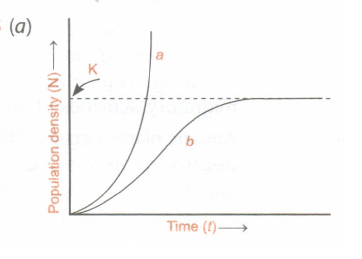
(I) When resources are limiting, the population growth curve is sigmoid and it is represented by the equation:
\(dN/dt=rN\left( \frac { K-N }{ K } \right) \), where
N = population density at time t
r = intrinsic rate of natural increase
K = carrying capacity
When resources are not limiting, the growth curve is J shaped and is represented by the equation: dN/dt = rN
\(N_{ t }={ N }_{ 0 }^{ e^{ rt } },where\)
\(N_{ t }\) =population density after time t
\(N_{ 0 }\)= population density at time zero
r = intrinsic rate of natural increase
e = the base .of natural logarithm (2.71828)

12th Standard CBSE Syllabus & Materials
12th Standard CBSE
CBSE 12th Computer Science Python Revision Tour I - New Previous year Question Papers Study Material - QB365 Set A
NEW12th Standard CBSE
CBSE 12th Business Studies Planning Important Questions And Answers Study Material - QB365 Set A
NEW12th Standard CBSE
CBSE 12th Business Studies Business Environment Important Questions And Answers Study Material - QB365 Set A
NEW12th Standard CBSE
CBSE 12th Business Studies Principles of Management Important Questions And Answers Study Material - QB365 Set A



NCERT Books

Syllabus

Exam Pattern

Sample Question Papers

Previous year Question Papers

Important Notes

MCQ Practice test

NCERT Exemplers

Case study Questions

Image Based Questions

Passage based Questions

HOT Questions

Value Based Questions

Model Questions Papers
NCERT ( Book Back ) Questions

Assertion and Reason
Important Questions And Answers

CBSE 12th Standard CBSE Subjects
CBSE Standards








