
 100% FREE ACCESS
12th Standard CBSE Syllabus & Materials
12th Standard CBSE
CBSE 12th Economics Government Budget and the Economy Previous year Question Papers Study Material - QB365 Set A
NEW12th Standard CBSE
CBSE 12th Computer Science Interface Python with MySQL - New Previous year Question Papers Study Material - QB365 Set A
NEW12th Standard CBSE
CBSE 12th Computer Science Database Concept - New Previous year Question Papers Study Material - QB365 Set A
NEW12th Standard CBSE
CBSE 12th Computer Science Data Communication - New Previous year Question Papers Study Material - QB365 Set A
NEW12th Standard CBSE
CBSE 12th Computer Science Data Structures - New Previous year Question Papers Study Material - QB365 Set A
NEW12th Standard CBSE
CBSE 12th Computer Science Functions - New Previous year Question Papers Study Material - QB365 Set A

Published on: 25/10/2025
Download CBSE Class 12th Standard CBSE Biology question papers, sample papers, important questions, and previous year solved papers in PDF format. Get free study materials, NCERT solutions, and exam preparation resources for Class 12th Standard CBSE Biology
Questions + Answers key
Take MCQ Biology Test
1.
Women are often blamed for producing female children. Consequently, they are ill treated and ostracized. How will you address this isssue scientifically if you were to conduct an awareness programme to highlight the values involved?
2.
Modern life style in big cities and towns is surely making the life more easy and comfortable for people. On the contrary many more health issues and problems are on the rise and one of them is allergic reactions.
(a) Write any four steps you would suggest to minimise the cause of the above allergic responses.
(b) List any two allergens. How does the human body respond to them? Explain
3.
(a) How does a chromosomal disorder differ from a Mendelian disorder?
(b) Name any two chromosomal aberration-associated disorders.
(c) List the characteristics of the disorders mentioned above that helps in their diagnosis.
4.
(a) Why is haemophilia generally observed in human males? Explain the conditions under which a human female can be haemophilic.
(b) A pregnant human female was advised to undergo MTP. It was diagnosed by her doctor that the foetus she is carrying has developed from a zygote formed by an XX-egg fertilised by Y-carrying sperm. Why was she advised to undergo MTP?
5.
What is the inheritance pattern observed in the size of starch grains and seed shape of pisum sativum? Work out the monohybrid cross showing the above traits. How does this pattern of inheritance deviate from that of Mendelian law of dominance.
6.
Why is thalassemia categorised as a Mendelian disorder? Write the symptoms and explain the cause of the disease. How does it differ from the sickle-cell anaemia?
7.
(a) Explain the mechanism of sex determination in humans.
(b) Differentiate between male heterogamety and female heterogamety with the help of an example of each.
8.
(a) Draw a diagram of a mature embryo sac of an angiosperm and label the following parts in it:
(i) Filiform apparatus
(ii) Synergids
(iii) Central cell
(iv) Egg cell
(v) Polar nuclei
(vi) Antipodals
(b) Write the fate of egg cell and polar nuclei after fertilisation.
9.
(a) Draw a labelled schematic diagram of the transverse section mature anther of an angiospermic plant.
(b) Describe the characteristic features of an insect-pollinated flower.
10.
(a) Describe the process of syngamy and triple fusion in angiosperms.
(b) Explain the development of a fertilised egg upto a mature embryo in a dicot plant. draw a labelled diagram of a mature dicot embryo,
11.
Describe in sequence the events that lead to the development of a 3-celled pollen grain from a microspore mother cell in angiosperms.
1.
1.Male produces two types of sperm (X & Y type in the ratio 1,: 1), Female produces only one type of ovum (X type), hence the sex of baby is determined by the type of sperm fertilizing the ovum. Therefore women should not be blamed
2. A genetic doss showing sex determination in human beings covering above value points can be considered in lieu of the explanation.
3.Sensitivity" towards community" / Social awareness / Self discipline /Responsible behaviour / Leadership quality! Caring attitude I Responsible attitude towards society / Concern for others / Sharing of kf\pwledge or information I Presence of mind / Being'proactive I any other relevant value.
2.
(a)Reduce air pollution, improve exposure/sensitivity of the children to the environment to reduce vulnerability, improve resistance,improve food habits, resulting in good health, introduce physical exercise (any other appropriate measure).
(b)Mites in dust pollen, animal dander. (any two) Immune system respond by producing antibodies of lgE type, inducing Mast cells release cl}emic<vs like histamine/serotonin ln response to allergens.
3.
| Mendelian disorders | Chromosomal disorders |
| These disorders are caused by mutation in a single gene. | They are caused by alteration in chromosome number or structure. |
| Muration at random place, time create allelic abnormalities. | Chromosomal abnormalities develop due to defective synapsis and non-disjunction phenomenon. |
| The Mendelian disorders follow Mendel's inheritance pattern and get transmitted to the progeny. |
These disorders are rarely transmitted. |
(b) Sickle-cell anaemia and Haemophilia.
(c) Sickle-cell anaemia
The RBCs become elongated and sickle-shaped, as the mutant haemoglobin undergoes polymerisation under low oxygen tension.
Haemophilia
One of the proteins involved in the clotting of blood is affected; blood clotting is much delayed and there is non-stop bleeding from even a small cut.
4.
(a) The genes for haemophilia and colour blindness are present on the X-chromosome.
a.A male has only one X-chromosome and bears only one allele for the trait i.e. he is hemizygous for the trait, as V-chromosome does not have a corresponding allele.
b. A female has two X-chromosomes, received one from each of her parents; she has to be homozygous recessive, i.e. her father must be a sufferer and mother either a sufferer or a carrier, to develop the disease.
(b) The zygote will be XXV and develop into a male with Klinefelter's syndrome.
1. Such individuals are sterile.
2. They show gynaecomastia and feminine characters.
3.To avoid such a hereditary disorder, the woman was advised MTP.
5.
(i) Seed shape shows complete dominance. Heterozygotes produce the round seeds.
(ii) Size of starch grains shows incomplete dominance. Heterozygotesproduce intermediate sized starch grains in seeds.
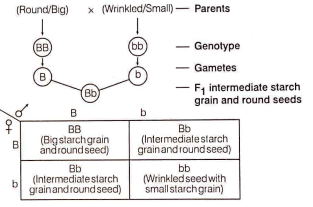
Size of starch grain is an example of incomplete dominance, whereas in Mendelian inheritance, seed shape shows complete dominance.
6.
Thalassemia is categorised as a Mendelian disorder, because it. is an autosomal, recessively-inherited disorder, whose transmission follows Mendel's laws/ principles of inheritance.
(i) The disease is caused by mutation or deletion of the alleles and there is reduced synthesis of alpha or beta globin chain of hemoglobin.
(ii) The symptom is anemia, which is due to less synthesis of hemoglobin.
| Thalassemia | Sickle-cell anemia |
| It is quantitative problem, where less amount of hemoglobin is synthesised | It is a qualitive problem,where defective hemoglobin (that is non-functional ) is synthesized. |
7.
(a)A female (mother) is homogametic and produces ova, all containing one X-chromosome and 22 autosomes.
A male (father) is heterogametic and produces sperms of two types-50% of them carrying one X-chromosome and the other 50% carrying V-chromosome and 22 autosomes each.
The sex of the child is determined by, the type of sperm fertilising the ovum.
If the ovum is fertilized by a sperm carrying X-chromosome, female child results
If the ovum is fertilised by a sperm carrying V-chromosome, a male child is formed.
.png)
(b)
| Male hetrogamety | Female hetrogamety |
| It is the phenomenon in which the male produces two types of sperms, with reference to the sex-chromosomes. | It is the phenomenon in which the female produces two types of oval,with reference to the sex-chromosomes. |
| The sex of the offspring is determined by the type of sperm fertilising the ovum. | The sex of the offspring is determined by the type of ovum that is fertilised. |
8.
(b) (i) The egg cell on fertilisation becomes the zygote, which later forms the embryo
(ii) The polar nuclei fuse to form a diploid secondary nucleus; on fertilisation by a male gamete, it forms the primary endosperm nucleus, which later forms the endosperm.
9.
(i) Insect-pollinated flowers are large, colourful and showy; if flowers are small, they are clustered into inflorescene to make them conspicuous.
(ii) The pollen grains and stigmatic surface are sticky.
(iii) They are highly fragrant; flowers pollinated by flies and beetle have foul odours to attract them.
(iv) To sustain animal visits, the flowers offer certain rewards like nectar, edible pollen and safe place for laying eggs.
10.
(a) Syngamy
Syngamy refers to the fusion of a male gamete with the female gamete in the embryo sac to form a diploid zygote.
Triple fusion
Triple fusion refers to the fusion of a male gamete with the secondary nucleus (formed by fusion of two haploid polar nuclei) to form the triploid primary endosperm nucleus.
(b) Embryo development
Th'e zygote undergoes mitotic divisions during embryogeny.
The first division is transverse and results in a basal cell and a terminal cell; the basal cell forms the suspensor while the terminal cell forms the embryo proper.
It first, forms a filamentous proembryo, which later forms in sequence a globular embryo, heart-shaped embryo and then a mature embryo.
11.
(a) Development of Pollen grain:
- Microsporocytes undergo mitotic divisions to increase the number of functional microspore mother cells.
- Each microspore mother cell undergoes meiosis to form a microspore tetrad.
- All the four microspores remain enclosed in a common wall.
- They start separating from each other.
- The nucleus undergoes a mitotic division resulting in the formation of a large vegetative cell and a small generative cell.
- The spore develops a wall of two layers the outer- exine and inner intine.
- At this stage, the pollen grains are liberated; but in some cereals the generative cell undergoes mitosis and the pollen grain is 3-celled, at the time of liberation.
(b) Mature Pollen Grain:
- A mature pollen grain has a protective covering of two layers.
- The outer is thick, sculptured variously and is made of sporopollenin; this layer is called exine.
- The inner layer, called intine is thin and is made of cellulose.
- A mature pollen grain is two celled with a large vegetative cell and a small generative cell floating in the cytoplasm of the vegetative cell.
- The pollen grains of dicot plants have three germ pores while those of monocots have one.

12th Standard CBSE Syllabus & Materials
12th Standard CBSE
CBSE 12th Computer Science Python Revision Tour I - New Previous year Question Papers Study Material - QB365 Set A
NEW12th Standard CBSE
CBSE 12th Business Studies Planning Important Questions And Answers Study Material - QB365 Set A
NEW12th Standard CBSE
CBSE 12th Business Studies Business Environment Important Questions And Answers Study Material - QB365 Set A
NEW12th Standard CBSE
CBSE 12th Business Studies Principles of Management Important Questions And Answers Study Material - QB365 Set A



NCERT Books

Syllabus

Exam Pattern

Sample Question Papers

Previous year Question Papers

Important Notes

MCQ Practice test

NCERT Exemplers

Case study Questions

Image Based Questions

Passage based Questions

HOT Questions

Value Based Questions

Model Questions Papers
NCERT ( Book Back ) Questions

Assertion and Reason
Important Questions And Answers

CBSE 12th Standard CBSE Subjects
CBSE Standards








