
 100% FREE ACCESS
12th Standard CBSE Syllabus & Materials
12th Standard CBSE
CBSE 12th Economics Government Budget and the Economy Previous year Question Papers Study Material - QB365 Set A
NEW12th Standard CBSE
CBSE 12th Computer Science Interface Python with MySQL - New Previous year Question Papers Study Material - QB365 Set A
NEW12th Standard CBSE
CBSE 12th Computer Science Database Concept - New Previous year Question Papers Study Material - QB365 Set A
NEW12th Standard CBSE
CBSE 12th Computer Science Data Communication - New Previous year Question Papers Study Material - QB365 Set A
NEW12th Standard CBSE
CBSE 12th Computer Science Data Structures - New Previous year Question Papers Study Material - QB365 Set A
NEW12th Standard CBSE
CBSE 12th Computer Science Functions - New Previous year Question Papers Study Material - QB365 Set A

Published on: 17/10/2025
Download CBSE Class 12th Standard CBSE Biology question papers, sample papers, important questions, and previous year solved papers in PDF format. Get free study materials, NCERT solutions, and exam preparation resources for Class 12th Standard CBSE Biology
Questions + Answers key
Take MCQ Biology Test
1.
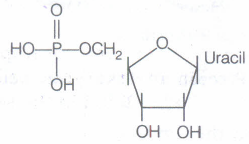
. Identify the structure given below
2.
Haemophilia is a sex-linked inheritance conditions in humans where a simple cut causes non-stop bleeding. Study the pedigree chart showing the inheritance of haemophilia in a family.
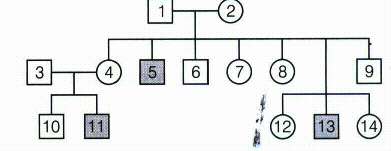
Give reasons, which explain that haemophilia is (i) sex-linked, (ii) caused by X-linked gene.
3.
Categories the following pairs of examples as convergent or divergent evolutions:
(a) Eyes of Octopus and mammals.
(b) Wings of butterfly and birds.
(c) Tuber of sweet potatoes and potato.
(d) Thorns in Bougainvillea and tendrils in Cucurbits.
4.
State the dual role of deoxyribonucleoside triphosphates during DNA replication
5.
In a cross between two tall pea plants, some of the offspring produced were dwarf. Show with the help of a Punnet square, how this is possible.
6.
Given below is a schematic representation of a lac operon.
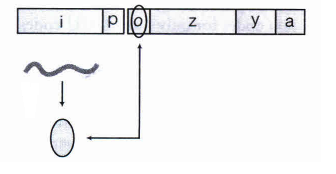
(i) Identify i and p.
(ii) Name the inducer for this operon and explain its function.
7.
Given below is a diagrammatic representation of the experimental set-up used by S.L. Miller for his experiment:
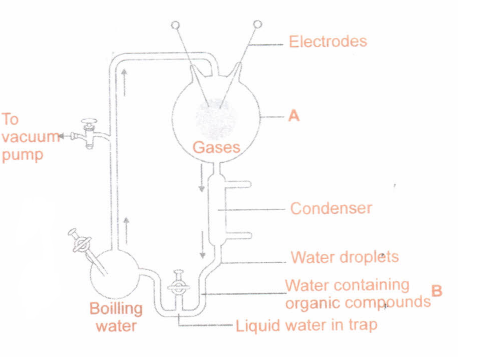
(a) Write the names of different gases contained and the conditions set for the reaction in the flask 'A'.
(b) State the type of organic molecule he collected in the water at 'B'.
(c) Write the conclusion he arrived at.
8.
Australian marsupials and placental mammals are suitable examples of adaptive radiation and convergent evolution. Explain giving reasons.
9.
What is DNA fingerprinting? Mention its application.
10.
Explain the role of 35S and 32P in the experiments conducted by Hershey and Chase.
11.
(i) Why are grasshopper and Drosophila said to show male heterogamety? Explain.
(ii) Explain female heterogamety with the help of an example.
12.
Name the phenomemon that leads to situations lie 'XO' abnormality in humans. How do humans with 'XO' abnormality suffer? Explain.
13.
Listed below are some amino acids and their corresponding mRNA codons.
| Amino acid | mRNA codons |
| Phenylalanine | UUU |
| Lysine | AAG |
| Arginine | CGA |
| Alanine | GCA |
Select the DNA sequence that would code for the following polypeptide sequence. Polypeptide : Alanine - Arginine - Lysine - Phenylalanine
CGT GCT TTC AAA
CGT GCT TTC TTT
CGU GCU UUC AAA
CGU GCU UUC TTT
14.
Darwin's finches show one of the following aspects of evolution
Biogeographic evidence
Industrial melanism
Biochemical evidence
Embryological evidance
15.
A typical nucleosome contains
100bp of DNA helix
200bp of DNA helix
300bp of DNA helix
400bp of DNA helix
16.
Evolutionary history of an organism is known as
ontogeny
phylogeny
ancestry
paleontology
17.
A baby has been born with a small tail.It is a case exhibiting
retrogressive evolution
mutation
atavism
mamorphosis
18.
F2 generation in a Mendelian cross showed that both genotypic and phenotypic ratios are same as 1 : 2 : 1. It represents a case of :
Co-dominance
Dihybrid cross
Monohybrid cross with complete dominance
Monohybrid cross with incomplete dominance.
19.
Study the pedigree chart of a certain family given below and select the correct conclusion which can be drawn for the character.
the female parent is heterozygous
the parents could not have had a normal daughter of this character
the trait under study can not be color blindness.
the male parent is homozygous dominant.
20.
During transcription, RNA polymerase holoenzyme binds to a gene promoter and assumes a saddle-like structure. What is its DNA-binding sequence?
AATT
CACC
TATA
TTAA
21.
Gynaecomastia is the symptom of
Klinefelter's syndrome
Turner's syndrome
SARS
Down syndrome
22.
Balance theory of sex determination was proposed by
Waldeyar
T.H. Morgan
Strassburger
Calvin B. Bridges
23.
Nucleoside is
Nitrogenous base + Sugar
Nitrogenous base + sugar + phospate
Sugar + phosphate
Nitrogenous base + phosphate
24.
The recessive genes located on X-chromosome in humans are always
sub-lethal
expressed in males
expressed in females
lethal
25.
(a) Write Hardy-Weinberg principle.
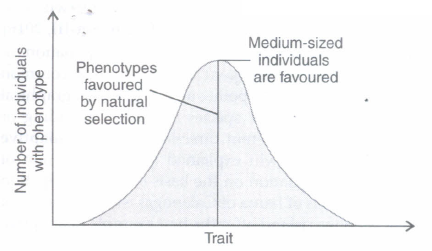
(b) Explain the three different ways the natural selection can affect the frequency of a heritable trait in a population shown in the graph given below.
26.
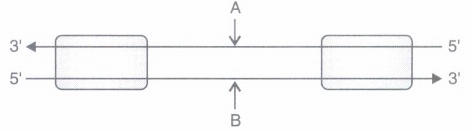
(a) Identify strands 'A' and 'B' in the diagram of transcription unit given above and write the basis on which you identified them.
(b) State the functions of Sigma factor and Rho factor in the transcription process in a bacterium.
(c) Write the functions of RNA polymerase-I and RNA polymerase-Ill in eukaryotes
(OR)
Describe the packaging of DNA helix in a prokaryotic cell and an eukaryotic nucleus.
27.
Sonu was very fond of gardening. He used to bring seeds of the flowers he liked from different places. Many times, he observed that all plants obtained from seeds were not similar. He discussed the observations with his biology teacher who explained that this is due to phenomenon of crossing over.
(i) What is crossing over?
(ii) What is the significance of cross over?
(iii) How can crossing over be used for commercial purposes?
(iv) What value is displayed by teacher?
28.
Turner’s syndrome is an example of mono somy. It is formed by the union of an allosome free egg and a normal ‘X’ containing sperm or a normal egg and an allosome free sperm. The individual has 2n = 45 chromosomes (44 + X0) instead of 46. Such individuals are sterile females who have rudimentary ovaries, under developed breasts, small uterus, short stature, webbed neck and abnormal intelligence. They may not menstruate or ovulate. This disorder can be treated by giving female sex hormone to the women from the age of puberty to make them develop breasts and have menstruation. This makes them feel more normal.
1.What is Turner’s syndrome an example of?
A) Trisomy
B) Monosomy
C) Polysomy
D) Karyotype alteration
2.How many chromosomes are typically present in an individual with Turner’s syndrome?
A) 44
B) 46
C) 45
D) 47
3.What is the chromosomal configuration in Turner’s syndrome?
A) 44 + XX
B) 44 + XY
C) 44 + X0
D) 44 + XXY
4.Which of the following is a characteristic of Turner’s syndrome?
A) Overdeveloped Breasts
B) Tall Stature
C) Normal Ovaries
D) Webbed Neck
5.What is the primary treatment approach for women with Turner’s syndrome from the age of puberty?
A) Giving Male Sex Hormone
B) Administering Insulin
C) Providing Female Sex Hormone
D) Performing Surgery
6.Individuals with Turner’s syndrome often experience which of the following reproductive issues?
A) Overactive Ovaries
B) Frequent Ovulation
C) Sterility and Rudimentary Ovaries
D) Multiple Pregnancies
29.
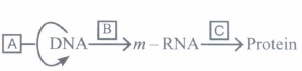
The Central dogma of molecular biology is shown above.
(a) Who proposed this?
(b) Identify the processes A, Band C in the above representation.
(c) Why is it not applicable to certain viruses?
30.
Assertion (A) : Hugo de Vries said mutations cause speciation
Reason (R) : Mutations are slow directional changes
(a) lf both A and R are true and R is the correct explanation of A
(b) If both A and R are true, but R is not the correct explanation of A
(c) If A is true, but R is false
(d) If A is false, but R is true
31.
Assertion : Complementary genes are non-allelic genes.
Reason : Complementary genes interact to produce a completely new trait.
Codes :
(a) Both assertion and reason are true and reason is the correct explanation of assertion.
(b) Both assertion and reason are true but reason is not the correct explanation of assertion.
(c) Assertion is true but reason is false.
(d) Both assertion and reason are false.
32.
Assertion : Hybrids are generally back crossed.
Reason : Back cross is done to increase the traits of the parent.
Codes :
(a) Both assertion and reason are true and reason is the correct explanation of assertion.
(b) Both assertion and reason are true but reason is not the correct explanation of assertion.
(c) Assertion is true but reason is false.
(d) Both assertion and reason are false
33.
Assertion: tRNA acts as an adapter molecule.
Reason: tRNA recognizes codon sequence of mRNA during translation.
Codes :
(a) Both assertion and reason are true and reason is the correct explanation of assertion.
(b) Both assertion and reason are true but reason is not the correct explanation of assertion.
(c) Assertion is true but reason is false.
(d) Both assertion and reason are false
1.
The given structure represents a nucleotide callel uridylic acid.
2.
(i) Haemophilia is sex-linked because:
(a) It is transmitted from an unaffected carrier female to some of the some of the male offsprings.
(b) Female rarely becomes haemophilic as her mother has to be atleast a carrier father should be heamophilic.
(ii)Gene for haemophilia is present on X-chromosome because the heterozygous female for heamophilia may transmit the disease to sons.
3.
(a) Convergent evolution.
(b) Divergent evolution.
(c) Convergent evolution.
(d) Divergent evolution.
4.
(i) The deoxyribonucleoside triphosphates are the building blocks for the DNA-strand(polynucleotide chain), as substrate.
(ii) These also serve as energy source in the form of ATP and GTP from there two terminal phosphates.
5.
Since dwarfness (recessive trait) has appeared in the progeny, the tall pea plant must be heterozygous for tallness, i.e. its genotype is Tt
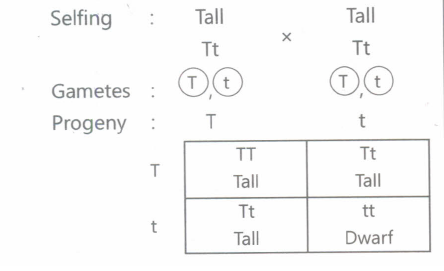
The phenotypic ratio is 3 Tall : 1 dwarf.
Since tallness is dominant over dwarfness, the homozygotes (TT) as well as the heterozygotes (Tt) are tall.
The recessive trait is expressed only under homozygous condition (tt) and hence appears only in one-fourth of the progeny.
6.
(i) i-Regulatory gene, p - Promotor gene.
(ii) Inducer is lactose.
Functions
(a) Enters the cell and binds to the repressor and inactivates it.
(b) As a result, repressor cannot bind to the operator .This allows RNA polymerase to have access to the promotor and transactions proceeds.
7.
(a) The gases are methane, ammonia, hydrogen and water vapour.
An electric discharge is created using electrodes. The temperature was kept at \(800^{ \circ }C\)
(b) Amino acids.
(c) It was concluded that life could have come from pre-existing nonliving organic molecules, and their formation was preceded by chemical evolution.
8.
Adaptive radiation is the evolutionary process in which a common ancestor evolves into a number of species, in a given geographical area, starting from a point and literally radiating to other areas of geography.
A number of Australian marsupials, each different from the other, evolved from an ancestral stock, all within the Australian island continent.
When more than one adaptive radiation appeared to have occurred in an isolated geographical area, representing different habitats, it can be called convergent evolution.
Placental mammals of Australia also exhibit adaptive radiation in evolving into varieties of such placental mammals, each of which appears to be 'similar' to a corresponding marsupial, e.g. Bob cat resembles Tasmanian tiger cat.
Lemur - Spotted cuscus.
Anteater - Numbat.
9.
DNA-fingerprinting
It is a method of comparing the DNA sequences of any two individuals, by identifying the differences in some specific regions of DNA.
DNA fingerprinting is used for the following:
(i) To identify criminals in the forensic laboratory.
(ii) To determine the real or biological parent in case of disputes.
(iii) To verify whether an immigrant is really a close relative of the mentioned resident.
(iv) To identify racial groups to rewrite the biological evolution.
10.
1. The viruses/bacteriophages grown on radioactive sulphur \(\left( ^{ 35 }{ S } \right) \) contained radioactive protein but not radioactive DNA, because DNA does not contain sulphur.
2.When these viruses were allowed to infect bacteria, the bacteria did not contain radioactivity, because proteins did not enter the bacteria; hence protein is not the genetic material.
3. The viruses grown on radioactive phosphorus \(\left( ^{ 32 }{ P } \right) \) contained radioactive DNA, becauseDNA contains phosphorus and not proteins.
4. When these viruses were allowed to infect the bacteria, the bacteria were radioactive, indicating that DNA is the genetic material that has passed from the virus into bacteria.
11.
(a) Male heterogamety
A male grasshopper produces two types of gametes with reference to sex chromosomes, i.e. 50% of them with one X-chromosome and 50% of them with no X-chromosome.
A male Drosophila produces 50% of gametes with one X-chromosome and 50% of them with one V-chromosome.
Since they produce two types of gametes with reference to sex chromosomes, they are said to show male heterogamety.
b)Female heterogamety
It is the phenomenon in which females of a species produce two types of gametes with reference to sex-chromosomes.
It is seen in fowls, where a female has ZW sex chromosomes and produces 50% of ova with one Z-chromosomes and 50% of them with one W-chromosome.
The sex of the offspring is determined by the type of ovum fertilised.
12.
Non-disjunction is responsible for chromosomal abnormalities.
Non-disjunction is the phenomenon of failure of segregation of the members of homologous pairs of chromosomes.
XO-abnormality results from fertilisation of an ovum with X-chromosome by a sperm carrying no sex-chromosome.
The individual has underdeveloped feminine characters.
Ovaries are rudimentary.
She is sterile.
13.
(a)
CGT GCT TTC AAA
14.
(a)
Biogeographic evidence
15.
(b)
200bp of DNA helix
16.
(b)
phylogeny
17.
(c)
atavism
18.
(d)
Monohybrid cross with incomplete dominance.
19.
(a)
the female parent is heterozygous
20.
(c)
TATA
21.
(a)
Klinefelter's syndrome
22.
(d)
Calvin B. Bridges
23.
(b)
Nitrogenous base + sugar + phospate
24.
(c)
expressed in females
25.
(a) Hardy-Weinberg's principle says that allele frequencies in a population are stable and constant
from generation to generation. The gene pool remains constant. This is called genetic equilibrium.
Sum total of all the allelic frequencies is 1. Individual frequencies, e.g., can be named p, q, etc.
Natural selection disturbs the allelic frequencies. Through natural selection either the frequency of
p increases or the frequency of q it will disturb the natural frequency. In a diploid, p and q represent the frequency of allele A and allele a. The frequency of AA individuals in a population is simply p2. This is simply stated in another ways , i.e., the probability that an allele A with a frequency of p appear on both the chromosomes of a diploid individual is the product of the probabilities.
Hence, p2 + 2pq + p2 = 1
The factors that affect the Hardy-weinberg's equilibrium are :
(i) Migration
(ii) Gene flow
(ill) Genetic drift
(iv) Mutation
(v) Genetic recombination
(b) Variation due to mutation or recombination during gametogenesis or due to gene flow or genetic drift results in changed frequency of genes and alleles in future generation. Natural selection can lead to stabilization (in which more individuals acquire mean character value), directional change (more individuals acquire value other than the mean character value) or disruption (more individuals acquire peripheral character value at both ends of the distribution curve).
26.
(a) A-Template strand = 1
B-Coding strand =1
Template strand has polarity 3'-5'
Coding strand has polarity 5'-3'
On the basis of polarity with respect to promoter
(b) In initiation sigma factor associates with RNA polymerase to initiate transcription, Rho factor gets associated to RNA polymerase to terminate transcription.
(e) RNA polymerase I -Transcribes -RNAs
RNA polymerase III-Transcribes tRNA / 5srRNA/5nRNA
(OR)
Prokaryotes : Negatively charged DNA, is held with positively charged proteins, in nucleoid, DNA in nucleoid is organised in large loops held by protein.
Eukaryotes : In nucleus the negatively charged DNA, is wrapped around positively charged histone octomer, to formnucleosome, nucleosomes are repeated, to constitute chromatin, at higher level additional set of non-histone chromosomal protein gets associated with chromatin.
27.
(i) It is a phenomenon of mutual exchange of the corresponding segments of the adjacent paternal and maternal chromatids.
(ii) It leads to the formation of recombinants.It is a major source of variations in sexual reproducing organisms which is responsible for evolution.
(iii) Crossing over offers a veriety of traits and some of these may be desirable and can be selected for commercial propagation.
(iv) Teacher enhanced the scientific knowledge of Sonu so that he maintains his interest in science.
28.
1.B) Monosomy
2.C) 45
3.C) 44 + X0
4.D) Webbed Neck
5.C) Providing Female Sex Hormone
6.C) Sterility and Rudimentary Ovaries
29.
(a) Francis Crick proposed this.
(b) A - Replication (of D A)
B - Transcription
C - Translation
(c) In some viruses (retroviruses), the flow of information is in reverse direction, i.e., from RNA to DNA catalysed by enzyme, reverse transcriptase; hence, it is not applicable to these viruses.
30.
(c) If A is true, but R is false
31.
(b) : Complementary genes are those non-allelic genes which independently show a similar effect but produces a new trait when present together in the dominant form. W. Bateson and R.C. Pun nett observed that, when two white flowered varieties of sweet pea, Lathyrus odoratus were crossed, F1 progeny had coloured flowers. When F2 progeny obtained from F1 was classified, plants with coloured flowers and those with white flowers were obtained in 9 : 7 ratio. The two dominants are brought together in F1 generation and therefore coloured flowers are produced.
32.
(a) : Back cross is a cross which is performed between hybrid and one of its parents. In plant breeding, back cross is performed a few times in order to increase the traits of that parent. For example, a crop plant is crossed with a wild variety in order to obtain its disease resistance. In the process, most good traits of the crop plant get diluted. The hybrid is, therefore, repeatedly crossed with parent crop plant in order to transfer the good traits back into it.
33.
(b): t-RNA is an adaptor molecule because it adapts amino acid to bring it to protein synthesis site in activated form and not because it recognises the codon on mRNA.

12th Standard CBSE Syllabus & Materials
12th Standard CBSE
CBSE 12th Computer Science Python Revision Tour I - New Previous year Question Papers Study Material - QB365 Set A
NEW12th Standard CBSE
CBSE 12th Business Studies Planning Important Questions And Answers Study Material - QB365 Set A
NEW12th Standard CBSE
CBSE 12th Business Studies Business Environment Important Questions And Answers Study Material - QB365 Set A
NEW12th Standard CBSE
CBSE 12th Business Studies Principles of Management Important Questions And Answers Study Material - QB365 Set A



NCERT Books

Syllabus

Exam Pattern

Sample Question Papers

Previous year Question Papers

Important Notes

MCQ Practice test

NCERT Exemplers

Case study Questions

Image Based Questions

Passage based Questions

HOT Questions

Value Based Questions

Model Questions Papers
NCERT ( Book Back ) Questions

Assertion and Reason
Important Questions And Answers

CBSE 12th Standard CBSE Subjects
CBSE Standards








