
 100% FREE ACCESS
12th Standard CBSE Syllabus & Materials
12th Standard CBSE
CBSE 12th Economics Government Budget and the Economy Previous year Question Papers Study Material - QB365 Set A
NEW12th Standard CBSE
CBSE 12th Computer Science Interface Python with MySQL - New Previous year Question Papers Study Material - QB365 Set A
NEW12th Standard CBSE
CBSE 12th Computer Science Database Concept - New Previous year Question Papers Study Material - QB365 Set A
NEW12th Standard CBSE
CBSE 12th Computer Science Data Communication - New Previous year Question Papers Study Material - QB365 Set A
NEW12th Standard CBSE
CBSE 12th Computer Science Data Structures - New Previous year Question Papers Study Material - QB365 Set A
NEW12th Standard CBSE
CBSE 12th Computer Science Functions - New Previous year Question Papers Study Material - QB365 Set A

Published on: 25/10/2025
Download CBSE Class 12th Standard CBSE Biology question papers, sample papers, important questions, and previous year solved papers in PDF format. Get free study materials, NCERT solutions, and exam preparation resources for Class 12th Standard CBSE Biology
Questions + Answers key
Take MCQ Biology Test
1.
Draw a neat labelled sketch of a replicating fork of DNA.
2.
What are two functions of DNA polymerase?
3.
Pick out the untranslated regions from the following mRNA and mention their location.
5' - ACGUCAUGGCGUUUUAGGAGGAA -3'
4.
Differentiate between Reprtitive DNA and Satellite DNA
5.
Explain the dual function of AUG codon.Give the sequence of basis it is transcribed from and its anticodon.
6.
Name any two copper releasing intrauterine Devices(IUDs). List two reasons that make them effective contraceptives.
7.
Name and explain a surgical contraceptive method that can be adopted by the male partner of a couple.
8.
(a) What does gamete intra fallopian transfer(GIFT) represent? (Define in brief).
(b) How do CU-T and CU-7 act as contraceptive devices?
9.
What is meant by R-cells and S-cells with which Fredrick Griffith carried out his experiments on Diplococus pneumoniae? What did he prove from these experiments?
10.
(a)Why is tRNA called an 'adopter'?
(b)Draw and label a secondary strucuture of tRNA.How does the actual structure of tRNA look like?
11.
(a)Who proposed the concept of lac operon?
(b)Draw a labelled schematic representation of a lac operon.
(c)Explain how this operon gets switched 'on' and 'off'
12.
How did Meselson and Stahl experimentally prove that DNA replication is semiconservative? Explain.
13.
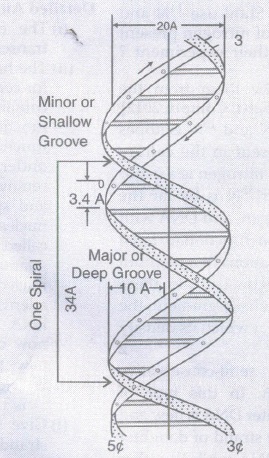
Enlist the salient features o the double helix strucutre of DNA.
14.
The method of directly injecting a sperm into ovum in assisted reproductive, technology is called
GIFT
ZIFT
ICSI
ET
15.
The amino acid attaches to the tRNA at its:
5' - end
3' - end
Anti codon site
DHU loop
16.
Removal of introns and joining the exons in a defined order in a transcription unit is called
Tailing
Transformation
Capping
Splicing
17.
During the replication of DNA, the synthesis of DNA as lagging strand takes place in segments, these segments are called
Double helix segments
Satellite segments
Kornberg segments
Okazaki segments
18.
The permissible use of the technique amniocentesis is for
detecting any genetic abnormally
detecting sex of the unborn foetus
artificial insemination
transfer of embryo into the uterus of a surrogate mother
19.
The correct surgical procedure as a contraceptive method is:
Ovariectomy
Hysterectomy
Vasectomy
Castration
20.
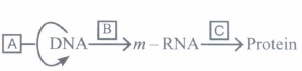
The Central dogma of molecular biology is shown above.
(a) Who proposed this?
(b) Identify the processes A, Band C in the above representation.
(c) Why is it not applicable to certain viruses?
21.
Assertion: UAA, UAG and UGA terminate protein synthesis.
Reason: They are not recognised by tRNA.
Codes :
(a) Both assertion and reason are true and reason is the correct explanation of assertion.
(b) Both assertion and reason are true but reason is not the correct explanation of assertion.
(c) Assertion is true but reason is false.
(d) Both assertion and reason are false.
1.
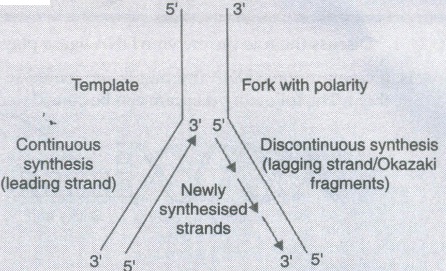
Polarity of the two strands of the fork to be shown and polarity as well as arrow mark of the lagging and leading strands to be shown with correct labellings.
2.
DNA polymerase catalyses synthesis of DNA and help also in proof-reading
3.
1. AUGUCG - at the 5' end before the initiation codon.
2. GAGGAA-at the 3' end after the termination codon.
3. They are normally located in front of the initiation codon at the 5' end and behind the termination codon at the 3' end of the coding strand of DNA.
4.
| Repetitive DNA | Satellite DNA |
| Repetitive DNA refers to the sequences of DNA when a small stretch ]of DNA is repeated many times;They code for proteins. | Satellite DNA refers to those repetitive DNA sequences which do not code for any protein but form a large portion of the gene. |
5.
Dual function of AUG codon
1. It codes for amino acid,methionine
2. It functions as the initiation codon
3. It is transcribed by TAC on DNA
4. Its anticodon is UAC.
6.
Cut is an intra-uterine device (IUD) and functions as follows:
1. It suppresses sperm motility and the fertilising capacity of sperms.
2. It increases phagocytosis of sperms within the uterus.
7.
The surgical contraceptive method adopted by the male partner is vasectomy.
In vasectomy a surgical expert cut the vas deferens and ties the ends to stop the transport of sperms from the epididymis to the ejaculatory duct. Thus, it ensures the absence of sperm in the male ejaculation to prevent unwanted pregnancies. This procedure is performed on both the vas deferens. It is an irreversible procedure thus, if the male partner wants to plan a baby with his partner can surgícally eliminate this restriction.
8.
(a) GIFT is an assisted reproduction which helps in the transfer of an ovum collected from a donor into the fallopian tube of another female who cannot produce ova but can provide suitable environment for fertilization and further development of embryo in the oviducts.
(b) CU-T and CU-7 are the intrauterine contraceptive devices used as means of birth control. When introduced into the female reproductive tract, the copper ions start releasing. These ions reduce sperm motility and their fertilizing capacity. The hormones released make the uterus unsuitable for implantation and the cervix hostile to the sperms.
9.
1. R-cells are those cells that form rough colonies, without a capsule and are non-virulent.
2. S-cells are those cells that form smooth colonies, protected by a capsule and, are virulent.
He showed that DNA is the transforming principle.
10.
(a) Since tRNA on one hand binds to a specific amino acid and on the other hand reads the codon of the amino acid bound to it through its anticodon, it is called an 'adapter'.
(b)
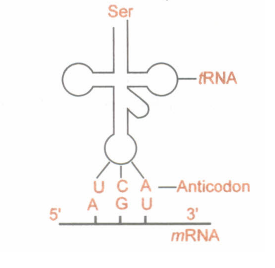
It actually looks like an inverted L.
11.
(a) Jacob and Monod proposed the concept of lac operon.
(c) The regulatory
(i) gene codes for repressor protein, which is synthesised constitutively all the time.
(ii) It binds to the operator and prevents the RNA polymerase from transcribing the operon; so the operon is 'switched off'.
(iii) When lactose is present in the cell, it functions as inducer.
(iv) When it binds to the repressor and inactivates it, the repressor does not bind to the operator.
(v) This allows RNA polymerase access to the promoter and transcription proceeds, i.e. the operon is 'switched on'.
12.
1. It was to show that DNA replication is semi conservative.
2. After completion of replication, each new/daughter molecule of DNA has one parental strand and one newly synthesised strand; this is called semiconservative replication of DNA.
Experiment
1. Mathew Meselson and Franklin Stahl performed the experiment.
2. They grew E.coli. in a medium containing \(^{ 15 }{ { NH }_{ 4 } }Cl,\) until \(^{ 15 }N\) was incorporated in the two strands of newly formed E.coli cells; this 'heavy' DNA can be separated from the normal \(^{ 14 }N-DNA\) by centrifugation in cesium chloride (CsCI) density gradient.
3. Then they transferred the cells into a medium with normal \(^{ 14 }{ { NH }_{ 4 } }Cl\) and took out samples at various time intervals.
4. They extracted the DNA and centrifuged it to measure the densities.
5. The DNA extracted from cells after one generation after transfer from the \(^{ 15 }{ { N } }\) medium to \(^{ 14 }{ { N } }\) medium (i.e. after about 20 minutes), had an intermediate/hybrid density.
6. The DNA extracted after two generations (i.e. after 40 minutes) consisted of equal amounts of 'light' DNA and 'hybrid' DNA.
This proves that after replication, each DNA molecule has one parental strand and one newly synthesised strand, i.e. replication is semiconservative.
13.
(i) In translation, a particular amino acid becomes activated and attached to the 3' end of a specific tRNA molecule.
(ii) The reaction is catalysed by the enzyme amino-acyl-tRNA synthetase.
\(Amino\quad acid\left( AA \right) +ATP\xrightarrow { Enzyme } AA-AMP-Enz+{ PP }_{ i }\\ AA-AMP-Enz+tRNA\longrightarrow AA-tRNA+AMP+{ PP }_{ i }\)
(iii) Initiation of protein synthesis
(iv) The ribosome, in its inactive state exits as two subunits - a large subunit and a small subunit.
(v) When the small subunit encounters the mRNA, translation begins.
(vi) The mRNA binds to the small subunit of ribosome, following base pair rule, between the bases of mRNA and those on rRNA; it is catalysed by certain 'initiation factors'.
(vii) There are two sites on the larger subunit, the P-site and the A-site.
(viii) The small subunit (with the tRNA) attaches to the large subunit in such. a way that the initiation codon (AUG) comes on the P-site.
The initiator tRNA (methionyl tRNA) binds to the P-site.
(ix) Elongation of polypeptide chain
(x) A second tRNA charged with an appropriate amino acid binds to the A-site of the ribosome.
(xi) A peptide bond is formed between the carboxyl group of methionine and the amino group of the second amino acid; this reaction is catalysed by the enzyme peptidyl transferase.
(xii) The ribosome moves from one codon to the next along the mRNA in the \({ 5 }^{ ' }\longrightarrow { 3 }^{ ' }\) direction.
(xiii) Amino acids are added 'one by one in the sequence of the codons and become joined together.
Termination of polypeptide synthesis
(i) When one of the termination codons (UAA, UAG, UGA) comes at the A-site, it does not code for any amino acid and there is no tRNA molecule for it.
(ii) As a result, the polypeptide synthesis (or elongation of polypeptide) stops.
The polypeptide synthesised is released from the ribosome, catalysed by a 'release factor'.
14.
(c)
ICSI
15.
(b)
3' - end
16.
(d)
Splicing
17.
(d)
Okazaki segments
18.
(a)
detecting any genetic abnormally
19.
(c)
Vasectomy
20.
(a) Francis Crick proposed this.
(b) A - Replication (of D A)
B - Transcription
C - Translation
(c) In some viruses (retroviruses), the flow of information is in reverse direction, i.e., from RNA to DNA catalysed by enzyme, reverse transcriptase; hence, it is not applicable to these viruses.
21.
(a): Synthesis of polypeptide terminates when a nonsense codon of mRNA reaches the A - site. There are three nonsense codons - UAA, UAG and UGA. These codons are not recognised by any of the tRNAs. Therefore, no more aminoacyl tRNA reaches the A - site. The P - site tRNA is hydrolysed and the completed polypeptide is released in the presence of release factor. Thus termination occurs.

12th Standard CBSE Syllabus & Materials
12th Standard CBSE
CBSE 12th Computer Science Python Revision Tour I - New Previous year Question Papers Study Material - QB365 Set A
NEW12th Standard CBSE
CBSE 12th Business Studies Planning Important Questions And Answers Study Material - QB365 Set A
NEW12th Standard CBSE
CBSE 12th Business Studies Business Environment Important Questions And Answers Study Material - QB365 Set A
NEW12th Standard CBSE
CBSE 12th Business Studies Principles of Management Important Questions And Answers Study Material - QB365 Set A



NCERT Books

Syllabus

Exam Pattern

Sample Question Papers

Previous year Question Papers

Important Notes

MCQ Practice test

NCERT Exemplers

Case study Questions

Image Based Questions

Passage based Questions

HOT Questions

Value Based Questions

Model Questions Papers
NCERT ( Book Back ) Questions

Assertion and Reason
Important Questions And Answers

CBSE 12th Standard CBSE Subjects
CBSE Standards








