
 100% FREE ACCESS
12th Standard CBSE Syllabus & Materials
12th Standard CBSE
CBSE 12th Economics Government Budget and the Economy Previous year Question Papers Study Material - QB365 Set A
NEW12th Standard CBSE
CBSE 12th Computer Science Interface Python with MySQL - New Previous year Question Papers Study Material - QB365 Set A
NEW12th Standard CBSE
CBSE 12th Computer Science Database Concept - New Previous year Question Papers Study Material - QB365 Set A
NEW12th Standard CBSE
CBSE 12th Computer Science Data Communication - New Previous year Question Papers Study Material - QB365 Set A
NEW12th Standard CBSE
CBSE 12th Computer Science Data Structures - New Previous year Question Papers Study Material - QB365 Set A
NEW12th Standard CBSE
CBSE 12th Computer Science Functions - New Previous year Question Papers Study Material - QB365 Set A

Published on: 25/10/2025
Download CBSE Class 12th Standard CBSE Biology question papers, sample papers, important questions, and previous year solved papers in PDF format. Get free study materials, NCERT solutions, and exam preparation resources for Class 12th Standard CBSE Biology
Questions + Answers key
Take MCQ Biology Test
1.
State the role of AUG codon at the 5' end and UAG at 3' end of a certain mRNA during translation.
2.
Draw a neat labelled sketch of a replicating fork of DNA.
3.
How do the oral pills help in birth control? Name common pills used.
4.
Briefly, explain the IVF and ET. What are the conditions in which these methods are advised?
5.
Recall the experiment of Frederick Griffith.If RNA instead of DNA was the genetic material would the heat-killed S-strain of the bacteria have transformed the R-strain into S-strain? Explain your answer
6.
Name and explain the surgical method advised to human males and females as a means of birth control. Mention its one advantage and one disadvantage.
7.
Given below is a schematic representation of a lac operon.
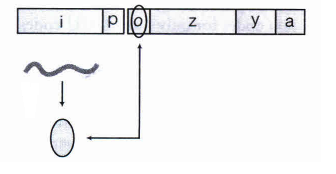
(i) Identify i and p.
(ii) Name the inducer for this operon and explain its function.
8.
Explain the process of charging of tRNA. Why is it essential in translation?
9.
(a)Why is tRNA called an 'adopter'?
(b)Draw and label a secondary strucuture of tRNA.How does the actual structure of tRNA look like?
10.
(a)How is DNA finger printing done? Name any two types of human samples which can be used for DNA fingerprinting. Explain the process sequentially.
(b) Mention any two situations when the technique is useful.
11.
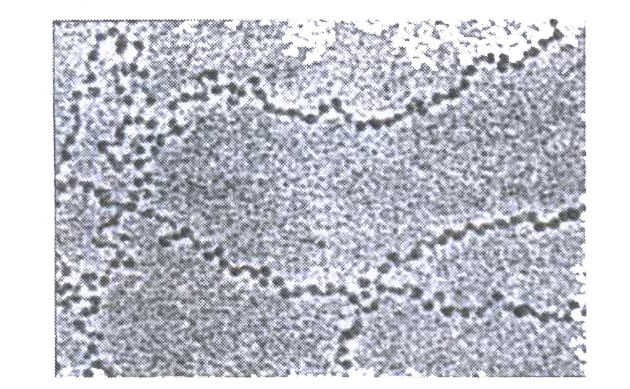
Shown above is the electron micrograph (EM) picture of 'beads-on- string'.
(a) Identify and explain the detailed structure of a bead with the help of a labelled diagram.
(b) Describe the packaging of 'beads-on- string' in a eukaryotic cell.
12.
Who proposed that DNA replication is semicoservative? How did Meselson and Stahl prove it experimentally?
13.
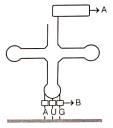
AUG on the mRNA will result in the activation of which of the following RNA having correct combination of amino acids?
| Site A | Site B |
| (a) UAC | Methionine |
| Site A | Site B |
| (b) Methionine | UAC |
| Site A | Site B |
| (c) Methionine | AUG |
| Site A | Site B |
| (d) AUG | Methionine |
14.
What is not true for genetic code?
It is nearly universal
It is degenerate
It is unambiguous
A codon in mRNA is read in a non-contiguous fashion
15.
Medical Termination of Pregnancy (MTP) is considered safe up to how many weeks of pregnancy?
8 weeks
12 weeks
18 weeks
6 weeks
16.
During transcription, if the nucleotide sequence of the DNA strand that is being coded is ATACG, then the nucleotide sequence in the mRNA would be
TCTGG
UAUGC
UATGC
TATGC
17.
Hargobind Khorana got Nobel Prize for
Gene synthesis
Determining genetic code
Producing disease resistant maize
Discovery of transposons
18.
Given below are the four methods and their modes of action in achieving contraception.Select their correct matching from the four options that follows.
|
control measures |
Mode of Action |
| (A) Pill | 1. Prevents sperms reaching cervix |
| (B) Condom | 2. Prevents implication |
| (C)Vasectomy | 3. Prevents ovulation |
| (D) Copper T | 4. Semen contains no sperms |
| A | B | C | D |
| 3 | 4 | 1 | 2 |
| A | B | C | D |
| 2 | 3 | 1 | 4 |
| A | B | C | D |
| 3 | 1 | 4 | 2 |
| A | B | C | D |
| 4 | 1 | 2 | 3 |
19.
Assertion: R-type of Pneumococcus is non-virulent.
Reason: R-type of Pneumococcus can be virulent by having transformation with S - type of Pneumococcus.
Codes :
(a) Both assertion and reason are true and reason is the correct explanation of assertion.
(b) Both assertion and reason are true but reason is not the correct explanation of assertion.
(c) Assertion is true but reason is false.
(d) Both assertion and reason are false
20.
Observe the diagram given below of Hershey and Chase experiment and answer the following questions.
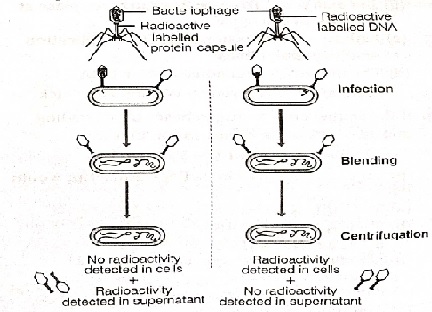
(i) ln Hershey and Chase experiment, bacteriophage nucleic acids were labelled as
(a) 32P labelled phosphate
(b) 3H labelled H20
(c) 35S labelled sulphate
(d) 14C labelled CO2
(ii) Bacteriophage protcin coat was labelled by _______ in Hershey and Chase experiment.
(a) 35S labelled sulphur
(b) 32S labelled sulphate
(c) 30S labelled sulphur
(a) 32P labelled sulphate
(iii) In Hershey and Chase experiment, radioactive 32P was used to culture bacteriophage which resulted in radioactive
(a) viral DNA
(b) bacterial capsule
(c) viral protein
(d) plasma membrane of bacteria
(iv) DNA with labelled thymidine is added to a medium where Escherichia coli is growing. After 5 minutes of growth
(a) All the DNA strands of parents and daughters will show DNA with labelled thymidine
(b) Only parental strands will show thymidine labelled DNA
(c) All the strands of daughters will be thymidine labelled
(d) Half the daughter strands will have labelled and half strands without labelled thymidine
1.
(i)The codon AUG is the initiation codon and codes for methionine, the initiator amino acid.
(ii) UAG IS a stop codon that does not code for any amino acid and brings about the termination of the translation process.
2.
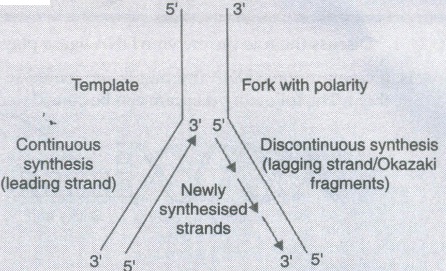
Polarity of the two strands of the fork to be shown and polarity as well as arrow mark of the lagging and leading strands to be shown with correct labellings.
3.
Oral pills contain progrestins and estrogen which check ovulation; Combined pill, Mala D and Saheli.
4.
1. IVF (In Vitro Fertilization) involves fusion of sperm and ovum in a culture medium outside the female genital tract.It should be performed under following conditions:
(a) Removal of unfertilized ovum from ovary of female or female reproduction tract with a laparoscope.
(b) Ovum is kept in culture medium in an aseptic conditions.
(c) Collection of semen of male in hygienic manner.
(d) Gamates are induced to fuse under simulated conditions to form zygote.
2. ET (Embryo Transfer) involves transfer of developing embryo from culture medium into female reproductive tract.It occurs in the presence of following conditions:
(a) Zygote is induced to develop in culture medium.It can implanted upto 32 cells stage into fallopian tube or uterus.
(b) Endometrium is stimulated to proliferate for implantation.
5.
1.The presence of 2'OH-group of ribose makes RNA more labile and prone to degradation.
2.In the heat-killed S-strain,it would not have remained functional and hence would not have transformed the R-cells into S-cells.
6.
Vasectomy in males & Tubectomy in females Devoid of ill effects of contraceptive (like nausea, abdominal pain, breakthrough bleeding, irregular menstruation or breast cancer), Reversibility is very poor.
7.
(i) i-Regulatory gene, p - Promotor gene.
(ii) Inducer is lactose.
Functions
(a) Enters the cell and binds to the repressor and inactivates it.
(b) As a result, repressor cannot bind to the operator .This allows RNA polymerase to have access to the promotor and transactions proceeds.
8.
Charging of tRNA
1. The amino acids are activated in the presence of ATP and linked to their cognate tRNA; this process is called charging of tRNA or amino acylation of tRNA.
2. This process is necessary as the formation of peptide bond between the amino acids is favoured energetically, when they are brought together
3. The activation of amino acids by ATP provides the energy for the formation of peptide bond.
9.
(a) Since tRNA on one hand binds to a specific amino acid and on the other hand reads the codon of the amino acid bound to it through its anticodon, it is called an 'adapter'.
(b)
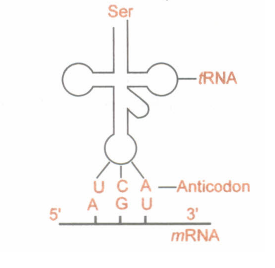
It actually looks like an inverted L.
10.
(a) High degree of polymorphism forms the basis of DNA fingerprinting. It involves isolation of DNA, digestion of DNA by restriction endonucleases, separation of DNA fragments by electrophoresis, transferringlblotting of separated DNA fragments to synthetic membranes (nylon or nitrocellulose), Hybridisation using labelled VNTR probes, detection of hybridised DNA fragments by authoradiography.
DNA from blood/hair follicle/skin/bone/saliva/ sperm
(b) Helps as identification toolinforensic applications, in determining population and genetic diversity and helps in paternity testing.
11.
(a) The bead-like structures are the nucleosomes.
1. There is a set of positively charged proteins, called histones, rich in basic amino acid residues, lysine and arginine.
2. Histones are organised to form a unit of eight molecules, called histone octamer.
3. The negatively charged DNA is wrapped around the positively charged histone octamer, to form a nucleosome; a nucleosome contains 200 bp of DNA helix.
(b) The nucleosomes form the repeating units of the chromatin fibre in the nucleus; these nucleosomes of a chromatin are seen as the beads-on-string structure under electron microscope.
1. The chromatin fibres are further coiled and condensed at metaphase stage to form the chromosomes.
2. The packaging of chromatin at higher levels requires another set of proteins, called non-histone chromosomal (NHC) proteins.
12.
1. It was to show that DNA replication is semi conservative.
2. After completion of replication, each new/daughter molecule of DNA has one parental strand and one newly synthesised strand; this is called semiconservative replication of DNA.
3. Experiment
Mathew Meselson and Franklin Stahl performed the experiment.
4. They grew E.coli. in a medium containing \(^{ 15 }{ { NH }_{ 4 } }Cl,\) until \(^{ 15 }N\) was incorporated in the two strands of newly formed E.coli cells; this 'heavy' DNA can be separated from the normal \(^{ 14 }N-DNA\) by centrifugation in cesium chloride (CsCI) density gradient.
5. Then they transferred the cells into a medium with normal \(^{ 14 }{ { NH }_{ 4 } }Cl\) and took out samples at various time intervals.
6. They extracted the DNA and centrifuged it to measure the densities.
7. The DNA extracted from cells after one generation after transfer from the \(^{ 15 }{ { N } }\) medium to \(^{ 14 }{ { N } }\) medium (i.e. after about 20 minutes), had an intermediate/hybrid density.
8. The DNA extracted after two generations (i.e. after 40 minutes) consisted of equal amounts of 'light' DNA and 'hybrid' DNA.
This proves that after replication, each DNA molecule has one parental strand and one newly synthesised strand, i.e. replication is semiconservative.
13.
(b)
| Site A | Site B |
| (b) Methionine | UAC |
14.
(d)
A codon in mRNA is read in a non-contiguous fashion
15.
(b)
12 weeks
16.
(b)
UAUGC
17.
(a)
Gene synthesis
18.
(c)
| A | B | C | D |
| 3 | 1 | 4 | 2 |
19.
(b): Transformation is the change in the genetic constitution of an organism by picking up genes present in the environment. Pneumococcus has two strains - virulent (S) and non-virulent (R). The virulent strain causes pneumonia. R-type bacteria form irregular or rough colonies and did not produce any disease while the S-type bacteria cause pneumonia and then death in the mice. Griffith injected a combination of live R-type and heat killed S-type bacteria into mice. While some mice survived, others developed the disease of pneumonia and died. Autopsy of the dead mice showed that they possessed both the types of bacteria in living state though the mice had been injected with dead virulent and living non-virulent bacteria. The occurrence ofliving S-type virulent bacteria is possible only by their formation from R-type non-virulent bacteria which pick up the trait of virulence from dead bacteria. The phenomenon is called transformation.
20.
(i) (a)
(ii) (a)
(iii) (a)
(iv) (c)

12th Standard CBSE Syllabus & Materials
12th Standard CBSE
CBSE 12th Computer Science Python Revision Tour I - New Previous year Question Papers Study Material - QB365 Set A
NEW12th Standard CBSE
CBSE 12th Business Studies Planning Important Questions And Answers Study Material - QB365 Set A
NEW12th Standard CBSE
CBSE 12th Business Studies Business Environment Important Questions And Answers Study Material - QB365 Set A
NEW12th Standard CBSE
CBSE 12th Business Studies Principles of Management Important Questions And Answers Study Material - QB365 Set A



NCERT Books

Syllabus

Exam Pattern

Sample Question Papers

Previous year Question Papers

Important Notes

MCQ Practice test

NCERT Exemplers

Case study Questions

Image Based Questions

Passage based Questions

HOT Questions

Value Based Questions

Model Questions Papers
NCERT ( Book Back ) Questions

Assertion and Reason
Important Questions And Answers

CBSE 12th Standard CBSE Subjects
CBSE Standards








