
 100% FREE ACCESS
12th Standard CBSE Syllabus & Materials
12th Standard CBSE
CBSE 12th Economics Government Budget and the Economy Previous year Question Papers Study Material - QB365 Set A
NEW12th Standard CBSE
CBSE 12th Computer Science Interface Python with MySQL - New Previous year Question Papers Study Material - QB365 Set A
NEW12th Standard CBSE
CBSE 12th Computer Science Database Concept - New Previous year Question Papers Study Material - QB365 Set A
NEW12th Standard CBSE
CBSE 12th Computer Science Data Communication - New Previous year Question Papers Study Material - QB365 Set A
NEW12th Standard CBSE
CBSE 12th Computer Science Data Structures - New Previous year Question Papers Study Material - QB365 Set A
NEW12th Standard CBSE
CBSE 12th Computer Science Functions - New Previous year Question Papers Study Material - QB365 Set A

Published on: 25/10/2025
Download CBSE Class 12th Standard CBSE Biology question papers, sample papers, important questions, and previous year solved papers in PDF format. Get free study materials, NCERT solutions, and exam preparation resources for Class 12th Standard CBSE Biology
Questions + Answers key
Take MCQ Biology Test
1.
Mention two strategies evolved to prevent self-pollination in flowers.
2.
If one can induce parthenocarpy through the application of growth substances, which fruits would you select to induce parthenocarpy and why?
3.
Why is apple called a false fruit? Which part(s) of the flower forms the fruit?
4.
What are the suggested reasons for population explosion?
5.
Amniocentesis for sex determination is banned in our country. Is this necessary? Comment.
6.
Removal of gonads cannot be considered as a contraceptive options.Why?
7.
Is the use of contraceptives justified? Give reasons.
8.
Name the four wall layers of a microsporangium.
9.
What is parturition? Which hormones are involved in induction of parturition?
10.
What is polyembryony and how can it be commercially exploited?
11.
Are parthenocarpy and apomixis different phenomena? Discuss their benefits.
12.
What are the functions of the two male gametes produced by each pollen grain in angiosperms?
13.
Define spermiogenesis and spermiation
14.
Name the functions of the following:
(a) Corpus luteum
(b) Endometrium
(c) Acrosome
(d) Sperm tail
(e) Fimbriae
15.
What is spermatogenesis? Briefly describe the process of spermatogenesis.
16.
Draw a labelled diagram of female reproductive system.
17.
What is bagging technique? How is it useful in a plant breeding programme?
18.
What are the major functions of male accessory ducts and glands?
19.
Name the hormones involved in the regulation of spermatogenesis.
20.
Do you think that reproductive heath in our country has improved in the past 50 years? If yes, mention some such areas of improvement.
21.
What are the measures one has to take to prevent from contracting STDs?
22.
Suggest the aspects of reproductive health which need to be given special attention in the present scenario.
1.
1. Self-incompatibility: A condition wherein the pollen is ineffective in fertilizing the same flower or other flowers on the same plant usually due to inhibition of the growth of the pollen tube in the stigma and style, thereby preventing delivery of male gametes to the ovules.
2. Maturation of pistil before that of stamen (protogyny) or maturation of stamen before that of the pistil (protandry) inhibit self-pollination.
2.
The fruits selected to induce parthenocarpy can be watermelon, papaya, etc. It is because these fleshy fruits have a large number of seeds, which interfere with the preparation of jams, jellies, etc.
3.
Apple is called a false fruit because it develops from the thalamus (enlarged structure at the base of the flower) instead of ovary.
4.
Reasons of population explosion are
(i) Rapid decline in the overall death rate because of better medical facilities.
(ii) Increase in number of people in reproducible age.
5.
Since it is misused to find out the sex of the foetus leading to female foeticides, it is necessary to ban amniocentesis. Amniocentesis is the prenatal diagostic technique that helps to find out chromosomal (genetic) disorders or metabolic disorders of the foetus; in extreme cases where the foetus is found to be suffering from an incurable disorder, MTP is advised. By banning this, the advantage of preventing an unwanted birth is lost.
6.
Removal of gonads cannot be considered as a contraceptive option because it not only stops the production of gametes, but also stops the secretion of many other hormones required for normal body function. Also, this is an irreversible method. It means once removed, gonads cannot be replaced and the person will remain infertile for whole life.
7.
Use of contraceptives is justified due to the following reasons
(i) In the absence of contraceptives, the population growth rate will rise at an explosive rate and there will be scarcity of even the basic necessities.
Earth's resources are limited. We have already started facing the problems of overcrowding, food price inflation, power and water shortage, etc. Further increase in population will only aggrevate situation.
(ii) Contraceptives provide an option for planning the family by spacing the pregnancies and avoiding unwanted pregnancies.
(iii) Contraceptives also guard against STDs to some extent.
8.
(i) Epidermis
(ii) Endothecium
(iii) Middle layers
(iv) Tapetum.
9.
Partiruition refers to the process of delivery if the fully-developed foetus,i.e.,childbirth.
Relaxin and oxytocin are the hormones involved in the process.
10.
Polyembryony is the phenomenon of occurrence of more than one embryo in a seed.
(i) All embryos can be isolated and cultured on an artificial medium under aseptic conditions in vitro and through micropropagation, many plants can be raised simultaneously from one seed.
11.
Parthenocarpy and apomixis are two different phenomena.
(i) Parthenocarpy is formation of fruit without fertilisation of the ovary; hence they are seedless.
(ii) Apomixis is the phenomenon of formation of seeds without fertilisation apomictic embryos are genetically identical to the female parent.
12.
One male gamete fuses with the female gamete (syngamy) to form the zygote. Another male gamete fuses with the polar nuclei (triple fusion) to form the primary endosperm.
13.
(i) Spermiogenesis is the process of transformation of spermatids into flagellated spermatozoa.
(ii) Spermiation is the process of release of spermatozoa from the seminiferous tubules.
14.
(a) Corpus luteum
It secretes large amounts of progesterone, which is essential for maintenance of the endometrium, implantation of embryo and other events of pregnancy.
(b) Endometrium
It is the inner most glandular lining of the wall of the uterus. - It undergoes cyclical changes during menstrual cycle and prepares itself for the implantation of embryo.
(c) Acrosome
The acrosome contains enzymes which help in dissolving the envelopes (zona pellucida and plasma membrane) of the ovum and facilitate the entry of sperm into the cytoplasm of the ovum.
(d) Sperm tail
It facilitates the movement of sperm inside the female reproductive tract to reach the ovum for fertilisation.
(e) Fimbriae
They help in collection of the ovum after ovulation, into the fallopian tube.
15.
Spermatogenesis is the process of the production of sperms from the immature germ cells in males. It takes place in seminiferous tubules present inside the testes. During spermatogenesis, a diploid spermatogonium (male germ cell) increases its size to form a diploid primary spermatocyte. This diploid primary spermatocyte undergoes first meiotic division (meiosis I), which is a reductional division to form two equal haploid secondary spermatocytes. Each secondary spermatocyte then undergoes second meiotic division (meiosis II) to form two equal haploid spermatids. Hence, a diploid spermatogonium produces four haploid spermatids. These spermatids are transformed into spermatozoa (sperm) by the process called spermiogenesis.
16.
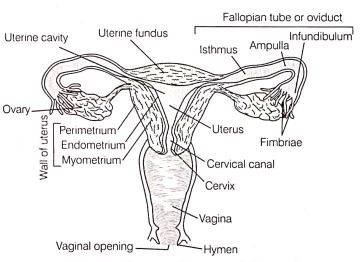
17.
Bagging The emasculated flower is covered by a bag of suitable size generally made up of butter paper, so as to prevent contamination of the stigma by unwanted pollen grains.
1.When the stigma of bagged flower becomes receptive, the collected pollen grains are dusted onto the stigma, the flower is rebagged and the fruits are allowed to develop.
2. If the female parent is unisexual, emasculation is not necessary. In this case, the female bud is directly bagged and when the stigma turns receptive, suitable pollen grains are dusted onto it so as to allow germination and the flowers are rebagged.
18.
The male accessory ducts are rete testis, vasa efferentia, epididymis and vas deferens.These ducts store and transport the sperms from the testes to the outside through the urethra. The male accessory glands are paired seminal vesicles, prostate gland and paired Bulbourethral glands. The secretion of these glands forms seminal plasma, which is rich in fructose, calcium and certain enzymes. The secretion of Bulbourethral glands lubricates the glans penis.
19.
Hormones controlling spermatogenesis.
Spermatogenesis is initiated by an increase in the secretion of GnRH (gonadotropin-releasing hormone) by the hypothalamus, at the age of puberty.
The increased levels of GnRH act on the anterior pituitary and stimulate it to secrete two gonaditropins namely:
(i) Follicle Stimulating Hormone (FSH) and
(ii) Luteinizing Hormone (LH).
LH acts o the Leydig cells and stimulates them to secrete testosterone.
FSH acts on Sertoli cells and stimulates them to secrete some factors which help in spermiogenesis.
20.
Reproductive health has improved in India, in terms of
(i) Reduced maternal and infant mortality rates.
(ii) Early detection and cure of STDs,
(iii) Assistance to infertile couples.
(iv) Availability of a variety of methods for family planning.
(v) Availability of maternal and child healthcare programmes.
(vi) Introduction of sex education in schools.
21.
STDs can be prevented by
(i) Avoiding sex with unknown partner or multiple partners.
(ii) Avoid unprotected sexual intercourse, always use condoms.
(iii) Use sterilised needles and syringes.
(iv) In case of doubt, consult a doctor as early as possible for early detection and get completely treated if diagnosed with disease.
22.
Special attention needs to be given to the following aspects
(i) Educating people (starting from age group above 12 years) about reproductive system, processes and practices and importance of safe and responsible sex.
(ii) Providing education about harmful sexual practices, unwanted pregnancy, unsafe abortion, reproductive tract infections and cancers, gender based responsibilities and gender equality in making decisions about sex, etc.
(iii) Establishing proper systems of education, counselling, prevention, detection and management of health problems, care and rehabilitation and ensuring easy accessibility of appropriate services.
(iv) Establishing appropriate systems to provide effective and accessible healthcare for women during pregnancy and childbirth to provide the best chance for a healthy mother.
(v) Making policies and practices for population growth control, so that people can have access to safe, effective and affordable contraception. But they should have the right to decide,when and which method to adopt.

12th Standard CBSE Syllabus & Materials
12th Standard CBSE
CBSE 12th Computer Science Python Revision Tour I - New Previous year Question Papers Study Material - QB365 Set A
NEW12th Standard CBSE
CBSE 12th Business Studies Planning Important Questions And Answers Study Material - QB365 Set A
NEW12th Standard CBSE
CBSE 12th Business Studies Business Environment Important Questions And Answers Study Material - QB365 Set A
NEW12th Standard CBSE
CBSE 12th Business Studies Principles of Management Important Questions And Answers Study Material - QB365 Set A



NCERT Books

Syllabus

Exam Pattern

Sample Question Papers

Previous year Question Papers

Important Notes

MCQ Practice test

NCERT Exemplers

Case study Questions

Image Based Questions

Passage based Questions

HOT Questions

Value Based Questions

Model Questions Papers
NCERT ( Book Back ) Questions

Assertion and Reason
Important Questions And Answers

CBSE 12th Standard CBSE Subjects
CBSE Standards








