
 100% FREE ACCESS
12th Standard CBSE Syllabus & Materials
12th Standard CBSE
CBSE 12th Economics Government Budget and the Economy Previous year Question Papers Study Material - QB365 Set A
NEW12th Standard CBSE
CBSE 12th Computer Science Interface Python with MySQL - New Previous year Question Papers Study Material - QB365 Set A
NEW12th Standard CBSE
CBSE 12th Computer Science Database Concept - New Previous year Question Papers Study Material - QB365 Set A
NEW12th Standard CBSE
CBSE 12th Computer Science Data Communication - New Previous year Question Papers Study Material - QB365 Set A
NEW12th Standard CBSE
CBSE 12th Computer Science Data Structures - New Previous year Question Papers Study Material - QB365 Set A
NEW12th Standard CBSE
CBSE 12th Computer Science Functions - New Previous year Question Papers Study Material - QB365 Set A

Published on: 25/10/2025
Download CBSE Class 12th Standard CBSE Biology question papers, sample papers, important questions, and previous year solved papers in PDF format. Get free study materials, NCERT solutions, and exam preparation resources for Class 12th Standard CBSE Biology
Questions + Answers key
Take MCQ Biology Test
1.
Which of the following statement is true for Hydra?
(i) It produces asexual gemmules.
(ii) It produces unicellular bud.
(iii) It produces multicellular bud.
2.
When does a woman attain puberty?
3.
What is "afterbirth".
4.
What are the fundamental methods of reproduction?
5.
Sexual reproduction of flowering plants was discovered by
(a) Camerarius
(b) Nawaschin
(c) Strasburger
(d) Maheswari
6.
Why Pea flowers produce assured seed sets? Give reasons.
7.
Elaborate the following abbreviations :
(i) RCH Programme
(ii) GIFT
(iii) ICSI
(iv) ART.
8.
Name the technique used for determining the sex and condition of the foetus.
9.
How are Cucurbita plants different from papaya plants with reference to the flowers they bear?
10.
The meiocyte of rice has 24 chromosomes. Write the number of chromosomes in its endosperm.
11.
Some important events in the human female reproductive cycle are given below.Arrange the events in a proper sequence.A-secretion of FSH, B-growth of corpus luteum, C-growth of the follicle and oogenesis, D-ovulation, E-sudden increase in the levels of LH
A D C E B
B A C D E
C A D B E
A C E D B
12.
Which part would be most suitable for raising virus-free plants for micropropagation?
Bark
Vascular tissue
Meristem
Node
13.
Which of the following is a hermaphrodite?
Ant
Aphids
Earthworms
Cockroach
14.
Which one of the following groups includes all sexually transmitted diseases?
AIDS, syphilis, cholera
HIV, malaria, trichomoniasis
Gonorrhoea, hepatitis-B, clamydiasis
Hepatitis-B, haemophilia, AIDS.
15.
The pollen tube usually enters the embryo sac
Through one of the synergids
By directly penetrating the egg
Between one synergid and central cell
By knocking off the antipodal cells
16.
The correct surgical procedure as a contraceptive method is:
Ovariectomy
Hysterectomy
Vasectomy
Castration
17.
In a flowering plant, archesporium gives rise to
only the wall of the sporangium
both wall and the sporogenous cells
wall and the tapetum
Only tapetum and sporogenous cells
18.
Which of the following statements is true of ginger?
Germinating bud appears from the eye of the stem tuber.
Germinating bud appears from the node of the rhizome
Germinating bud appears from the notch of the leaf margin.
19.
Which of the following statements is true of yeast?
The cell divides by binary fission. One of them develops into a bud.
The cell divides unequally. The smaller cell develops into a bud.
The cell produces conidia, which develop into a bud.
20.
Where does fertilisation occur in humans? Explain the events that occur during this process.
21.
Describe the lactational Amenorrhoea method of birth control.
22.
Why is 'Saheli' cosidered an effective contraceptive for womem to space children?
23.
Why is parturition called a neuro-endocrine mechanism?Explain.
24.
State one advantage and one disadvantage of cleistogamy.
25.
A large number of married couples the world over are childless. It is shocking to know that in India the female partner is often blamed for the couple being childless.
(a) Why in your opinion the female partner is often blamed for such situations in India? Mention any two values that you as a biology student can promote to check this social evil.
(b) State any two reasons responsible for the cause of infertility.
(c) Suggest a technique that can help the couple to have a child where the problem is with the male partner.
26.
On world population day, Rohit and his friends arranged an awareness campaign on population explosion programme in their locality. Some elderly people tried to stop the children and asked them not to talk about such things in public.
The children convinced the elders about the need for the programme and on understanding their point of view, the elders also joined the campaign.
(i) Why is such awareness programme necessary?
(ii) What role has the government played in controlling population explosion?
(iii) When were reproductive health programmes initiated in India?
(iv) What values did Rohit and his friends show on the occasion?
27.
Explain the events taking place at the time of fertilisation of an ovum in human female.
28.
Explain the hormonal control of spermatogenesis in humans.
29.
Draw a labelled diagram of the sectional view of a mature pollen grain of angiosperms. Explain the function of any two of its parts.
30.
(i) Explain MTP.
(ii) Give two situations when MTP is advised.
(iii) Write when amniocentesis and MTP can be misused.
31.
Write the modes of asexual reproduction in the following organism Bryophyllum, Potato, Yeast, Rhizopus, Penicillium.
1.
()
Statement(iii) is true. Multicellular organism like Hydra reproduce asexually by producing multicellular bud that further develops into a new organism.
2.
()
Women attain puberty about the age of 13.
3.
()
Placenta expelled after delivery.
4.
()
There are two fundamental methods of reproduction - asexual and sexual methods.
5.
()
(a) Camerarius
6.
()
Because Pea flowers are cleistogamous, autogamous and homogamous, hence self-pollination occurs before the flowers open up at maturity.
7.
()
(i) Reproductive and Child Health Care Programme,
(ii) Gamete Intra Fallopian Transfer,
(iii) Intra Cytoplasmic Sperm Injection,
(iv) Assisted Reproductive Technologies.
8.
()
Amniocentesis
9.
()
Papaya plants are dioecious as an individual plant bears exclusively either staminate flowers or pistillate flowers.
10.
()
36 chromosomes.
11.
(d)
A C E D B
12.
(c)
Meristem
13.
(c)
Earthworms
14.
(c)
Gonorrhoea, hepatitis-B, clamydiasis
15.
(a)
Through one of the synergids
16.
(c)
Vasectomy
17.
(b)
both wall and the sporogenous cells
18.
(b)
Germinating bud appears from the node of the rhizome
19.
(b)
The cell divides unequally. The smaller cell develops into a bud.
20.
Fertilisation in human beings takes place in the ampullary isthmic junction of the Fallopian tube.
The events/steps of fertilisation are as follows.
Discharge of semen in female vagina
\(\downarrow \)
Movement of sperms to reach ampullary-isthmic junction of Fallopian tube
\(\downarrow \)
Release and transport of ovum at the same junction
\(\downarrow \)
Formation of zygote
21.
1. Lactational Amenorrhoea refers to the absence of menstriation during the period of intense lactation following parturition.
2. It is because ovulation and other events in menstrual cycle do not occur during this period.
3. Hence as long as the mother breast feeds her child chances of conception are almost nil.
22.
(i) It is a non-steroidal preparation.
(ii) It is a 'once' a week' pill.
(iii) It has high contraceptive value.
(iv) It has fewer side effects than other oral contraceptives.
23.
Parturition is initiated by the foetal ejection reflex,a neural mechanism of mild contractions of the uterus,initiated by the fully developed foetus and placenta.
It triggers the release of oxyticin from material pituitary,which causes stronger contractions of uterine muscles and stimulates more secretion of oxytocin.
The stimulatory reflex between uterine contractions and secretion of oxytocin continues and results in parturition,i.e.the delivery of the baby;hence it is called an neuro-endocrine mechanism.
24.
Advantage
1. Since cleistogamous flowers are autogamous, there is an assured seed-set.
Disadvantage
1. Continued self-pollination leads to inbreeding depression.
25.
(a) Female partner is blamed due to social mind set/inequality of sexes/lack of awareness/male dominated society/any other relevent point.
(i) Awareness to be created that abnormality can occur in both male and females and infertility issues with suitable examples.
(ii) Mutual respect towards both the partners in case of the problem and to find the remedy from medical experts instead of visiting quacks.
(iii) Educate them to find the reason and not believe in superstitions.
(b) Physical (abnormality in reproductive system), congenital, immunological or psychological.
(c) Intra cytoplasmic sperm injection (ICSI)/artificial insemination (AI)/Intra uterine insemination (IUI).
26.
(i) To understand the problem faced by the family and the nation due to increasing population and the benefits of having a small family.
(ii) Role of Government in controlling population explosion are:
(a) Creating public awareness through mass media.
(b) Education at all Levels.
(c) Family planning.
(d) Increasing marriageable age (18 for girls and 21 for boys)
(iii) In India, these programmes called 'family planning' were initiated in 1951.
(iv) Rohit and his friends showed understanding about the problem of population explosion, teamwork, and motivational capacity.
27.
Fertilisation is the fusion of two gametic nuclei to form a diploid zygote.It involves a series of chemical and physical steps as follows:
The cortical cytoplasm of ovum shows the physicochemical reactions called the cortical reactions.
1.Sperm lysins dissolve the membranes around egg.centriole physically passes into ovum.
3.Normally these reactions result in the formation of fertilisation membrane outside the egg plasma membrane.
4.In man, cortical granules burst and release their contents between egg plasma membrane and zona pellucida i.e. perivitelline space (No fertilisation membrane formation).The plasma membrane shows increased permeability for water, phosphate and potassium.
5.Electrical potentiality of plasma membrane changes from positive to negative, NAD kinase enzyme becomes activated after fertilisation for the oxidation and reduction reaction of the cell.
6.Rate of DNA synthesis increases with great pace after fertilisation.Hence the ovum is now ready for mitosis(cleavage).
7.Cleavage results in multicellular in dividual.
28.
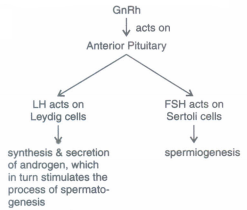
Spermatogenesis is under the control of endocrine hormones. In human male reproductive system, spermatogenesis starts at the age of puberty due to significant increase in the secretion of gonadotropin-releasing hormone by hypothalmus. The increased level of GnRH then acts on the anterior pituitary gland and stimulates secretion of the two gonadotropins : Luteinising hormone (LH) and follicle stimulating hormone (FSH). LH acts on leydig cells and stimulates synthesis and secretion of androgens, like testosterone which stimulates spermatogenesis. FSH acts on the sertoli cells and stimulates secretion of some factors which help in the process of spermiogenesis. Excess of testosterone inhibits the secretion of LHP and GnRH. A glycoprotein called inhibin supresses FSH synthesis. Thus normal release of testosteron is under negative feed back control.
29.
Exine: It can withstand high temperature/strong acids/alkali. It protects pollens.
Intine: It is a thin and continuous layer made up of cellulose and pectin. The intine produces pollen tube.
Vegetative cell: It is bigger and has abundant food reserve.
Generative cell: It divides mitotically to give rise to two male gametes
30.
(i) Medical Termination of Pregnancy-Intentional or voluntary termination of pregnancy before full term with help of an expert doctor is called MTP
(ii) (a) MTP is advised in the following situations-(i) when there is unwanted pregnancy.
(b) When continuation of pregnancy is harmful or fatal to either mother or foetus or both.
(c) When there is failure of contraceptive used during coitus or rapes in either case it is advisable to go for MTP during first trimester
i.e., up to 12 weeks of pregnancy.
(d) MTP is also advised if the foetus suffers from incurable genetic and metabolic disorder.
(iii) Amniocentesis is a prenatal technique of studying genetic disorders of foetus by taking out anniotic fluid. But however amniocentesis and MTP has been misused for knowing the sex of the foetus and destroying the same if the foetus is female.
31.
The modes are reproduction are listed below:
1.Bryophyllum: Reproduce asexually by formation of marginal adventitious buds in mature leaves.
2.Potato: Buds in the eyes in potato tuber grow to form aerial shoots.
3.Yeast: Budding.
4.Rhizopus: Sporangiospores formed inside sporangia.
5.Penicillium: Conidia formed on conidiophores.

12th Standard CBSE Syllabus & Materials
12th Standard CBSE
CBSE 12th Computer Science Python Revision Tour I - New Previous year Question Papers Study Material - QB365 Set A
NEW12th Standard CBSE
CBSE 12th Business Studies Planning Important Questions And Answers Study Material - QB365 Set A
NEW12th Standard CBSE
CBSE 12th Business Studies Business Environment Important Questions And Answers Study Material - QB365 Set A
NEW12th Standard CBSE
CBSE 12th Business Studies Principles of Management Important Questions And Answers Study Material - QB365 Set A



NCERT Books

Syllabus

Exam Pattern

Sample Question Papers

Previous year Question Papers

Important Notes

MCQ Practice test

NCERT Exemplers

Case study Questions

Image Based Questions

Passage based Questions

HOT Questions

Value Based Questions

Model Questions Papers
NCERT ( Book Back ) Questions

Assertion and Reason
Important Questions And Answers

CBSE 12th Standard CBSE Subjects
CBSE Standards








