
 100% FREE ACCESS
12th Standard CBSE Syllabus & Materials
12th Standard CBSE
CBSE 12th Economics Government Budget and the Economy Previous year Question Papers Study Material - QB365 Set A
NEW12th Standard CBSE
CBSE 12th Computer Science Interface Python with MySQL - New Previous year Question Papers Study Material - QB365 Set A
NEW12th Standard CBSE
CBSE 12th Computer Science Database Concept - New Previous year Question Papers Study Material - QB365 Set A
NEW12th Standard CBSE
CBSE 12th Computer Science Data Communication - New Previous year Question Papers Study Material - QB365 Set A
NEW12th Standard CBSE
CBSE 12th Computer Science Data Structures - New Previous year Question Papers Study Material - QB365 Set A
NEW12th Standard CBSE
CBSE 12th Computer Science Functions - New Previous year Question Papers Study Material - QB365 Set A

Published on: 25/10/2025
Download CBSE Class 12th Standard CBSE Biology question papers, sample papers, important questions, and previous year solved papers in PDF format. Get free study materials, NCERT solutions, and exam preparation resources for Class 12th Standard CBSE Biology
Questions + Answers key
Take MCQ Biology Test
1.
Ramesh got a job in Mumbai but his family was still living in the village. One day, he received a letter from his father stating that he is planning marriage of her sister who will be fifteen years old in March. Ramesh did not like the idea of his father of arranging plan of his sister till she attains age of 18 years.
Read the above passage and answer the following questions:
(i) In your opinion, who is right Ramesh or his Father?
(ii) What is the right age of marriage for girls?
(iii) What are the risks involved in early marriage?
2.
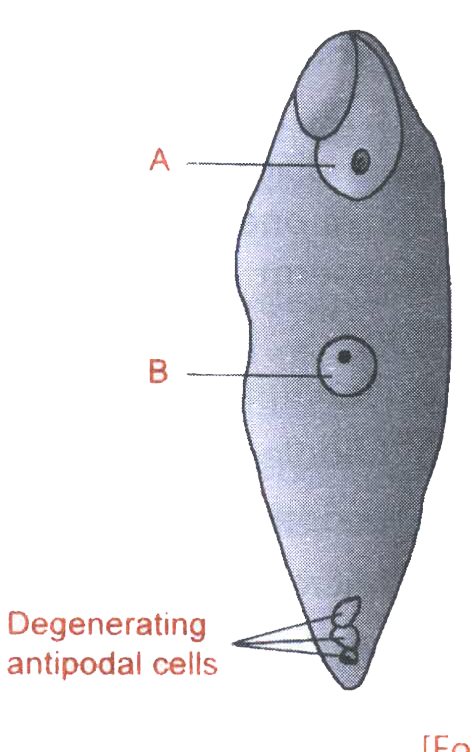
(a) Name the structures which the parts 'A' and 'B' shown in the diagram below respectively develop into.
(b) Explain the process of development which 'B' undergoes in albuminous and exalbuminous seeds. Give one
example of each of these seeds.
3.
Differentiate between in vitro fertilisation and in vivo fertilisation.
4.
What is meant by monosporic development of female gametophyte?
5.
Males in whom testes fail to descend into the scrotum are generally infertile. why?
6.
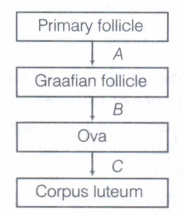
Given below is a flow chart showing ovarian changes during menstrual cycle. Fill in the spaces with the hormonal factor(s) responsible for the events shown.
7.
If for some reason, the vasa efferentia gets blocked, the gametes will not transported from
testes to epididymis
epididymis to the vas deferens
Ovary to uterus
vagina to uterus
8.
Which layer develops first during embryonic development?
ectoderm
mesoderm
endoderm
both (b) and (c)
9.
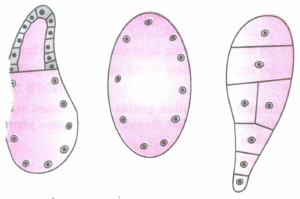
Select the correct order of endosperm types
cellular, helobial, free nuclear
cellular, free nuclear, helobial
helobial, free nuclear, cellular
free nuclear, cellular, helobial
free nuclear, helobial, cellular
10.
Given below are the four methods and their modes of action in achieving contraception.Select their correct matching from the four options that follows.
|
control measures |
Mode of Action |
| (A) Pill | 1. Prevents sperms reaching cervix |
| (B) Condom | 2. Prevents implication |
| (C)Vasectomy | 3. Prevents ovulation |
| (D) Copper T | 4. Semen contains no sperms |
| A | B | C | D |
| 3 | 4 | 1 | 2 |
| A | B | C | D |
| 2 | 3 | 1 | 4 |
| A | B | C | D |
| 3 | 1 | 4 | 2 |
| A | B | C | D |
| 4 | 1 | 2 | 3 |
11.
Intraspecific incompatibility can be overcome by
Wetting of anthers
Mixed pollination
Intraovarian fertilization
Intraspecific competition
12.
All papaya plants bear flowers but fruits are seen in some. Explain
13.
In our society the women are often blamed for giving birth to daughters. Can you explain why this is not correct?
14.
(a) What does gamete intra fallopian transfer(GIFT) represent? (Define in brief).
(b) How do CU-T and CU-7 act as contraceptive devices?
15.
The data given below shows the rates of sexually transmitted infections from the year 2014 to 2018. Refer to the given data and answer the following questions.
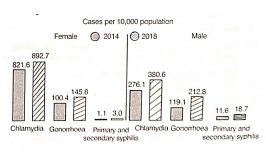
(i) Why do you think rates of STIs have increased in the duration of four years (2014-18)?
(ii) What can be the major causes of sexually transmitted diseases/infections ?
(iii) What kind of symptons does one experience to suspect an STI?
(OR)
How can you prevent STDs? Mention any two ways.
16.
Assertion: Family planning is an action plan to attain reproductive health among people.
Reason: Improved programmes covering reproduction related areas were propagated by RCH to create awareness among people.
Codes:
(a) If both Assertion and Reason are true and Reason is the correct explanation of Assertion.
(b) If both Assertion and Reason are true but Reason is not the correct explanation of Assertion.
(c) If Assertion is true but Reason is false.
(d) If both Assertion and Reason are false.
17.
Assertion: Although geitonogamy is functionally cross-pollination involving a pollinating agent, genetically it is similar to autogamy since the pollen grains come from the same parent.
Reason: In getionogamy, pollen grains from the anthers of one flower are transferred to the stigma of another flower borne on the same plant.
Codes:
(a) If both Assertion and Reason are true and Reason is the correct explanation of Assertion.
(b) If both Assertion and Reason are true but Reason is not the correct explanation of Assertion.
(c) If Assertion is true but Reason is false.
(d) If both Assertion and Reason are false.
1.
(i) Ramesh is right in this matter as early or child marriage can endanger the life of girl.
(ii) 18 years
(iii) The reproductive organs of girls below 18 years are not fully prepared for pregnancy. Also, early pregnancy may have serious harmful effects on the health of the young mother.
2.
(a) A develops into the embryo.
B develops into the endosperm.
(b) 1. The endosperm development starts from the primary endosperm cell containing the primary endosperm nucleus.
2. In the most common type of endosperm development, the primary endosperm nucleus undergoes successive free nuclear divisions to give rise to a number of free nuclei; at this stage, it is called free nuclear endosperm.
3. Subsequently wall formation takes place from the periphery and proceeds towards the centre and the endosperm becomes cellular.
4. This type of endosperm development is seen in coconut; the water of the tender coconut represents the free nuclear endosperm with thousands of nuclei in it and the white kernel around it represents the cellular endosperm.
5. In albuminous seeds, some amount of endosperm persists in the mature seed, as the developing' embryo does not consume it fully, e.g. wheat/maize.
6. In exalbuminous seeds, the endosperm is completely consumed by the developing embryo before seed maturation, e.g. groundnut and pea.
3.
| In vitro fertilisation | In vivo fertilisation |
| When fertilisation is induced to occur outside the body of the organism, under conditions similar to that inside the body, it is called in vitro fertilisation. | When fusion of gametes, i.e. fertilisation occurs naturally inside the body of the organism, it is called in vivo fertilisation. |
4.
An embryo sac is called monosporic because it develops from one of the four megaspores formed from the division of megaspore mother cell.
5.
Since the testes are very sensitive to temperature, if they do not descend into the scrotum prior to adolescence, then they will stop producing sperms that will lead to infertility in males, a condition known as cryptorchidism.
6.
A - FSH and oestrogen, B - LH and C - Progesterone
7.
(a)
testes to epididymis
8.
(c)
endoderm
9.
(c)
helobial, free nuclear, cellular
10.
(c)
| A | B | C | D |
| 3 | 1 | 4 | 2 |
11.
(b)
Mixed pollination
12.
The papaya trees are all of the same species. Some trees bear bisexual flowers, both male and female parts are present. But the flowers of other trees are unisexual; they bear only either male or female part. So the trees that bear only male flowers cannot produce fruit.
13.
In our society, Women are blamed for giving birth to daughters. This is wrong because sex of the baby is determined by the sperm that can have either X or Y-chromosomes.
Since Women have only one type of chromosome (X) in all the ova.
If the sperm having X-chromosome fertilises the ovum (X), the resulting zygote (XX) will become a female.
If the sperm having Y-chromosome fertilises the ovum (X), the resulting zygote (XY) will become a male.
14.
(a) GIFT is an assisted reproduction which helps in the transfer of an ovum collected from a donor into the fallopian tube of another female who cannot produce ova but can provide suitable environment for fertilization and further development of embryo in the oviducts.
(b) CU-T and CU-7 are the intrauterine contraceptive devices used as means of birth control. When introduced into the female reproductive tract, the copper ions start releasing. These ions reduce sperm motility and their fertilizing capacity. The hormones released make the uterus unsuitable for implantation and the cervix hostile to the sperms.
15.
(i) Rates of sexually transmitted diseases/infections have increased as people are getting less precautious. They are not using any kind of precautions like condoms in order to prevent spread of STDs.
(ii) Sexually transmitted diseases/infections are mainly caused by various bacteria, viruses and some yeasts.
(iii) Symptoms that one experiences to suspect sexually transmitted infection include
(a) Burning/itching in vaginal areas.
(b) Unusual discharge from the penis.
(c) Pain in pelvic/ abdominal region.
(OR)
(ii) STDs/STIs can be prevented by the following two ways
(a) Avoiding sex with unknown/multiple partners.
(b) Using condoms during intercourse.
16.
(b) If both Assertion and Reason are true but Reason is not the correct explanation of Assertion.
Explanation:
Family planning helps in maintaining reproductive health.
17.
(a) If both Assertion and Reason are true and Reason is the correct explanation of Assertion.
Explanation:
Geitonogamy is a type of pollination in which pollen grains of one flower are transferred to the stigma of another flower belonging to either the same plant or genetically similar plant. It usually occurs in plants which show monoecious condition (unisexual male and female flowers borne on the same plant. Thus, geitonogamy is functionally cross pollination as it involves pollinating agent to carry out pollination, but genetically it is similar to autogamy (self-pollination) since the pollen grains come from the genetically same plant.

12th Standard CBSE Syllabus & Materials
12th Standard CBSE
CBSE 12th Computer Science Python Revision Tour I - New Previous year Question Papers Study Material - QB365 Set A
NEW12th Standard CBSE
CBSE 12th Business Studies Planning Important Questions And Answers Study Material - QB365 Set A
NEW12th Standard CBSE
CBSE 12th Business Studies Business Environment Important Questions And Answers Study Material - QB365 Set A
NEW12th Standard CBSE
CBSE 12th Business Studies Principles of Management Important Questions And Answers Study Material - QB365 Set A



NCERT Books

Syllabus

Exam Pattern

Sample Question Papers

Previous year Question Papers

Important Notes

MCQ Practice test

NCERT Exemplers

Case study Questions

Image Based Questions

Passage based Questions

HOT Questions

Value Based Questions

Model Questions Papers
NCERT ( Book Back ) Questions

Assertion and Reason
Important Questions And Answers

CBSE 12th Standard CBSE Subjects
CBSE Standards








