
 100% FREE ACCESS
12th Standard CBSE Syllabus & Materials
12th Standard CBSE
CBSE 12th Economics Government Budget and the Economy Previous year Question Papers Study Material - QB365 Set A
NEW12th Standard CBSE
CBSE 12th Computer Science Interface Python with MySQL - New Previous year Question Papers Study Material - QB365 Set A
NEW12th Standard CBSE
CBSE 12th Computer Science Database Concept - New Previous year Question Papers Study Material - QB365 Set A
NEW12th Standard CBSE
CBSE 12th Computer Science Data Communication - New Previous year Question Papers Study Material - QB365 Set A
NEW12th Standard CBSE
CBSE 12th Computer Science Data Structures - New Previous year Question Papers Study Material - QB365 Set A
NEW12th Standard CBSE
CBSE 12th Computer Science Functions - New Previous year Question Papers Study Material - QB365 Set A

Published on: 17/10/2025
Download CBSE Class 12th Standard CBSE Biology question papers, sample papers, important questions, and previous year solved papers in PDF format. Get free study materials, NCERT solutions, and exam preparation resources for Class 12th Standard CBSE Biology
Questions + Answers key
Take MCQ Biology Test
1.
How is the process of mRNA synthesis different from that in prokaryotes?
2.
what are the causes of variations in clones? Are identical twins clones of each other?
3.
Why is the human placenta referred to as haemochorial type? Name the hormone it secretes to facilitate parturition.
4.
Mention two evolutionary features of mammals.
5.
Differentiate between albuminous and non-albuminous seeds, giving one example of each.
6.
Describe two natural methods of birth control, other than lactational amenorrhoea.
7.
Is sex education necessary in schools? Why?
8.
Explain three outbreeding devices.
9.
(a)Name a genetic RNA and a non-genetic RNA
(b)Differntiate between prokaryotic mRNA and eukaryotic mRNA on the basis of any one character.
10.
Fill in the Blanks:
(i)The________ shown by the individuals of species and also by the________of the same parents are referred to as variation.
(ii)Germinal variations affect the________cells of the organism and are, consequently, inheritable. on the other hand, somatic variations affects the________cells of an organism and are not inheritable.
(iii)Theory of pangenesis was forwarded by.... He assumed that tiny representative partice called________by him are formed in each part of body and migrated via blood to the games and thences to the offsprings to guide the formation of the respective part.
(iv)Mendel's results were rediscovered in 1900 independently by three biologists namely________ and ________.
(v)Mendel worked on________ and gave famous laws of inheritance
(Vi)The phenotypic ratio obtained by mendel in his famous monohybrid cross in F2 generation was________while the genotypic ratio was________
11.
Point out reptilian and avian features of Archaeopteryx.
12.
Explain (in one or two lines) the function of the followings:
(a) Promoter
(b) tRNA
(c) Exons
13.
Work out a monohybrid cross upto F2 generation, between two pea plants and two Antirrhinum plants, both having contrasting traits with respect to colour of flower. Comment on the patterns of inheritance in the crosses carried above.
14.
Explain the process of microsporogenesis in angiosperms.
15.
Describe the structure of an ovum.
16.

17.
18.
19.
Match the items of Column I with those of Column II.
| Column I | Column II |
| A. Lactational amenorrhoea | 1. Directly injecting a sperm into the ovum |
| B. ICSI | 2. Suppressing ovulation and implantation. |
| C. Tubectomy | 3. Suppression of gonadotropins. |
| D. Oral contraceptive | 4. Blocking the transport of gametes. |
| 5. Implant under the skin. |
A - 3, B - 4, C - 1, D - 2
A - 3, B - 1, C - 4, D - 2
A - 2, B - 1, C - 4, D - 3
A - 4, B - 1, C - 3, D - 2
20.
Match the terms in Column I with the descriptions in Column II.
| Column I | Column II |
| A. Syncarpous ovary |
1. Occurrence of more than one embryo in a seed |
| B. Polyembryony | 2.Carpels in a flower are fused together |
| C. Apomixis | 3. Removal of stamens from the bisexual flower bud |
| D. Emasculation | 4. Formation of seeds without fertilisation. |
| 5. Development of ovary into fruit without fertilisation. |
A - 4, B - 1, C - 2, D - 3
A - 2, B - 1, C - 4, D - 3
A - 2, B - 4, C - 1, D - 3
A - 3, B - 1, C - 4, D - 2
21.
An evolutionary pattern characterised by a rapid increase in the number and kinds of closely related species is called
convergent evolution
divergent evolution
adaptive radiaton
parallel evolution
22.
Genetic drift operates only in
Island populations
Smaller populations
Larger populations
Mendelian populations
23.
In E.coli, the lac operon gets switched on when:
lactose is present and it binds to the repressor
repressor binds to operator
RNA polymerase binds to the operator
lactose is present and it binds to RNA plymerase
24.
The number of stop codons which do not code for any amino acid is
1
2
3
4
25.
In a certain taxon of insects some have 17 chromosomes and the others have 18 chromosomes. The 17 and 18 chromosome-bearing organisms are :
males and females, respectively
females and males, respectively
all males
all females
26.
Cu ions released from copper releasing Intra Uterine Devices(IUDs)
prevent ovulation
make uterus unsuitable for implantation
increase phagocytosis sperms
suppress sperm motility
27.
Which type of association is found in between entomophilous flower and pollinating agent?
Mutualism
Commensalism
Cooperation
Coevolution
28.
Read the following and answer any four questions from (i) to (v) given below:
Medical termination of pregnancy is termination of pregnancy before the fetus become viable. To reduce the incidence of illegal abortion and consequent maternal mortality, MTP Amendment Act, 2017 was enacted by the government of India. About 40-50 million MTPs are done in a year all over the world.
(i) Abortion can be safely done for about_________ weeks of pregnancy.
| (a) 4 | (b) 12 | (c) 8-10 | (d) 15-18 |
(ii) How is MTP helpful in decreasing human population?
| (a) By aborting normal female fetus | (b) By increasing maternal mortality rate |
| (c) By getting rid of unwanted pregnancies | (d) None of these |
(iii) Select an incorrect statement for MTP.
| (a) Second trimester abortions are more risky than first trimester | (b) It is being misused to abort normal female fetus. |
| (c) It helps to get rid of unwanted pregnancies. | (d) Child detected with congenital heart disease cannot be aborted |
(iv) MTP was legalised by Government of India in
| (a) 1971 | (b) 1982 | (c) 1973 | (d) 1991. |
(v) Assertion : MTPs are safe during first trimester of pregnancy.
Reason : After first trimester, fetus become intimately associated with the maternal tissues.
| (a) Both assertion and reason are true and reason is the correct explanation of assertion | (b) Both assertion and reason are true but reason is not the correct explanation of assertion. |
| (c) Assertion is true but reason is false | (d) Both assertion and reason are false |
29.
Read the following and answer any four questions from (i) to (v) given below:
Deoxyribonucleic acid (DNA) and ribonucleic acid (RNA) are the two types of nucleic acids found in the living systems. DNA acts as the genetic material in most of the organisms. Although RNA also acts as a genetic material in some organisms.
(i) In which of the following organisms, RNA acts as a genetic material?
| (a) Escherichia coli | (b) Q\(\beta\) Bacteriophage | (c) Tobacco Mosaic viruses | (d) Both (b) and (c) |
(ii) What is the reason for the additional stability of DNA in comparison to RNA?
| (a) Presence of thymine | (b) Presence of uracil | (c) Presence of OH group | (d) Presence of deoxyribose sugar |
(iii) Which of the following criteria a molecule must fulfill to act as a genetic material?
| (a) It should be able to generate its replica. | (b) It should be stable chemically and structurally |
| (c) It should be able to express itself in the form of Mendelian character. | (d) All of these |
(iv) Assertion: RNA is liable and easily degradable.
Reason: The 2'-OH group present at every nucleotide in RNA is a reactive group.
| (a) Both assertion and reason are true and reason is the correct explanation of assertion. |
(b) Both assertion and reason are true but reason is not the correct explanation of assertion. |
| (c) Assertion is true but reason is false. | (d) Both assertion and reason are false. |
(v) Read the given statement and select the option that correctly fill in the blanks. Pyrimidines present in DNA are (i) and (ii) while pyrimidines present in RNA are (iii) and (iv) .
| (a) (i)-Adenine, (iii)-Guanine, (iii)-Cytosine, (iv) Thymin | (b) (i)-Cytosine, (ii)- Thymine, (iii) -Cytosine, (iv)- Uracil |
| (c) (i)-Cytosine, (ii) -Uracil, (iii) -Adenine, (iv)-Guanine | (d) (i) -Cytosine, (ii)- Uracil, (iii) -Cytosine, (iv)- Thymine. |
30.
Assertion: Reusable contraceptives are not full proof method of contraceptions.
Reason: Diaphragms, cervical caps and vaults are barrier methods which prevent conceptions by blocking entry of sperms through cervix. They are reusable.
Codes:
(a) If both Assertion and Reason are true and Reason is the correct explanation of Assertion.
(b) If both Assertion and Reason are true but Reason is not the correct explanation of Assertion.
(c) If Assertion is true but Reason is false.
(d) If both Assertion and Reason are false.
31.
Assertion (A) : Hugo de Vries said mutations cause speciation
Reason (R) : Mutations are slow directional changes
(a) lf both A and R are true and R is the correct explanation of A
(b) If both A and R are true, but R is not the correct explanation of A
(c) If A is true, but R is false
(d) If A is false, but R is true
32.
Assertion (A) ln molecular diagnosis, single stranded DNA or RNA tagged with radioactive molecule is called a probe.
Reason (R) A probe always searches and hybridises with its complementary DNA in a clone of cells.
(a) Both Assertion (A) and Reason (R) are true and Reason (R) is the correct explanation of Assertion (A).
(b) Both Assertion (A) and Reason (R) are true, but Reason (R) is not the correct explanation of Assertion (A),
(c) Assertion (A) is true, but Reason (R) is false
(d) Assertion (A) is false, but Reason (R) is true
33.
Assertion : In a monohybrid cross, F1 generations indicate dominant characters.
Reason : Dominance occurs only in heterozygous state.
Codes :
(a) Both assertion and reason are true and reason is the correct explanation of assertion.
(b) Both assertion and reason are true but reason is not the correct explanation of assertion.
(c) Assertion is true but reason is false.
(d) Both assertion and reason are false
1.
| mRNA synthesis in prokaryotes |
mRNA synthesis in eukaryotes |
| There is a single RNA polymerase, to catalyse formation of all types of RNAs. |
There are three RNA polymerases, and RNA polymerase II catalyses synthesis of mRNA. |
| There is no need for splicing, as information is continuous |
There is need for splicing, as information is split. |
| There is no capping and tailing of RNA transcript. |
The hnRNA also undergoes capping and tailing. |
2.
Causes of variations in clones.
Clones have the same genetic makeup but variations appear in clones due to following reasons:
(i) Effect of environment termed acquired variations are not inherited.
(ii) Mutations. These are sudden stable abrupt changes and they are discontinuous inheritable as produced due to changes in genetic makeup.
(iii) Identical twins arising from one fertilized egg are clones of each other though they are offspring of their parents and have the same genetic set up.
3.
(i) Human placenta is called haemochorial type because the maternal blood and foetal blood are separated by only foetal placental tissues while all the maternal placental tissues have been digested.
(ii) During parturition, placenta releases relaxin hormone which softens the pubic symphysis present between the pubic symphysis present between the pubic bones of two pelvic girdles so widens the pelvis for easy childbirth.
4.
Evolutionary features of mammals:
(i) Mammals become viviparous and protected their unborn young ones inside the mothers body.
(ii) They are more intelligent (with increased brain size) in sensing and avoiding danger.
5.
| Albuminous seeds | Non-albuminous seeds |
|
The endosperm is completely used by the developing embryo before the maturation of seed and so there is no endosperm left in the seed, e.g. pea, bean, groundnut. |
The endosperm is not completely used by the developing embryo and hence, a portion of it remains in the seed, e.g. castor, maize, coconut. |
6.
1. Periodic abstinence and coitus interruptus (withdrawal method) are the natural methods of birth control.
2. Periodic abstinence is the method in which the couples avoid or abstain from sexual intercourse from day 10 to 17 of the menstrual cycle, when chances of fertilisation are high.
3.Coitus interruptus or withdrawal is a method in which the male partner withdraws his penis from the vagina just before ejaculation.
7.
Yes, sex education is necessary in schools because
(i) The children should know about sex-related issues and problems like adolescence changes, menstrual cycle, menstrual problems, unwanted pregnancy, unsafe abortion, reproductive tract infections, STDs and cancer.
(ii)They should be aware of changes happening in their body and should be taught about healthy habits including personal cleanliness and hygiene.
(iii) Counselling and awareness regarding reproductive organs, safe and hygienic sexual practices will play an important role in making people reproductively healthy.
8.
(i) Pollen release and stigma receptivity is not synchronised.
(ii) Anther and stigma are placed at different position.
(ill) Self-incompatibility.
(iv) Production of unisexual flowers
Three outbreeding devices are:
(i) Dichogamy: Stamens and carpels do not mature at the same time. Therefore stigma is not receptive at the time of pollen release or vice-versa.
(ii) Dicliny: The flowers are unisexual
(iii) Herkogamy: There is a physical barrier present between anther and stigma e.g. in calotropis or the anther and stigma are placed in different positions.
9.
(a) Genetic RNA-Double stranded RNA of mammalian reovirus
Non-genetic RNA-Ribosomal RNA, messenger RNA or transfer RNA
(b)Prolaryotic mRNA is short lived and hardly undergoes processing(capping, methylation and polyadenylation)to from comparatively stable mRNA.
10.
(i)differences,offsprings
(ii)germ,somatic
(iii)charles Darwin,pangenes,
(iv)Hugo devries,Karl Correns,T-shermak
(v)Garden pea
(vi)3:1 ; 1: 2 : 1.
11.
Reptilian characters:
1. Presence of similar teeth in jaws.
2. Each finger ending into a claw.
3. A long tail with free caudal vertebrae.
4. Presence of weak and keelless sternum.
Avian characters:
1. Presence of feathers on body.
2. Rounded cranium.
3. Forelimbs modified into wings and have three figures.
4. Presence of four toes.
5. Presence of furcula or wish bone.
12.
(a) Promoter
This is the sequence of DNA/gene, that provides place for binding of RNA polymerase.
(b) tRNA
It acts as an adapter molecule, that reads the code on the mRNA on one hand and binds to a specific amino acid on the other hand.
By its anticodon, it recognises the codon of the amino acid it carries, and transports the amino acid to the site of protein synthesis.
(c) Exons
These are the regions of eukaryotic gene/DNA, which form parts of RNA and code for different regions in the proteins.
13.
The plants must be crossed with a white flowered (homozygous recessive) plant, i.e. a test cross is conducted.
Garden Pea
1.If the plant is homozygous dominant, all the plants in the progeny would bear red flowers (heterozygous) and if the plant is heterozygous, the progeny would consist of red-flowered plants and white-flowered plants in the ratio of 1 : 1.
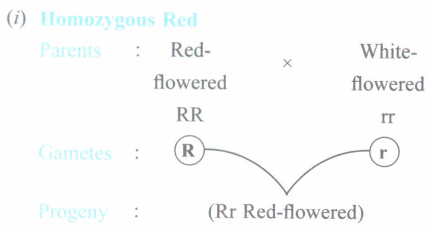
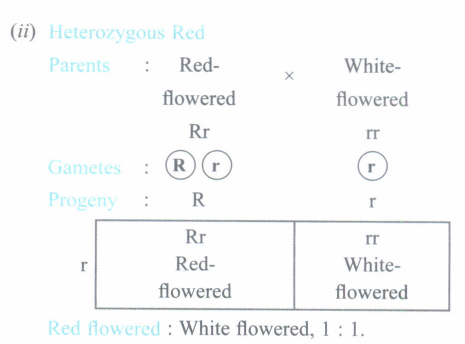
2.In snapdragon, when a red-flowered plant is crossed to a white-flowered plant, the progeny would consist of pink-flowered plants.
3.So, red-flowered plants are homozygous dominant, while heterozygous condition produces pink-flowered plants.
4.The cross is as follows:
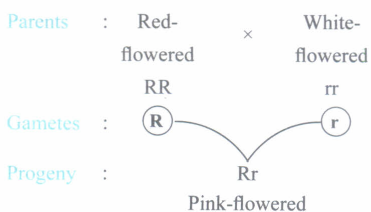
5.It is because of incomplete dominance, where neither of the two alleles is completely dominant over the other and the hybrid is intermediate between the two i.e. pink-flowered.
14.
Microsporogenesis :
(i)When the anther develops, each cell of sporogenous tissue functions as microspore mother cell (MMC) or pollen mother cell (PMC) and undergoes is meiotic divisions to form microspore tetrads.
(ii) The process of formation of microspores from a pollen mother cell (PMC) through meiosis is called microsporogenesis.
(iii) The microspores get arranged in a cluster of four cells and hence are microspore tetrad.
(iv) As the anthers mature and dehydrate, the microspores dissociate from each other and develop into pollen grains
(v) In each microsporangium, thousands of pollen grains are formed and released with the dehiscence of anther.
15.
a) Structure of ovum. Most animal eggs are spherical or oval, non-motile but on close examination
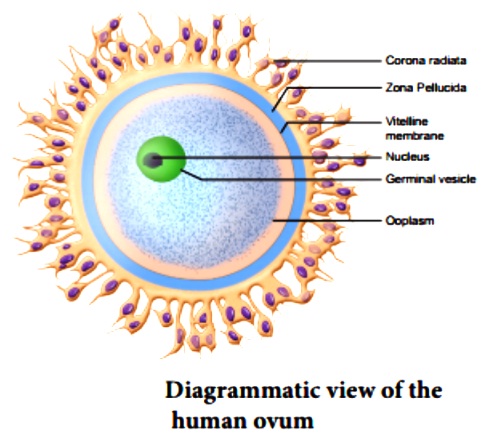
it is noted that one pole is different from the other. The pole from which polar bodies are given off is called animal pole while the opposite is termed as vegetal pole. Thus it is said to have polarity. Thus various
cytoplasmic substances are distributed along the axis in unequal manner. The nucleus also called (germinal vesicle) having chromatin network is surrounded by nuclear membrane. It also contains prominent nucleolus. All animal eggs contain some reserve material to provide food called yolk. The cytoplasm of ovum is called ooplasm. It lacks centrosome but contains cortical granules derived from Golgi bodies in its outer region termed cortex.
(b) Function of Zona pellucida. During fertilisation as a result of cortical reaction, zona pellucida hardens and prevents the entry of additional sperms (polyspermy).
16.
(c)
17.
(b)
18.
(d)
19.
(b)
A - 3, B - 1, C - 4, D - 2
20.
(b)
A - 2, B - 1, C - 4, D - 3
21.
(c)
adaptive radiaton
22.
(b)
Smaller populations
23.
(a)
lactose is present and it binds to the repressor
24.
(c)
3
25.
(a)
males and females, respectively
26.
(d)
suppress sperm motility
27.
(a)
Mutualism
28.
(i) (b) : MTP is comparatively safe upto 12 weeks (the first trimester) of pregnancy. It becomes more risky after the first trimester period of pregnancy as the fetus becomes intimately associated with the maternal tissues.
(ii) (c) : MTP helps to get rid of unwanted pregnancies due to casual unprotected intercourse, or where pregnancy can be harmful to either mother or fetus.
(iii) (d) : Child detected with congenital heart disease can be aborted upto 28th week of pregnancy under the guidance of family physician and the gynaecologist.
(iv) (a) : Government ofIndia legalised MTP in 1971 with some strict conditions to avoid its misuse.
(v) (a) : MTP is comparatively safe upto 12 weeks (the first trimester) of pregnancy. It becomes more risky after the first trimester period of pregnancy as the fetus becomes intimately associated with the maternal tissues.
29.
(i) (d): DNA is the genetic material in E. coli. RNA is the genetic material in Tobacco Mosaic virus and Q\(\beta\) bacteriophage.
(ii) (a): The presence of thymine in DNA at the place of uracil which is present in RNA provides additional stability to DNA.
(iii) (d)
(iv) (a)
(v) (b): Purines present in DNA and RNA are adenine and guanine, while pyrimidines present in DNA are cytosine and thymine and pyrimidines present in RNA are cytosine and uracil.
30.
(b) If both Assertion and Reason are true but Reason is not the correct explanation of Assertion.
Explanation:
Reusable contraceptives do not guarantee prevention from accidental pregnancy.
31.
(c) If A is true, but R is false
32.
(a) Both A and R are true and R is the correct explanation of A.
A single stranded DNA or RNA, tagged with a radioactive molecule called probe is allowed to hybridise to its complementary DNA in a clone of cells followed by detection using autoradiography.
33.
(c) : Monohybrid cross is a cross between two organisms of a species which, is made to study the inheritance of a single pair of alleles or factors of a character. Dominant character is one of a pair of alleles which can express itself whether present in homozygous or heterozygous state. In F1 generation, (the generation of hybrids produced from a cross between the genetically different homozygous individuals called parents the progenies are heterozygous dominant.

12th Standard CBSE Syllabus & Materials
12th Standard CBSE
CBSE 12th Computer Science Python Revision Tour I - New Previous year Question Papers Study Material - QB365 Set A
NEW12th Standard CBSE
CBSE 12th Business Studies Planning Important Questions And Answers Study Material - QB365 Set A
NEW12th Standard CBSE
CBSE 12th Business Studies Business Environment Important Questions And Answers Study Material - QB365 Set A
NEW12th Standard CBSE
CBSE 12th Business Studies Principles of Management Important Questions And Answers Study Material - QB365 Set A



NCERT Books

Syllabus

Exam Pattern

Sample Question Papers

Previous year Question Papers

Important Notes

MCQ Practice test

NCERT Exemplers

Case study Questions

Image Based Questions

Passage based Questions

HOT Questions

Value Based Questions

Model Questions Papers
NCERT ( Book Back ) Questions

Assertion and Reason
Important Questions And Answers

CBSE 12th Standard CBSE Subjects
CBSE Standards








