
 100% FREE ACCESS
12th Standard CBSE Syllabus & Materials
12th Standard CBSE
CBSE 12th Economics Government Budget and the Economy Previous year Question Papers Study Material - QB365 Set A
NEW12th Standard CBSE
CBSE 12th Computer Science Interface Python with MySQL - New Previous year Question Papers Study Material - QB365 Set A
NEW12th Standard CBSE
CBSE 12th Computer Science Database Concept - New Previous year Question Papers Study Material - QB365 Set A
NEW12th Standard CBSE
CBSE 12th Computer Science Data Communication - New Previous year Question Papers Study Material - QB365 Set A
NEW12th Standard CBSE
CBSE 12th Computer Science Data Structures - New Previous year Question Papers Study Material - QB365 Set A
NEW12th Standard CBSE
CBSE 12th Computer Science Functions - New Previous year Question Papers Study Material - QB365 Set A

Published on: 23/07/2018
Some of the important questions are covers in this question paper. In this question paper, it covers the entire chapter of the current academic year.
Download CBSE Class 12th Standard CBSE Biology question papers, sample papers, important questions, and previous year solved papers in PDF format. Get free study materials, NCERT solutions, and exam preparation resources for Class 12th Standard CBSE Biology
Questions + Answers key
Take MCQ Biology Test
1.
Ina normal pregnant woman, the amount of total gonadotropin activity was assessed. the result expected was
High level of circulating FSH and LH in the uterus to stimulate implantation of the embryo
High level of circulating HCG to stimulate endometrial thickening
High level of FSH and LH in uterus to stimulate endometrial thickening
high level of circulating Hcg to stimulate estrogen and progesterone synthesis
2.
The haploid content of human DNA is
3.3x10⁹bp
3.3x10⁹kbp
4.6x10⁶bp
48501 bp
1.65x10⁹bp
3.
Which of the following is an abiotic component of the ecosystem?
Bacteria
Humus
Plants
Fungi
4.
The test-tube baby programme employs which one of the following techniques
Intra cytoplasmic sperm injection (ICSI)
Intra uterine insemination (IUI)
Gamete intra fallopian transfer (GIET)
Zygote intra fallopian transfer (ZIFT)
5.
Milky water of tender coconut is
Liquid gametes
liquid nucellus
Liquid female gametophyte
Liquid embryo
Liquid endosperm
6.
Saccharomyces cerevisiae is used for production of
Bread
Ethanol
Both (a) and (b)
Acetic acid
7.
Temin and Baltimore are associated with the discovery of
RNA synthesis
Transcription
Reverse transcription
photorespiration
8.
Which of the following statements true of date plam?
It is monoecious producing both staminate flowers and pistilate flowers in the same plant.
It is monoecious producing staminate flowers in one tree and pistillate flowers in another tree.
It is dioecious producing staminate flowers in one tree and pistillate flowers in another tree.
9.
Which of the following statements is true of yeast?
The cell divides by binary fission. One of them develops into a bud.
The cell divides unequally. The smaller cell develops into a bud.
The cell produces conidia, which develop into a bud.
10.
Give the ill effect of benzpyrene. Mention its sources also.
11.
What factors increased the hunting of animals?
12.
What is a deme?
13.
Placenta acts as an endocrine tissue. Justify.
14.
Name one example for each of the following :
A plant in which separate male and female flowers are borne on the same individual at different positions.
15.
List two primary factors for the increase in human population.
16.
Name the various groups of viruses which act as carcinogenic factors.
17.
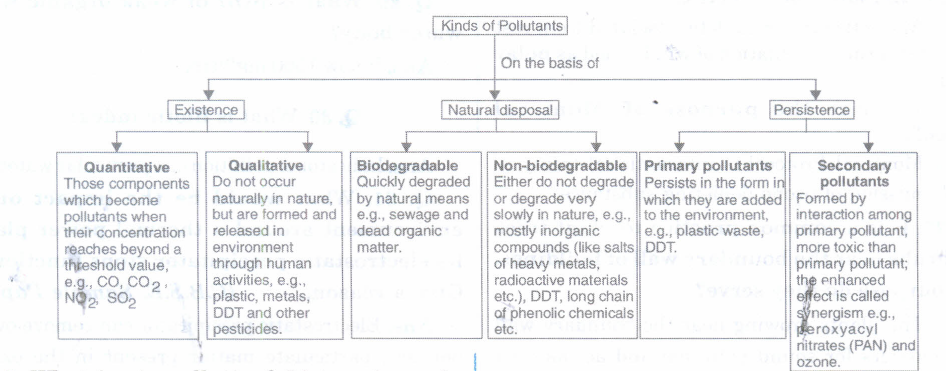
Write main kinds of pollutants.
18.
Give a brief account of loss of biodiversity at global level.
19.
What is the difference between cloning and expression vectors?
20.
There is greater biodiversity in tropical/subtropical regions than in temperate region.Explain.
21.
Mention how e-waste is produced and disposed off. Write the solution for its treatment.
22.
Many microbial pathogens enter the gut of humans along with food.What are the preventive barriers to protect the body from such pathogens?What type of immunity do you observe in this case?
23.
Who proposed the biogenetic law? Who disapproved it? Why?
24.
What are genetically modified organisms? Name two factors on which their behaviour depends.
25.
Name any four crop plants pollinated by honeybee.
26.
Mention the two assumptions that led to HGP
27.
Thalassemia \(\alpha\) is different from thalassemia \(\beta\). Justify.
28.
Define ovulation.When does it occur?
29.
Unicellular organisms are immortal, whereas multicellular organisms are not. Justify.
30.
Does light factor affect the distribution of organisms? Write a brief note giving suitable examples of either plants or animals.
31.
What is air pollution? Write the preventive measures for air pollution.
32.
What are three types of ecological pyramids? What information is conveyed by each pyramid with regard to structure, function and energy in the ecosystem?
33.
Differentiate: (a)hypocotyl and epicotyl
(b) Coleoptile and coleorhiza
(c) Integument and testa
(d) Perispern and pericarp.
34.
(ii) Explain a monohybrid cross, taking seed coat colour as a trait in pisum sativum. Work out the cross upto F2 generation.
(ii) State the laws of inheritance that can be derived from such a cross.
(iii) What is the phenotypic ratio in a dihybrid cross?
35.
Explain with help of a diagram, the development of a mature embryo sac from a megaspore mother cell in an angiosperm.
36.
You must have seen your mother adding 3-4 globules of yeast to the idli paste she has prepared. Similarly, brewing industry uses yeast in the manufacture of alcohol.
(a) How does such a small amount of yeast added help to produce thousands of litres of alcohol? Explain how yeast multiples so fast.
(b) Name the process carried out by yeast in these cases.
(c) What value is learnt from these?
37.
(a) Mention those red list categories which together are referred to as 'threatened species'.
(b) What are rare species? Are these endangered or vulnerable at present? Give any one example of rare species in India.
38.
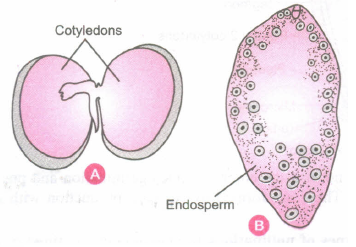
Which one of the following is responsible for nourishment to the developing embryo? Answer giving reasons.
39.
Which one is advance- external fertilization or internal fertilization? Give reasons in support of your answer.
40.
(a) Some men have abnormally low sperm count in seminal fluid. Also, some women cannot normally conceive because of any of the following reasons:
(i) They cannot produce ova,
(ii) They have blocked oviducts, or
(iii) They have spermicidal secretions in the vagina.
In such couples, one technique is commonly used. Name that Assisted Reproduction Technique.
(b) At what stage, fertilized egg is transferred into the fallopian tube or uterus of the mother in this technique?
41.
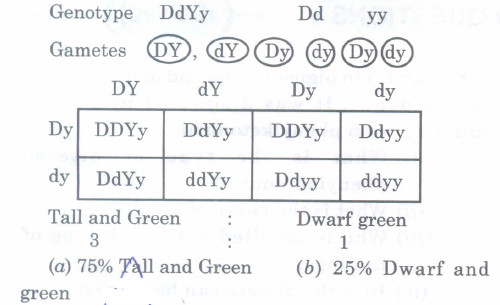
In a cross between a tall pea plant with yellow seeds (DdYy) and plant with green seeds (DdYy), what proportion of the offsprings could be expected to be:
(a) Tall and green;
(b) dwarf and green?
42.
Discuss the importance of artificial selection in the derivation of the concept of natural selection.
43.
(a) Read the graph given above and correlate the uterine events that take place according to the hormonal levels on
(i) 6-15 days
(ii) 16-25 days
(iii) 26-28 days(if the ovum is not fertilized)
(b) Specify the sources of the hormones mentioned in the graph.
44.
Why do we refer to offspring, formed by asexual method of reproduction as clones?
45.
How can diseases be broadly classified?Differentiate between them.
46.
How does an algal bloom cause eutrophication of a water body? Name the weed that can grow in such a eutrophiclake.
47.
Describe any three reproductive strategies that organisms have evolved in relation to a particular set of selective pressures.
48.
Write short notes on RNA polymerases of eukaryotic cells.
49.
It is not possible to study the inheritance of traits in humans, the same way as in peas. Give two main reasons for it and name the alternative method employed for such a study.
50.
Name the three parts of pistil and mention one function of each of them.
51.
Mention any six reproduction-related problems/issues.
52.
State the name of the hormone which is secreted by corpus luteum.
53.
What are omnivores?
54.
What is the meaning of the term vehicle in genetic engineering ?
55.
Write the most important characteristic that aspergillus niger, Clostridium acetobutylicum and Lactobacillus share?
56.
Give two examples of disease caused by protozoans.
57.
Name the ancestor of Bryophytes.
58.
By what Latin name, is the first human-like being, the hominid known?
1.
(d)
high level of circulating Hcg to stimulate estrogen and progesterone synthesis
2.
(a)
3.3x10⁹bp
3.
(b)
Humus
4.
(d)
Zygote intra fallopian transfer (ZIFT)
5.
(d)
Liquid embryo
6.
(a)
Bread
7.
(c)
Reverse transcription
8.
(c)
It is dioecious producing staminate flowers in one tree and pistillate flowers in another tree.
9.
(b)
The cell divides unequally. The smaller cell develops into a bud.
10.
Benzopyrene causes cancer. Its source are tobacco smoke, coal and oil combustion, road and roof tar.
11.
Invention of firearms and recognition of hunting as a sport.
12.
Small group of large population are called demes. Members of a deme usually mate among themselves they are closer together.
13.
Placenta secretes human chorionic gonadotrophin (hCG), estrogens, progesterone and human placental lactogen
14.
Zea-mays (Maize)
15.
(i) Decrease in death rate, and
(ii) increase in longevity
16.
(1) The Herpsevirus group.
(2) The papovavirus group
(3)The poxvirus group.
(4) The Oncornavirus group.
17.
Pollutants are of two types:
18.
The colonisation of tropical Pacific Islands by human beings has led to the extinction of more than two thousand species of native birds.
IUCN red list(2004) documents the extinction of 784 species in the last 500 years that include 359 invertebrates, 338 vertebrates and 87 plants.
Some of the animals that have become extinct in recent times are given below;
(i) steller's sea cow (Russia)
(ii) Dodo (Mauritius)
(iii) Thylacine (Australia)
(iv) Quagga (Africa)
(v) Three sub-species (Bali, Javan, Caspian) of tiger.
(iv) 27 species have become extinct in last twenty years alone.
(vii) Amphibians are more vulnerable to extinction.
Though about 15,5000 species are facing extinction, at present the following face the threat of extinction:
(i) 31% of gymnosperms
(ii) 32% of amphibians
(iii) 12% of bird species
(iv) 23% of mammals
Since the origin of life on earth and evolution, three have been five episodes of mass extinction, but the current rate of extinction is 100 1000 times faster than them, due to human activities.
19.
All vectors that are used for propagation of DNA inserts in a suitable host are called cloning vectors. When a vector is designed for the expression of, i.e., production of the protein specified by, the DNA insert, it is termed as expression vector.
20.
India has high ecological diversity due to variety of topography, soil types, climates, rainfall zones, sea coasts.islands, etc. Ten well demarcated biogeographical zones with different biota occur in India.
21.
(i) Irreparable computers and (ii) other electronic gadgets.
(i) Incineration and (ii) burying in the landfills.
(a) In developing countries, they are recycled involving manual labourers.
(b) In developed countries, they are recycled in specifically built chambers, without involving manual labourers.
22.
(i) The mucus coating of the gut epithelium is a barrier that traps microbes.
(ii) The hydrochloric acid secreted by gastric glands retards the growth of microbes.
This type of immunity is called innate immunity, which occurs right from birth.
23.
1. Ernst Haeckel proposed embryological support for organic evolution.
2. It was disapproved by Ernst Von Baer.
3. He noted that embryos never pass through the adult stage of other animals.
24.
Plants, fungi, bacteria and animals whose DNA has been manipulated to possess and express a foreign DNA, are called, genetically modified organisms or transgenic organisms.
The factors are:
(i) The nature of gene transferred.
(ii) The nature of the host cell.
25.
Apple, pear, sunflower, Brassica sp.
26.
The two assumptions are
(i)Genetic make up of an organism lies in the DNA-sequences
(ii)If two individuals differ then their DNA sequences also be different.
27.
| Thalassemia \(\alpha\) | Thalassemia \(\beta\) |
| It is under the control of two genes HBA1 and HbA2 on chromosome 16. |
It is controlled by a single gene HBB on chromosome 11. |
| The synthesis of \(\alpha\) chain is impaired | The synthesis of \(\beta\) chain is impaired. |
28.
Ovulation is the process of rupture of a mature Graafian follicle and the subsequent release of ovum from it.
It occurs around the 14th day/middle of the menatrual cycle.
29.
1. Since single-celled organisms reproduce by cell division (into two individuals), there is no natural death for them and hence, they are considered immortal.
2. In multicellular organisms, reproduce occurs in specialised organs involvin specialised cells; their body as a whole dies due to ageing and senescence.
30.
Plants require sunlight for photosynthesis. Therefore, light is an important factor that affects the distribution of plants, e.g.,
(i) Many species of small plants (herbs and shrubs) growing in forests are adapted to photosynthesis optimally under very low light conditions so they are seen distributed in shady areas under tall, canopied trees.
(ii) Many plants in the shade will grow vertically to gain access to light. These plants will appear to have maller4 leafs than others of the same species of the same age found in conditions with better sunlight.
(iii) Large sized trees will be present in areas that get abundant sunlight.
(iv) Plants dependent on sunlight to meet their photoperiodic requirements of flowering, will try to be distributed in area where this requirement is being met for their reproductive success.
31.
Air pollution. Air pollution refers to the release into the atmosphere of materials that are harmful to man, other animals, plants and buildings or other objects.
Preventive measures for air pollution
To prevent and control air pollution two types of measures can be adopted.
1. Instead of releasing poisonous gases containing various pollutants into the atmosphere they could be destroyed or used by some other measures.
2. Converting harmful pollutants to harmless products and then releasing them into the atmosphere.
32.
(a) Removal of all producer reduce primary production in the ecosystem. Hence, no biomass will be available to the successive/higher trophic level or heterotrophic organisms.
(b) Elimination of all organisms of herbivore level results into an increase in primary productivity and biomass of producer and carnivorous animal will not survive due to availability of food due to elimination of herbivores.
(c) Removal of top carnivores also disturb the ecosystem as it will result in huge increase in number of herbivores which will finish plants (producers) creating desertification.
33.
(a) Hypocotyl and epicotyl. Hypocotyl is part of stem below cotyledons in the embryo of a plant and epicotyl is part of stem above cotyledons.
(b) Coleoptile and coleorhiza. Coleoptile is the sheath around the plumule. Coleorphiza is a sheath enveloping the radicle and root cap in certain plants.
(c) Integument and testa. Any protective covering around ovule is integument and testa is outer integument of seed coat.
(d) Perispern and pericarp. Pericarp is wall of ripened ovary of fruit and perisperm is remnant of nucellus in a seed.
34.
(i) In a monohybrid cross, when homozygous dominant and honozygous recessive parents arc crossed, F1- hybrid would be heterozygous for the trait and would express the dominant allele.
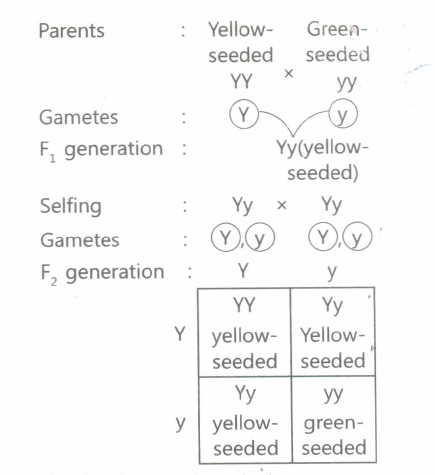
(ii) The hybrid is heterozygous containing both alternative alleles (Y and y) but only one trait, i.e. yellow colour appeared and green colour trait is suppressed in F1 -generation.
This shows that yellow seed colour is dominant over the green seed colour trait. This explains Mendel's law of dominance.
(iii) Phenotypic ralio in Fgeneration, Yellow seeds :Green seeds (3 : 1) in monohybrid cross andin dihybrid cross 9:3 :3: 1.
35.
Development of Female Gametophyte:
- The megaspore mother cell undergoes meiosis to form four megaspores.
- Three of them degenerate and the functional megaspore enlarges to form the embryo sac.
- Its haploid nucleus undergoes a mitotic division and the two daughter nuclei move towards the poles.
- Each of them undergoes two successive mitotic divisions.
- Cell wall formation starts in the 8-nucleate stage.
- Three of them at the micropylar end form the egg apparatus, consisting of a female gamete and two synergids.
- Three of them at the chalazal end form the antipodal cells.
- One nucleus from each of the poles moves to the centre; they are called polar nuclei.
- The two polar nuclei fuse in the centre (now the central cell) to form a diploid secondary nucleus.
- Thus, the mature embryo sac is 7-celled and 8-nucleate.
36.
(a) Yeast multiplies by budding very fast In yeast, the cell division is unequal and results in a large cell and a small cell, called bud which remains attached to the large cell; the bud gets separated and grows into an adult yeast.
The yeast cells secrete enzymes to produce alcohol.
(b) It carries out the process of fermentation.
(c) Mother shows how to make use of the natural processes and to live with nature and to appreciated how such microbes are useful to us; try to help others.
37.
(a) Species belonging to critically endangered, endangered, vulnerable and lower risk categories are referred to as 'threatened species'.
(b) Rare species normally have small populations in the world. They are confined to limited areas or are thinly distributed over a more wide area.
They are not endangered or vulnerable at present but have risk of becoming so because of their small numbers.
Example of rare species : Great Indian bustard in some parts of Gujarat and Rajasthan.
38.
The part responsible for supplying nourishment to the developing embryo is (B) Endosperm because embryo development occurs in the endosperm which is specially meant food to the developing embryo. Cotyledons are the parts of mature embryo which supply food during seed germination.
39.
External fertilization is primitive and internal fertilization is advance. External fertilization is not advanced because it occurs outside the body of the organisms, mostly in water in most aquatic organisms so that a large number of gametes are wasted. Moreover, the offsprings are not protected from predators and their survival threatened.
40.
(a) This technique is called test tube baby.
(b) Zygote or early embryo (upto 8 blastomere stage) is transferred into the fallopian tube of mother (ZIFT, zygote intra fallopian transfer) or embryo with more than 8 blastomeres in transferred into the uterus of the mother (Intra uterine transfer or IUT).
41.
\(F_{ 1 }\) generation Parents Tall, Yellow seeds x Tall green seeds Genotype DdYy Dd yy
42.
Importance of artificial selection: From his enquiries on breeding domesticating plants and animals, Darwin obtained clear evidence for selection, in the case of artificial selection. The breeders selected and perpetuated those variant types that interested them or seemed to be useful for them. Similar to artificial selection, natural selection also controls the speciation. But natural selection is too slow to observe.
43.
(a) (i) It is the follicular phase, when the endometrium of uterus regenerates through proliferation.
(ii) Secretion of progesterone maintains the endometrium, which is necessary for implantation of embryo.
In the absence of fertilisation, the endometrium disintegrates, leading to menstruation.
Estrogen is secreted by the follicle cells of the ovary.
Progesterone is secreted by the corpus luteum of ovary.
44.
Offspring formed by asexual reproduction referred to as clones because they are morphologically, physiologically and genetically similar to the parent.
45.
Diseases can be broadly classified as
(i) Infectious diseases,and
(ii) Non-infectious diseases
|
Infectious Diseses |
Non-infectious Diseases |
|
These are the diseases,which are easily transmitted from one person to the other. |
These are the diseases which are not transmitted from one person to the other. |
|
They are caused by biological agents,called pathogens. |
They occur due to deficiencies,habits,hereditary factors,etc. |
46.
Algal bloom, the excess growth of planktonic algae is stimulated by contaminants like nitrates and phosphates.
1. The excess growth of algae causes an unsightly scum and decreases the dissolved oxygen content of the water body.
2. Consequently fish populations and other aquatic organisms die.
3. The decomposition of these dead and decaying organic matter causes further depletion of the dissolved oxygen content of the water.
4. The organic matter increases and the eutrophication becomes accelerated. Water hyacinth (Eichhornia crassipes) grows in the eutrophic water.
47.
Reproductive strategies:
(i) Some organisms breed only once in their life time-e.g. Bamboo, Pacific Salmon.
(ii) Some produce a large number of small-sized offspring-Oysters.
(iii) Some breed many times during their life time-e.g. birds.
(iv) Some produce a small number of large sized offspring, e.g. Mammals.
48.
In eukaryotes, there are three RNApolymerases.
(i) RNA-polymerase I catalyses transcription of rRNAs (28 S, 18 Sand 5.8 S).
(ii) RNA- polymerase II catalyses transcription of precursor of mRNA; it is called hnRNA.
(iii) RNA- polymerase III catalyses tRNA, 5srRNA and snRNAs.
49.
(i) Controlled crosses cannot be made.
(il) The progeny produced is very small (usually one).
(iii) They have a long generation time of about 20 years.
The alternate method is called pedigree analysis, which is a system to follow the movement and distribution of genetic traits in a series of generations in the family.
50.
The three parts of a pistil and their functions are:
(i) Stigma - it acts as the platform where the pollen grains are lodged during pollination.
(ii) Style - it exposes the stigma for easy pollination.
(iii) Ovary - it encloses the ovule(s) inside which is the female gametophyte.
51.
(i)Pregnancy
(ii)Delivery
(iii)STDs
(iv)Abortions
(v)Contraception
(vi)Menstrual problems
(vii)Infertility
52.
()
Progesterone
53.
()
Animals that take both animals and plant food.
54.
()
The word vehicle is used as substitute for vector which transports the gene.
55.
()
Fermentation to produce organic acids on commercial scale.
56.
()
Malaria,Amoebiasis
57.
()
Chlorophyta (Green algae).
58.
()
Homo habilis is the first hominid.

12th Standard CBSE Syllabus & Materials
12th Standard CBSE
CBSE 12th Computer Science Python Revision Tour I - New Previous year Question Papers Study Material - QB365 Set A
NEW12th Standard CBSE
CBSE 12th Business Studies Planning Important Questions And Answers Study Material - QB365 Set A
NEW12th Standard CBSE
CBSE 12th Business Studies Business Environment Important Questions And Answers Study Material - QB365 Set A
NEW12th Standard CBSE
CBSE 12th Business Studies Principles of Management Important Questions And Answers Study Material - QB365 Set A



CBSE 12th Standard CBSE Subjects
CBSE Standards










