
 100% FREE ACCESS
12th Standard CBSE Syllabus & Materials
12th Standard CBSE
CBSE 12th Economics Government Budget and the Economy Previous year Question Papers Study Material - QB365 Set A
NEW12th Standard CBSE
CBSE 12th Computer Science Interface Python with MySQL - New Previous year Question Papers Study Material - QB365 Set A
NEW12th Standard CBSE
CBSE 12th Computer Science Database Concept - New Previous year Question Papers Study Material - QB365 Set A
NEW12th Standard CBSE
CBSE 12th Computer Science Data Communication - New Previous year Question Papers Study Material - QB365 Set A
NEW12th Standard CBSE
CBSE 12th Computer Science Data Structures - New Previous year Question Papers Study Material - QB365 Set A
NEW12th Standard CBSE
CBSE 12th Computer Science Functions - New Previous year Question Papers Study Material - QB365 Set A

Published on: 03/10/2019
Evolution
Download CBSE Class 12th Standard CBSE Biology question papers, sample papers, important questions, and previous year solved papers in PDF format. Get free study materials, NCERT solutions, and exam preparation resources for Class 12th Standard CBSE Biology
Questions + Answers key
Take MCQ Biology Test
1.
(a) Write Hardy-Weinberg principle.
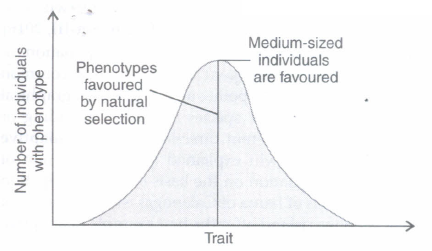
(b) Explain the three different ways the natural selection can affect the frequency of a heritable trait in a population shown in the graph given below.
2.
How they are considered as an evidence of evolution.
3.
(i) List any four evidences of evolution.
(ii) Explain any one of the evidences that helps to understand the concept of evolution.
4.
State the modifications of forelimb in animals as an example of homology.
5.
One day, while returning home from school, Anil saw a crowd gathering front of Mr. Sharma's house. He asked his mother about it. She told that Mrs. Sharma gave birth to a child with small tail. Many people gathered just for curiosity and some whispered that it is a bad omen.
Read the above passage and answer the following questions:
(i) What is your opinion about child?
(ii) What is atavism?
(iii) What will be your role as a good citizen and student of biology?
6.
Two organisms occupying particular geographical area show similar adaptive strategies. Taking examples, describe the phenomenon.
7.
Name the law that states that the sum of allelic frequencies in a population remains constant. What are the five factors that influence these values?
8.
(a) Explain taking one example of vertebrate anatomy, that evolution of life has occurred on earth.
(b) 'Nature selects for fitness'. Explain with suitable example.
9.
(a) Name the primates that lived about 15 million years ago. List their characteristic features.
(b) (i) Where was the first man-like animal found?
(ii) Write the order in which Neanderthals, Homo habilis and Homo erectus appeared on the earth. State the brain capacity of each one of them.
(iii) When did modern Homo sapiens appear on this planet?
10.
(a) List the various causes of variations in the progeny of a population.
(b) Describe the three different ways in which natural selection operates in nature, with regard to organic evolution.
1.
(a) Hardy-Weinberg's principle says that allele frequencies in a population are stable and constant
from generation to generation. The gene pool remains constant. This is called genetic equilibrium.
Sum total of all the allelic frequencies is 1. Individual frequencies, e.g., can be named p, q, etc.
Natural selection disturbs the allelic frequencies. Through natural selection either the frequency of
p increases or the frequency of q it will disturb the natural frequency. In a diploid, p and q represent the frequency of allele A and allele a. The frequency of AA individuals in a population is simply p2. This is simply stated in another ways , i.e., the probability that an allele A with a frequency of p appear on both the chromosomes of a diploid individual is the product of the probabilities.
Hence, p2 + 2pq + p2 = 1
The factors that affect the Hardy-weinberg's equilibrium are :
(i) Migration
(ii) Gene flow
(ill) Genetic drift
(iv) Mutation
(v) Genetic recombination
(b) Variation due to mutation or recombination during gametogenesis or due to gene flow or genetic drift results in changed frequency of genes and alleles in future generation. Natural selection can lead to stabilization (in which more individuals acquire mean character value), directional change (more individuals acquire value other than the mean character value) or disruption (more individuals acquire peripheral character value at both ends of the distribution curve).
2.
Analogy and homology of structures indicate the evidences of evolution from comparative study of morphology and anatomy of form, structure, relative position of different organs and their functions. Analogy indicates that similar environmental conditions and habitat result in the selection of similar adaptive features in different groups of organisms towards the similar function.
This shows the evolution of similar functional structures from unrelated organs. This is the result of convergent evolution.
Homology includes the organs having similar structure origin and development, developed to have different forms so as to perform different functions in different groups of organisations. This phenomenon of producing functionally different forms from structurally similar organs is the result of divergent evolution. It indicates towards the common ancestory.
3.
(i) Four evidence = Fossils/ comparative anatomy/homologous organs/Analogous organs / Bio- Chemical evidences/embryological evidences.
(ii) Any one evidence explained
Definition / concept
Example
How it explains evolution
4.
The forelimb of vertebrates are pentadactyl, i.e. consist of same bones humerous, radius, ulna, carpals, metacarpals and phalangers, but differ in their function in different organisms. The forelimbs of the following animals got modified as shown below:
(i) Whale are modified for swimming
(ii) Bat and bird are modified for flying.
(iii) Horse are modified for running
(iv) Frog are modified for leaping.
(v) Man are modified for grasping.
The indicates common ancestry and homology based on divergent evolution.
5.
(i) Actually, the child is normal and carries the vestigial organ, i.e., remnant of last vertebra.
(ii) It refers to the reappearance of structures that were dominant in our remote ancestors.
(iii) As a good citizen and a biology student, I will educate people about vestigial organs and phenomenon of atavism so that they stop believing in myths.
6.
This phenomenon indicated in the questions is convergent evolution where by organisms, not closely related, evolve similar environment e.g.,
(i) Streamlined shape of sharks and dolphins. The former is a fish, while dolphin is a mammal, but both of them depend on swift movement through the water so a streamlined shape is essential. Thus, it is the similar habitat that resulted in selection of similar adaptive features in different groups of organisms, but toward the same funcion.
(ii) Spines and thorns, both look similar and provide protection to the plant, but the plants to which they belong are distantly related.
7.
Hardy-Weinberg Principle: States that the sum of allelic frequencies in a population is stable and is constant from generation to generation, i.e., the gene pool in a population remains constant. This is called genetic equilibrium remains constant. This is called genetic equilibrium. The sum total of all the allelic frequencies is
Hardy-Weinberg's Equilibrium p2+q2+2pq = Five factors that influence these values are
1. The Five factors which affect Hardy-Weinberg's equilibrium are as follows:
1. Gene migration: When some individuals of a population migrate to other populations or when certain individuals come into a population, some genes are lost in the first case and added in the second.
2. Genetic drift: Random changes in the allele frequencies of a population occurring only by chance, constitute genetic drift. The change in allele frequency may become so drastically different that they from a new species.
3. Mutations: The mutations are random and occur at very slow rates, they are suffiicient to create considerable genetic variation for speciation to occur.
4. Recombination: New combinations of genes occur due to crossing over in meiosis during gametic formation.
5. Natural selection: It is the most critical evolutionary process, that leads to changes in allele frequencies and favours adaptation as a product of evolution.
8.
(a)The forelimbs of cheetah, whales, bats and humans have a similar anatomical structure.
All of them have the bones, humerus, radius, ulna, carpals, metacarpals and phalanges.
It indicates divergent evolution where the same structure has developed along different directions as adaptations to different needs.
Such structures are called homologous organs and homology indicates common ancestry.
(b) Nature selects for fitness.
We must remember that fitness is based on the characteristics which are inherited.
So there must be a genetic basis for getting selected and to evolve; in other words, there are some organisms which are better adapted to survive in an otherwise hostile environment.
Adaptive ability is inherited and it has a genetic basis; hence fitness is the end result of the ability to adapt and get selected by nature.
9.
(a) Dryopithecus and Ramapithecus:
Characteristics:
(i) They were hairy.
(ii) They walked like gorillas and chimpanzees.
(iii) Ramapithecus was more man-like while Dryopithecus was more ape-like.
(b) (i) East African grasslands.
(ii) Homo habilis, Homo erectus and Neanderthals had brain capacities of 650-800 cc, 900 cc and 1400 cc, respectively.
(iii) During the ice age between 75,000-10,000 years ago.
10.
(a) (i) Mutation,
(ii) genetic recombination during gametogenesis,
(iii) gene flow and
(iv) genetic drift.
(b) Different ways in which natural selection results in different populations include the following:
(i) Stabilisation - More individuals acquire mean character value, i.e. variation is much reduced.
(ii) Directional change - More individuals acquire value other than the mean character value.
(iii) Disruption - More individuals acquire peripheral character values at both ends of the distribution curve.

12th Standard CBSE Syllabus & Materials
12th Standard CBSE
CBSE 12th Computer Science Python Revision Tour I - New Previous year Question Papers Study Material - QB365 Set A
NEW12th Standard CBSE
CBSE 12th Business Studies Planning Important Questions And Answers Study Material - QB365 Set A
NEW12th Standard CBSE
CBSE 12th Business Studies Business Environment Important Questions And Answers Study Material - QB365 Set A
NEW12th Standard CBSE
CBSE 12th Business Studies Principles of Management Important Questions And Answers Study Material - QB365 Set A



CBSE 12th Standard CBSE Subjects
CBSE Standards










