
 100% FREE ACCESS
12th Standard CBSE Syllabus & Materials
12th Standard CBSE
CBSE 12th Economics Government Budget and the Economy Previous year Question Papers Study Material - QB365 Set A
NEW12th Standard CBSE
CBSE 12th Computer Science Interface Python with MySQL - New Previous year Question Papers Study Material - QB365 Set A
NEW12th Standard CBSE
CBSE 12th Computer Science Database Concept - New Previous year Question Papers Study Material - QB365 Set A
NEW12th Standard CBSE
CBSE 12th Computer Science Data Communication - New Previous year Question Papers Study Material - QB365 Set A
NEW12th Standard CBSE
CBSE 12th Computer Science Data Structures - New Previous year Question Papers Study Material - QB365 Set A
NEW12th Standard CBSE
CBSE 12th Computer Science Functions - New Previous year Question Papers Study Material - QB365 Set A

Published on: 25/09/2019
Principles of Inheritance and Variation
Download CBSE Class 12th Standard CBSE Biology question papers, sample papers, important questions, and previous year solved papers in PDF format. Get free study materials, NCERT solutions, and exam preparation resources for Class 12th Standard CBSE Biology
Questions + Answers key
Take MCQ Biology Test
1.
Explain the genetic basis of blood grouping in human population.
2.
Explain Monohybrid cross.
3.
State the law that Mendel proposed on the basis of such a cross.
4.
Haemophilia and sickle-cell anaemia are blood related Mendelian disorders. Yet, they differ in their pattern of inheritance. Explain the difference.
5.
Explain the causes, inheritance patterns and symptoms of any two Mendelian genetic disorders.
6.
(a) A garden pea plant bearing terminal, violet flowers, when crossed with another pea plant bearing axial, violet flowers produced axial, violet flowers in the ratio of 3 : 1.
Work out the cross showing the genotypes of the parent pea plants and their progeny.
(b) Name and state the law that can be derived from this cross and not from a mohohybrid cross.
7.
Why is thalassemia categorised as a Mendelian disorder? Write the symptoms and explain the cause of the disease. How does it differ from the sickle-cell anaemia?
8.
(a) Explain the mechanism of sex determination in humans.
(b) Differentiate between male heterogamety and female heterogamety with the help of an example of each.
1.
Genetic Basis Blood Grouping in human shows the phenomenon ABO blood grouping in human shows the phenomenon of codominance (alleles are able to express themselves independently when present together) and multiple allelism (more than two alleles govern the same character.
2.
Monohybrid cross. It is a cross in which only one character is considered at a time. In a cross between tall and dwarf plant, the size of stem is considered. Mendel made a cross between pure tall
(TT) and a pure dwarf (tt) pea plant as follows:
Mendel selected a tall pea plant represented by genes (TT)and a dwarf pea plant represented by genes (tt). Pea plant is self pollinating. He removed the anthers of tall plant and stigma of dwarf plant, deposited pollen grains of dwarf plant on the stigma of tall plant and obtained seeds.
When the seeds were placed in the soil and allowed to grow he obtained only tall plant (Tt), although he was expecting the plants of an intermediate size. These plants were labelled as plants of First filial generation (\(F_{ 1 }\)
generation). In \(F_{ 1 }\) generation all plants were tall because the character tall is dominant over the dwarf.
He allowed the plants ofY~enerl:!tion to self pollinate. Gametes formed by meiosis contained only
3.
\((i)W-I^{ \wedge }I^{ \wedge }\quad or\quad I^{ \wedge }i;\quad X-ii\\ Y-B-\quad group;Z-AB-group\)
(ii)
(b) Dominance·
It is the phenomenon in which one allele of a gene expresses itself and suppresses the expression of the other (recessive) allele of the same gene, when they are present together in a hybrid.
The hybrid resembles one of the parents.
Codominance:
It is the phenomenon in which two alleles of a gene are equally dominant and express themselves in the presence of the other.
The hybrid shows characters of both the parents.
Incomplete dominance:
It is the phenomenon in which neither of the two alleles of a gene is completely dominant over the other.
The hybrid is intermediate between the two parents.
(iii) Y The allele \(I^{ B }\) dominant over i and hence the phenotype is B-group. Z : The alleles \(I^{ A }\) and \(I^{ B }\) are codominant and both express themselves and the phenotype is AB- group.
4.
Symptoms of Haemophilia:
1.Since a protein necessary for blood clotting is not formed, the blood does not clot and there is non-stop bleeding in case of an injury in the afflicted individual. Symptoms of sickle-cell anaemia.
2. The RBCs become sickle-shaped.
3. The oxygen transport to the tissues is impaired.
Differences
| Haemophilia | sickle-cell anaemia |
| 1. It is due to a defective recessive allele present on the X-chromosomes,i.e. it is a sex-linked disorder. 2. More males than females are affected 3. The female parent passes on the disorder to male progency but father never passes it on to the male progency. |
1.It is due to point mutation i.e. a single base pair change leading to change acid i.e. it is an autosomal disorder. 2. Both males and females are affected . 3. The female parent passes on the disorder to male or female progency in equal frequency also passes on the disorder to male and female progency. |
5.
(i) Sickle-cell anaemia
It is caused by a change of a single base pair in the gene, leading to substitution of glutamic acid by valine. Inheritance pattern
It is transmitted from parents to the offspring, when both the partners are carriers
(heterozygous) of the disease.
Symptoms
The RBCsbecome sickle-shaped.
(ii) Phenylketonuria
It is due to a defective allele on the autosome. Inheritance pattern
It is passed on from the parent who are heterozygous for the gene to the offspring.
The affected individual lacks an enzyme that converts the amino acid phenylalanine into tyrosine; consequently,phenylalanine gets accumulated and converted into phenyl pyruvate and other derivatives.
Symptoms
Accumulation of these compounds in the brain results in mental retardation; they are also excreted in the urine.
6.
(a) Dihybrid cross:
1.Since white flowers have appeared in the progeny, both the parents must be heterozygous for flower colour, i.e. Vv.
2.Since all plants in the progeny have axial flowers, the parent with axialm flowers, must be homozygous for the trait, i.e. AA.
3. Genotypes of the parents are as follows: Terminal, violet flowers : aaVv
Axial, violet flowers: AAVv
Parents : Terminal Violet flowers X Axial Violet flowers
aaVv AAVv
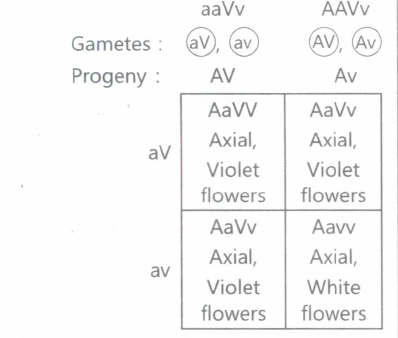
4. The phenotypic ratio:
3 Axial, violet flower 1 axial, white flowers is justified
(b) Law of independent assortment It states that when two pairs of traits are combined in a hybrid, segregation of one pair of traits is independent of the other pair of trait.
7.
Thalassemia is categorised as a Mendelian disorder, because it. is an autosomal, recessively-inherited disorder, whose transmission follows Mendel's laws/ principles of inheritance.
(i) The disease is caused by mutation or deletion of the alleles and there is reduced synthesis of alpha or beta globin chain of hemoglobin.
(ii) The symptom is anemia, which is due to less synthesis of hemoglobin.
| Thalassemia | Sickle-cell anemia |
| It is quantitative problem, where less amount of hemoglobin is synthesised | It is a qualitive problem,where defective hemoglobin (that is non-functional ) is synthesized. |
8.
(a)A female (mother) is homogametic and produces ova, all containing one X-chromosome and 22 autosomes.
A male (father) is heterogametic and produces sperms of two types-50% of them carrying one X-chromosome and the other 50% carrying V-chromosome and 22 autosomes each.
The sex of the child is determined by, the type of sperm fertilising the ovum.
If the ovum is fertilized by a sperm carrying X-chromosome, female child results
If the ovum is fertilised by a sperm carrying V-chromosome, a male child is formed.
.png)
(b)
| Male hetrogamety | Female hetrogamety |
| It is the phenomenon in which the male produces two types of sperms, with reference to the sex-chromosomes. | It is the phenomenon in which the female produces two types of oval,with reference to the sex-chromosomes. |
| The sex of the offspring is determined by the type of sperm fertilising the ovum. | The sex of the offspring is determined by the type of ovum that is fertilised. |

12th Standard CBSE Syllabus & Materials
12th Standard CBSE
CBSE 12th Computer Science Python Revision Tour I - New Previous year Question Papers Study Material - QB365 Set A
NEW12th Standard CBSE
CBSE 12th Business Studies Planning Important Questions And Answers Study Material - QB365 Set A
NEW12th Standard CBSE
CBSE 12th Business Studies Business Environment Important Questions And Answers Study Material - QB365 Set A
NEW12th Standard CBSE
CBSE 12th Business Studies Principles of Management Important Questions And Answers Study Material - QB365 Set A



CBSE 12th Standard CBSE Subjects
CBSE Standards










