
 100% FREE ACCESS
12th Standard CBSE Syllabus & Materials
12th Standard CBSE
CBSE 12th Economics Government Budget and the Economy Previous year Question Papers Study Material - QB365 Set A
NEW12th Standard CBSE
CBSE 12th Computer Science Interface Python with MySQL - New Previous year Question Papers Study Material - QB365 Set A
NEW12th Standard CBSE
CBSE 12th Computer Science Database Concept - New Previous year Question Papers Study Material - QB365 Set A
NEW12th Standard CBSE
CBSE 12th Computer Science Data Communication - New Previous year Question Papers Study Material - QB365 Set A
NEW12th Standard CBSE
CBSE 12th Computer Science Data Structures - New Previous year Question Papers Study Material - QB365 Set A
NEW12th Standard CBSE
CBSE 12th Computer Science Functions - New Previous year Question Papers Study Material - QB365 Set A

Published on: 18/01/2020
Download CBSE Class 12th Standard CBSE Biology question papers, sample papers, important questions, and previous year solved papers in PDF format. Get free study materials, NCERT solutions, and exam preparation resources for Class 12th Standard CBSE Biology
Questions + Answers key
Take MCQ Biology Test
1.
What is LSD?
2.
Coin a term for following:
(i) Within community diversity
(ii) Between community diversity.
3.
The enzyme DNA polymerase on E.coli is a DNA-dependent polymerase and also has the ability to proof-read the DNA strand being synthesised. Explain. Discuss the dual polymerase.
4.
Name a microbe used for the production of 'Swiss Cheese'.
5.
All data palm plants bear flowers but fruits are seen in some. Explain.
6.
When do oogenesis and spermatogenesis initiate in human female and male,respectively?
7.
Observe this diagram and answer the following question.
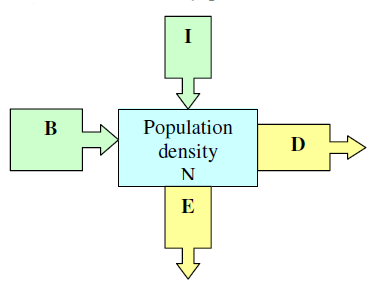
a) What is the terminology for B& E?
b) If B + I is more then D + E then what will happen to population density?
c) What are the most important factors which influence a population density of an area under normal condition?
d) If a habitat is being colonised recently then which factor contribute more to the population growth ?
8.
Give the name of the organism from where the thermostable DNA polymerase is isolated. State its role in genetic engineering.
9.
What is individual's role in the evolutionary process?
10.
(a)Name the infective stage of Plasmodium which Anopheles mosquito take along with the blood meal from an infected human.
(b)Why does the infection cause fever in humans?
(c)Give a flow chart of the part of the life-cycle of this parasite passed in the insect.
11.
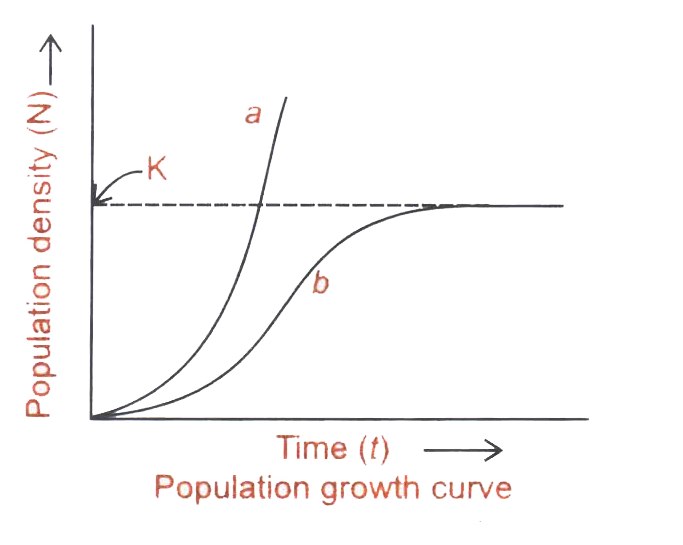
Identify the curves 'a' and 'b' shown in the graph given below. List the conditions responsible for growth patterns 'a' and 'b'.
12.
Match the items given in column A and B:
| Column A | Column B |
|---|---|
|
(a) Catalytic converter |
(i) Particular matter |
13.
What modification is done on the Ti-plasmid of Agrobacterium tumefaciens to convert it into a cloning vector?
14.
In the table given below select and enter the correct device out of the following;
oral pill, condom, copper T,Saheli, vasectomy, diaphragm, tubectomy, cervical cap.
| Method of birth control | Device |
|
1.Barrier |
- |
15.
Differentiate between external and internal fertilisation with examples.
16.
Geeta & her mother were going to market. On they way to market they came across a street play being staged. The play was about the female foeticide. Later Geeta asked her mother as to why the people terminate the female foetus.
(i) How & at what stage of development the determination of sex of the foetus can be done.
(ii) How it can be stopped.
(iii) What values are exhibited by Geeta.
17.
Co-extinction is the loss of species as a results of loss of other species that depends on it. Such effects are likely to be most severe in interactions. State the effect of such type of interaction on both species and an example of each.
18.
Name any one greenhouse gas and its possible source of production on a large scale. What are the harmful effects of it?
19.
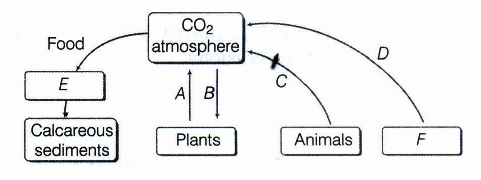
Complete the following model of carbon cycle by filling A,B,C,D,E and F.
20.
Fill in the blanks in the different columns of the table given below:
| Disease | Causative organism | Medium of transfer | Symptoms |
| Filariasis | Wuchereria | (a) | Lymphatic vessels of lower limbs affected |
| (b) | Trichophyton | Using towels of infected person | Dry, scaly leisons on body |
| Common cold | (c) | Droplets from sneezing of infected persons | Affect nose, and respiratory passage, sore throat |
| Ascariasis | Ascaris | Through contaminated water, vegetables and fruits | (d) |
21.
Name the following structures:
(a) Single cotyledon of the monocotyledonous embryo of grass family.
(b) The portion of embryonal axis above the level of cotyledons in dicotyledonous embryo.
(c) Occurrence of more than one embryo in a seed
(d) Seedless fruits produced without fertilization.
22.
Explain how polymerase chain reaction (PCR) technique is helpful in detecting bacterial and viral diseases when symptoms of the disease are not yet visible? Give two examples.
23.
Write the major steps involved in gene cloning.
24.
Match the items given in column I with appropriate items (one or more) of column II.
| Column I | Column II |
| (i) Vasectomy | (a) Progesterone and estrogens |
| (ii) Tubectomy | (b) Coitus interruptus |
| (iii) Oral pills | (c) Acne |
| (iv) Temporary birth control method | (d) Male |
| (v) Adolescents | (e) Female |
| (f) Vas deferens | |
| (g) Oviduct |
25.
How does parturition take place? Which hormones are involved in the induction of parturition?
26.
(i) Give any two striking similarities in the structure of embryos of all the vertebrates.
(ii) What is the significance of such similarities in the significance of such similarities in the concept of organic evolution?
27.
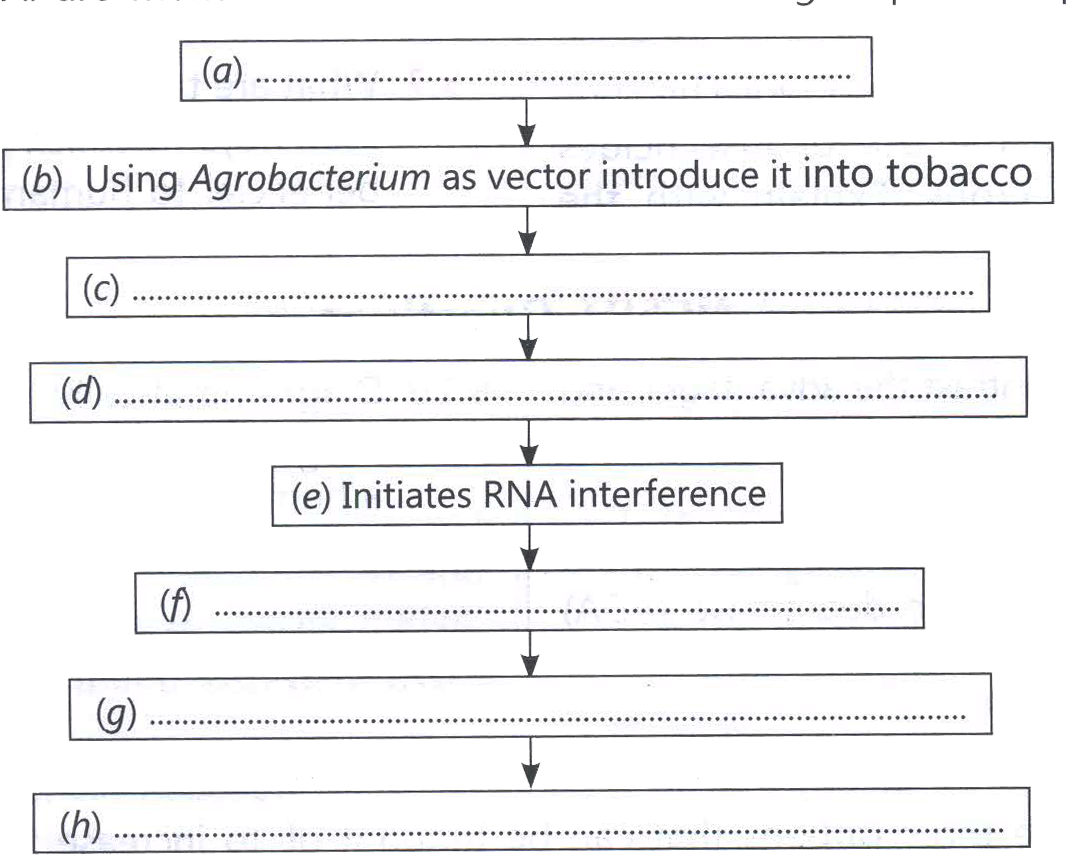
Two of the steps involved in producing nematode resistant tobacco plants based on the process of RNAi are mentioned below. Write the missing steps in its proper sequence.
28.
Name some traditional Indian foods made of wheat, rice and Bengal gram, which involve use of microbes.
29.
Explain the role of 35S and 32P in the experiments conducted by Hershey and Chase.
30.
What is the figure given below showing in particular?
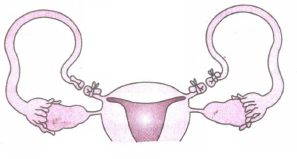
Ovarian cancer
Uterine cancer
Tubectomy
Vasectomy
31.
Given below is the representation of a kind of chromosomal mutation

What is the kind of mutation represented?
Deletion
Duplication
Inversion
Reciprocal translocation
32.
An autotriploid has ____ copies of a single genome.
33.
Differentiate between
i) estrous and menstrual cycle
ii) oviparity and vivipary.Give an example of each type.
34.
The biology teacher was explaining about restriction enzymes and came to a point explaining that these enzymes are extracted from bacteria and are called as molecular scissors. Varun, a student got curious and asked some questions for more clarity on the concept to his teacher.
(i) From which part of microorganisms are restriction enzymes derived?
(ii) Why are restriction enzymes called molecular scissors?
(iii) What if some strands are needed to be cut from within. would that lead to wastage of DNA?
(iv) What value are shown by varun?
1.
()
It is the most potent hallucinogen obtained from dried fruiting body of ergot fungus.
2.
()
(i) Alpha diversity
(ii) Beta diversity.
3.
()
(i) The DNA polymerase catalyses the addition of nucleotides, i.e. polymerization of nucleotides to form a DNA strand in the 5' -3' direction only
(ii) In prokaryotes, It removes any wrong base added to the DNA strand being synthesised.
4.
()
Propionibacterium sharmanii.
5.
()
The plant is dioecious; the plants which produce only male flowers, do not bear fruits, while the plants which produce female flowers, bear fruits.
6.
()
Oogenesis starts during embryonic developmental stages of the female foetus.
Spermatogenesis starts at puberty.
7.
a) B- Natality ( births), E- Emigration
b) Population density will increase
c) Births and deaths
d) Immigration
8.
Bacterium Thermus aquaticus is a source of enzyme Tag polymerase. As it is a thermostable enzyme and work at high temperature, it is used to amplify DNA in vitro by PCR. The amplified fragment of desired DNA can be used to ligate with the vector for further cloning.
9.
To pass on its genetic variation to its offspring and thereby to contribute its specific genes to the gene pool of the population.
10.
(a)Gametocytes.
(b)Release of haemozoin in blood.
11.
'a' is Exponential growth curve.
When the resources are not limiting, this form of curve appears.
'b' is Logistic growth curve.
When the resources are limiting, this form of growth curve appears; where K is the carrying capacity.
12.
(a)-(ii),
(b)-(i),
(c)-(iii),
(d)-(iv)
13.
()
Tumour inducing (Ti) plasmid of Agrobacterium tumefaciens is modified into a cloning vector by removing/ altering the gene responsible for its pathogenic property.
14.
(1) Condoms diaphragms or cervical caps
(2) Copper T
(3) Vasectomy (in male),Tubectomy (in female)
(4) Oral pill, Saheli
15.
| External Fertilisation | Internal Fertilisation |
| Fertilisation or syngamy occurs in the external medium (water), i.e., outside the body of the organism. | Fertilisation or syngamy occurs inside the body |
| Examples - Aquatic organisms like algae, bony fishes and amphibians. | Examples - Terrestrial organisms, belonging to fungi, animals like reptiles, birds, mammals and plants like bryophytes, pteridophytes, gymnosperms & angiosperms |
| The offspring are extremely vulnerable to predators threatening their survival up to adulthood. | The offspring are relative safe because they develop, inside mothers body and get parental care after birth. |
| Both male and female gametes are produced in large number | The female gametes are produced in small number |
| Number of young is very high. | Number of young is small. |
16.
(i) The sex of baby in the womb can be determined by amniocentesis technique. It can be done after first three months of pregnancy.
(ii) It can be stopped by legislation. The Government has already imosed a ban on sex-determination of the foetus. In & also declared that those who are involved in foeticide practise are liable to punishment. Public awamess about it is also being spread through media & plays etc.
(iii) Geeta is quite enquiring & has exhibited the values of awareness, inquisition & curiosity.
17.
Co-extinction is most severe in mutualism and parasitism.
| Interaction | Effect on species A | Effect on species A | Example |
| Mutualism (beneficial to both, obligatory) | (+) | (+) | Lichen (mutualism between algae and a fungus) |
| Parasitism (parasite benefitted, host harmed) | (+) | (-) | Barnacles and whales |
18.
Carbon dioxide is a major greenhouse gas. Various human activities such as combustion of fossil fuels, electricity generation, transportation and industries are sources of its large scale production. Excess of CO2 is harmful and considered as a pollutant. It is because it traps longer wavelength IR radiations reflected by earth's surface, thus causing global warming.
19.
A - Respiration
B - Photosynthesis
C - Respiration
D - Combustion of fossil fuels
E - Aquatic food chain and
F - Coal and oil
20.
(a) The bite by a female mosquito vector.
(b) Ring worms.
(c) Rhino virus.
(d) Serve abdominal pain, nausea/vomiting, cough, intestinal obstruction
21.
(a) Scutellum
(b) Epicotyl
(c) Polyembryony
(d) Patrhenocarpic fruits.
22.
Very low concentration of a bacteria or virus in human body can be detected by amplification of their nucleic acid using the technique of polymerase chain reaction (PCR).This method is applied to detect HIV in suspected AIDS patients and to detect mutations in genes in suspected cancer patients.
23.
The technique of gene cloning involves__
(i) Isolation of desired DNA fragment containing the to be cloned ;
(ii) Isolation of the vector used as cloning vehicle ;
(iii) Incubation of DNA fragments and digested vector in presence of DNA ligase producing recombinant DNA molecules : and
(iv) Introduction of recombinant DNA into the host.
24.
(i) d,f (ii) e,g (iii) a (iv) b (v) c
25.
Parturition
1.Onset of labour is termed as parturition.The human gestation period (duration of pregnancy) is normally 280 days from the time of last menstrual period to the birth of the baby.
2.The process of uterine contractions which expel the baby and placenta is called 'Labour pains'.
3.The ovary (corpus luteum) at this period secretes a hormone, called relaxin, that softens the connective tissue of pubic symphysis.
4.A fully developed foetus and the placenta initiate the secretion of certain hormones, which bring about the mild contractions of uterus, called foetal ejection reflex.
5.It can be divided into three phases.The first stage is dilation, which usually lasts from 2 to 20 hours and ends up with cervix of uterus fully open or dilated.
6.The second state, expulsion which lasts from about 2 to 100 minutes begins with full crowning, the appearance of baby's head in the cervix and continues while the baby is pushed, head first, down through the vagina into outside where it draws its first breath.
7.During this phase, placentation which costs for 10-15 minutes after the birth of child, the placenta and the foetal membranes are loosened from the lining of uterus by another series of contraction and expelled.They are collectively called after birth or decidua.
Hormonal control
1.The foetal ejection reflex triggers the release of oxytocin from the posterior pituitary.
2.Oxytocin induces stronger contractions of the uterine muscles, which ultimately lead to the expulsion of the baby from the uterus, through birth canal.
3.Corticotropin-releasing hormone (CRH) takes part in the 'Clock' that establishes the timing of birth.
26.
(i) Embryos of all vertebrates possess.
(a) pharynx with perforated gill slits (b) tail and (c) similar head with eyes and ear rudiments.
(ii) This similarity in embryos shows that all the vertebrates have evolved from a common ancestor.
27.
(a) Isolation of nematode-specific gene.
(c) Production of sense and anti-sense RNA in the host.
(d) Formation of ds RNA (as the sense and anti-sense RNA are complementary to each other). if Silencing of specific mRNA of the nematode.
(g) Host expresses the interfering RNA.
(h) Parasite cannot survive and host (tobacco) plant is protected.
28.
(i) Wheat - Roti
(ii) Rice - Idli and Dosa
(iii) Bengal gram - Dhokla and khandvi.
29.
1. The viruses/bacteriophages grown on radioactive sulphur \(\left( ^{ 35 }{ S } \right) \) contained radioactive protein but not radioactive DNA, because DNA does not contain sulphur.
2.When these viruses were allowed to infect bacteria, the bacteria did not contain radioactivity, because proteins did not enter the bacteria; hence protein is not the genetic material.
3. The viruses grown on radioactive phosphorus \(\left( ^{ 32 }{ P } \right) \) contained radioactive DNA, becauseDNA contains phosphorus and not proteins.
4. When these viruses were allowed to infect the bacteria, the bacteria were radioactive, indicating that DNA is the genetic material that has passed from the virus into bacteria.
30.
(c)
Tubectomy
31.
(c)
Inversion
32.
three
33.
| estrous cycle | menstrual cycle |
| the cyclic change in the activities of ovaries and accessory ducts as well as hormones during the reproductive phase of non-primate mammals is called oestrus cyclic |
The cyclic changes in the activities of ovaries and accessory ducts as well as hormones during the reproductive the phase of primate mammals is called menstrual cycle. |
| Female show strong irresistible sexual urge. |
Female do not show irresistible sexual urge. |
| There is heat production at the time of ovulation and copulation occurs only at that period. |
There is no heat period and population can occur during any time of the cycle. |
| The shedding of endometrium and bleeding does not occur e.g. cows, sheep, rats, deer, dogs, tigers, etc |
The shedding of endometrium and bleeding occur. e.g. monkeys, apes, humans, etc. |
ii) Difference between i) oviparity and ii) vivipary are as follows:
| oviparity | vivipary |
| In oviparity, female animals lay eggs. |
In vivipary, female animals give birth to young ones |
| The development of zygote takes place outside the female's body. |
The development of zygote takes place inside the female's body. |
| Female lay eggs in a safe place in the environment, but the chance of survival are less. e.g. all birds, most of the reptiles and egg laying mammals. |
Female deliver young ones and the chance of survival are more. e.g. mammals except monotremes (egg-laying mammals) |
34.
(i) Restriction enzymes are derived from a defence unit called restriction modification system which protects the microorganisms from harm.
(ii) They are called as molecular scissors because they cut DNA molecules at specified location indicated by presence of specific recognition sequence.
(iii) No, the strands cut from within are joined by another enzyme called DNA ligase. This joining is either with self or with another different strand.
(iv) Varun is curious, has scientific temperament and ask quick and intelligent questions.

12th Standard CBSE Syllabus & Materials
12th Standard CBSE
CBSE 12th Computer Science Python Revision Tour I - New Previous year Question Papers Study Material - QB365 Set A
NEW12th Standard CBSE
CBSE 12th Business Studies Planning Important Questions And Answers Study Material - QB365 Set A
NEW12th Standard CBSE
CBSE 12th Business Studies Business Environment Important Questions And Answers Study Material - QB365 Set A
NEW12th Standard CBSE
CBSE 12th Business Studies Principles of Management Important Questions And Answers Study Material - QB365 Set A



CBSE 12th Standard CBSE Subjects
CBSE Standards










