
 100% FREE ACCESS
12th Standard CBSE Syllabus & Materials
12th Standard CBSE
CBSE 12th Economics Government Budget and the Economy Previous year Question Papers Study Material - QB365 Set A
NEW12th Standard CBSE
CBSE 12th Computer Science Interface Python with MySQL - New Previous year Question Papers Study Material - QB365 Set A
NEW12th Standard CBSE
CBSE 12th Computer Science Database Concept - New Previous year Question Papers Study Material - QB365 Set A
NEW12th Standard CBSE
CBSE 12th Computer Science Data Communication - New Previous year Question Papers Study Material - QB365 Set A
NEW12th Standard CBSE
CBSE 12th Computer Science Data Structures - New Previous year Question Papers Study Material - QB365 Set A
NEW12th Standard CBSE
CBSE 12th Computer Science Functions - New Previous year Question Papers Study Material - QB365 Set A

Published on: 23/09/2019
Reproduction in Organisms
Download CBSE Class 12th Standard CBSE Biology question papers, sample papers, important questions, and previous year solved papers in PDF format. Get free study materials, NCERT solutions, and exam preparation resources for Class 12th Standard CBSE Biology
Questions + Answers key
Take MCQ Biology Test
1.
Write a note on artificial vegetative propagation.
2.
Rachna's father went to Kolkata where he was gifted a pot with new variety of rose. The flowers were very beautiful. On birthday of Rachna's father to bring for her the same variety of rose on his next visit to Kolkata. He smiled and advised her to raise it herself from the plants growing in his home.
Read the above passage and answer the following question:
(i) How can father's advice help Neena to raise new seedling of rose variety present in Ranchna's home?
(ii) Which method of reproduction is involved in this process?
(iii) Can this technique be used for commercial propagation of other ornamental plants?
3.
Enumerate the differences between asexual and sexual reproduction. Describe the types of asexual reproduction exhibited by unicellular organisms.
4.
(i) What are the three clear-cut phases in the life of annual and biennial type of plants?
(ii) Why is it difficult to define these phases in perennial species of plants?
5.
Which is a better mode of reproduction, sexual or asexual? why?
6.
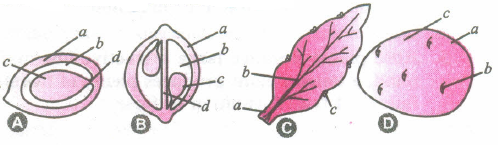
In the following figures label the parts responsible for production of new plants
7.
Distinguish between oviparous and viviparous animals.
1.
Man-made methods of vegetative reproduction are called artificial vegetative propagation. They are mainly as follows:
(i) Cutting: In this method, a small piece of any plant organ bearing buds such as stem, (sugarcane, rose, Bougainvillea etc), root (Tamarind) and leaves (Bougainvillea) are used for propagation.
(ii)Layering: In this method the roots are artificially method produced on the stem or branches before they are cut and detached from the parent.
(iii)Grafting: In this method, the parts of plants are joined in such a way that they appear and grow as one plant. The supporting part of the plant which is rooted is called stock. The twig or the part of another plant which is joined to itis called Scion. Grafting is commonly used in mango, guava, apple, pear, etc.
(iv) Micropropagation: This is a method of propagating the plants by tissue culture technique. This includes culturing of cells, tissue or organs in the laboratory under aseptic conditions resulting in the formation of an undifferentiated mass of cells called callus. Later on, a large number of plantlets are produced from this callus.
2.
(i) Father's advice helped Neena to raise new seedlings of rose variety by using 'cuttings' of the desired variety and planting them in soil in favorable season.
(ii) Asexual method of reproduction is involved.
(iii) Yes, this can be used commercially for Bougainvillea, Carnation and Coleus.
3.
(i) Differences between asexual and sexual reproduction
| Asexual Reproduction | Sexual Reproduction |
| 1. The process involves only one cell or one parent 2. The whole body of the parent may act as reproductive unit or it can be single cell. 3. The offsprings are genetically similar to parents. (clone) 4. Only mitotic division takes place. 5. No formation of sex organs. 6. No evolutionary significance. |
1. This process involves two cells or gametes belonging to either the same or different parents. 2. The reproductive unit is called gamete which is unicellular and haploid. 3. The offsprings differ genetically from parents. 4. Meiosis and mitosis are essential events. 5. Formation of sex organs is essential. 6. It introduces variations hence of evolutionary significance. |
(ii) Types of asexual reproduction in unicellular organisms.
4.
(i) The three clear-cut phases are:
(i) Vegetative phase
(ii) Reproductive phase and
(iii) Senescent phase.
(ii) In perennial plants, vegetative growth continues throughout the year; it is more durin favourable seasons like spring and rainy season and less during winter and summer.
(i) Flowering occurs at a particular season of every year.
(ii) Order branches and leaves are shed during all parts of the year.
5.
Sexual reproduction can generate variation in the population.These variations provide better chances of survival to the organisms in changing the environment.Thus, sexual mode of reproduction is considered a better mode of reproduction.
6.
(A) c is a seed that produces new plant.
(B) c is a seed that produces new plant.
(C) c is an adventitious bud that produces a new plant.
(D) b is an eye that has a bud.
7.
The major difference between oviparous and viviparous animals are listed below:
| Oviparous Animals | Viviparous Animals |
| The development of zygote takes place outside the body of the female parent. | The development of zygote takes place inside the body of the female parent. |
| These animals lay fertilized/unfertilized eggs. | These animals give birth to young ones. |
| Females lay eggs in a safe place in the environment, but the chances of survival is always doubtful., | Females deliver young ones out of the body after attaining a certain stage of growth. Thus, the chances of survival of young ones is greater. |
| Examples: Birds and Reptiles. | Examples: Mammals (including human beings) |

12th Standard CBSE Syllabus & Materials
12th Standard CBSE
CBSE 12th Computer Science Python Revision Tour I - New Previous year Question Papers Study Material - QB365 Set A
NEW12th Standard CBSE
CBSE 12th Business Studies Planning Important Questions And Answers Study Material - QB365 Set A
NEW12th Standard CBSE
CBSE 12th Business Studies Business Environment Important Questions And Answers Study Material - QB365 Set A
NEW12th Standard CBSE
CBSE 12th Business Studies Principles of Management Important Questions And Answers Study Material - QB365 Set A



CBSE 12th Standard CBSE Subjects
CBSE Standards










