
 100% FREE ACCESS
12th Standard CBSE Syllabus & Materials
12th Standard CBSE
CBSE 12th Economics Government Budget and the Economy Previous year Question Papers Study Material - QB365 Set A
NEW12th Standard CBSE
CBSE 12th Computer Science Interface Python with MySQL - New Previous year Question Papers Study Material - QB365 Set A
NEW12th Standard CBSE
CBSE 12th Computer Science Database Concept - New Previous year Question Papers Study Material - QB365 Set A
NEW12th Standard CBSE
CBSE 12th Computer Science Data Communication - New Previous year Question Papers Study Material - QB365 Set A
NEW12th Standard CBSE
CBSE 12th Computer Science Data Structures - New Previous year Question Papers Study Material - QB365 Set A
NEW12th Standard CBSE
CBSE 12th Computer Science Functions - New Previous year Question Papers Study Material - QB365 Set A

Published on: 23/09/2019
Sexual Reproduction in Flowering Plants
Download CBSE Class 12th Standard CBSE Biology question papers, sample papers, important questions, and previous year solved papers in PDF format. Get free study materials, NCERT solutions, and exam preparation resources for Class 12th Standard CBSE Biology
Questions + Answers key
Take MCQ Biology Test
1.
Write the changes a fertilized ovule undergoes within the ovary in an angiosperm plant.
2.
Draw a neat labelled sketch of L.S. of an endospermous monocot seed.
3.
Puneet used to like beautiful flowers but not the insects flying in the garden.He discussed his plan but his father advised him not to do so as it will affect seed formation in ornamental plants of the garden.
Read the above passage and answer the following questions:
(i) Was the decision of Puneet to kill insects of garden with insecticide right?
(ii) Why did his father advise him not to do so?
(iii) Are chemical insecticides safe for living organisms including human beings?
4.
Differentiate simple, aggregate and composite fruit.
5.
Describe the structure of pollen grain.
6.
Write a note on the development of endosperm. Mention the types with examples.
7.
Describe contrivances for cross-pollination.
8.
How does the megaspore mother cell develop into a 7-celled, 8-nucleate embryo sac in an angiosperm? Draw a labelled diagram of a mature embryo sac.
9.
(a) Differentiate between: Autogamy, geitonogamy and xenogamy.
(b) Explain the events that occur during pollen-pistil interaction.
1.
A fertilized ovule undergoes the following changes in the ovary in an angiosperm plant:
Unfertilized ovule \(\rightarrow \) Fertilized ovule \(\rightarrow \)Seed
Funiculus \(\rightarrow \) Present
Hilunf \(\rightarrow \) Present
Integument \(\rightarrow \) Seed coat
Outer integument \(\rightarrow \) Testa
Inner integument \(\rightarrow \) Tegmen
Chalaza \(\rightarrow \) Present
Micropyle \(\rightarrow \) Present
Nucellus \(\rightarrow \) Absent or present as perisperm
Embryo Sac:
Antipodal cells \(\rightarrow \) Degenerate
Synergid cells \(\rightarrow \) Degenerate
Secondary nucleus \(\rightarrow \) Endosperm
Egg \(\rightarrow \) Embryo
When the unfertilized ovule undergoes double fertilization, it makes fertilized ovule and then seeds. In this process funiculus and hilum are present. Outer integument makes testa and inner integument is tegmen. Chalaza and micropyle are present but nucellus is absent, partly persish. as perisperm.
In embryo sac antipodals and synergids degenerate. The central cell makes endosperm, and the egg changes into embryo.
2.
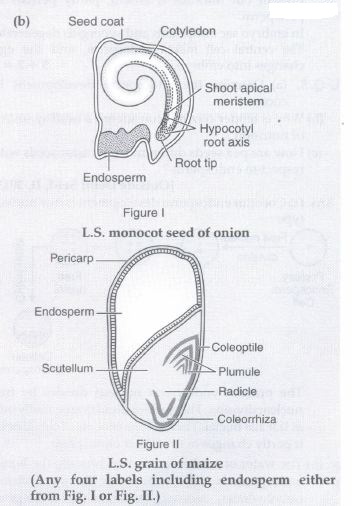
3.
(i)No,it was not a wise decision.
(ii) Insecticides kill the insects.These insects are very important for plants as many of these are helpful in carrying out pollination which is very essential for fertilization and seed formation in sexually reproducing species.
(iii)No,many insecticides pollute and, being non-biodegradable, have harmful effects on living organisms
4.
Differences between Simple, Aggregate and Composite Fruits
| Simple Fruit | Aggregate Fruit | Composite Fruit |
|
1. It develops from a flower with a single ovary. |
1.The fruit is formed a flower with two or more ovaries. |
1.It develops from the whole inflorescence. |
| 2. A single fruit is borne at one place | 2. It is a group or etaerio of fruitlets. | 2. A large number of fruitlets from a composite fruit. |
| 3. The fruit is compact. | 3. Aggregate fruit can be compact (e.g., Strawberry) or loose (e.g. Calotropis). | 3. Composite fruit is generally compact. |
| 4. Simple fruit can be true or false. | 4. It can be true or false. | 4. It is usually false. |
5.
Structure of microspore (Pollen grain):
Pollen grain develop from the diploid microspore mother cells in pollen sacs of anthers.Typically pollen grain is a haploid, unicellular body with a single nucleus.
The pollen grain represents male gametophyte. The term sporoderm is usually used to designate collectively the two major wall layers-
(i) the exine, which is the outer layer and chiefly composed of sporopollenin (an organic polymer that is resistant to oxidation and leaching), and
(ii) the intine, which is the inner layer and chiefly composed of pecto-cellulose.
The exine is differentiated into two layers. The inner endoexine and outer tectum. The exine surface of pollen grains often bear various patterns of microsculpturing and ornamentation. At one or more places, the exine is very thin or absent. These regions are called apertures or germ pores through which the pollen tube emerges at the time of germination on stigma.
The germ pores lack sporopollenin. The protoplasm of pollen grain is surrounded by plasma membrane.
In a mature pollen grain two cells are present, vegetative cell and generative cell. Vegetative cells has abundant food reserve. Generative cell divides and form two male gametes during the growth of pollen tube.
6.
Development of endosperm. Endosperm develops after double fertilization in angiosperms. It is triploid and develops from primary endosperm nucleus. In angiosperms three types of endosperm development are observed:
(1) Nuclear endosperm. In nuclear endosperm development nucleus divides by free nuclear division, there is appearance of central vacuole, all the nuclei are pushed towards periphery then starts cytokinesis and results into the formation of cells hut in coconut vacuole persists which is filled with fluid.
(2) Cellular endosperm. In cellular endosperm each and every division is followed by cytokinesis, so endosperm is cellular from the very beginning e.g. Datura, Petunia.
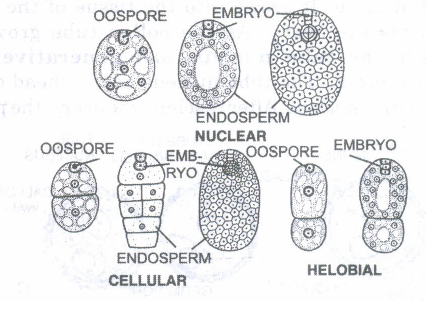
(3) Helobial endosperm. It is intermediate between cellular and nuclear endosperm. The first division is followed by cytokinesis to form two unequal cells, micropylar cell and chalazal cell. Further divisions in each cell are free nuclear divisions. This type of endosperm is found in order Helobiales.
7.
Contrivances for cross pollination
1. Dicliny
It is formation of unisexual flowers. Statements and carpels occur in different plants. The diclinous plant may be monoecious or dioecious. In monoecious plants, the two types of flower \((\underset { + }{ O } \quad and\quad { O }^{ \nearrow })\) are located in the same plant (e.g., Cucurbita) and in 'dioecious plants, \(({ O }^{ \nearrow }\quad and\quad \underset { + }{ O } )\) flowers are present in different plants, e.g., Carcia papaya.
2. Dichogamy
A condition where male and female sex organs mature at different times. It can be of two types : protandry where anthers mature earlier than the gynoecium, (e.g., Helianthus annus, tagetes, cotton, lady's finger, etc.) and protogyny where gynoecium matures earlier than the anthers,(e.g., Michelia champaca, Brassia, Ficus, Mirabilis, etc.
3. Heterostyly (Hetero = different)
Occurrence of styles and statements of different lengths as heterostyly. Based on this, flowers may have two (dimorphic) or three (trimorphic) forms of anthers and stigmas at different levels. One form has short stamen and long style (pineyed) and the other has long stamens and short style (thrum eyed).
4. Herkogamy (Herko = barrier)
It is presence of natural and physical barriers between androecium and gynoecium which help in avoiding self pollination e.g., in Calotropics, gynoecium is fused with pollinium(anthers) and forms gynostegium, Salvia.
5. Self sterility
Pollen fails to germinate on the stigma of same flower due to physiological or genetic reasons e.g., Malva, petunia, Solanum, etc.
6. Pollen prepotency
The condition characterized by rapid germination of foreign pollen instead of self pollen thereby affecting fertilization.
7. Sensitive stigma
In some plants stigmatic lobes are so sensitive that once cross-pollinated, they come closer to prevent self-pollination. e.g., Martynia.
8.
Development of Female Gametophyte:
- The megaspore mother cell undergoes meiosis to form four megaspores.
- Three of them degenerate and the functional megaspore enlarges to form the embryo sac.
- Its haploid nucleus undergoes a mitotic division and the two daughter nuclei move towards the poles.
- Each of them undergoes two successive mitotic divisions.
- Cell wall formation starts in the 8-nucleate stage.
- Three of them at the micropylar end form the egg apparatus, consisting of a female gamete and two synergids.
- Three of them at the chalazal end form the antipodal cells.
- One nucleus from each of the poles moves to the centre; they are called polar nuclei.
- The two polar nuclei fuse in the centre (now the central cell) to form a diploid secondary nucleus.
- Thus, the mature embryo sac is 7-celled and 8-nucleate.
9.
(a) Differences:
| Autogamy | Getonogamy | Xenogamy |
| It refers to the transfer of pollen grains from the anther of a flower to the stigma of the same flower | It refers to the transfer of pollen grains from the anther of a flower to the stigma of same plant. | It refers to the transfer of pollen grains from the anther of a flower to the stigma of another flower on a different plant of the same species. |
| It does not lead to genetic variation in the progency | It does not lead to genetic variation in the progeny. | It leads to genetic variation in the progeny |
| No pollinating agent is needed. | A pollinating agent is needed. | A pollinating agent is needed. |
(b) Pollen-Pistil Interaction.
The stigma/pistil has the ability to recognise the right type of pollen, i.e. the compatible pollen of the same species and rejects the wrong type of pollen grains.
It is the result of interaction between the chemical components of the pollen and those of stigma. - A compatible pollen grain starts its germination on the stigma.
The intine grows out through one of the germ pores as a protuberance.
The contents of the pollen move into this tube, i.e. the tube nucleus (nucleus of the vegetative cell) and the generative cell (or the two male gametes in those species where pollen is liberated in the three-celled stage).
The pollen tube grows through the tissues of stigma and style and enters the ovule through micropyle.
It enters the embryo sac through the filiform apparatus of one of the synergids to liberate the male gametes.
The events from the deposition of pollen on the stigma till the pollen tube enters the ovule, are collectively referred to as pollen-pistil interaction.

12th Standard CBSE Syllabus & Materials
12th Standard CBSE
CBSE 12th Computer Science Python Revision Tour I - New Previous year Question Papers Study Material - QB365 Set A
NEW12th Standard CBSE
CBSE 12th Business Studies Planning Important Questions And Answers Study Material - QB365 Set A
NEW12th Standard CBSE
CBSE 12th Business Studies Business Environment Important Questions And Answers Study Material - QB365 Set A
NEW12th Standard CBSE
CBSE 12th Business Studies Principles of Management Important Questions And Answers Study Material - QB365 Set A



CBSE 12th Standard CBSE Subjects
CBSE Standards










