
 100% FREE ACCESS
12th Standard CBSE Syllabus & Materials
12th Standard CBSE
CBSE 12th Economics Government Budget and the Economy Previous year Question Papers Study Material - QB365 Set A
NEW12th Standard CBSE
CBSE 12th Computer Science Interface Python with MySQL - New Previous year Question Papers Study Material - QB365 Set A
NEW12th Standard CBSE
CBSE 12th Computer Science Database Concept - New Previous year Question Papers Study Material - QB365 Set A
NEW12th Standard CBSE
CBSE 12th Computer Science Data Communication - New Previous year Question Papers Study Material - QB365 Set A
NEW12th Standard CBSE
CBSE 12th Computer Science Data Structures - New Previous year Question Papers Study Material - QB365 Set A
NEW12th Standard CBSE
CBSE 12th Computer Science Functions - New Previous year Question Papers Study Material - QB365 Set A

Published on: 30/07/2019
Principles of Inheritance and Variation
Download CBSE Class 12th Standard CBSE Biology question papers, sample papers, important questions, and previous year solved papers in PDF format. Get free study materials, NCERT solutions, and exam preparation resources for Class 12th Standard CBSE Biology
Questions + Answers key
Take MCQ Biology Test
1.
Give the scientific name of the plant Mendel chose for his genetic experiments.
2.
Name the Indian breed of cow that was developed through artificial selection and domestication of wild cows.
3.
What do you mean by variation in biology?
4.
In a test cross progeny of pea plats, all were bearing violet flowers. Give the genotypes of the parent pea plants.
5.
What will be the consequence, if cytokinesis does not follow the telophase stage of cell division? What term is given to this phenomenon?
6.
In dogs, black coat colour is dominant over white. What coloured dog will you choose to breed with a given back dog, in order to find its genotype. What is this type of cross known as?
7.
Work out a cross to find the genotype of a tall plant. Name the type of cross.
8.
In a typical monohybrid cross, the F2 population ratio is written as 3 : 1 for phenotype, but expressed as 1 : 2 : 1 for phenotype. Explain with the help of an example.
9.
In a test cross, AaBb \(\times\) aabb, 90 percent of the progeny are like parents. Determine.
(i) the progeny type for the rest of the population?
(ii) Are the genes linked?
(iii) Is there any crossing over of the genes?
10.
In cattle, hornless (H) is dominant over horned (h) and black (B) is dominant over red (b). Consider that these two pairs of genes assort independently.
(i) What proportion of the offspring from the cross, BbHh \(\times\) bbhh, would be black and hornless?
(ii) From the cross Bbbh \(\times\) Bbhh, how many will be
(a) black and horned and
(b) red and horned
11.
Name the genetic disorder caused by trisomy of 21 st chromosome in humans. Write the diagnostic features of the disorder.
12.
Explain how trisomy of 21st chromosome occurs in humans. List any four characteristic features in an individual suffering from it.
13.
There is a 6 year old boy in a colony,who is suffering from Down's syndrom disorder Shyam is living in his neighborhood and who is kind to him and is always ready to help him but his other fellow children do not interact with him.
On the basis of above information answer following questions
(i) Is it right not to interact with the boy
(ii) What is the cause of Down's syndiom
(iii)What values are shown by Shyam?
14.
Neha met with an accident. She was admitted to hospital where she needed blood transfusion. Due to carelessness of the hospital, she became HIV positive. What precautions should be taken during blood transfusion?
15.
What exactly is dominance? Why are some alleles dominant and some recessive?
16.
By which process there is a gain o segment of DNA which results in alteration in chromosome?
Insertion
Duplication
Both a and b
Deletion
17.
A male human is heterozygous for autosomal genes A and B and is hemizygous for haemophilic gene h. What proportion of his sperms will be abh?
\(\frac{1}{32}\)
\(\frac{1}{16}\)
\(\frac{1}{4}\)
\(\frac{1}{8}\)
18.
A self-fertilizing trihybrid plant forms
4 different gametes and 16 different zygotes
8 different gametes and 16 different zygotes
8 different gametes and 32 different zygotes
8 different gametes and 64 different zygotes
19.
In a plant, red fruit (R) is dominant over yellow fruit (r) and tallness (T) is dominant over shortness (t). If a plant with RRTt genotype is crossed with a plant that is rrtt
50% will be tall with red fruit
75% will be tall with red fruit
all the offspring will be tall with red fruit
25% will be tall with red fruit
20.
Two crosses between the same pair of genotype or phenotypes in which the sources of the gametes are reversed in one cross, is known as
Reverse cross
Dihybrid cross
Test cross
Reciprocal cross
1.
()
Pisum sativum
2.
()
Sahiwal
3.
()
Variation refers to the differences in a character among individulas of the same species.
4.
()
VV and vv
5.
1.It leads to an increase in a whole set of chromosomes of the organism.
2. It is called polyploidy.
6.
(i) A white colour dog will be chosen.
(ii) White colour is recessive; a homozygous white do, that breeds true will be chosen.
(iii) Such a cross is called test cross.
7.
In the test cross, an individual showing dominant phenotype would be crossed to an individual with recessive phenotype for the same trait.
(i) If the individual is homozygous dominant, all the individuals in the progeny would show the dominant phenotype.
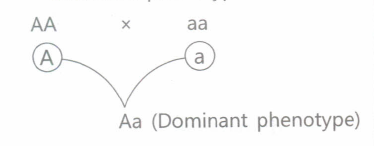
(ii) If the individual is heterozygous, the progeny will show dominant phenotype and recessive phenotype in the ratio of 1 : 1.
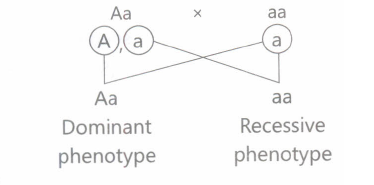
Thus, the genotype of the individual with dominant phenotype can be ascertained.
8.
A monohybrid cross is as follows:
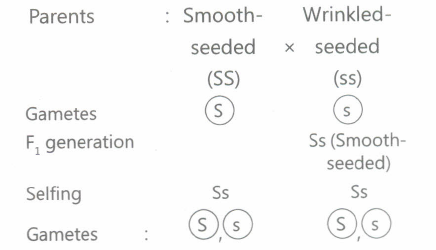
\(F_{ 2 }\)
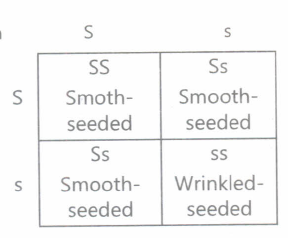
The phenotypic ratio of smooth-seeded to wrinkled-seeded plants, is 3 : 1.
From the Punnett square, it can be seen that one of the smooth-seeded plants is homozygous (55), while the other two are heterozygous (Ss): hence the genotypic ratio is 1 : 2 : 1.
9.
(i) The rest of the progeny will be aaBb and Aabb.
(ii) Yes, the genes are linked.
(iii) Yes, there is crossing over, as 10% of the progeny are recombinants.
10.
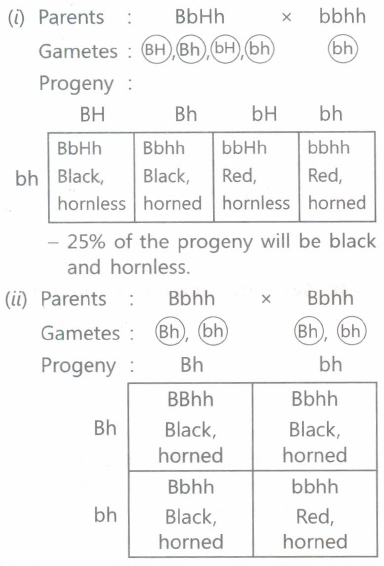
(a) 3/4 of the progeny will be black and horned.
(b) 1/4 of the progeny will be red and horned.
11.
Trisomy of 21st chromosome occurs due to non-disjunction, i.e. non-separation of the homologous pair of 21st chromosomes at anaphase I of meiosis during ova formation and ferlilisation of such an ovum with two 21st chromosomes with a normal sperm.
Symptoms of Down's Syndrome:
(i) Partially open mouth with furrowed tongue.
(ii) Broad, flat face with slanting eyes.
(iii) Broad palm with characteristic palm increase.
(iv) Small and arched palate.
(v) Epicanthic eye fold.
(vi) Congenital heart diseases.
(vii) Mental retardation
12.
Trisomy of 21st chromosome occurs due to non-disjunction, i.e. non-separation of the homologous pair of 21st chromosomes at anaphase I of meiosis during ova formation and ferlilisation of such an ovum with two 21st chromosomes with a normal sperm.
Symptoms of Down's Syndrome:
(i) Partially open mouth with furrowed tongue.
(ii) Broad, flat face with slanting eyes.
(iii) Broad palm with characteristic palm increase.
(iv) Small and arched palate.
(v) Epicanthic eye fold.
(vi) Congenital heart diseases.
(vii) Mental retardation
13.
(i)No
(ii) Down's syndrome (Mangolism) is ca~ed due to trisomy of chromosome 21. Such children. have 47 chromosomes instead of 46 which is the normal condition.
(iii) Sensitivity towards fellow childem & compassion.
14.
(a) Blood to be transfused should be first tested for HIV
(b) The injections or the needles to be used should be clean, new and sterile
(c) Presence of other contamination in the blood should also be checked
(d) Donor's and recipient's blood groups (ABO as well as Rh) should be checked and cross-matching should be done to exclude mismatching of blood groups.
15.
Dominance:
Every gene contains the information to express a particular trait.
In a diploid organism, there are two alternate forms of a gene, or a pair of alleles.
The two alleles may be similar (homo-zygous) or may be different (heterozygous).
One of them may be different due to some changes that it has undergone, which modify the information of that particular allele.
The phenotype will be dependent on the original unmodified allele.
16.
(c)
Both a and b
17.
(d)
\(\frac{1}{8}\)
18.
(d)
8 different gametes and 64 different zygotes
19.
(b)
75% will be tall with red fruit
20.
(d)
Reciprocal cross

12th Standard CBSE Syllabus & Materials
12th Standard CBSE
CBSE 12th Computer Science Python Revision Tour I - New Previous year Question Papers Study Material - QB365 Set A
NEW12th Standard CBSE
CBSE 12th Business Studies Planning Important Questions And Answers Study Material - QB365 Set A
NEW12th Standard CBSE
CBSE 12th Business Studies Business Environment Important Questions And Answers Study Material - QB365 Set A
NEW12th Standard CBSE
CBSE 12th Business Studies Principles of Management Important Questions And Answers Study Material - QB365 Set A



CBSE 12th Standard CBSE Subjects
CBSE Standards










