
 100% FREE ACCESS
12th Standard CBSE Syllabus & Materials
12th Standard CBSE
CBSE 12th Economics Government Budget and the Economy Previous year Question Papers Study Material - QB365 Set A
NEW12th Standard CBSE
CBSE 12th Computer Science Interface Python with MySQL - New Previous year Question Papers Study Material - QB365 Set A
NEW12th Standard CBSE
CBSE 12th Computer Science Database Concept - New Previous year Question Papers Study Material - QB365 Set A
NEW12th Standard CBSE
CBSE 12th Computer Science Data Communication - New Previous year Question Papers Study Material - QB365 Set A
NEW12th Standard CBSE
CBSE 12th Computer Science Data Structures - New Previous year Question Papers Study Material - QB365 Set A
NEW12th Standard CBSE
CBSE 12th Computer Science Functions - New Previous year Question Papers Study Material - QB365 Set A

Published on: 21/08/2019
Alcohols, Phenols, and Ethers
Download CBSE Class 12th Standard CBSE Chemistry question papers, sample papers, important questions, and previous year solved papers in PDF format. Get free study materials, NCERT solutions, and exam preparation resources for Class 12th Standard CBSE Chemistry
Questions + Answers key
Take MCQ Chemistry Test
1.
Why is o-nitrophenol less soluble in water?
2.
Out of 2-chloroethanol and ethanol, which one is more acidic and why?
3.
Arrange the following sets of compounds in order of their increasing order of their acid strength:
Propan-1-ol, 2,4,6-trinitrophenol, 3-nitro-phenol, 3,5-dinitrophenol, phenol, 4-methyl-phenol.
4.
Describe the mechanism of alcohols reacting both as nucleophiles and as electrophiles in their reactions.
5.
Write the structure of the molecule of a compound whose IUPAC name is 1-phenylpropan-2-ol.
6.
How would you convert ethanol to ethene?
7.
Write structures of the products of the following reactions:
(i)

(ii)
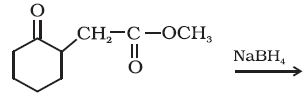
(iii)
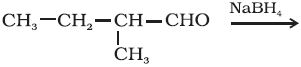
8.
State the products of the following reactions:
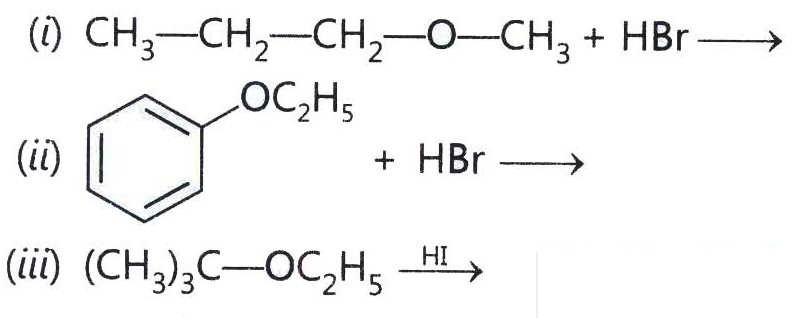
9.
In the following sequence of reactions, CH3-Br \(\overset{KCN}\longrightarrow\) A \(\overset{H_3O^+}\longrightarrow\) B \(\overset { LiAlH_{ 4 } }{ \underset { ether }{ \longrightarrow } } \) C the end product (c) is
acetone
methane
acetaldehyde
ethyl alcohol
10.
Among the alkenes which one produces tertiary butyl alcohol on hydration?
CH3CH2CH = CH2
CH3CH = CHCH3
(CH3)2C = CH2
CH3CH = CH2
11.
CH3OC2H5 and (CH3)3 COCH3 are treated with hydriodic acid. The fragments after reactions obtaind are:
CH3I+HOC2H5 ; (CH3)3C-I+HOCH3
CH3HO+C2H5I; (CH3)3C-I+HOCH3
CH3OH+C2H5I; (CH3)3C-OH+CH3I
CH3I+HOC2H5; CH3I+(CH3)3C-O H
12.
The relative ease of dehydration of alcohols follows the following order :
tertiary>secondary>primary
primary>secondary>tertiary
secondary>tertiary>primary
tertiary>primary>secondary
13.
The general molecular formula which represents the homologous series of alkanols is
\({ C }_{ n }{ H }_{ 2n+2 }O\)
\({ C }_{ n }{ H }_{ 2n }{ O }_{ 2 }\)
\({ C }_{ 2 }{ H }_{ 2n }O\)
\({ C }_{ n }{ H }_{ 2n+1 }O\)
14.
A teacher ordered ethanol for laboratory. She preferred denatured alcohol over absolute alcohol.
(i) Give reason for the decision taken by the teacher.
(ii) What value was kept in mind while taking the decision?
15.
A compound A (C4H10O) is found to be soluble in concentrated sulphuric acid. (A) does not react with sodium metal or potassium permanganate. When (A) is heated with excess of HI, it gives a single alkyl halide. Deduce the structure of compound (A) and explain all the reactions involved.
1.
Due to intramolecular H-bonding, o-nitrophenol cannot form H-bonds with water. Hence, it is insoluble in water.
2.
2-chloroethanol is more acidic than ethanol. Due to -I-effect (electron withdrawing group)of the CI-atom, electron density on O-H bond decreases. So, O-H bond of 2-chloroethanol becomes weaker than O-H bond of ethanol. Thus, the release of H+ ion from O-H bond of 2-chloroethane becomes easier.
3.
Propan-1-ol, 4-methylphenol, phenol, 3-nitro-phenol, 3,5-dinitrophenol, 2,4,6-trinitrophenol is increasing order of acid strength.
4.
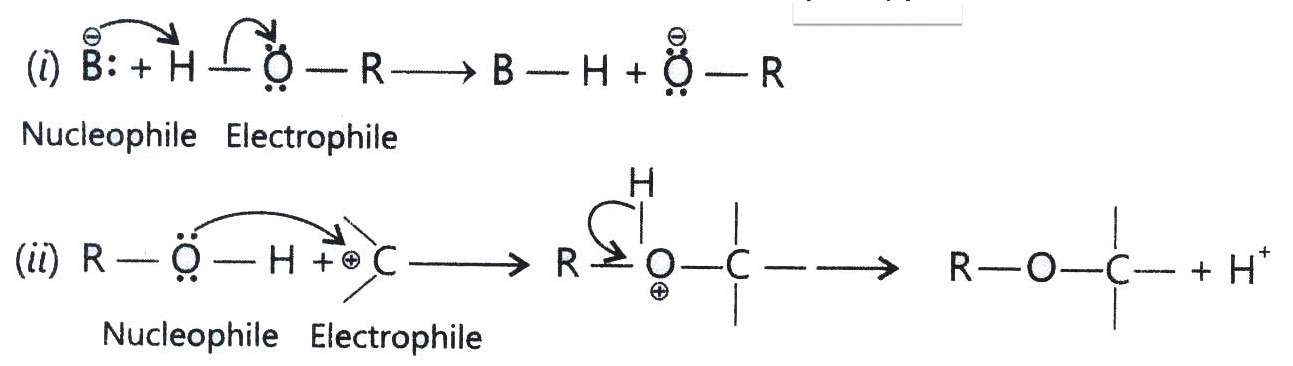
5.

6.

7.
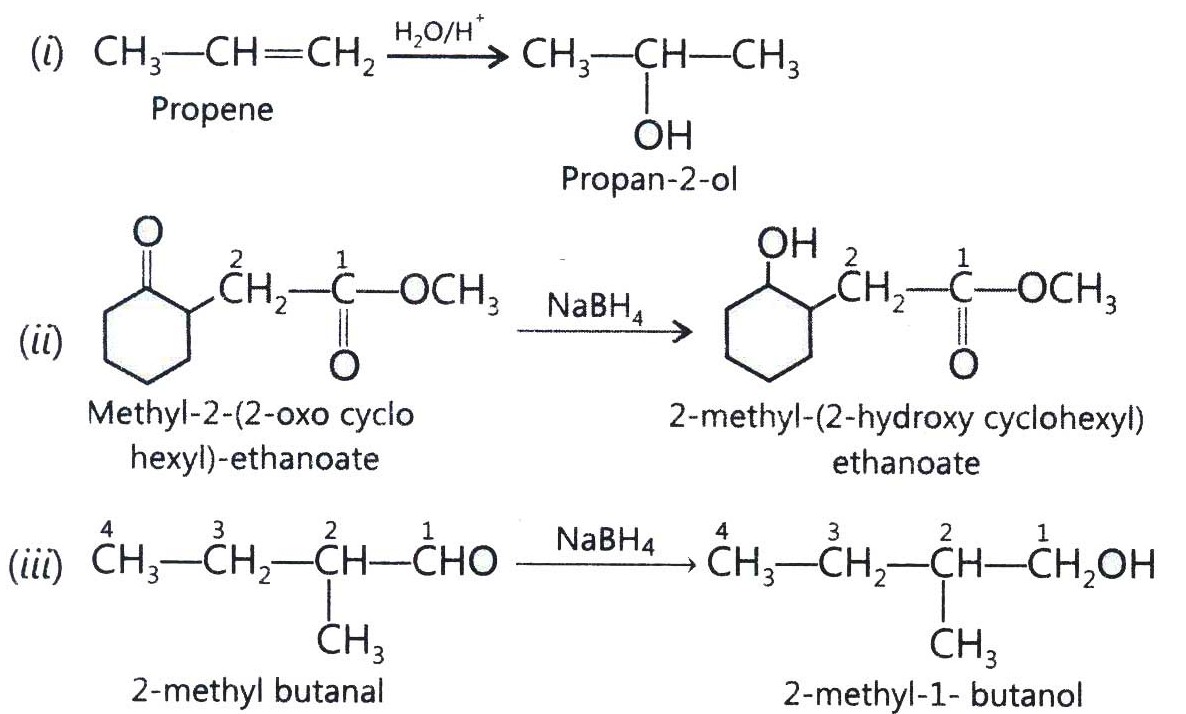
8.
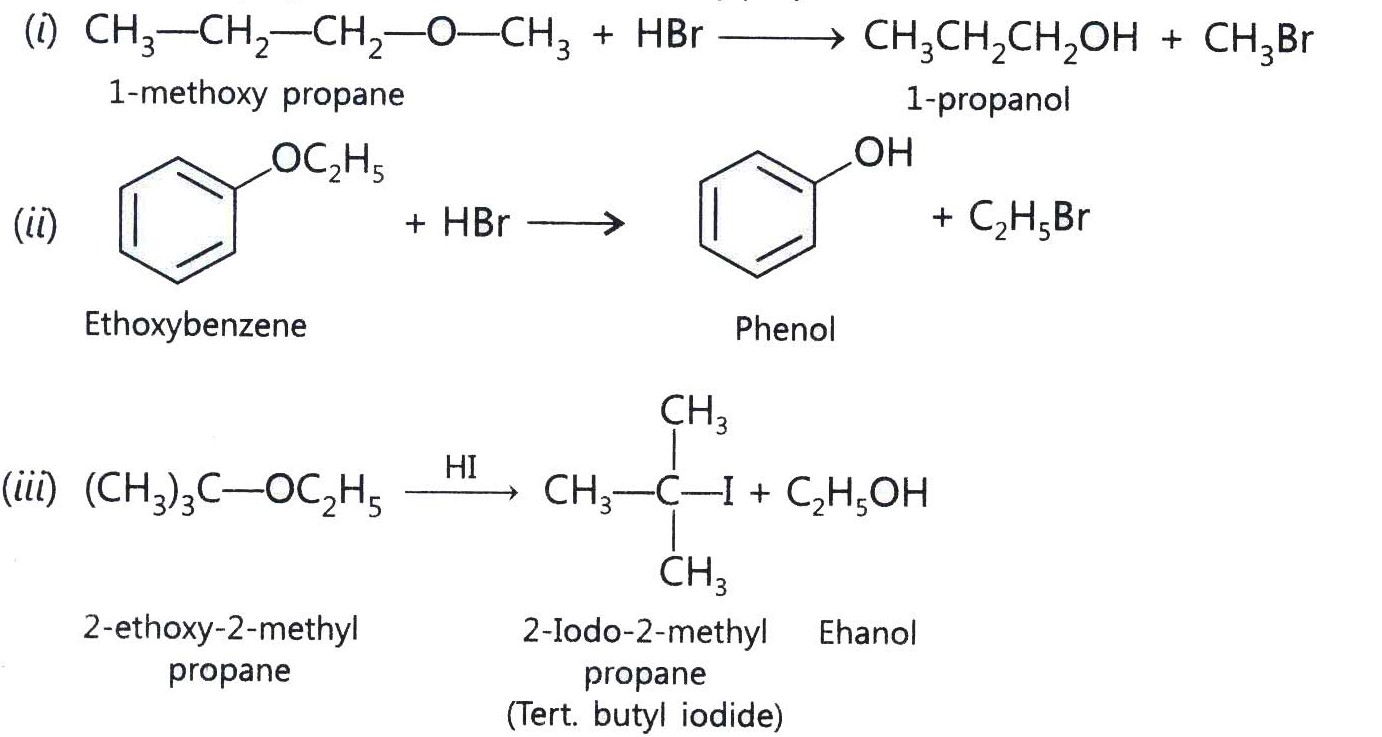
9.
(d)
ethyl alcohol
10.
(c)
(CH3)2C = CH2
11.
(a) CH3OC2H5 undergoes cleavage by SN2 mechanism to give CH3I and C2H5OH while (CH3)3COCH3 undergoes cleavage by SN1 mechanism to give (CH3)3CI and CH3OH.
12.
(a)
tertiary>secondary>primary
13.
(a)
\({ C }_{ n }{ H }_{ 2n+2 }O\)
14.
(i) Teacher preferred denatured alcohol over absolute alcohol as it would be unfit for drinking. As commercial alcohol is mixed with copper sulphate to give it a colour and pyridine to give a foul smell, which makes absolute alcohol unfit for drinking and called as denatured alcohol.
(ii) As the teacher was ordering ethanol for school laboratory, maintaining discipline, repsonsible behaviour and social obligation were values kept in her mind, while taking decision.
15.
(i) Since compound A (C4H10O) does not react with Na metal or KMnO4, it cannot be an alcohol.
(ii) Since compound A dissolves in cone, H2SO4, it may be an ether.
(iii) Since ether A on heating with excess of HI gives a single alkyl halide, therefore, ether (A) must be symmetrical. Now the only symmetrical ether having M.F. C4HIOO is diethyl ether (CH3CH2OCH2CH3).

12th Standard CBSE Syllabus & Materials
12th Standard CBSE
CBSE 12th Computer Science Python Revision Tour I - New Previous year Question Papers Study Material - QB365 Set A
NEW12th Standard CBSE
CBSE 12th Business Studies Planning Important Questions And Answers Study Material - QB365 Set A
NEW12th Standard CBSE
CBSE 12th Business Studies Business Environment Important Questions And Answers Study Material - QB365 Set A
NEW12th Standard CBSE
CBSE 12th Business Studies Principles of Management Important Questions And Answers Study Material - QB365 Set A



CBSE 12th Standard CBSE Subjects
CBSE Standards










