
 100% FREE ACCESS
12th Standard CBSE Syllabus & Materials
12th Standard CBSE
CBSE 12th Economics Government Budget and the Economy Previous year Question Papers Study Material - QB365 Set A
NEW12th Standard CBSE
CBSE 12th Computer Science Interface Python with MySQL - New Previous year Question Papers Study Material - QB365 Set A
NEW12th Standard CBSE
CBSE 12th Computer Science Database Concept - New Previous year Question Papers Study Material - QB365 Set A
NEW12th Standard CBSE
CBSE 12th Computer Science Data Communication - New Previous year Question Papers Study Material - QB365 Set A
NEW12th Standard CBSE
CBSE 12th Computer Science Data Structures - New Previous year Question Papers Study Material - QB365 Set A
NEW12th Standard CBSE
CBSE 12th Computer Science Functions - New Previous year Question Papers Study Material - QB365 Set A

Published on: 06/09/2019
Biomolecules Book Back Questions
Download CBSE Class 12th Standard CBSE Chemistry question papers, sample papers, important questions, and previous year solved papers in PDF format. Get free study materials, NCERT solutions, and exam preparation resources for Class 12th Standard CBSE Chemistry
Questions + Answers key
Take MCQ Chemistry Test
1.
Which component of starch is a branched polymer of \(\alpha\)-glucose and insoluble in water?
2.
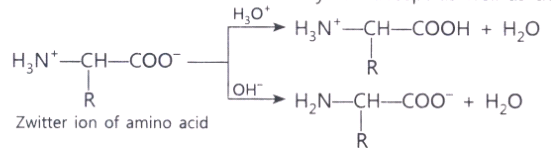
How do you explain the amphoteric behavior of amino acids?
3.
State what the following are and how they differ from each other:
(i) a nucleotide and
(ii) a nucleoside
4.
What are vitamins?Deficiency of which vitamin causes
(i) Pernicious anaemia?
(ii) Convulsions?
5.
Write such reactions and facts about glucose which cannot be explained by its open chain structure.
6.
Sucrose is dextrorotatory but the mixture obtained after hydrolysis is laevorotatory. Explain.
7.
Name the linkage connecting monosaccharide units in polysaccharides.
8.
Why cannot vitamin C be stored in our body?
9.
Name the deficiency diseases resulting from lack of vitamins A and E in the diet.
10.
(i) Which one of the following is a disaccharide: Starch, Maltose, Fructose, Glucose?
(ii) What is the difference between fibrous protein and globular protein?
(iii) Write the name of vitamin whose deficiency causes bone deformities in children.
11.
(a) A non reducing disaccharide 'A' on hydrolysis with dilute acid gives an equimolar mixture of D-( +)-glucose and D-(-)-Fructose.
\(A+{ H }_{ 2 }\quad \underrightarrow { HCl } { \quad C }_{ 6 }{ H }_{ 12 }{ O }_{ 6 }+{ C }_{ 6 }{ H }_{ 12 }{ O }_{ 6 }\)
[\(\alpha\)] = +66.5ο +52.5ο -92.4o
Identify A.What is the mixture of D-( +)-glucose and D-(-)-Fructose known as ? Name the linkage that holds the two units in the disaccharide.
(b) \(\alpha\) -amino acids have relatively higher melting points than the corresponding halo acids. Explain.
12.
(i) Deficiency of which vitamin causes night blindness?
(ii) Name the base that is found in nucleotide of RNA only.
(iii) Glucose on reaction with HI gives n-hexane. What does it suggest about the structure of glucose?
13.
(a) Write the important structure difference between DNA and RNA.
(b) Mention the names of the bases produced on hydrolysis of DNA
14.
Amino acids may be acidic, alkaline or neutral. How does this happen? What are essential and non-essential amino acids? Name one of each type.
15.
Vitamin A is
ascorbic acid
retinol
calciferol
thiamine
16.
The helical structure of protein is stabilized by
dipeptide bonds
hydrogen bonds
ether bonds
peptide bonds
17.
Important constituent of cell wall is
lipid
cellulose
protein
vitamin
18.
The term anomer of glucose refers to
isomers of glucose that differ in configuration at carbons one and four (C-1 and C-4)
a mixture of (D)-glucose and (L)-glucose
enantiomers of glucose
isomers of glucose that differ in configuration at carbon one (C-1)
19.
Which of the following is incorrect for glucose?
It contains four > CHOH groups
It contains one ketone group
It contains one CH2OH group
It contains one-CHO group
20.
Denaturation involves conversion of ........... proteins to ....... proteins
21.
The monosaccharide units in oligosaccharides and polysaccharides are connected through ......... linkages
22.
The Ka and Kb values of \(\alpha\) - amino acids are very low. Explain.
23.
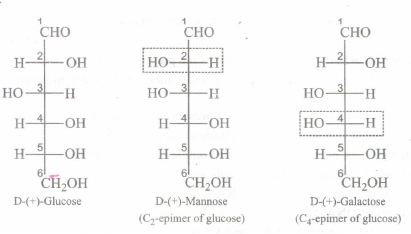
How do expimers differ from anomers ?
1.
Amylopectin is a branched polymer of \(\alpha\)-glucose and insoluble in water.
2.
Amino acids have both acidic as well as basic group, therefore they are amphoteric in nature. i.e., they react both with acids as well as bases. They can accept as well as bases. They can accept as well as donate a proton.
3.
(i) Nucleotides: They are monomers of nucleic acids. They are made up of a heterocyclic base containing nitrogen, a five carbon sugar and a phosphate group, e.g. adenosine monophosphate (AMP), adenosine diphosphate (ADP) and adenosine triphosphate (ATP).
They contain P—O—P bonds which are high energy phosphate bonds and due to them nucleotides are energy carriers.Or Sugar + Phosphate + Nitrogen base.
(ii) Nucleosides: A base joined to a sugar molecule is called nucleoside, e.g., adenosine contains adenine and ribose, guanosine contains ribose and guanine, cytidine contains ribose and cytosine.Or Sugar + Nitrogen base.
4.
Vitamins: Vitamins are group of organic compounds which are required in very small amounts for the healthy growth and functioning of animal organism. They cannot be made by organism and so have to be part of our diet. The deficiency of a vitamin can cause a specific disease, e.g.
(i) Vitamin B, deficiency causes pernicous anaemia.
(ii) Vitamin B, deficiency causes convulsion.
5.
(t) Glucose does not respond to Schiff's reagent test.
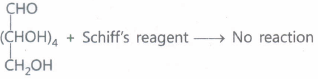
(il) It does not react with sodium bisulphite and ammonia.
.png)
6.
On hydrolysis sucrose gives glucose (dextrorotatory +52.5) and fructose (laevorotatory, -92.4o). Since laevorotation fructose is more than dextrorotation of glucose, therefore, mixture is laevorotatory.
7.
Glycosidic linkage.
8.
Vitamin C cannot be stored in our body because it is soluble in water therefore gets excreted in urine.
9.
(i) Night blindness is caused by lack of vit. A
(ii) Loss of reproduction power is caused by deficiency of vit. E.
10.
(i) Maltose is disaccharide.
(ii)
| Fibrous protein | Globular protein |
|---|---|
| It consist linear thread like molecules which tend to lie side by side to form fibres. Example: Keratin, collagen |
It consist compact form of molecules which are folded together. Example: enzymes, hormones. |
(iii) The deficiency of vitamin D causes bone deformities in children.
11.
(a) A-Sucrose (C12H22O11)
The mixture of D-(+)- glucose and D-(-)-Fructose is knows as invert sugar.
The linkage which holds the two monosaccharide units through oxygen atom is called glycosidic linkage.
The amino acids exits as dipolar Zwitter ion. Due to this dipolar salt like character they have strong dipole dipole attractions. Thus their melting points are higher than the corresponding haloacids which do not exist as Zwitter ions.
12.
(i) Vitamin A
(ii) Uracil
(iii) It suggests that six carbon atoms are in straight chain/CHO-(CHOH)4-CH2OH
13.
(i)
| DNA | RNA |
| (i) It has double helix structure. |
(i) It has single helix structure |
| (ii) It has Adenine , Thymine, Guanine and Cytocine. | (ii) It has Adenine, Guanine, Cytocine and Uacil |
(b) Hydrolysis of DNA gives Adenine, Thymine,Guanine and Cytocine.
14.
Amino acids may be acidic, basic or neutral depending upon the relative number of amino and carboxyl groups present in the molecule. Equal number of amino and carboxyl groups makes it neutral, more number of amino than carboxyl groups makes it basic and more carboxylic groups as compared to amino groups makes it acidic.
Essential Amino Acids: Amino acids which can't be created in our body but can only be received from proper food or diet are called Essential Amino Acids. Examples- Histidine, Isoleucine, Lysine.
Non- essential amino acids: Amino acids which can be created in our body itself are Non- essential amino acids. Examples-alanine, arginine, asparagine, aspartic acid. Examples- Histidine, Isoleucine, Lysine.
15.
(b)
retinol
16.
(b)
hydrogen bonds
17.
(b)
cellulose
18.
(d)
isomers of glucose that differ in configuration at carbon one (C-1)
19.
(b)
It contains one ketone group
20.
()
globular, fibrous
21.
()
glycosidic
22.
The Ka and Kb values of a-amino acids are very low because, in a-amino acids, the acidic group is \({ NH }_{ 3 }\) instead of -COOH in carboxylic acids and basic group is -\({ COO }^{ - }\) instead of -\({ NH }_{ 2 }\) group in aliphatic amines. For example, the Ka and Kb values of glycine are \(1.6\times { 10 }^{ -10 }\) and \(2.5\times { 10 }^{ -12 }\) respectively.
23.
Carbohydrates which differ in configuration at the glycosidic carbon (i.e. \({ C }_{ 1 }\) in aldoses and \({ C }_{ 2 }\) in ketoses) are called anomers while those which differ in configuration at any carbon other than glycosidic carbon are called epimers. For example, \(\alpha \)-D-glucose and \(\beta \)-D-glucose are anomers since they differ in configuration at \({ C }_{ 1 }\) (glycosidic carbon) while glucose and mannose are called epimers since they differ in configuration at \({ C }_{ 2 }\)(other than the glycosidic carbon \({ C }_{ 1 }\) ). In other words, glucose and mannose are Cr epimers. Similarly, we can show that glucose and galactose are \({ C }_{ 4 }\) -epimers since they differ in configuration only at \({ C }_{ 4 }\).

12th Standard CBSE Syllabus & Materials
12th Standard CBSE
CBSE 12th Computer Science Python Revision Tour I - New Previous year Question Papers Study Material - QB365 Set A
NEW12th Standard CBSE
CBSE 12th Business Studies Planning Important Questions And Answers Study Material - QB365 Set A
NEW12th Standard CBSE
CBSE 12th Business Studies Business Environment Important Questions And Answers Study Material - QB365 Set A
NEW12th Standard CBSE
CBSE 12th Business Studies Principles of Management Important Questions And Answers Study Material - QB365 Set A



CBSE 12th Standard CBSE Subjects
CBSE Standards










