
 100% FREE ACCESS
12th Standard CBSE Syllabus & Materials
12th Standard CBSE
CBSE 12th Economics Government Budget and the Economy Previous year Question Papers Study Material - QB365 Set A
NEW12th Standard CBSE
CBSE 12th Computer Science Interface Python with MySQL - New Previous year Question Papers Study Material - QB365 Set A
NEW12th Standard CBSE
CBSE 12th Computer Science Database Concept - New Previous year Question Papers Study Material - QB365 Set A
NEW12th Standard CBSE
CBSE 12th Computer Science Data Communication - New Previous year Question Papers Study Material - QB365 Set A
NEW12th Standard CBSE
CBSE 12th Computer Science Data Structures - New Previous year Question Papers Study Material - QB365 Set A
NEW12th Standard CBSE
CBSE 12th Computer Science Functions - New Previous year Question Papers Study Material - QB365 Set A

Published on: 10/12/2018
Chemistry has revolutionized the world and changed lives for the better. From medical applications to gene studies, having a foundation knowledge of Chemistry better equips students to theorize concepts and bring applications to life. The CBSE Class 12 Chemistry NCERT Solutions have been written by some of the best educational experts in the country, thus making concepts easy to understand and grasp quickly. The Chemistry Class 12 NCERT solutions covers chapters and topics which appear in various entrance exams, like the JEE. Different types of questions that are asked in the textbooks can be repetitive or confusing, but NCERT Chemistry PDF solutions help deal with any problems while answering the questions or solving equations. Useful in individual and group studies, by practicing these solutions, students can thoroughly prepare for academic exams and understand topics from a practical perspective. This acts as a gateway to the mind of the examiner.
In this post Class 12, Chemistry Chapter Biomolecules solved by Expert Teachers as per NCERT (CBSE) Book guidelines. All Chapter Biomolecules Exercise Questions with Solutions to help you to revise complete Syllabus and Score More marks.
Get 100 percent accurate NCERT Solutions for Class 12 Chemistry Chapter Biomolecules solved by expert Chemistry teachers. We provide solutions for questions given in Class 12 Chemistry text-book as per CBSE Board guidelines from the latest NCERT book for Class 12 Chemistry.
Download CBSE Class 12th Standard CBSE Chemistry question papers, sample papers, important questions, and previous year solved papers in PDF format. Get free study materials, NCERT solutions, and exam preparation resources for Class 12th Standard CBSE Chemistry
Questions + Answers key
Take MCQ Chemistry Test
1.
What type of linkage holds together the monomer of DNA ?
2.
Which component of starch is a branched polymer of \(\alpha\)-glucose and insoluble in water?
3.
Which of the following base pairs are found in DNA and which of them in RNA ?
(i) A : A, (ii) A : T, (iii) C : G, (iv) G : C, (v) G : A, (vi) A : U, (vii) G : U and (viii) A : C
4.
Name the three nucleic acids used in protein synthesis.
5.
Name the enzyme which is used to dissolve the blood clot.
6.
Write the zwitterion structure of glycine.
7.
What are polysaccharides ? Give one example.
8.
Is a diet coinsisting mainly of rice an adequate diet ? why or why not ?
9.
Coagulation of egg white on boiling is an example of denaturation of protein. Explain it in terms of structural changes.
10.
Protein found in a biological system with a unique three-dimensional structure and biological activity is called a native protein. When a protein in its native form is subjected to a physical change in temperature or a chemical change like, change in pH, denaturation of protein takes place. Explain the cause.
11.
Sucrose is dextrorotatory but the mixture obtained after hydrolysis is laevorotatory. Explain.
12.
Glucose on reaction with HI gives n-hexane. What does it suggest about the structure of glucose?
13.
What is the structural feature characterising reducing sugar?
14.
(a) What is denaturation and renaturation of proteins?
(b) Give reason:Amylase present in the saliva becomes inactive in the stomach
15.
Write the chemical reaction equations for the glucose with
(i) acetic anhydride
(ii) NH2OH Also draw Fischer projections of D-glucose and L-glucose.
16.
Define the following, giving one example of each:
(i) Zwitter ion
(ii) Glycosidic linkage
17.
(a)What is the structural difference between a nucleoside and a nucleotide?
(b)The two strands in DNA are not identical but are complementry. Explain
18.
The beta and alpha glucose have different specific rotations. When either is dissolved in water, their rotation changes until the same fixed value result. This is called
epimerization
racemisation
anomerisation
mutarotation
19.
Which of the following hexoses will form the same osazone when treated with excess phenylhydrazine ?
D-glucose, D-fructose and D-galactose
D-glucose, D-fructose and D-mannose
D-glucose, D-mannose and D-galactose
D-fructose, D-mannose and D-galactose
20.
In fibrous proteins polypeptide chains are held together by ............ .
van der Waals forces
disulphide linkage
electrostatic forces of attraction
hydrogen bonds
21.
Dinucleotide is obtained by joining two nucleotides together by phosphodiester linkage. Between which carbon atoms of pentose sugars of nucleotides are these linkages present ?
5' and 3'
1' and 5'
5' and 5'
3' and 3'
22.
Which sugar is present in DNA ?
Ribose
2-Deoxyribose
Flucose
Fructose
23.
The helical structure of protein is stabilized by
dipeptide bonds
hydrogen bonds
ether bonds
peptide bonds
24.
Which of the following disaccharide gives a ketose and an aldose only on hydrolysis?
Sucrose
Maltose
Lactose
All the three
25.
When glucose is treated with excess of phenylhydrazine in acetic acid, the product is
glucosazone
phenylhydrazone of glucose
oxime of glucose
glucosamine
26.
Which of the following is incorrect for glucose?
It contains four > CHOH groups
It contains one ketone group
It contains one CH2OH group
It contains one-CHO group
27.
Hormone secretion in mammals is under the control of ........... .
28.
Carbohydrates form a group of naturally occuring organic compounds and are a major source of energy for our body. Some common examples are of cane sugar, glucose etc. Chemically these are either polyhydric aldehydes or polyhydric ketones and are classified as monosaccharides, oligosaccharides and polysaccharides.
(i) Name the carbohydrates which has maximum sweetners.
(ii) Which carbohydrate is present in milk?
(iii) Why is sucrose a non-reducing sugar ?
(iv) How do carbohydrates (starch in particular) act as a source of energy for our body?
29.
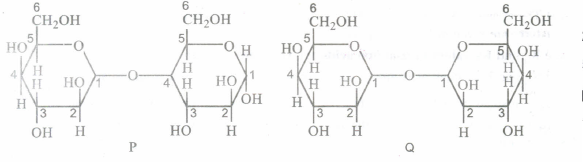
Which of the following will reduce Tollens ' reagent ? Explain.
30.
How do expimers differ from anomers ?
1.
Monomer of DNA are held together by phospho diester linkage.
2.
Amylopectin is a branched polymer of \(\alpha\)-glucose and insoluble in water.
3.
DNA : (ii), (iii), (iv) ; RNA : (vi).
4.
mRNA, tRNA, rRNA
5.
Streptokinase.
6.
A zwittierion is a dipolar ion formed by neutralization of acidic and basic centres present within the molecule. For example, all aminoacids and sulphuric acid exist as zwitterions.
7.
Polysaccharides on hydrolysis give a large number of molecules of monosaccharides. For example, starch or cellulose.
8.
A diet consisting mainly of rice is not an adequate diet because it is deficient in lysine and threonmine which are essential amino acids required for growth and maintenence of health and hence their deficiency has to be supplemented by other protein rich diets like pulses, etc.
9.
During denaturation of proteins 2° and 3° structures are destroyed but primary structure remains intact.
10.
H—bonds in proteins are disturbed, globules unfold, helix gets uncoiled, therefore, protein loses its biological activity. This is called denaturation of protein.
11.
On hydrolysis sucrose gives glucose (dextrorotatory +52.5) and fructose (laevorotatory, -92.4o). Since laevorotation fructose is more than dextrorotation of glucose, therefore, mixture is laevorotatory.
12.
n-hexane is formed when glucose is treated with HI. This reaction shows that all six carbon atoms are linked in a straight chain.
13.
The main structural feature of reducing sugars is the presence of an aldehyde group (-CO) such as in glucose, mannose, galactose , etc. . Or the α -ketol grouping (-CO-CH2OH) as present in fructose.
14.
(a)The process of disruption of higher structure without changing its primary structure is called denaturation. If the disruptive agent is removed and protein recovers its original structure, it is called renaturation.
(b)In stomach pH is acidic, therefore, amylase becomes inactive, that is why digestion of carbohydrates does not take place in stomach.
15.
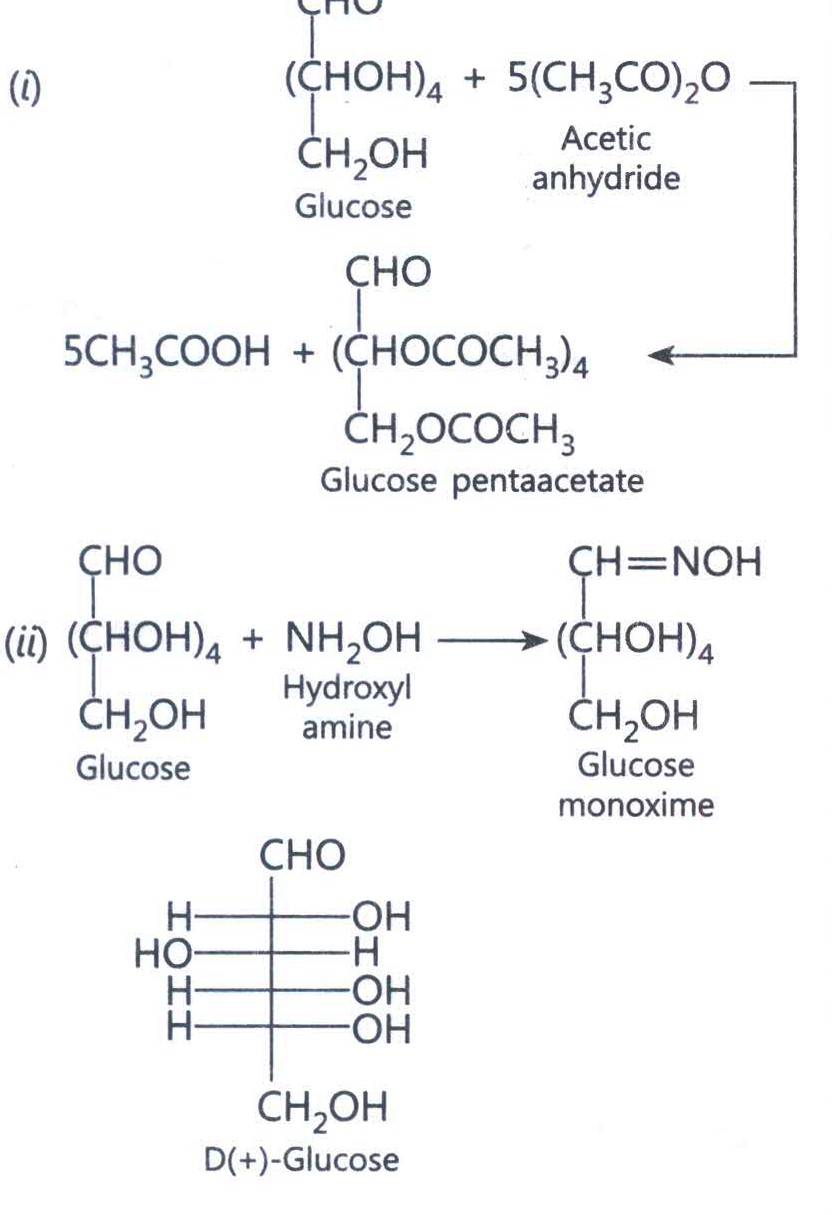
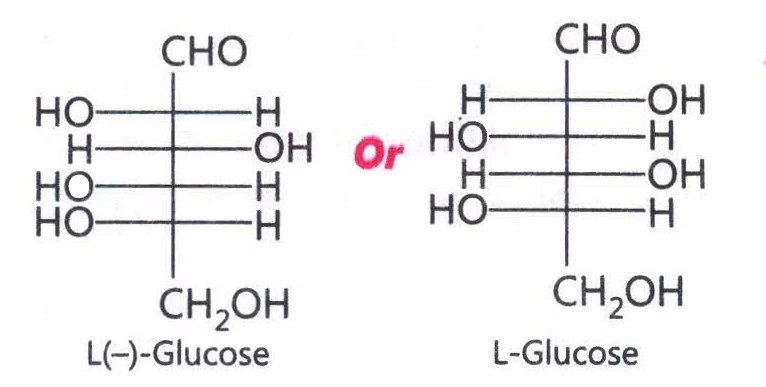
16.
(i)The ion whose one end is positively charged and other end is negatively charged is called Zwitter ion, e.g.,
\({ H }_{ 2 }N-CH_{ 2 }-COOH\rightleftharpoons { H }_{ 3 }^{ \oplus }N-CH_{ 2 }-COO^{ - }\)
(ii) Glycosidic Linkage: The oxide linkage between monosachharide units in oligo and polysachharide is called glycosidic linkage, e.g.
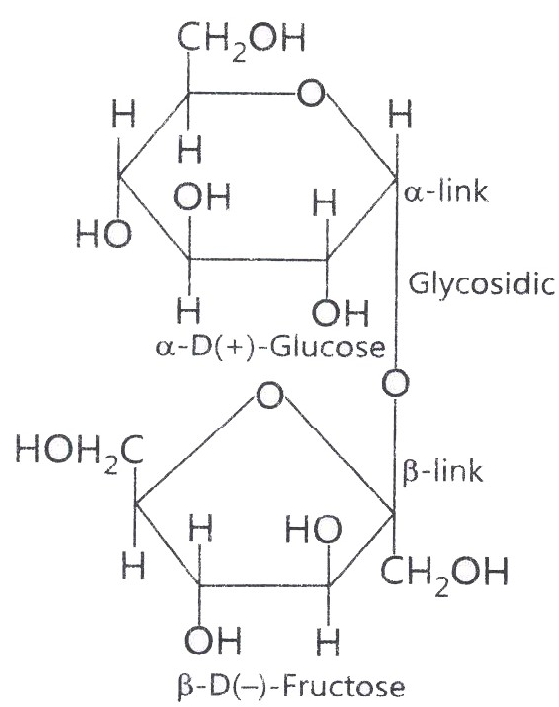
17.
a) Nucleoside contains ribose or deoxyribose sugar and heterocyclic base, e.g., adenosine, whereas nucleotides contain phosphoric acid residue also along with heterocyclic base and pentose sugar, e.g., adenosine triphosphate (ATP).
b) DNA consists of two strands of polynucleotides coiled around each other in the form of a double helix. The nucleotides making up each strand of DNA are connected by phosphodiester bonds. This forms the backbone of each DNA strand from which the bases extend. The bases of one strand of DNA are paired with bases on the other strand by means of hydrogen bonding. This hydrogen bonding is very specific as the structures of bases permit only one mode of pairing. Adenine pairs with thymine through two hydrogen bonds and guanine pairs with cytocine through three hydrogen bonds. The two strands of DNA are said to be complementary to each other in sense that the sequence of bases in one strand automatically determines that of the other. The strands are not identical but complementary.
18.
(d)
mutarotation
19.
(b)
D-glucose, D-fructose and D-mannose
20.
(d)
hydrogen bonds
21.
(a)
5' and 3'
22.
(b)
2-Deoxyribose
23.
(b)
hydrogen bonds
24.
(a)
Sucrose
25.
(a)
glucosazone
26.
(b)
It contains one ketone group
27.
()
endocrine glands
28.
(i) Sucrose is the sweetest of all the known carbohydrates.
(ii) Lactose is present in milk.
(iii) Sucrose is a disaccharide in which two reducing monosaccharides are linked to each other by glycosidic linkange and are not free.
(iv) In our body starch get hydrolysed to glucose in the presence of enzymes. Glucose is slowly oxidised to CO2 and water in the presence of enzyme oxidase present in our body. The oxidation reaction is accompanied by the release of energy.
29.
In disaccharide (Q), both the monosaccharides are linked through their reducing centres (\({ C }_{ 1 }\)), therefore, it is not a reducing disaccharide. In disaccharide (P), the reducing end (\({ C }_{ 1 }\)) of one monosaccharide is linked to non-reducing end (\({ C }_{ 4 }\)) of the other monosaccharide. In other words, reducing end of one monosaccharide is free. Therefore, it is a reducing disaccharide.
30.
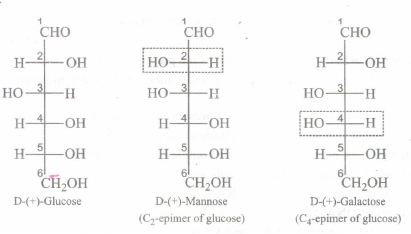
Carbohydrates which differ in configuration at the glycosidic carbon (i.e. \({ C }_{ 1 }\) in aldoses and \({ C }_{ 2 }\) in ketoses) are called anomers while those which differ in configuration at any carbon other than glycosidic carbon are called epimers. For example, \(\alpha \)-D-glucose and \(\beta \)-D-glucose are anomers since they differ in configuration at \({ C }_{ 1 }\) (glycosidic carbon) while glucose and mannose are called epimers since they differ in configuration at \({ C }_{ 2 }\)(other than the glycosidic carbon \({ C }_{ 1 }\) ). In other words, glucose and mannose are Cr epimers. Similarly, we can show that glucose and galactose are \({ C }_{ 4 }\) -epimers since they differ in configuration only at \({ C }_{ 4 }\).

12th Standard CBSE Syllabus & Materials
12th Standard CBSE
CBSE 12th Computer Science Python Revision Tour I - New Previous year Question Papers Study Material - QB365 Set A
NEW12th Standard CBSE
CBSE 12th Business Studies Planning Important Questions And Answers Study Material - QB365 Set A
NEW12th Standard CBSE
CBSE 12th Business Studies Business Environment Important Questions And Answers Study Material - QB365 Set A
NEW12th Standard CBSE
CBSE 12th Business Studies Principles of Management Important Questions And Answers Study Material - QB365 Set A



CBSE 12th Standard CBSE Subjects
CBSE Standards










