
 100% FREE ACCESS
12th Standard CBSE Syllabus & Materials
12th Standard CBSE
CBSE 12th Economics Government Budget and the Economy Previous year Question Papers Study Material - QB365 Set A
NEW12th Standard CBSE
CBSE 12th Computer Science Interface Python with MySQL - New Previous year Question Papers Study Material - QB365 Set A
NEW12th Standard CBSE
CBSE 12th Computer Science Database Concept - New Previous year Question Papers Study Material - QB365 Set A
NEW12th Standard CBSE
CBSE 12th Computer Science Data Communication - New Previous year Question Papers Study Material - QB365 Set A
NEW12th Standard CBSE
CBSE 12th Computer Science Data Structures - New Previous year Question Papers Study Material - QB365 Set A
NEW12th Standard CBSE
CBSE 12th Computer Science Functions - New Previous year Question Papers Study Material - QB365 Set A

Published on: 30/11/2018
Chemistry has revolutionized the world and changed lives for the better. From medical applications to gene studies, having a foundation knowledge of Chemistry better equips students to theorize concepts and bring applications to life. The CBSE Class 12 Chemistry NCERT Solutions have been written by some of the best educational experts in the country, thus making concepts easy to understand and grasp quickly. The Chemistry Class 12 NCERT solutions covers chapters and topics which appear in various entrance exams, like the JEE. Different types of questions that are asked in the textbooks can be repetitive or confusing, but NCERT Chemistry PDF solutions help deal with any problems while answering the questions or solving equations. Useful in individual and group studies, by practicing these solutions, students can thoroughly prepare for academic exams and understand topics from a practical perspective. This acts as a gateway to the mind of the examiner.
In this post Class 12 Chemistry Chapter 16 - Chemistry in Everyday Life solved by Expert Teachers as per NCERT (CBSE) Book guidelines. All Chapter 16 - Chemistry in Everyday life Exercise Questions with Solutions to help you to revise complete Syllabus and Score More marks.
Get 100 percent accurate NCERT Solutions for Class 12 Chemistry Chapter 16 (Chemistry in Everyday Life) solved by expert Chemistry teachers. We provide solutions for questions given in Class 12 Chemistry text-book as per CBSE Board guidelines from the latest NCERT book for Class 12 Chemistry.
After studying this chapter, students will be able to visualize the importance of Chemistry in daily life; explain the term ‘chemotherapy’; describe the basis of classification of drugs; explain drug-target interaction of enzymes and receptors; explain how various types of drugs function in the body; know about artificial sweetening agents and food preservatives and discuss the chemistry of cleansing agents.
NCERT Grade 12 Chemistry Chapter 16, Chemistry in Everyday Life holds a total weightage of 3 marks in the final examination.
Download CBSE Class 12th Standard CBSE Chemistry question papers, sample papers, important questions, and previous year solved papers in PDF format. Get free study materials, NCERT solutions, and exam preparation resources for Class 12th Standard CBSE Chemistry
Questions + Answers key
Take MCQ Chemistry Test
1.
What is the difference between bathing soap and washing soaps?
2.
Which site of an enzyme is called allosteric site?
3.
Name two narcotics which are used as analogesics.
4.
Define the term chemotherapy.
5.
What is the side product of soap industry? Give reactions showing soap formation.
6.
Explain the following terms giving an example of each:
(i) Antacids
(ii) Sweetening agents
7.
(i) Pick out the odd one from among the following on the basis of their medicinal properties mentioning the reason: Luminal, Seconal, Phenacetin, Equanil.
(ii) Give an example of a substance that can act as a disinfectant as well as antiseptic depending upon its concentration. (Specify concentration)
(iii) Name any two macromolecules chosen as drug targets.
8.
What are the following substances? Give one example of each one of them:
(i) Tranquilizers,
(ii) Food preservatives,
(iii) Synthetic detergents.
9.
Name the action of the following on the human body:
(a) Pencillium
(b) Morphine
(c) Analgin
10.
How do antiseptics differ from disinfectants? Give one example of each.
11.
What are biodegradable and non-biodegradable detergents? Give one example of each.
12.
Which of the following can be used as artificial sweeteners ?
Aspartame
Alitame
Sucrolose
Saccharin
13.
Which one of the following is a cationic detergent ?
Sodium lauryl sulphate
Cetyltrimethylammonium bromide
Sodium dodecylbenzenesulphonate
Glyceryl palmitate
Glyceryl oleate
14.
Bithional is generally added to the soaps as an additive to function as a/an
buffering agent
antiseptic
softner
dryer
15.
Chloramphenicol is
antiseptic and disinfactant
antibiotic broad spectrum
antifertility drug
antihistamine
16.
Which of the following is not an antacid ?
Phenelzine
Ranitidine
Aluminium hydroxide
Cimetidine
17.
Compounds with antiseptic properties are ....... .
CHCI3
CHI3
Boric acid
0.3 ppm aqueous solution of CI2
18.
Equanil is ............ .
artificial sweetener
tranquillizer
antihistamine
antifertility drug
19.
Which statement about aspirin is not true ?
Aspirin belongs to narcotic analgesics
It is effective in relieving pain
It has antiblood clotting action
It is a neurologically active drug
20.
Which of the following is not a surfactant ?
\(CH_3-(CH_2)_{15}-\overset{+}{N}(CH_3)_3\ Br^-\)
\(CH_3-(CH_2)_{14}-CH_2NH_2\)
\(CH_3-(CH_2)_{16}CH_2OSO\overset{-}{3}Na^+\)
\(OHC-(CH_2)_{14}-CH_2-COO^-Na^+\)
21.
Which of the following antacids is an antihistamine ?
Ranitidine
Lansoprazole
Terfenadine
Luminal
22.
Tripolyphosphate is added to detergents as ________ .
23.
The antiseptic dettol is a mixture of ________ and ________ in a suitable solvent.
24.
Morphine or Heroin is a ________ analgesic.
25.
________ is widely used to prevent heart attacks.
26.
________ is the branch of chemistry which deals with the treatment of diseases using chemicals.
27.
Ankit's grandfather is not only obese but he is also a diabetic patient. Seeing his fondness for sweets, Ankit suggested him to replace sugar with artificial sweeteners. After few days, Ankit observed a controlled level to sugar in his grandfather. Answer the following:
(i) What are the values displayed by Ankit?
(ii) What are artificial sweeteners?
(iii)Give two examples of artificial sweeteners.
(iv) Name an artificial sweetener which is unstable at cooking temperature.
28.
Ramesh went to a department store to purchase groceries, On one of shelves he noticed sugar-free tablets, He decided to buy them for his grandfather who was a diabetic. There was three types of sugar-free tablets, Ramesh decided to buy sucralose which was good for his grandfather's health.
(i) Name another sugar-free tablet which Ramesh did not buy,
(ii) Was it right to purchase such medicines without doctor's prescription?
(iii)Wha is quality of Ramesh is reflected above?
1.
()
Bathing soaps are potassium salts, whereas washing soaps are sodium salts of fatty acids.
2.
()
Sites different from active site of enzymes where a molecule can bind and affect the active site is called allosteric site.
3.
()
(i) morphine
(ii) codeine
(iii) pethidine hydrochlorides
(iv) methadine
(v) heroin, etc. are narcotics and used as analgesics. (any two)
4.
The branch of chemistry which deals with the treatement of diseases using chemicals is caled chemotherapy.
5.
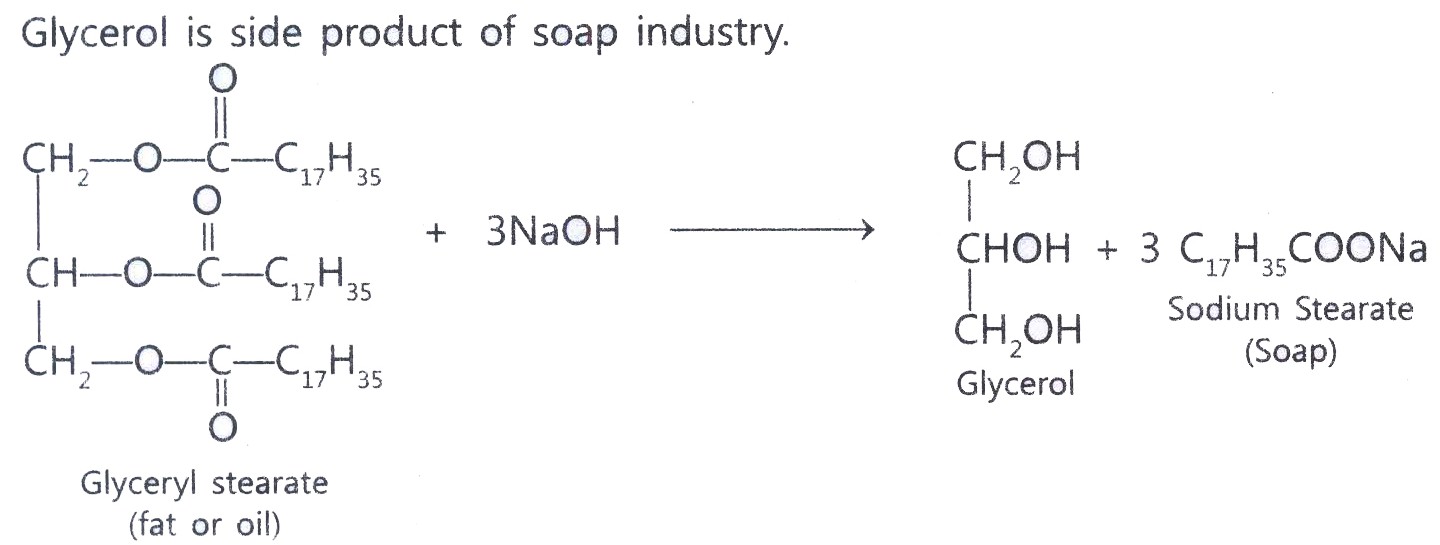
6.
(i) Antacids: Substances which remove the excess acid and raise the pH to appropriate level in stomach are called antacids, e.g. Milk of Magnésia [Mg(OH)2], Ranitidine (Zantac) etc.
(ii) Sweeting agents: Those substances which do not add calories are sweetening agents, e.g. alitame.
7.
(i) Phenacetin is an antipyretic, while the rest are tranquillizers.
(ii) Carbohydrates, proteins, nucleic acids, lipids.
(iii) 0.2% solution of phenol acts as antiseptic whereas 1% solution of phenol acts as a disinfectant.
8.
(i) Tranquilizers are chemical compounds used for the treatment of stress and mild or even severe mental diseases. e.g., equanil / meprobamate/veronal
(ii) Food preservatives: are the compounds which prevent spoilage of food due to microbial growth. e.g., sodium benzoate, vinegar.
(iii) Synthetic detergents: are cleansing agents which have all the properties of soap but actually do not contain any soap. e.g., Sodium lauryl sulphate.
9.
(a) Penicillin is an antibiotic used against large number of infections caused by various cocci, gram positive bacteria, etc. It is an effective drug for pneumonia, bronchitis, sore throat and abscesses.
(b) Morphine is a strong analgesic and narcotics. It causes addiction. It gives relief from acute pain, induce sleep and unconsciousness in higher doses.
(c) Analgin is antipyretic and analgesic. It brings down temperature of body in fever and give relief from pain.
10.
Antiseptics: These are chemicals which kill or prevent the growth of micro-organisms. They are applied to living tissues.
Disinfectants: They kill microorganisms but are not safe for contact with living tissues. 0.2% solution of phenol is antiseptic. 2% solution of phenol is disinfectant.
11.
Biodegradable detergents are those which are decomposed by microorganisms like bacteria into harmless products. They do not create water pollution. Detergents having linear alkyl chains are biodegradable.
Non-biodegradable detergents are those which are not decomposed by microorganisms in sewage. They create water pollution. For example, n-lauryl sulphonate is biodegradable whereas detergent with branched chains are non-biodegradable.
12.
(c)
Sucrolose
13.
(b)
Cetyltrimethylammonium bromide
14.
(b)
antiseptic
15.
(b)
antibiotic broad spectrum
16.
(a)
Phenelzine
17.
(b)
CHI3
18.
(b)
tranquillizer
19.
(a)
Aspirin belongs to narcotic analgesics
20.
(b)
\(CH_3-(CH_2)_{14}-CH_2NH_2\)
21.
(a)
Ranitidine
22.
()
water-softener
23.
()
chloroxylenol, \(\alpha\)-terpineol
24.
()
narcotic
25.
()
aspirin
26.
()
Chemotherapy
27.
(i) Caring, concerned, helpful (or any other two values)
(ii) Artificial sweeteners are the chemical compounds which give sweetening effect to the food, enhances its odour and flavour and is used as a substitute of sugar due to its low-calorie intake.
(iii) Sucrolose/Aspartame/Alitarne
(iv) Aspartame.
28.
(i) Aspartame, Saccharin (anyone).
(ii) No.

12th Standard CBSE Syllabus & Materials
12th Standard CBSE
CBSE 12th Computer Science Python Revision Tour I - New Previous year Question Papers Study Material - QB365 Set A
NEW12th Standard CBSE
CBSE 12th Business Studies Planning Important Questions And Answers Study Material - QB365 Set A
NEW12th Standard CBSE
CBSE 12th Business Studies Business Environment Important Questions And Answers Study Material - QB365 Set A
NEW12th Standard CBSE
CBSE 12th Business Studies Principles of Management Important Questions And Answers Study Material - QB365 Set A



CBSE 12th Standard CBSE Subjects
CBSE Standards










