
 100% FREE ACCESS
12th Standard CBSE Syllabus & Materials
12th Standard CBSE
CBSE 12th Economics Government Budget and the Economy Previous year Question Papers Study Material - QB365 Set A
NEW12th Standard CBSE
CBSE 12th Computer Science Interface Python with MySQL - New Previous year Question Papers Study Material - QB365 Set A
NEW12th Standard CBSE
CBSE 12th Computer Science Database Concept - New Previous year Question Papers Study Material - QB365 Set A
NEW12th Standard CBSE
CBSE 12th Computer Science Data Communication - New Previous year Question Papers Study Material - QB365 Set A
NEW12th Standard CBSE
CBSE 12th Computer Science Data Structures - New Previous year Question Papers Study Material - QB365 Set A
NEW12th Standard CBSE
CBSE 12th Computer Science Functions - New Previous year Question Papers Study Material - QB365 Set A

Published on: 14/09/2019
Surface Chemistry
Download CBSE Class 12th Standard CBSE Chemistry question papers, sample papers, important questions, and previous year solved papers in PDF format. Get free study materials, NCERT solutions, and exam preparation resources for Class 12th Standard CBSE Chemistry
Questions + Answers key
Take MCQ Chemistry Test
1.
Explain the curdling of milk when it is sour.
2.
Explain the following terms by giving one example for each.
(i) Micelles
(ii) Aerosol
3.
Giving appropriate examples, explain how the two types of processes of adsorption (physisorption and chemisorption) are influenced by the prevailing temperature, the surface area of adsorbent and the activation energy of the process?
4.
Explain the following methods for preparing colloids:
(i) Bredig's arc method.
(ii) Peptisation.
5.
(a) In reference to Freundlich adsorption isotherm, write the expression for absorption of gases on solids in the form of an equation.
6.
(a) Heat of adsorption is greater for chemisorption than physiorption. Why?
(b) What is collodion?
(c) Differentiate between peptization and coagulation.
7.
Describe the preparation of the following colloidal solutions. Name the method used in each case.
(i) Silver sol
(ii) Sulphur sol
(iii) Collodion
(iv) Gold sol.
8.
Give an example where physisorption changes to chemisorption with rise in temperature. Explain the reason for the change.
9.
Explain the terms with suitable examples:
(i) Alcosol
(ii) Aerosol and
(iii) Hydrosol
10.
What role does adsorption play in hetrogeneous catalysis?
11.
Why are substances like platinum and palladium often used for carrying out electrolysis of aqueous solutions?
12.
What happens when a solution of NaCl is added to Fe(OH)3 sol, explain? Write whether Fe(OH)3 sol is a multimolecular colloid or macromolecular colloid.
13.
What is the sign of \(\Delta H\) and \(\Delta S\) when bromine gas gets adsorbed on charcoal?
14.
(a) What happens when a freshly precipitated Fe(OH)3 is shaken with water containing a small quantity of FeCl3?
(b) Why is finely divided substance more effective as an adsorbent?
15.
What is the role of activated charcoal in gas mask used in coal mines?
1.
When milk goes “off” or turns sour, it is because acids produced by bacteria lower the pH of milk so the proteins can clump together. The increased acidity of the milk also causes it to taste sour.
2.
(i) Micelles Some substances at higher concentrations show colloidal behaviour due to the formation of aggregates. These aggregated particles are called micelles or
associated colloids, e.g. soap at concentration. 10-4 to 10-3 mol/L behaves as micelles.
(ii) Aerosol It is a type of colloidal system in which dispersion medium is gas and dispersed phase is either solid or liquid, e.g. fog, smoke, mist, etc. Colloidal suspensions in the air are also called aerosols
3.
Effect of temperature Physisorption decreases with increase of temperature and chemisorption first increases then decreases with increase of temperature.
Effect of surface area Greater the surface area of adsorbent, greater is the physisorption and chemisorption.
Effect of activation energy In physisorption, no appreciable activation energy is needed. In chemisorption, sometimes high activation energy is needed.
4.
(i) Bredig's arc method. This method is used to prepare sols, of metals such' as platinum, silver, copper or gold. The metal whose sol is to be prepared is made as two electrodes immersed in a dispersion medium such as water as shown in the figure. The dispersion medium is kept cool by surrounding it with a freezing mixture. An electric arc is struck between the electrodes. The tremendous heat generated by the arc vaporizes the metals which are condensed immediately in the liquid to give colloidal solutions. The colloidal solution prepared is stabilized by adding a small amount of KOH to it.
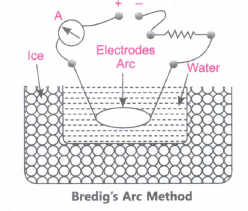
(ii) Peptisation. The process of converting freshly prepared precipitates into colloidal form by the addition of a suitable electrolyte is called peptization. The electrolytes used for the purpose are called peptizing agents. For example, on treating precipitate of iron (III) oxide with a small amount of FeCl3 solution, gives a reddish brown colored colloidal solution. During peptization, the suitable ions from the added electrolyte are adsorbed by the particles of the precipitate. The charged particles repel one another and form a colloidal solution. In this case, Fe3+ ions from ferric chloride are adsorbed by Fe(OH)3 precipitate.
5.
\(\frac { x }{ m } =k{ P }^{ 1/n }\)
where x/m is the extent of adsorption, x is the mass of m adsorbate, m is the mass of adsorbent, P is pressure at a particular temperature, k is a constant and n takes any whole number value.
(ii) In lyophilic sols, the particles of dispersed phase have a great affinity for the dispersion medium and are reversible in nature.
(iii) Associated colloids: Soap (e.g., sodium stearate)., Multimolecular colloids: Sol of gold (atoms)
6.
(b) It is 4% solution of nitrocellulose in a mixture of alcohol and ether.
7.
(i) Bredig's Arc method: Take silver electrodes in form of electric arc in water and pass high voltage through it. A lot of heat will be generated which will vaporize silver metal into vapors which on condensing form silver sol.
(ii) Oxidation: Pass H2S gas through an aqueous solution of nitric acid. A colloidal solution of sulfur will be obtained.
\({ H }_{ 2 }S+[O]\xrightarrow [ ]{ Conc.{ HNO }_{ 3 } } { H }_{ 2 }O+S\)
8.
Adsorption of H2 on finely divided nickel at room temperature is due to physisorption. As temperature is increases, H2 dissociates into atoms which are held on the surface of nickel by chemisorption.
9.
(i) Alcosol: Is is a colloidal dispersion having alcohol as the dispersion medium, e.g., collodion (a colloidal sol of cellulose nitrate in ethyl alcohol).
(ii) Aerosol: It is a colloidal dispersion of a liquid in a gas, e.g., fog.
(iii) Hydrosol: It is a colloidal sol of a solid in water as the dispersion medium, e.g., starch sol or gold sol.
10.
In heterogeneous catalysis, generally, the reactants are gaseous whereas catalysts a solid. The reactant molecules are adsorbed on the surface of the solid catalyst by physical adsorption or chemisorption. As a result of the concentration of the reactant molecules on the surface increases and hence the rate of reaction increases. Alternatively, one of the reactant molecules undergoes fragmentation on the surface of the solid catalyst producing active species which react faster. The product molecules, in either case, have no affinity for the solid catalyst and are desorbed making the surface free for fresh adsorption. This theory is called adsorption theory.
11.
It is because they are inert, i.e. least reactive.
12.
Coagulation of Fe(OH)3 sol takes place because excess of Cl- will react with Fe(OH)3. Fe(OH)3 is multimolecular colloid.
13.
Both \(\Delta H\) and \(\Delta S\) are -ve when bromine gas gets adsorbedon charcoal.
14.
(a) Colloidal solution of Fe(OH)3 is formed. FeCl3 acts as peptizing agent.
(b) It is due to greater surface area and it has more active sites. Therefore, extent of adsorption is more.
15.
Activated charcoal adsorbs the poisonous gases usually present in coal mines.

12th Standard CBSE Syllabus & Materials
12th Standard CBSE
CBSE 12th Computer Science Python Revision Tour I - New Previous year Question Papers Study Material - QB365 Set A
NEW12th Standard CBSE
CBSE 12th Business Studies Planning Important Questions And Answers Study Material - QB365 Set A
NEW12th Standard CBSE
CBSE 12th Business Studies Business Environment Important Questions And Answers Study Material - QB365 Set A
NEW12th Standard CBSE
CBSE 12th Business Studies Principles of Management Important Questions And Answers Study Material - QB365 Set A



CBSE 12th Standard CBSE Subjects
CBSE Standards










