
 100% FREE ACCESS
12th Standard CBSE Syllabus & Materials
12th Standard CBSE
CBSE 12th Economics Government Budget and the Economy Previous year Question Papers Study Material - QB365 Set A
NEW12th Standard CBSE
CBSE 12th Computer Science Interface Python with MySQL - New Previous year Question Papers Study Material - QB365 Set A
NEW12th Standard CBSE
CBSE 12th Computer Science Database Concept - New Previous year Question Papers Study Material - QB365 Set A
NEW12th Standard CBSE
CBSE 12th Computer Science Data Communication - New Previous year Question Papers Study Material - QB365 Set A
NEW12th Standard CBSE
CBSE 12th Computer Science Data Structures - New Previous year Question Papers Study Material - QB365 Set A
NEW12th Standard CBSE
CBSE 12th Computer Science Functions - New Previous year Question Papers Study Material - QB365 Set A

Published on: 24/07/2019
The Solid State
Download CBSE Class 12th Standard CBSE Chemistry question papers, sample papers, important questions, and previous year solved papers in PDF format. Get free study materials, NCERT solutions, and exam preparation resources for Class 12th Standard CBSE Chemistry
Questions + Answers key
Take MCQ Chemistry Test
1.
What is the effect of Schottky and Frenkel defects on the crystaline solids?
2.
What makes the crystal of KCI appear sometimes violet?
3.
Name the crystal defect which lowers the density of an ionic crystal.
4.
Name an element with which silicon can be doped to give a p-type semiconductor.
5.
Name the non-stoichiometric point defect responsible for colour in alkali halides.
6.
Why does table salt, NaCl sometimes appear yellow in colour?
7.
Why are solids incompressible?
8.
Why are liquids and gases categorised as fluids?
9.
Why is glass considered as supercooled liquid?
10.
How many atoms can be assigned to its unit cell if an element forms
(i) a body-centred cubic cell, and
(ii) a face-centred cubic cell?
11.
A solid with cubic crystal is made of two elements 'P' and 'Q'. Atoms of 'Q' are at the corners of the cube and 'P' at body centre. What is formula of compound?
12.
Conductivity of silicon increases on doping it with phosphorus. Why
13.
Show that in cubic packed structure, eight tatrahedral voids are persent per unit cell.
14.
With the help of a labelled diagram show that there are four octahedral voids per unit cell in cubic close packed structure.
15.
A cubic solid is made of two elements X and Y. Atoms Y are at the corners of the cube and X at the body centre. What is the formula of the compound?
16.
What type of structure is generally adopted by alkali metal halides at ordinary temperature and pressure? What happens to structure when pressure is applied to alkali metal halides?
17.
What are ferromagnets and ferro-electrics? Give on example of each case.
18.
Copper crystallises with face-centred cubic unit cell. If the radius of copper atom is 127.8 pm, calculate the density of copper metal.(Atomic mass of Cu = 63.55 u and Avogadro's number, NA = 6.02\(\times \) 1023 MOL-1)
19.
An example of a face centered cubic lattice is
Zinc
Sodium
Copper
Caesium chloride
20.
In a tetragonal crystal
\(a=b=c,\alpha =\beta ={ 90 }^{ ° }\neq \gamma \)
\(\alpha =\beta =\gamma ={ 90 }^{ ° },a=b\neq c\)
\(\alpha =\beta =\gamma ={ 90 }^{ ° },a\neq b\neq c\)
\(\alpha =\beta ={ 90 }^{ ° }\gamma ={ 120 }^{ ° },a=b\neq c\)
21.
Which one of the following is a molecular crystal ?
Rock salt
Quartz
Dry ice
Diamond
22.
Wax is an example of
ionic crystal
covalent crystal
molecular crystal
amorphous crystal
23.
The property of crystalline solid is not
anisotropic
isotropic
hard
dense
24.
X=At the corners;Y=At face centre
25.
Graphite
26.
Diamond
27.
NaSO4.10 H2O
28.
CuSO4.5 H2O
29.
Compounds having general molecular formula \(AFe_{ 2 }O_{ 4 }\) are called ferrites and posses spinel type structures. Some common examples are \(MgFe_{ 2 }O_{ 4 }\) and \(ZnFe_{ 2 }O_{ 4 }\) They may be thought of being formed by replacing \(Fe^{ 2+ }\) ions present in \(Fe_{ 3 }O_{ 4 }\) by bivalent cations such as \(Mg^{ 2+ },Zn^{ 2+ }\) ions etc. Now answer the following questions :
(i) What types of materials are ferrites?
(ii) What are the main uses of ferrites?
1.
()
The density decreases in the case of Schottky defect, whereas it remain the same in the case of Frenkel defect.
2.
()
It is due to presence of F-centre. Electrons present at the site of anion forming f-centre absorb ligh form visible region and radiate complementary colour.
3.
()
Schottky defect.
4.
()
Silicon doped with Gallium will be p-type semiconductor.
5.
()
Metal excess defect: Excessof metal ions and formation of F-centre due to trapped electrons are responsible for colour in alkali halides.
6.
()
It is due to the presence of unpaired electrons which occupy anionic sites called F- centres due to metal excess defect. These electrons absorb energy from the visible region and radiate yellow colour.
7.
()
The particles of solids are closely packed, therefore, they cannot be brought further closer; i.e. they cannot be compressed.
8.
()
The liquids and gases have a property to flow, therefore, they are categorised as fluids.
9.
()
It is because glass windows are thicker at the bottom and thinner at the top. it shows that glass can flow, that is why it is called super cooled liquid.
10.
()
(i) Z = 2 for bcc element
(ii) Z = 4 for fcc element
11.
()
\(Q=8\times \frac { 1 }{ 8 } =1, \ P=1\)
\(\therefore\) Formula of compound is PQ.
12.
()
It is because it forms n-type semiconductor in which electrons are free to move.
13.
In ccp structure, there are 8 tetrahedral voids. In dose-packed structure, there are eight spheres in the corner of the unit cell and each sphere is in contact with three others giving rise to eight tetrahedral voids.
14.
In a ccp structure, there is 1 octahedral void in the centre of the body and 12 octahedral voids are on 12 edges of the cube.Each octahedral void on the edge is
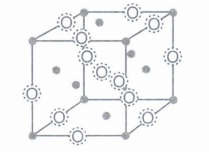
common to four other unit cells (as shown in figure). Thus, in cubic close-packed structure, octahedral voids in the centre of the cube = 1.
Effective number of octahedral voids on edges = 12 x 1/4 = 3
Total number of octahedral voids = 1 + 3 = 4
15.
Y = 8 ×\(\frac{1}{8}\)= 1; X = 1,
∴ Formula is XY.
16.
Structure of alkali metal halides: At ordinary temperature and pressure,halides of alkali metals (iodides, bromides and chlorides of lithium, sodium, potassium and rubidium) posses NacI type structure with 6:6 coordination.
When high pressure is applied, the coordination number increases and the alkali metal halides transform to CsCI structure with coordination number 8:8.
17.
Ferromagnets. The substances which are strongly attracted by the magnetic field and do not lose their magnetism even in the absence of magnetic field are called ferromagnets. For example, Fe3O4 .
Ferroelectrics: the substance in which the dipoles may even in the absence of electric field and the direction of polarisation may change by applying electric field are called ferroelectrices. For example barium titanate (BaTiO3).
18.
For a fcc structure, length of the unit cell is related to radius of atom as
\(r=\frac { a }{ 2\sqrt { 2 } } \)
\(\\ or \ a=2\sqrt { 2 } r\)
\(=2\times 1.414\times 127.8 \ pm=361.42pm\)
\(Density, \ \rho =\frac { Z\times M }{ { a }^{ 3 }\times { N }_{ A } } \)
\(=Z=4(for \ fcc),M=63.55 \ g \ { mol }^{ -1 }\)
\(a=361.42\times { 10 }^{ -12 }m=361.42\times { 10 }^{ -10 }cm\)
\({ N }_{ A }=6.02\times { 10 }^{ 23 }\)
\(\rho =\frac { 4\times 63.55 }{ { \left( 361.42\times { 10 }^{ -10 } \right) }^{ 3 }\times 6.02\times { 10 }^{ 23 } }\)
\(=8.94 \ g{ cm }^{ -3 }\)
\(Density, \ \rho =\frac { Z\times M }{ { a }^{ 3 }\times { N }_{ A } } \)
\(a=286.65pm=286.65\times { 10 }^{ -12 }m\)
\(=286.65\times { 10 }^{ -10 }cm\)
\(\ Z=2(for \ bcc), \ M=56.0\)
\(\rho =7.87 \ g{ cm }^{ -3 }\)
\(7.87=\frac { 2\times 56.0 }{ { \left( 286.65\times { 10 }^{ -10 } \right) }^{ 3 }\times { N }_{ A } }\)
\( { N }_{ A }=\frac { 2\times 56.0 }{ { \left( 286.65\times { 10 }^{ -10 } \right) }^{ 3 }\times 7.87 } \)
\(=6.04\times { 10 }^{ 23 }\)
19.
(c)
Copper
20.
(b)
\(\alpha =\beta =\gamma ={ 90 }^{ ° },a=b\neq c\)
21.
(c)
Dry ice
22.
(c)
molecular crystal
23.
(b)
isotropic
24.
()
XY3
25.
()
Hexagonal
26.
()
Cubic
27.
()
Monoclinic
28.
()
Triclinc
29.
(i) Ferrites are magnetic material.
(ii) They are used in telephones and memory loops in computers.

12th Standard CBSE Syllabus & Materials
12th Standard CBSE
CBSE 12th Computer Science Python Revision Tour I - New Previous year Question Papers Study Material - QB365 Set A
NEW12th Standard CBSE
CBSE 12th Business Studies Planning Important Questions And Answers Study Material - QB365 Set A
NEW12th Standard CBSE
CBSE 12th Business Studies Business Environment Important Questions And Answers Study Material - QB365 Set A
NEW12th Standard CBSE
CBSE 12th Business Studies Principles of Management Important Questions And Answers Study Material - QB365 Set A



CBSE 12th Standard CBSE Subjects
CBSE Standards










