
 100% FREE ACCESS
12th Standard CBSE Syllabus & Materials
12th Standard CBSE
CBSE 12th Economics Government Budget and the Economy Previous year Question Papers Study Material - QB365 Set A
NEW12th Standard CBSE
CBSE 12th Computer Science Interface Python with MySQL - New Previous year Question Papers Study Material - QB365 Set A
NEW12th Standard CBSE
CBSE 12th Computer Science Database Concept - New Previous year Question Papers Study Material - QB365 Set A
NEW12th Standard CBSE
CBSE 12th Computer Science Data Communication - New Previous year Question Papers Study Material - QB365 Set A
NEW12th Standard CBSE
CBSE 12th Computer Science Data Structures - New Previous year Question Papers Study Material - QB365 Set A
NEW12th Standard CBSE
CBSE 12th Computer Science Functions - New Previous year Question Papers Study Material - QB365 Set A

Published on: 28/07/2019
Chemical Kinetics
Download CBSE Class 12th Standard CBSE Chemistry question papers, sample papers, important questions, and previous year solved papers in PDF format. Get free study materials, NCERT solutions, and exam preparation resources for Class 12th Standard CBSE Chemistry
Questions + Answers key
Take MCQ Chemistry Test
1.
Explain the terms:
(i) Rate determining step of a reaction
(ii) Molecularity of a reaction
2.
The thermal decomposition of HCO2H is a first-order reaction with a rate constant of 2.4 \(\times\) 10-3 s-1 at a certain temperature. Calculate how long will it take for three-fourths of initial quantity of HCO2H to decompose. (log 0.25 = - 0.6021)
3.
Oxygen is available in plenty in air yet fuels do not burn by themselves at room temperature. Explain.
4.
The reaction between H2(g) and O2(g) is highly feasible yet allowing the gases to stand at room temperature in the same vessel does not lead to the formation of water. Explain.
5.
What is physical significance of energy of activation? Explain with diagram.
6.
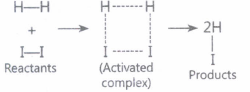
With the help of diagram explain the role of activated complex in a reaction.
7.
In some cases it is found that a large number of colliding molecules have energy more than threshold energy but yet the reaction is slow. Why?
8.
According to Arrhenius, rate of reaction increases with increase in temperature. Give reasons.
9.
A substance with initial concentration 'a' follows zero order kine ics with the rate constant 'k' mol L-1s-1. In how much time will the reaction go to completion?
10.
How does the value of rate constant vary with reactant concentration?
11.
For the reaction R \(\longrightarrow\) P, a graph of [R] against time is found to be a straight line with negative slope. What is the order of reaction ?
Second order
Third order
First order
Zero order
12.
Consider the reaction : CI2 (aq) + H2S (aq) \(\rightarrow\) S (s) + 2 H+ (aq) +2 CI- (aq) The rate equation for this reaction is rate k [CI2] [H2S] Which of these mechanisms is / are consistant with this rate equation ?
A. CI2+H2S \(\longrightarrow\) H+ + CI- + CI+ HS- (slow) ; CI+ Hs- \(\longrightarrow\) H+ + CI- + S (fast)
B. H2S \(\rightleftharpoons \) H+ + HS - (fast equilibrium) ; CI2 + HS- \(\longrightarrow\) 2 CI- + H+ S (slow)
Neither A nor B
A only
B only
Both A and B
13.
The molecularity and order of the reaction 2 NO (g) + O2 (g) \(\rightarrow\)2NO2 (g) are respectively
one and one
two and two
three and three
two and three
14.
The rate of the reaction 2 NO + CI2 \(\rightarrow\) 2NOCI is given by the rate equation : rate = k [NO]2 [CI2]. The value of the rate constant can be increased by
increasing the temperature
increasing the concentration of NO
increasing the concentration of CI2
doing all of these
15.
In the reaction BrO-3 (aq) + 5 Br - (aq) + 6 H+ \(\longrightarrow\) 3 Br2(I) + 3 H2O (l), the rate of apperance of bromine (BHr2) is related to the disapearance of bromide uions as follows :
\(\frac { d[{ Br }_{ 2 }] }{ dt } =-\frac { 5 }{ 3 } \frac { d[{ Br }^{ - }] }{ dt } \)
\(\frac { d[{ Br }_{ 2 }] }{ dt } =\frac { 5 }{ 3 } \frac { d[{ Br }^{ - }] }{ dt } \)
\(\frac { d[{ Br }_{ 2 }] }{ dt } =\frac {3 }{ 5} \frac { d[{ Br }^{ - }] }{ dt } \)
\(\frac { d[{ Br }_{ 2 }] }{ dt } =-\frac { 3 }{ 5 } \frac { d[{ Br }^{ - }] }{ dt } \)
16.
In the reaction, 2 NO2 (g) + F2 (g) \(\longrightarrow\) 2 NO2 F (g) , order with respect to NO2 is................ and that with respect to F2 is ............ .
17.
The rate of reaction when the concentration of each reactant is taken as unity is called ......... .
18.
If the rate of reaction, 4 NH3 + O2 \(\longrightarrow\) 2 NO + 5 H2O at any instant of time is 9 \(\times\) 10-4 mol L-1 s-1, then rate of disapperance of NH3 is ......... .
19.
In the plot of concentratiuon of reactant versus time, the tangent at any instant of time has a......... slope (opositive or negative or zero).
20.
For a gaseous reaction, the units of the reaction are..............
21.
At constant temperature and volume, X decomposes as 2 X (g) \(\longrightarrow\) 3 Y (g) + 2 Z (g). Px is the partial pressure of X.
| Observation No. | Time (in minutes) | Px (in mm of Hg) |
|---|---|---|
| 1 | 0 | 800 |
| 2 | 100 | 400 |
| 3 | 200 | 200 |
(i) What is the order of reaction with respect to X?
(ii) Find the time for 75% completion of the reaction.
(iii) Find the total pressure when pressure of X is 700 mm of Hg.
22.
Linear horizontal plot
23.
Linear plot passing through the orgin
24.
Pseduounimolecular reactions
25.
Second order reactions
1.
(i) The slowest step among the elementary reactions determines the rate of reaction, e.g.
\({ NO }_{ 2 }+{ F }_{ 2 }\overset { Slow }{ \longrightarrow } { NO }_{ 2 }F+F\)
\({ NO }_{ 2 }+F\overset { Fast }{ \longrightarrow } { NO }_{ 2 }F\)
From slow step
\(Rate=k\left[ { NO }_{ 2 } \right] \left[ { F }_{ 2 } \right] \)
(ii) Molecularity is defined as number of atoms or molecules or ions which must collide to each other simultaneously as to result in chemical reaction, e.g.
\({ H }_{ 2 }(g)+I_{ 2 }(g)\longrightarrow 2HI(g)\)
It is a biomolecular reaction.
2.
\(k=\frac { 2.303 }{ t } \log { \frac { \left[ { R }_{ 0 } \right] }{ \left[ R \right] } }\)
\( \\ \Rightarrow \ 2.4\times { 10 }^{ -3 }{ s }^{ -1 }=\frac { 2.303 }{ { t }_{ { 3 }/{ 4 } } } \log { \frac { \left[ { R }_{ 0 } \right] }{ \frac { 1 }{ 4 } \left[ { R }_{ 0 } \right] } }\)
\({ t }_{ { 3 }/{ 4 } }=\frac { 2.303 }{ 2.4\times { 10 }^{ -3 } } \log { 4 } =\frac { 2.303\times 0.6021 }{ 2.4\times { 10 }^{ -3 } } \)
\({ t }_{ { 3 }/{ 4 } }=\frac { 1.386\times { 10 }^{ 3 } }{ 2.4 } =\frac { 13.86{ \times 10 }^{ 2 } }{ 2.4 }\)
\( \\ { t }_{ { 3 }/{ 4 } }=5.77{ \times 10 }^{ 2 }s\)
3.
It is because multimolecular collisions have least or rare probability.
4.
It is because activation energy is higher and therefore reaction is not feasible at room temperature.
5.
Energy of activation is the extra energy which must be supplied to the reactants so that these can change into products. It is difference between energy of reactants and energy of activated complex as shown in diagram below.
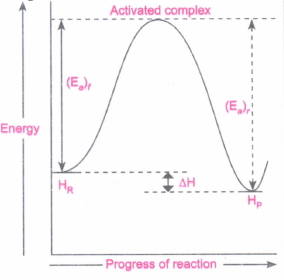
The reactants molecules which possess activation energy and collide in proper orientation lead to formation of product molecules.
6.
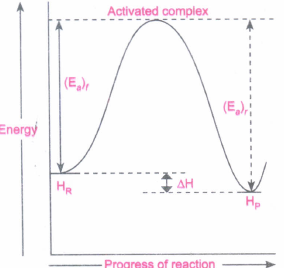
Activated complex is intermediate compound between reactants and products as shown above. It is highly unstable as it has highest energy. It readily charges into product. Those molecules which can form activated complex can lead to formation of products, e.g
7.
It is because these molecules do not collide in a proper orientation that is why the reaction is slow.
8.
Rate of reaction increases with increase in temperature because kinetic energy of molecules increases, increases, number of molecules possessing activation energy increases, rate of reaction increases.
9.
\(\frac{a}{t}=\mathrm{k} \Rightarrow \mathrm{t}=\frac{a}{k}\) In time \(\frac{a}{k}\) the reaction will go to completion in case of zero order reaction.
10.
Rate constant is not affected by reactants' concentrations.
11.
(d) : For zero order reaction, k = \(\frac {1}{t}\)\(\left[ { \left[ A \right] }_{ 0 }-\left[ A \right] \right] \) or \( { \left[ A \right] }-\left[ A \right] _{ 0 } - kt\)
12.
(b)
A only
13.
(c)
three and three
14.
(a) : The rate of constant of a reaction depends only on temperature and does not depend upon concentrations of the reactants.
15.
(d) \(\frac{1}{3} \frac { d[{ Br }_{ 2 }] }{ dt } =-\frac { 1 }{ 5 } \frac { d[{ Br }^{ - }] }{ dt } \) or \(\frac { d[{ Br }_{ 2 }] }{ dt } =-\frac {3 }{ 5 } \frac { d[{ Br }^{ - }] }{ dt } \)
16.
()
1 , 1
17.
()
rate constant or specific reaction rate
18.
()
3.6 \(\times\) 10-3 mol L-1 s-1
19.
()
negative
20.
()
atm time -1 or bar time -1, e.g., atm s-1 or bar min-1 etc.
21.
(i) As pressure of X is changing with time, it cannot be a zero order reaction. Let us now check it for 1st order.
At t = 100 min, \(k={2.303\over 100}log{P_0\over P_t}={2.303\over 100}log {800\over 400}=6.932\times 10^{-3}min^{-1}\)
At t = 200 min, \(k={2.303\over 200}log{800\over 200}={2.303\over 800}log4=6.932\times10^{-3}min^{-1}\)
As k comes out to be constant, hence it is a reaction of 1st order
(ii)\(t_{75./.}={2.303\over k}log{100\over 100-75}={2.303\over 6.932\times10-3min}log4=200min\)
(iii) 2x (g)⟶ 3 y (g) + 2z (g)
Initial Pressure 800mm 0 0
Pressure after time t 800 - 2p 3 p 2 p
When pressure of X is 700 mm, 800 - 2 p = 700 or p = 50 mm
Total pressure = (800 - 2 p) + 3 p + 2 p = 800 + 3 p = 800 + 3 x 50 = 950 mm.
22.
()
t1/2 vs [A]0 for 1and order
23.
()
t1/2 vs [A]0 for 2 and order
24.
()
Involves at least two reactants
25.
()
t1/2 \(\propto \) \(\frac {1}{[A]_0}\)

12th Standard CBSE Syllabus & Materials
12th Standard CBSE
CBSE 12th Computer Science Python Revision Tour I - New Previous year Question Papers Study Material - QB365 Set A
NEW12th Standard CBSE
CBSE 12th Business Studies Planning Important Questions And Answers Study Material - QB365 Set A
NEW12th Standard CBSE
CBSE 12th Business Studies Business Environment Important Questions And Answers Study Material - QB365 Set A
NEW12th Standard CBSE
CBSE 12th Business Studies Principles of Management Important Questions And Answers Study Material - QB365 Set A



CBSE 12th Standard CBSE Subjects
CBSE Standards










