
 100% FREE ACCESS
12th Standard CBSE Syllabus & Materials
12th Standard CBSE
CBSE 12th Economics Government Budget and the Economy Previous year Question Papers Study Material - QB365 Set A
NEW12th Standard CBSE
CBSE 12th Computer Science Interface Python with MySQL - New Previous year Question Papers Study Material - QB365 Set A
NEW12th Standard CBSE
CBSE 12th Computer Science Database Concept - New Previous year Question Papers Study Material - QB365 Set A
NEW12th Standard CBSE
CBSE 12th Computer Science Data Communication - New Previous year Question Papers Study Material - QB365 Set A
NEW12th Standard CBSE
CBSE 12th Computer Science Data Structures - New Previous year Question Papers Study Material - QB365 Set A
NEW12th Standard CBSE
CBSE 12th Computer Science Functions - New Previous year Question Papers Study Material - QB365 Set A

Published on: 31/07/2019
General Principles and Processes of Isolation of Elements
Download CBSE Class 12th Standard CBSE Chemistry question papers, sample papers, important questions, and previous year solved papers in PDF format. Get free study materials, NCERT solutions, and exam preparation resources for Class 12th Standard CBSE Chemistry
Questions + Answers key
Take MCQ Chemistry Test
1.
What is role of flux in metallurgical processes?
2.
Why are sulphide ores converted into oxide before reduction?
3.
What type of ores can be concentrated by magnetic separation method?
4.
Differentiate between a mineral and an ore.
5.
What is the role of collectors in Froth Floatation process?
6.
How is copper extracted from a low grade ore of it?
7.
Name the method used for removing gangue from sulphide ore.
8.
How do we separate two sulphide ores by froth floatation method ? Explain with an example.
9.
How is chemical reduction different from electrolytic reduction? Name a metal each which is obtained by
(i) electrolytic reduction,
(ii) chemical reduction.
10.
Name one chief ore each of copper and aluminium. Name the method used for the concentration of these two ores.
11.
Cinnabar and Galena on roasting often give their respective metals but Zincblende does not. Explain.
12.
State the role of
(i) depressant in froth floatation process.
(ii) silica in the metallurgy of copper.
(iii) graphite rod in the electrolytic reduction of alumina.
13.
State the principles of the following methods of refining crude metals:
(i) Zone refining
(ii) Liquation method
(iii) Chromatographic method
14.
Brine solution on electrolysis will give
NaOH
O2
Cl2
H2
15.
The carbon-based reduction method is NOT used for the extraction of
tin from SnO2
iron from Fe2O3
aluminium from alumina
magnesium from MgCO3.CaCO3
16.
Upon heating with Cu2S,the reagent(s) that give copper metal is/are
CuFeS2
CuO
Cu2O
CuSO4
17.
Identify the alloy containing a non-metal as a constituent in it
Invar
Steel
Bell metal
Bronze
18.
Which method of purification is represented by the following equation? Ti(S)+2I2(g)\(\overset{523K}{\longrightarrow}\)TiI4(g)\(\overset{51700K}{\longrightarrow}\)Ti(s)+2I2(g)
Cupellation
Poling
van Arckel
Zone refining
19.
Which step is not correct for refining of crude metals?
Cu2S+2Cu2O\(\longrightarrow\)6Cu+SO2
CuSO4+Fe\(\longrightarrow\)Cu+FeSO4
CuFeS2+2H2SO4\(\longrightarrow\)CuSO4+FeSO4+2H2S
CuCO3+H2SO4\(\longrightarrow\)CuSO4+CO2+H2O
20.
Heating pyrites to remove sulphur is called
smelting
calcination
liquation
roasting
21.
Which of the following benefaction processes is used for the mineral,Al2O3.2H2O?
Froth floatation
Leaching
Liquation
Magnetic separation
22.
The metal always found in free state is
Au
Ag
Cu
Na
23.
Which one of the following is most abundant in earth crust?
Mg
Na
Al
Fe
24.
Purification of Ge complex
25.
Impure metal to volatile complex
26.
Coloured bands
27.
Cryolite
28.
Calamine
29.
While washing a miner's overalls, a washerwoman noticed that sand and similar dirt fell to the bottom of the washtub. What was peculiar, the copper-bearing compounds that had come to the clothes from the mines were caught in the soaplids and so they came to the top. One of her clients was a chemist, Mrs. Malik. The washerwoman told her experience to Mrs. Malik. The latter thought that the idea could be used for separating copper compounds from rocky and earth materials on a large scale. After reading the above passage answer the following questions-
What type of ores are concentrated by this process?
1.
()
Flux is used for making the molten mass more conducting and it reacts with gangue to form slag which can be easily removed.
2.
()
It is because oxides ores can be easily reduced, whereas sulphide ores cannot be reduced easily.
3.
()
Those ores which are magnetic in nature, i.e. attracted by magnet, whereas impurities are non-magnetic in nature or vice-versa are concentrated by magnetic separation method.
4.
()
Mineral is a naturally occuring substance from which metal may or may not be extracted profitably.
Ore is a naturally occuring rocky material which contains sufficient quantity of mineral from which metal can be extracted profitably and conveniently.
5.
()
Collectors like pine oil, fatty acids, xanthates enhance non-wettability of mineral particles.
6.
()
Extraction of Copper from low-grade ores and scraps: It is extracted by hydrometallurgy. It is carried out in two steps:
(a) Leaching: Low-grade copper ores and scraps are leached by using acid or bacteria.
(b) Reduction: The solution containing copper ions is treated with H2.
\({ Cu }^{ 2+ }(aq)+{ H }_{ 2 }(g)\rightarrow Cu(s)+2{ H }^{ + }(aq)\)
7.
()
Froth floatation process.
8.
They can be separated by using depressants, e.g. NaCN forms complex with ZnS but not with PbS and prevents ZnS from coming with froth but PbS remains with the froth.
9.
In chemical reduction, metal is obtained by reduction of its ore by a suitable reducing agent, whereas in electrolytic reduction, reduction is carried out by passing electric current through molten ore.
(i) Aluminium is obtained by electrolytic reduction.
(ii) Iron is obtained by chemical reduction.
10.
| Ores | Methods of concentration of ores |
| Copper: Copper pyrites | Froth Floatation process |
| Aluminium: Bauxite (Al2O3.2H2O) | Chemical separation (leaching) |
11.
On roasting al these sulphide ores are partly converted into their respective oxides. Since the oxides of mercury and lead are unstable while that of zinc is stable., therefore, oxides of mercury and lead bring about the reduction of their respective sulphides to the corresponding metals but zinc oxides does not reduce ZnS to Zn metal\(\begin{aligned} &\mathrm{HgS}+2 \mathrm{HgO} \stackrel{\Delta}{\longrightarrow} 3 \mathrm{Hg}+\mathrm{SO}_{2} \end{aligned}\)
(unstable)
\(\mathrm{PbS}+2 \mathrm{P} \mathrm{bO} \stackrel{\Delta}{\longrightarrow} 3 \mathrm{~Pb}+\mathrm{SO}_{2}\)
(unstable)
\(\mathrm{ZnS}+\underset{(\text { stable })}{2 \mathrm{ZnO}} \stackrel{\Delta}{\longrightarrow} 3 \mathrm{Zn}+\mathrm{SO}_{2}\)
12.
(i) It prevents certain sulphides like ZnS to enter the froth in presence of PbS, therefore, helps in their separation. Sodium cyanide is used as depressant in the separation of ZnS from PbS.
(ii) It acts as flux.
(iii) Graphite rods act as anode in the extraction of aluminium.
13.
(i) Zone refining: It is based on the principle that impurities are more soluble in the melt (molten state) than in the solid state of the metal
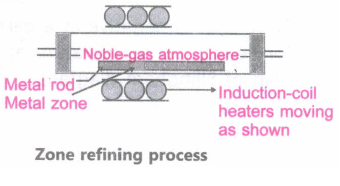
The impure metal is heated with the help of circular heaters at one end of the rod of impure metal. The molten zone is moved forward. along with impurities and reaches the other end and is discarded. Pure metal crystallises out of the melt The process is repeated several times and heater is moved in the same direction. It is used for purifying semiconductors like B, Ge, Si, Ga and In.
(ii) Liquation Method: Those metals which have impurities whose melting points are higher than metal can be purified by this method. Sn metal is purified by this method. Tin containing iron as impurity is heated on the top of sloping furnace. Tin melts and flows down the sloping surface whereas iron is left behind and pure tin is obtained.
(iii) Chromatographic Method: It is based on the principle of separation or purification by chromatography which is based on differential adsorption on an adsorbent. In column chromatography, AIP3 is used as an adsorbent. The mixture to be separated is taken in a suitable solvent and applied on the column. They are then eluted out with suitable solvent (eluent). The weakly adsorbed component is 'eluted first, then the more strongly adsorbed and so on. 'This method is suitable for such elements which are available only in minute quantities and the impurities are not very much different in their chemical behaviour from the element to be purified.
14.
(a)
NaOH
15.
(c)
aluminium from alumina
16.
(c)
Cu2O
17.
Steel contains the non-metal carbon
18.
(c)
van Arckel
19.
(a)
Cu2S+2Cu2O\(\longrightarrow\)6Cu+SO2
20.
(d)
roasting
21.
(b)
Leaching
22.
(a)
Au
23.
(c)
Al
24.
()
Zone refining
25.
()
Mond Process
26.
()
Chromatogrphy
27.
()
Na3AlF6
28.
()
ZnCO3
29.
Only sulphide ores like ZnS, CuFeS2, etc. are concentrated by froth floatation process

12th Standard CBSE Syllabus & Materials
12th Standard CBSE
CBSE 12th Computer Science Python Revision Tour I - New Previous year Question Papers Study Material - QB365 Set A
NEW12th Standard CBSE
CBSE 12th Business Studies Planning Important Questions And Answers Study Material - QB365 Set A
NEW12th Standard CBSE
CBSE 12th Business Studies Business Environment Important Questions And Answers Study Material - QB365 Set A
NEW12th Standard CBSE
CBSE 12th Business Studies Principles of Management Important Questions And Answers Study Material - QB365 Set A



CBSE 12th Standard CBSE Subjects
CBSE Standards










