
 100% FREE ACCESS
12th Standard CBSE Syllabus & Materials
12th Standard CBSE
CBSE 12th Economics Government Budget and the Economy Previous year Question Papers Study Material - QB365 Set A
NEW12th Standard CBSE
CBSE 12th Computer Science Interface Python with MySQL - New Previous year Question Papers Study Material - QB365 Set A
NEW12th Standard CBSE
CBSE 12th Computer Science Database Concept - New Previous year Question Papers Study Material - QB365 Set A
NEW12th Standard CBSE
CBSE 12th Computer Science Data Communication - New Previous year Question Papers Study Material - QB365 Set A
NEW12th Standard CBSE
CBSE 12th Computer Science Data Structures - New Previous year Question Papers Study Material - QB365 Set A
NEW12th Standard CBSE
CBSE 12th Computer Science Functions - New Previous year Question Papers Study Material - QB365 Set A

Published on: 10/12/2018
From this post, Class 12 Macro Economics Chapter 4 - Determination of Income and Employment prepared by expert teachers.
These papers have been created with the sole purpose of helping the students with their preparations. We hope that these sample papers will help you prepare better for your exams and help you fine-tune your strategies for the board exams.
In this question paper, questions are covered from the chapter Determination of Income and Employment and questions are prepared as per NCERT guidelines. Questions are covered from NCERT solutions and NCERT Exemplar.
The latest sample papers have been designed as per the latest blueprints, syllabus and examination trends. Sample papers should be practiced in examination condition at home or school and also show it to your teachers for checking or compare with the answers provided.
Download CBSE Class 12th Standard CBSE undefined question papers, sample papers, important questions, and previous year solved papers in PDF format. Get free study materials, NCERT solutions, and exam preparation resources for Class 12th Standard CBSE undefined
Questions + Answers key
Take MCQ Biology Test
1.
If MPC = 0, the value of multiplier is:
0
1
Between 0 and 1
Infinity
2.
In a situation of 'Deficient demand' at the full employment level of income:
AD = AS
AD < AS
AD > AS
None
3.
Value of aggregate supply equals:
National Income
Domestic Income
Private Income
Personal Income
4.
Aggregate Supply=Consumption+___________.
Supply
Investment
Saving
Expenditure
5.
Investment is an addition to_______
supply
current stock
capital stock
None of these
6.
What is the difference between ex-ante investment and ex-post investment?
7.
In an economy, investment is increased by RS.2000 crore. Calculate the change in total income, if Marginal Propensity to Save is 0.25.
8.
In an economy, total savings are RS.2000 crore and that the ratio of Average Propensity to Save and Average Propensity to Consume is 2 : 7. Calculate the level of income in an economy.
9.
Define frictional and structural unemployment.
10.
Calculate autonomous consumption expenditure from the following data about an economy which is in equilibrium:
National Income=1200
Marginal Propensity to save=0.20
Investment expenditure=100
11.
Distinguish between inflationary gap and diflationary gap. State one measure for each, by which these can be corrected.
12.
Define aggregate demand in macroeconomics.
13.
What is meant by voluntary unemployment?
14.
If the value of MPC is 0.8, calculate the value of multiplier.
15.
What can be the minimum value of investment multiplier?
16.
Given the meaning of aggregate supply in macro-economics.
17.
Given consumption function is C = 80 + 0.75 Y (where C = consumption function, Y = National income) and investment expenditure Rs.200.
(i) What will be equilibrium level of income?
(ii) What will be a new equilibrium level of income if investment increases by Rs.25 crores?
18.
If national income is Rs. 50 crore and saving is Rs.5 crore, find out average propensity to consume. When income rises to Rs. 60 crore and saving to Rs.9 crore, what will be the average propensity to consume and the marginal propensity to save?
19.
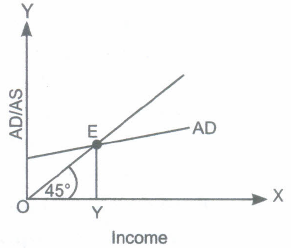
Explain with the help of a diagram, how aggregate demand and aggregate supply determine the equilibrium level of income.
20.
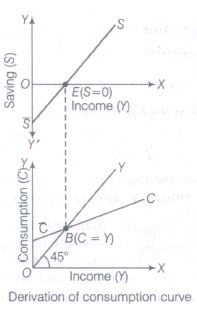
Explain the steps taken in derivation of the saving curve from the consumption curve. Use diagram.
(or)
Given saving curve, derive the consumption curve and state the steps in doing so. Use diagram.
(or)
Outline the steps taken in deriving consumption curve from the saving curve. Use diagram
1.
(b)
1
2.
(b)
AD < AS
3.
(a)
National Income
4.
Saving
5.
capital stock
6.
The difference between ex-ante investment and ex-post investment lies in the fact that ex-ante investment is the "planned" investment in the economy during a given year whereas, ex-post investment is the "actual" investment in the economy during a given year.
7.
\(\triangle\)Y = RS.8000 crore.
8.
National Income = RS.9000 crore.
9.
Frictional unemployment: It is the unemployment association with the changing of jobs in dynamic economy. It arises due to immobility of labour, shortage of raw material, lack of information regarding opportunities of employment, ets.
Structural unemployment: It is the unemployment that results from the long-term decline of certain industries. It is association with the structural changes in the economy. It arises due to shortage of capital, land, trained labour and updated technique.
10.
Given,
I=100, Y=1200, MPS=0.20
MPC or b=1-MPS=1-0.20=0.80
Y=C+I, or C=Y-I=1200-100=1100
\(C=\overline { C } +bY\)
\(1100=\overline { C } +0.80\times 1200\)
\(\overline { C } \)=1100-960=140
\(\therefore \) Autonomous consumption expenditure
(\(\overline { C } \))=140
11.
The excess of Aggregate Demand above the level required to maintain equilibrium in full employment situation in an economy is termed as inflationary gap. It causes inflation and increases price levels in an economy. When there is involuntary unemployment in the economy, there is a short fall in Aggregate Demand from the level required to maintain a full employment equilibrium. This short fall is termed as deflationary gap. It causes reduction in prices in the economy. Inflationary and deflationary gap can be corrected by opting following means:
(i) To correct the inflationary gap, government should form fiscal and monetary policy to close the gap. Monetary policy can be used in such a manner that it will contract the money supply in the economy by raising interest rates and opts the method of progressing taxation.
(ii) To correct the deflationary gap, government should stood doing the additional expenditure equal to deflationary gap, so that deflationary gap is wiped out.
12.
()
Aggregate demand is the total demand for final goods and services in the economy that all sectors of the economy are planning to buy at a given level of income during a period of time.
13.
()
'Voluntary unemployment' refers to that part of the population, which prefers not to work, even though suitable work is available for them.
14.
()
Given: MPC = 0.8, k = ?
\(\therefore \quad k=\frac { 1 }{ 1-MPC } =\frac { 1 }{ 1-0.8 } =\frac { 1 }{ 0.2 } =\frac { 10 }{ 2 } =5\)
\(\therefore \quad Multiplier\left( k \right) =5\)
15.
()
Minimum value of the investment multiplier is 1 and maximum value is infinity.
16.
()
Aggregate supply in Macroeconomics refers to the value of total final output available in the economy during a period of time, say an year. It represents the national income of the country during a given period. Symbolically, AS = Y.
17.
(i) Given C = 80 + 0.75 Y
and I = Rs.200 crores
To Calculate NI/Y = 80 + 0.75 Y + 200
Y - 0.75 Y = 80 + 200
Y = \(\frac { 280 }{ 0.25 } =\frac { 28000 }{ 25 } \) = Rs.1120.
(ii) New equilibrium level of income, if investment increases by Rs.25 crores
Y = 80 + 0.75 Y + 225
Y - 0.75 Y = 80 + 225
\(\Rightarrow \) Y = \(\frac { 305 }{ 0.25 }\) = \(\frac { 30500 }{ 25 } \) = 1220
18.
(i) APC = \(\frac { C }{ Y } \), where C = Y-S
= 50-5 = 45 = \(\frac { 15 }{ 50 } \) = 0.90
(ii) APC = \(\frac { C }{ Y } \) =\(\frac { 51 }{ 60 } \) = 0.85
where C = Y - S = 60-9 = 51
(iii) MPS = \(\frac { \triangle S }{ \triangle Y } \) = \(\frac { 4 }{ 10 } \) = 0.40
19.
Equilibrium level of income is determined at that point when aggregate demand is equal to aggregate supply. Aggregate Demand represents the total expenditure on final goods and services in an economy. It consists of (a) Consumption expenditure (C) and (b) Investment expenditure (I). Thus, AD = C + I. Aggregate supply refers to the total production of final goods and services in an economy. In other words, it refers to the country's National Product or National Income. Thus, AS = Y. The equilibrium level of income is determined at a point where AD = AS. The given diagram illustrates the idea. In the diagram, AD and AS curves intersect each other at point E, which is the point of equilibrium. The equilibrium level of income is OY.
20.
Steps taken for derivation \(O\bar { S } \) of consumption curve are:
(i) At zero level of income, the savings are which is the amount of autonomous consumption at Y = 0. So, \(-O\bar { S } =O\bar { C } \). Hence, the consumption will start from the point C.
(ii) We draw a 450 line passing through the origin which shows that C = Y. This is the income line
(iii) Now, we draw a vertical line from the point E, where saving is zero. At zero level of saving, C = Y. So, B is the break-even point
(iv) The consumption curve is derived meeting \(\bar { C } \) and B and extending it forward.

12th Standard CBSE Syllabus & Materials
12th Standard CBSE
CBSE 12th Computer Science Python Revision Tour I - New Previous year Question Papers Study Material - QB365 Set A
NEW12th Standard CBSE
CBSE 12th Business Studies Planning Important Questions And Answers Study Material - QB365 Set A
NEW12th Standard CBSE
CBSE 12th Business Studies Business Environment Important Questions And Answers Study Material - QB365 Set A
NEW12th Standard CBSE
CBSE 12th Business Studies Principles of Management Important Questions And Answers Study Material - QB365 Set A



CBSE 12th Standard CBSE Subjects
CBSE Standards











