
 100% FREE ACCESS
12th Standard CBSE Syllabus & Materials
12th Standard CBSE
CBSE 12th Economics Government Budget and the Economy Previous year Question Papers Study Material - QB365 Set A
NEW12th Standard CBSE
CBSE 12th Computer Science Interface Python with MySQL - New Previous year Question Papers Study Material - QB365 Set A
NEW12th Standard CBSE
CBSE 12th Computer Science Database Concept - New Previous year Question Papers Study Material - QB365 Set A
NEW12th Standard CBSE
CBSE 12th Computer Science Data Communication - New Previous year Question Papers Study Material - QB365 Set A
NEW12th Standard CBSE
CBSE 12th Computer Science Data Structures - New Previous year Question Papers Study Material - QB365 Set A
NEW12th Standard CBSE
CBSE 12th Computer Science Functions - New Previous year Question Papers Study Material - QB365 Set A

Published on: 24/09/2019
Production and Cost
Download CBSE Class 12th Standard CBSE undefined question papers, sample papers, important questions, and previous year solved papers in PDF format. Get free study materials, NCERT solutions, and exam preparation resources for Class 12th Standard CBSE undefined
Questions + Answers key
Take MCQ Biology Test
1.
State whether the following statements are true or false.Give reasons for your answer.
(i)When there are diminishing returns to a factor Total product first increases and than starts falling
(ii)When marginal Revenue falls to zero,Average revenue becomes maximum
(iii)The difference between Total Cost and Total Cost falls with increase in output.
2.
Distinguish between (i) Fixed Cost and Variable Cost.giving examples and (i)Average Cost and Marginal Cost giving an example.
3.
Explain with the help of a numerical example different phases in the Law of Variable Proportions
4.
State the different phases of changes in Total Product and Marginal Product in the law of variable proportions.Also, show the same in a single diagram.
5.
Explain the law of variable proportions through the behaviour of total and marginal product. Give reasons.
6.
Giving reason, state whether the following statements are true or false:
(i)Increase in Total Product always indicates that there are increase returns to a factor.
(ii) Marginal Revenue is always the price at which the last unit of commodity is sold.
(iii)When these are diminishing returns to a factor Marginal and Total Product both always fall.
1.
(i) True. When there are diminishing returns to a factor, TP first increases and then starts falling. Diminishing returns to a factor operates when MP starts falling.Thus, TP, in this case, increases at a diminishing rate. When MP becomes negative, TP starts falling.
(ii) False.When Marginal Revenue falls to zero, Total Revenue becomes maximum. in this situation, Average Revenue continues to fall.
(iii) False. The difference between Total Cost and Total Variable Cost is Total Fixed Cost. The difference between and Total Fixed Cost remains constant, no matter what the level of output is. Thus, the difference between Total Cost and Total Variable Cost also remains constant.
2.
(i) Following are the points of difference between Fixed Cost and Variable Cost:
| S.No | Fixed Cost (FC) | Variable Cost (VC) |
| 1 | Fixed Costs (FC) are the costs incurred on the employment of fixed factors of production | Variable Costs (VC) are the costs incurred on the employment of vaiable factors of production |
| 2. | These costs remain constant and do not change with the level of output | These costs vary with the vary level of output |
| 3 | Examples
|
Examples
|
(ii) Following are the points of difference between Average Cost and Marginal Cost
| S.No | Average Cost(AC) | Marginal Cost (MC) |
| 1 | Average Cost(AC) is the cost per unit of output produced | Marginal Cost (MC) is the change in the Total Cost by producing an additional unit of output. |
| 2. | It is calculated by dividing the Total Cost with the number of units produced \(AC=\frac { TC }{ q } \) q being the units of output produced |
It can be derived as: \(MC_{ q }=TC_{ q }-TC_{ q-1 }\\ or\quad MC=\frac { \Delta TC }{ \Delta q } \) q being the units of output produced |
3.
The factors of production can be classified as fixed and variable factors. The fiied factors cannot be changed over a short period. The Law of Variable Proportions (or the Law of Returns to a Factor) states that when more and more units of a variable factor are employed, keeping the other factors fixed. the Marginal Product (MP) first increases, then it decreases and finallybecomes negative. The law explains the change in output due to the change in the proportions between the fixed and variable factors. The law of returns to a factor can be explained with the help of following schedule
| Units Of Labour | Total Product(TP) | Marginal Product (MP) | Phase |
| 1 2 |
10 25 |
10 25 |
I |
| 3 4 5 6 7 |
37 47 55 60 63 |
12 10 8 5 3 |
I |
| 8 9 |
63 62 |
0 -1 |
III |
Phase I: Increasing Returns to Variable Factor
Between Ist and 2nd unit of labour, Marginal Product (MP) is increasing. That is. adding one more variable factor increases the Total Product of the firm.
Phase 2: Diminishing Returns to Variable Factor
Between 3rd and 7th unit of labour, Marginal Product (MP) is decreasing. That is, adding one more , increases theTotal Product of the firm but at diminishing rate. MP is zero
Phase 3: Negative Returns to Variable Factor
Beyond 8th unit of labour, Marginal Product (MP) is negative. That is, the output decreases as an additional unit of variable factor is employed.
4.
Total Product, denoted by TP, simply defines the total output at a particular level of employment of an input, when the employment of all other inputs is unchanged. On the other hand, Marginal Product (MP) is defined as the increase in the Total Product per unit increase in the employment of an input, when the employment of other inputs is given.
Law of Variable Proportion explains the change in output due to the change in the 'proportions between the fixed and variable factors. It can be explained with the help of a,schedule and diagram:
| Units of Land (Acre) | Units of Labours (Hours) | Total Product(TP) | Average Product(AP) | Marginal Product (MP) | |
| 1 1 1 1 |
0 1 2 3 |
0 |
0 4 5 6 |
--- 4 6 8 |
Stage I |
| 1 1 1 |
4 5 6 |
24 28 30 |
6 5.6 5 |
6 4 2 |
Stage II |
| 1 1 1 |
7 8 |
30 28 |
4.2 3.5 |
0 -2 |
Stage II |
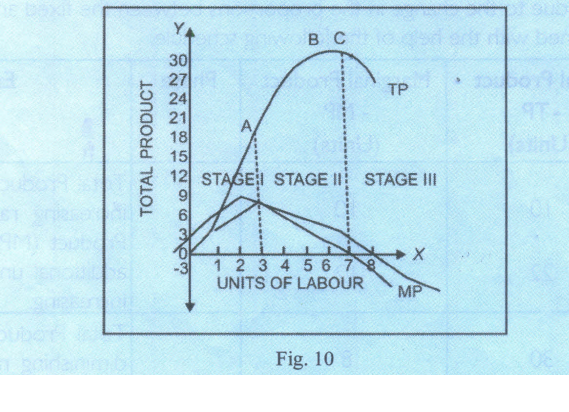
Stage I: Increasing Returns to Variable Factor:
The Total Product (TP) increases at an increasing rate from 0 to 3 units of labour, That is, Marginal Product (MP) is increasing. In the diagram, the phase of increasing returns is shown up to point A.
Stage 2: Diminishing Returns to Variable Factor
The Total Product (TP) increases at a diminishing rate from 4 to 7 units of labour, That is, Marginal :: Product (MP) is decreasing. In the diagram, the phase of diminishing returns is shown between point :: A and point B.Marginal Product is zero at point C implying that Total Product is constant between points Band C.
Stage 3: Negative Returns to Variable factor
The Total Product (TP) is decreasing beyond 7 units of labour. The output decreases as an additional .unit of labour is employed. That is, Marginal Product (MP) is negative. In the diagram, the phase of j negative retums is shown beyond point C.
5.
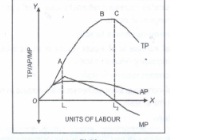
The factors of production can be classified as fixed and variable factors. The fixed factors cannot be changed over a short period. The Law of Variable Proportions (or the Law of Returns to a Factor) states that when more and more units of a variable factor are employed, keeping the other factors fixed, the Total Product (TP) first increases at an increasing rate, then increases at a diminishing rate and finallIy starts falling.The law explains the change in output due to the change in the proportions between the fixed and variable factors. The law of returns to a factor can be explained with the help of following diagram:
Stage I: Increasing Returns to Variable Factor
The Total Product (TP) increases at an increasing rate from 0 to \(L_{ 1 }\) units of labour. That is, Marginal Product (MP) is increasing.
Stage 2: Diminishing Returns to Variable Factor
The Total Product (TP) increases at a diminishing rate from \(L_{ 1 }\) , to \(L_{ 2 }\) units of labour. That is, Marginal Product (MP) is decreasing. MP is 0 at \(L_{ 2 }\) units of labour. •
Stage 3: Negative Returns to Variable Factor
The Total Product (TP) is decreasing beyond ~ units of labour. The output decreases as an additional unit of labour is employed. That is, Marginal Product (MP) is negative.
6.
(i) False. Increasing in Total Product indicates increasing returns to a factor as well as decreasing returns to a factor. When Marginal Product increases, Total Product increases at increasing rate causing increasing returns to a factor. When Marginal Product decreases, Total Product increases at decreasing rate causing decreasing returns to a factor.
(ii) False. Marginal Revenue is not always the price at which the last unit of commodity is sold. It is rue only under perfectly competitive market structure. Marginal Revenue can be zero or even negative under other forms of market, but-price cannot be zero or negative
(iii) False. When there are diminishing returns to a factor, only Marginal Product falls. However, Total Product increases but at a diminishing rate. Total Product tends to increase as long as Marginal Product is positive. When there are diminishing returns to a factor marginal and total products both always fall is a false statement. We can understand this situation with the help of schedule.

12th Standard CBSE Syllabus & Materials
12th Standard CBSE
CBSE 12th Computer Science Python Revision Tour I - New Previous year Question Papers Study Material - QB365 Set A
NEW12th Standard CBSE
CBSE 12th Business Studies Planning Important Questions And Answers Study Material - QB365 Set A
NEW12th Standard CBSE
CBSE 12th Business Studies Business Environment Important Questions And Answers Study Material - QB365 Set A
NEW12th Standard CBSE
CBSE 12th Business Studies Principles of Management Important Questions And Answers Study Material - QB365 Set A



CBSE 12th Standard CBSE Subjects
CBSE Standards











