
 100% FREE ACCESS
12th Standard CBSE Syllabus & Materials
12th Standard CBSE
CBSE 12th Economics Government Budget and the Economy Previous year Question Papers Study Material - QB365 Set A
NEW12th Standard CBSE
CBSE 12th Computer Science Interface Python with MySQL - New Previous year Question Papers Study Material - QB365 Set A
NEW12th Standard CBSE
CBSE 12th Computer Science Database Concept - New Previous year Question Papers Study Material - QB365 Set A
NEW12th Standard CBSE
CBSE 12th Computer Science Data Communication - New Previous year Question Papers Study Material - QB365 Set A
NEW12th Standard CBSE
CBSE 12th Computer Science Data Structures - New Previous year Question Papers Study Material - QB365 Set A
NEW12th Standard CBSE
CBSE 12th Computer Science Functions - New Previous year Question Papers Study Material - QB365 Set A

Published on: 01/12/2018
Getting a good score in class 12 requires dedicated, untiring focus towards studies on the part of the student. It is important to have a strategic approach towards your exams where extra effort is put in analyzing and understanding what topics are important from the exam point of view. Practice makes perfect, and there is no better way to practice than to attempt previous year question paper of CBSE class 12. A thorough study of past year question papers will help you to understand the pattern of how questions are being asked so that you are able to identify and focus on the important topics that are frequently asked.
In this post Class 12 Maths Chapter 12 - Linear Programming solved by Expert Teachers as per NCERT (CBSE) Book guidelines. All Linear Programming Exercise Questions with Solutions to help you to revise complete Syllabus and Score More marks.
Get 100 percent accurate NCERT Solutions for Class 12 Maths Chapter 12 (Linear Programming) solved by expert Maths teachers. We provide step by step solutions for questions given in Class 12 maths text-book as per CBSE Board guidelines from the latest NCERT book for Class 12 maths. The topics and sub-topics in
Chapter 12 Linear Programming
12.1 Introduction
12.2 Linear Programming Problem and its Mathematical Formulation
12.2.1 Mathematical formulation of the problem
12.2.2 Graphical method of solving linear programming problems
12.3 Different Types of Linear Programming Problems.
Download CBSE Class 12th Standard CBSE Maths question papers, sample papers, important questions, and previous year solved papers in PDF format. Get free study materials, NCERT solutions, and exam preparation resources for Class 12th Standard CBSE Maths
Questions + Answers key
Take MCQ Maths Test
1.
Solve the following Linear Programming Problem graphically:
Maximize Z = 3x + 4y subject to the constraints:
\(x+y\le 4,\)
\(x\ge 0 \ \text {and} \)
\(y\ge 0.\)
2.
Draw the graph of the following LLP:\(3x+y\le 17,x,y\ge 0\)
3.
A dietician wishes to mix two types of foods in such a way that the vitamin contents of the mixture contains at least 8 units of vitamin A and 10 units of vitamin C. Food I contains 2 unit/ kg of vitamin A and 1 unit/kg of vitamin C while food II contains 1 unit/kg of vitamin A and 2 units/kg of vitamin C. It costs Rs. 5 per kg to produce Food I and Rs. 7 per kg to produce food II. Determine the minimum cost of such a mixture. Formulate the above as a LLP and solve 3 it graphically.
4.
Kellogg is a new cereal formed of a mixture of bran and rice that contains at least 88 grams of protein and at least 56 milligrams of iron. Knowing that bran contains 80 grams of protein and 40 milligrams of iron per kilogram, and that rice contains 100 grams of protein and 30 milligrams of iron per kilogram, find the minimum cost of producing this new cereal if bran costs Rs. 5 per kilogram and rice costs Rs. per kilogram.
5.
Minimize and Maximize Z = 5x + 2y, subject to the following constraints:
\(x-2y\le 2,3x+2y\le 12,-3x+2y\le 3,x\ge 0,y\ge 0.\)
6.
A toy company manufactures two types of dolls, A and B. Market tests and available resources have indicated that the combined production level should not exceed 1200 dolls per week and the demand for dolls of type B is at most half of that for dolls of type A. Further, the production level of dolls of type of other type by at most 600 units. If the company makes profit of Rs. 12 and Rs. 16 per doll respectively on dolls A and B, how many of each should be produced weekly in order to maximise the profit?
7.
An oil company has two depots A and B with capacities of 7000 L and 4000 L respectively. The company is to supply oil to three petrol pumps, D, E and F whose requirements are 4500 L, 3000 L and 3500 L respectively. The distance (in km) between the depots and the petrol pumps are given in the following table:
| Distance in (km.) | ||
| From/To | A B | |
| D E F |
7 6 3 |
3 4 2 |
Assuming that the transportation cost of 10 litres of oil is Rs. 1 per km, how should the delivery be scheduled in order that the transportation cost is minimum? What is the minimum cost?
8.
A farmer mixes two brands P and Q of cattle feed. Brand P, costing Rs. 250 per bag, contains 3 units of nutritional element A, 2.5 units of element B and 2 units of vitamin C. Brand Q costing Rs. 200 per bag contains 1.5 units of nutritional element A, 11.25 units of element B, and 3 units of element C. The minimum requirements of nutrients A,B and C are 18 units, 45 units and 24 units respectively. Determine the number of bags of each brand which should be mixed in order to produce a mixture having a minimum cost per bag? What is the minimum cost of the mixture per bag?
9.
Reshma wishes to mix two types of food P and Q in such a way that the vitamin contents of the mixture contain at least 8 units of vitamin A and 11 units of vitamin B. Food P costs Rs. 60/kg and Food Q costs Rs. 80/kg. Food P contains 3 units/kg of Vitamin A AND 4 units/kg of vitamin B. Food Q contains 5 units/kg Vitamin A and 2 units/kg of vitamin B. Determine the minimum cost of the mixture.
10.
Solve the following Linear Programming Problems graphically:
Maximise Z = 3x + 2y
subject to x + 2y ≤ 10, 3x + y ≤ 15, x, y ≥ 0.
11.
Solve the following problem graphically:
Minimise and Maximise : Z = 3x + 9y
subject to the constraints:
\(x+3y\le 60,\)
\(x+y\ge 10,\)
\(x\le y\)
\(x\ge 0,\)
\(y\ge 0.\)
12.
Suppose every gram of wheat produces 0.1 g of protein and 0.25 g of carbohydrates and corresponding values for rice are 0.05 g and 0.5 g respectively. Wheat cost Rs. 25 and rice Rs. 100 per kilogram. The minimum daily requirements of proteins and carbohydrates for an mixed in a daily diet to provide minimum daily requirements of proteins and carbohydrates at minimum cost, assuming that both wheat and rice are to be taken in a diet? What is your opinion about healthy diet? Name few ingredients necessary for a healthy diet.
13.
(Manufacturing Problem) A small firm manufactures gold rings and chains. The total number of rings and chains manufactured per day is atmost 24. It takes 1 hour to make a ring and 30 minutes to make a chain. The maximum number of hours available per day is 16. If the profit on a ring is Rs. 300 and that on a chain is Rs. 190, find the number of rings and chains that should be manufactured per day, so as to earn the maximum profit. Make it as an LPP and solve it graphically.
14.
The objective function is maximum or minimum, which lies on the boundary of the feasible region.
15.
A retired person wants to invest an amount of Rs. 50,000. His broker recommends investing in two type of bonds 'A' and 'B' yielding 10% and 9% return respectively on the invested amount. He decides to invest at least Rs. 20,000 in bond 'A' and at least Rs. 10,000 in bond 'B'. He also wants invest at least as much in boud 'A' as in bond ·'B'. Solve this linear programming problem graphically to maximise his returns.
16.
Find graphically, the maximum value of Z = 2x + 5y, subject to constraints given below: 2x + 4y \(\le \) 8 \(\Rightarrow\) x + 2y \(\le \) 4
3x + y \(\le \) 6
x + y \(\le \) 4
x \(\\ \ge \) 0, y \(\\ \ge \) 0
17.
A manufacturer produces nuts and bolts. It takes 2 hours work on machine A and 3 hours on machine B to produce a package of nuts. It takes 3 hours on machine A and 2 hours on machine B to produce a package of bolts. He earns a profit of Rs. 24 per package on nuts and Rs. 18 per package on bolts. How many packages of each should be produced each day so as to maximize his profit, if he operates his machines both for at the most 10 hours a days. Make an LPP from above and solve it graphically?
18.
A manufacture produces two products A and B. Both the products are processed on two different machines. The available capacity of first machine is 12 hours and that of second machine is 9 hours for day. Each unit of product A requires 3 hours on both machines and each unit of product B requires 2 hours on first machine and 1 hour on second machine, Each unit of product A is sold at Rs. 7 profit and that of B at a profit of Rs. 4. Find the production level per day for maximum profit graphically.
1.
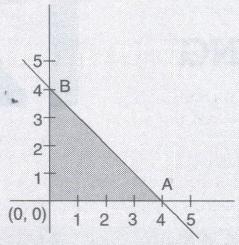
The feasible region determined by the constraints, x + y ≤ 4, x ≥ 0, y ≥ 0, is as follows.
The corner points of the feasible region are O (0, 0), A (4, 0), and B (0, 4). The values of Z at these points are as follows.
| Corner point | Z = 3x + 4y | |
| O(0, 0) | 0 | |
| A(4, 0) | 12 | |
| B(0, 4) |
16 |
→ Maximum |
Therefore, the maximum value of Z is 16 at the point B (0, 4).
2.
200 at (50,0)
3.
Let 'x' kg of food I and 'y' kg of food II be mixed we have the table:
| Food | Amount | Unit of Vitamin A | Unit of Vitamin C | Cost (in RS) |
| I | x kg | 2x | x | 5x |
| II | y kg | y | 2y | 7y |
| Total | 2x+y | x+2y | 5x+7y |
Thus LPP problem is as below:
Minimize Z = 5x + 7y ...(1)
Subject to: \(2x+y\ge 8\) ...(2)
\(x+2y\ge 10\) ...(3)
and \(x\ge 0,y\ge 0\) ...(4)
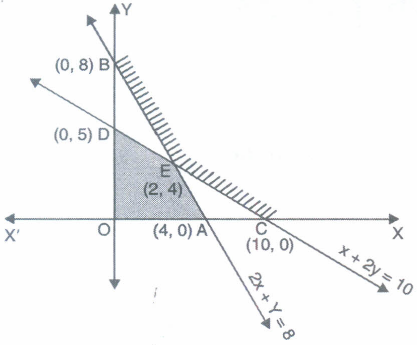
Draw the lines x + 2y = 10 and 2x + y = 8, x = 0 and The lines x + 2y = 10 and 2x + y = 8 meet at E(2, 4).
First of all, we locate the region represented by (2)-(4).
The shaded region, as shown above, is feasible region.
Applying Corner Point Method, we have:
| Corner Point | Z = 5x + 7y |
| C : (10, 0) E : (2, 4) B : (0, 8) |
50 38 (Maximum) 56 |
Hence, the minimum cost = Rs. 38 when 2kg of food I and 4 kg of food II are mixed.
These days people are aware of having balanced, healthy and nutrious diet. For this reason, people get advice from dieticians.
4.
Let 'x' kg bran and 'y' kg of rice be required.
Minimize: Z = 5x + 4y subject to:
\(x\ge 0,y\ge 0,80x+100y\ge 88\) and \(40x+30y\ge 56\)
i.e. \(x\ge 0,\quad y\ge 0,20x+25y\ge 22\)
and \(20x+15y\ge 28\)
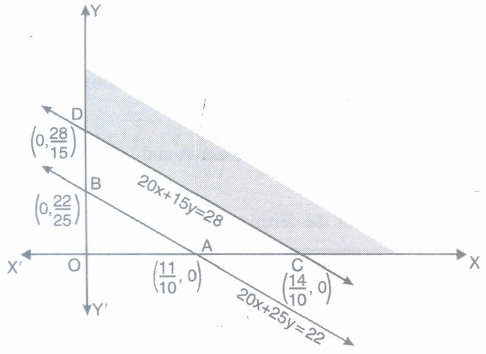
The feasible region (shaded) is unbounded.
Let us evaluate Z at the corner points:
| Corner Point | Z = 5x + 4y |
| \(C:\left( \frac { 14 }{ 10 } ,0 \right) \) \(D:\left( 0,\frac { 28 }{ 15 } \right) \) |
7 (Minimum) \(\frac { 112 }{ 15 } \) |
Hence, the minimum cost is Rs. 7 when \(\frac { 14 }{ 10 } \) kg of bran is used.
5.
The system constraints is:
\(x-2y\le 2\)....(1)
\(3x+2y\le 12\) ..(2)
\(-3x+2y\le 3\) ..(3)
and \(x\ge 0,y\ge 0\) ..(4)
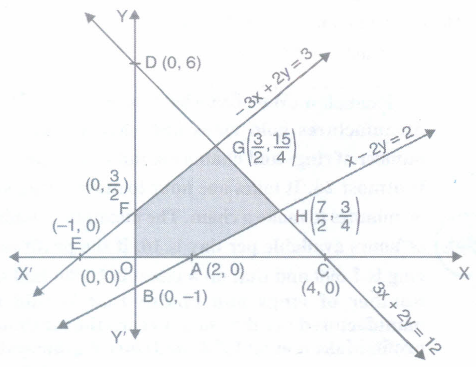
The line x - 2y and 3x + 2y = 12 meet at H \(\left( \frac { 7 }{ 2 } ,\frac { 3 }{ 4 } \right) \).
The lines -3x + 2y = 3 and 3x + 2y = 12 meet at G \(\left( \frac { 3 }{ 2 } ,\frac { 15 }{ 4 } \right) \)
The shaded portion in the above figure is the feasible region, which is bounded.
Applying Corner Point Method, we are to determine the maximum and minimum values of Z, where Z = 5x + 2y.
| Corner Point | Z = 5x + 2y |
| O : (0, 0) | 0 |
| A : (2, 0) | 10 |
| H : \(\left( \frac { 7 }{ 2 } ,\frac { 3 }{ 4 } \right) \) | 19 |
| G : \(\left( \frac { 3 }{ 2 } ,\frac { 15 }{ 4 } \right) \) | 15 |
| F : \(\left( 0,\frac { 3 }{ 2 } \right) \) | 3 |
Hence, Zmin = 0 at (0,0) and Zmax = 19 at \(\left( \frac { 7 }{ 2 } ,\frac { 3 }{ 4 } \right) \)
6.
Let x and y be the number of dolls of type A and B respectively that are produced per week.
The given problem can be formulated as follows.
Maximize z = 12x + 16y … (1)
subject to the constraints,
\(x+y\le 1200\) ..(1)
\(y\le \frac { x }{ 2 } \Leftrightarrow x-2y\ge 0\) ..(2)
\(x\le 3y+600\Leftrightarrow x-3y\le 600\) ...(3)
and \(x,y\ge 0\) ....(4)
The feasible region determined by the system of constraints is as follows.
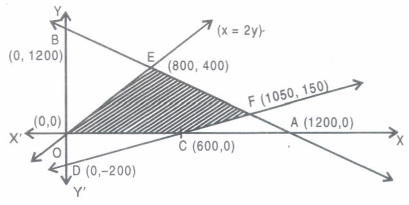
The corner points are A (600, 0), B (1050, 150), and C (800, 400).
The values of z at these corner points are as follows.
| Corner point | z = 12x + 16y | |
| A (600, 0) | 7200 | |
| B (1050, 150 | 15000 | |
| C (800, 400) | 16000 | → Maximum |
The maximum value of z is 16000 at (800, 400).
Thus, 800 and 400 dolls of type A and type B should be produced respectively to get the maximum profit of Rs. 16000.
7.
Let x and y litres of oil be supplied from A to the petrol pumps, D and E. Then, (7000 − x − y) will be supplied from A to petrol pump F.
The requirement at petrol pump D is 4500 L. Since x L are transported from depot A, the remaining (4500 −x) L will be transported from petrol pump B.
Similarly, (3000 − y) L and 3500 − (7000 − x − y) = (x + y − 3500) L will be transported from depot B to petrol pump E and F respectively.
The given problem can be represented diagrammatically as follows.
Minimize: \(C=\frac { 3x }{ 10 } +\frac { y }{ 10 } +3950\)
Subject to: \(4500-x\ge 0\Leftrightarrow x\le 4500\) ...(1)
\(3000-y\ge 0\Leftrightarrow y\le 3000\)....(2)
\(x+y-3500\ge 0\Leftrightarrow x+y\ge 3500\) ...(3)
\(7000-(x+y)\ge 0\Leftrightarrow x+y\le 7000\) ..(4)
and \(x,y\ge 0\) ....(5)
Cost of transporting \(10 \mathrm{~L} \text { of petrol }=\operatorname{Re} 1\)
Cost of transporting \( 1 \mathrm{~L} \text { of petrol }=\mathrm{Rs} \frac{1}{10}\)
Therefore, total transportation cost is given by,
\(z =\frac{7}{10} \times x+\frac{6}{10} y+\frac{3}{10}(7000-x-y)+\frac{3}{10}(4500-x)+\frac{4}{10}(3000-y)+\frac{2}{10}(x+y-3500)\)
\(=0.3 x+0.1 y+3950 \)
The problem can be formulated as follows.
Minimize z = 0.3x + 0.1y + 3950 … (1)
subject to the constraints,
\(x+y \leq 7000 \)
\(x \leq 4500 \)
\(y \leq 3000 \)
\(x+y \geq 3500 \)
\(x, y \geq 0 \)
The feasible region determined by the constraints is as follows.
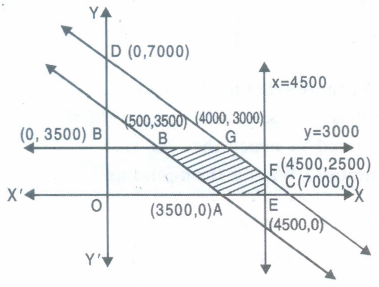
The corner points of the feasible region are A (3500, 0), B (4500, 0), C (4500, 2500), D (4000, 3000), and E (500, 3000).
The values of z at these corner points are as follows.
| Corner point | z = 0.3x + 0.1y + 3950 | |
| A (3500, 0) | 5000 | |
| B (4500, 0) | 5300 | |
| C (4500, 2500) | 5550 | |
| D (4000, 3000) | 5450 | |
| E (500, 3000) | 4400 | → Minimum |
The minimum value of z is 4400 at (500, 3000).
Thus, the oil supplied from depot A is 500 L, 3000 L, and 3500 L and from depot B is 4000 L, 0 L, and 0 L to petrol pumps D, E, and F respectively.
The minimum transportation cost is Rs. 4400.
8.
Let the farmer mix x bags of brand P and y bags of brand Q.
The given information can be compiled in a table as follows.
| Vitamin A (units/bag) | Vitamin B (units/bag) | Vitamin C (units/bag) | Cost (Rs/bag) | |
| Food P | 3 | 2.5 | 2 | 250 |
| Food Q | 1.5 | 11.25 | 3 | 200 |
| Requirement (units/bag) | 18 | 45 | 24 |
The given problem can be formulated as follows.
Minimize z = 250x + 200y … (1)
subject to the constraints,
\(3x+1.5y\ge 18\)
\(2.5x+11.25y\ge 14\)
\(2x+3y\ge 24\)
and \(x,y\ge 0\)
The feasible region determined by the system of constraints is as follows
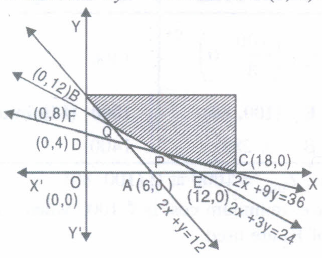
The corner points of the feasible region are A (18, 0), B (9, 2), C (3, 6), and D (0, 12).
The values of z at these corner points are as follows.
| Corner point | z = 250x + 200y | |
| A (18, 0) | 4500 | |
| B (9, 2) | 2650 | |
| C (3, 6) | 1950 | → Minimum |
| D (0, 12) | 2400 |
As the feasible region is unbounded, therefore, 1950 may or may not be the minimum value of z.
For this, we draw a graph of the inequality, 250x + 200y < 1950 or 5x + 4y < 39, and check whether the resulting half plane has points in common with the feasible region or not.
It can be seen that the feasible region has no common point with 5x + 4y < 39
Therefore, the minimum value of z is 1950 at (3, 6).
Thus, 3 bags of brand P and 6 bags of brand Q should be used in the mixture to minimize the cost to Rs. 1950.
9.
Let the mixture contain x kg of food P and y kg of food Q. Therefore, x ≥ 0 and y ≥ 0
The given information can be compiled in a table as follows.
| Vitamin A (units/kg) | Vitamin B (units/kg) | Cost (Rs/kg) | |
| Food P | 3 | 5 | 60 |
| Food Q | 4 | 2 | 80 |
| Requirement (units/kg) | 8 | 11 |
The mixture must contain at least 8 units of vitamin A and 11 units of vitamin B. Therefore, the constraints are
3x + 4y ≥ 8
5x + 2y ≥ 11
Total cost, Z, of purchasing food is, Z = 60x + 80y
The mathematical formulation of the given problem is
Minimise Z = 60x + 80y … (1)
subject to the constraints,
3x + 4y ≥ 8 … (2)
5x + 2y ≥ 11 … (3)
x, y ≥ 0 … (4)
The feasible region determined by the system of constraints is as follows.
It can be seen that the feasible region is unbounded.
The corner points of the feasible region are and \(A\left(\frac{8}{3}, 0\right), B\left(2, \frac{1}{2}\right) \text { and } C\left(0, \frac{11}{2}\right)\)
| Corner points | z = 60x +80 y |
| \(A\left(\frac{8}{3}, 0\right)\) | 160 |
| \(B\left(2, \frac{1}{2}\right) \) | 160 |
| \(C\left(0, \frac{11}{2}\right)\) | 440 |
As the feasible region is unbounded, therefore, 160 may or may not be the minimum value of Z.
For this, we graph the inequality, 60x + 80y < 160 or 3x + 4y < 8, and check whether the resulting half plane has points in common with the feasible region or not.
It can be seen that the feasible region has no common point with 3x + 4y < 8
Therefore, the minimum cost of the mixture will be Rs 160 at the line segment joining the points \(\left(\frac{8}{3}, 0\right) \text { and }\left(2, \frac{1}{2}\right)\)
10.
The feasible region determined by the constraints, x + 2y ≤ 10, 3x + y ≤ 15, x ≥ 0, and y ≥ 0, is as follows.
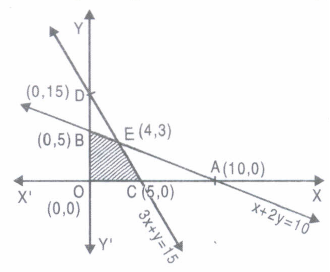
The corner points of the feasible region are A (5, 0), B (4, 3), and C (0, 5).
The values of Z at these corner points are as follows.
| Corner Point | Corresponding Value of Z |
| O : (0,0) | 0 |
| C : (5,0) | 15 |
| E : (4,3) | 18 (Maximum) |
| B : (0,5) | 10 |
Therefore, the maximum value of Z is 18 at the point (4, 3).
11.
First of all, let us graph the feasible region of the system of linear inequalities (2) to (5). The feasible region ABCD. Note that the region is bounded. The coordinates of the corner points A, B, C and D are (0, 10), (5, 5), (15,15) and (0, 20) respectively
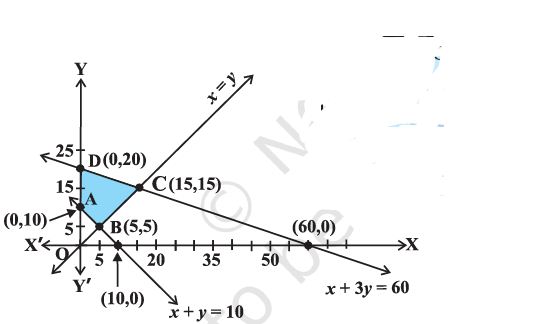
We now find the minimum and maximum value of Z. From the table, we find that the minimum value of Z is 60 at the point B (5, 5) of the feasible region.
The maximum value of Z on the feasible region occurs at the two corner points C (15, 15) and D (0, 20) and it is 180 in each case.
| Corner Point | Corresponding value of Z |
| D : (0,10) | 90 |
| E : (5,5) | 60 (Minimum) |
| F : (15,15) | 180} Maximum Values |
| B : (0,20) | 180} Maximum Values |
12.
Wheat 400 g and rice 200 g at a minimum cost of Rs. 30. We must take balanced healthy diet for good health. Wheat, rice, milk, fruits, nut etc.
We must take balanced healthy diet for good health; Wheat, rice, milk, fruits, nut etc.
13.
Let 'x' and 'y' be the number of gold rings and chains respectively.
We have:
\(x\ge 0\) ...(1)
\(y\ge 0\)...(2)
\(x+y\le 24\)...(3)
\(x+\frac { y }{ 2 } \le 16\) ...(4)
The objective function, or the profit, Z is:
Z = 300x + 190y ..(5)
We have to maximise Z subject to (1)-(4).
For solution set, we draw the lines:
x = 0, y = 0, x + y = 24, 2x + y = 32.
The lines x + y = 24 and 2x + y = 32 meet at E (8,16).
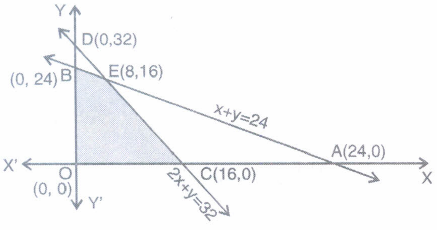
The shaded portion represents the feasible region, which is bounded.
Applying Corner Point Method, we have:
| Corner Point | Z = 300x + 190y |
| O : (0,0) | 0 |
| C : (16,0) | 4800 |
| E : (8,16) | 5440 (Maximum |
| B : (0,24) | 4560 |
Hence, the maximum profit is Rs. 5,440 and it is obtained when 8 gold rings and 16 chains are manufactured.
14.
True.
15.
Let the investment in bond A be Rs. x and in bond B Rs. y.
Obective function is
\(Z=\frac { x }{ 10 } +\frac { 9 }{ 100 } y\)
Subject to constraints
x + y \(\le \) 50,000; x \(\ge \) 20,000;
y \(\ge \) 10,000, x\(\ge \) y(*)
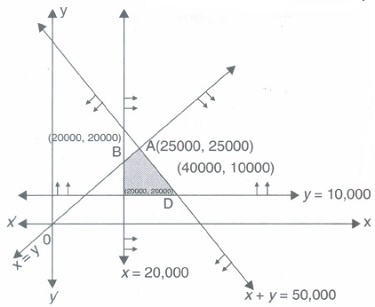
Vertices of feasible region are A, B, C and D.
| Corner Points | \(Z=\frac { x }{ 10 } +\frac { 9 }{ 100 } y\) | Value |
| A(25,000, 25,000) | 2,500 + 2,250 | 4,750 |
| B(20,000, 20,000) | 2,000 + 18,00 | 3,800 |
| C(20,000, 10,000) | 2,000 + 900 | 2,900 |
| D(40,000, 10,000) | 4,000 + 900 | 4,900 |
Return is maximum when Rs. 40,000 are invested in Bond A and Rs. 10,000 in Bond B maximum return is Rs. 4,900.
Since there are more than 3 constraints, student may be given full 6 marks even if reaches upto (*).
16.
Given inequations are
\(2 x+4 y \leq 8 \text { or } \ x+2 y \leq 4 \)
\(3 x+y \leq 6, x+y \leq 4, \ x \geq 0, \ y \geq 0
\)
Maximise Z = 2x + 5y on plotting the graph of the inequations we notice shaded portion as feasible solution
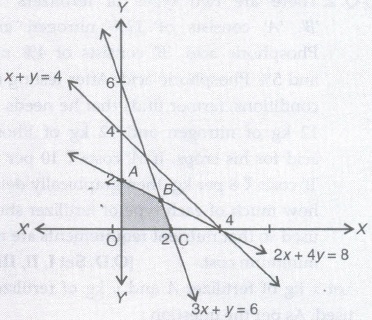
Possible points for maximum Z are A(2, 0),\(B\left(\frac{8}{5}, \frac{6}{5}\right)\) C (0,2)
| Points | Z= 2x + 5y | Values |
| A(2,0) | 4 + 0 | 4 |
| \(B\left(\frac{8}{5}, \frac{6}{5}\right)\) | \(\frac{16}{5}+\frac{30}{5}\) | \(\frac{46}{5}=9 \frac{1}{5}\) |
| C(0,2) | 0 + 10 | 10 \(\leftarrow\) Maximum |
Z is maximum at qo, 2), i.e. x = 0, y = 2, maximum value = 10
17.
Let x and y be nut packages and bolt packages produced each day, respectively.
\(\therefore\) LPP is Maximize Z = 24x + 18y
Subject to 2x + 3y \(\le \) 10
3x + 2y \(\le \) 10
x, y \(\ge \) 0
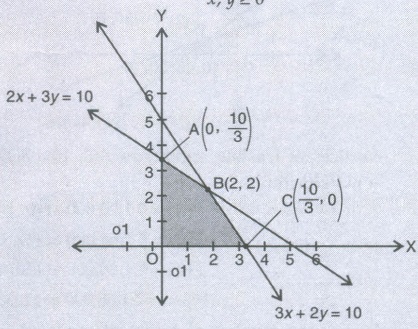
Vertices are
\(A\left( 0,\frac { 10 }{ 3 } \right) ,B(2,2)\quad and\quad C\left( \frac { 10 }{ 3 } ,0 \right) \)
| Points | Z = 24x + 18y |
| \(0,\frac { 10 }{ 3 } \) | z = 0+ 60 = Rs. 60 |
| (2, 2) | z = 48 + 36 = Rs. 84 (Max) |
| \(\left( \frac { 10 }{ 3 } ,0 \right) \) | z = 80 + 0 = Rs. 80 |
Hence, 2 nuts & 2 bolts to be produced to get max. profit of Rs. 84.
18.
Let the manufacturer produces the products A and B be x and y units, respectively.
We construct the following table
\(\begin{array}{c|c|c|c|c} \hline \text { Products } & \begin{array}{c} \text { Produce } \\ \text { (in units) } \end{array} & \begin{array}{c} \text { Time on } \\ \text { Machine I } \\ \text { (in hours) } \end{array} & \begin{array}{c} \text { Time on } \\ \text { Machine II } \\ \text { (in hours) } \end{array} & \begin{array}{c} \text { Profit } \\ \text { (in Rs.) } \end{array} \\ \hline \begin{array}{c} A \\ B \end{array} & \begin{array}{c} x \\ y \end{array} & \begin{array}{c} 3 x \\ 2 y \end{array} & \begin{array}{c} 3 x \\ 7 y \end{array} & \begin{array}{c} 7 x \\ 4 y \end{array} \\ \hline \text { Total } & x+y & 3 x+2 y & 3 x+y & 7 x+4 y \\ \hline \text { Availability } & & 12 & 9 & \\ \hline \end{array}\)
Here, total profit z = 7x + 4y
i.e. maximise Z = 7x + 4y
subject to the constraints
\(3 x+2 y \leq 12\)
\(3 x+y \leq 9\)
and \(x \geq 0, y \geq 0\)
Now, consider the given inequations as equations
\(3 x+2 y=12\) ...(i)
3x + y = 9 ...(ii)
Table for line \(3 x+2 y=12 \text { or } y=\frac{12-3 x}{2}\) is
\(\begin{array}{c|c|c} \hline x & 0 & 4 \\ \hline y & 6 & 0 \\ \hline \end{array}\)
It psses through the points (0, 6) and (4, 0).
On putting (0, 0) in the inequality \(3 x+2 y \leq 12\), we get
\(0+0 \leq 12 \Rightarrow 0 \leq 12\)
So, the half plane is towards the origin.
Table for line 3x + y = 9 or y = 9 - 3x is
\(\begin{array}{c|c|c} \hline x & 0 & 3 \\ \hline y & 9 & 0 \\ \hline \end{array}\)
It passes through the points (0, 9) and (3, 0).
On putting (0, 0) in the inequality \(3 x+y \leq 9\), we get
\(0+0 \leq 9 \Rightarrow 0 \leq 9\)
So, the half plane is towards the origin
Also, \(x \geq 0 \text { and } y \geq 0\) so the region lies in 1st quadrant.
Now, the intersection point oflines (i) and (ii) is
\((3 x+2 y)-(3 x+y)=12-9\)
\(\Rightarrow y=3\)
\(\text { and } \quad 3 x=12-2 \times 3\)
\(\Rightarrow 3 x=12-6\)
\(\Rightarrow x=2\)
Thus, the point of intersection is B (2, 3).
The graph of inequations is shown below
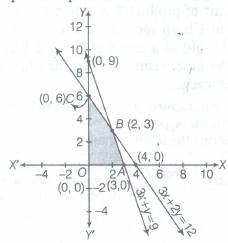
Here, we see that OABC is a required feasible region, whose corner points are 0(0, 0), A(3, 0), B(2,3) and C{0, 6).
The values of Z at these corner points are as follows
\(\begin{array}{c|l} \hline \text { Corner points } & z=7 x+4 y \\ \hline O(0,0) & z=0+0=0 \\ A(3,0) & Z=7 \times 3+0=21 \\ B(2,3) & z=7 \times 2+4 \times 3=26 \text { (maximum) } \\ C(0,6) & Z=7 \times 0+4 \times 6=24 \end{array}\)
Hence, for maximum profit, manufacturer produce 2 units of product A 3 units of product B.

12th Standard CBSE Syllabus & Materials
12th Standard CBSE
CBSE 12th Computer Science Python Revision Tour I - New Previous year Question Papers Study Material - QB365 Set A
NEW12th Standard CBSE
CBSE 12th Business Studies Planning Important Questions And Answers Study Material - QB365 Set A
NEW12th Standard CBSE
CBSE 12th Business Studies Business Environment Important Questions And Answers Study Material - QB365 Set A
NEW12th Standard CBSE
CBSE 12th Business Studies Principles of Management Important Questions And Answers Study Material - QB365 Set A



CBSE 12th Standard CBSE Subjects
CBSE Standards










