
 100% FREE ACCESS
12th Standard CBSE Syllabus & Materials
12th Standard CBSE
CBSE 12th Economics Government Budget and the Economy Previous year Question Papers Study Material - QB365 Set A
NEW12th Standard CBSE
CBSE 12th Computer Science Interface Python with MySQL - New Previous year Question Papers Study Material - QB365 Set A
NEW12th Standard CBSE
CBSE 12th Computer Science Database Concept - New Previous year Question Papers Study Material - QB365 Set A
NEW12th Standard CBSE
CBSE 12th Computer Science Data Communication - New Previous year Question Papers Study Material - QB365 Set A
NEW12th Standard CBSE
CBSE 12th Computer Science Data Structures - New Previous year Question Papers Study Material - QB365 Set A
NEW12th Standard CBSE
CBSE 12th Computer Science Functions - New Previous year Question Papers Study Material - QB365 Set A

Published on: 11/10/2019
Linear Programming
Download CBSE Class 12th Standard CBSE Maths question papers, sample papers, important questions, and previous year solved papers in PDF format. Get free study materials, NCERT solutions, and exam preparation resources for Class 12th Standard CBSE Maths
Questions + Answers key
Take MCQ Maths Test
1.
A factory makes two types of items A and B, made of plywood. One piece of item A requires 5 minutes for cutting and 10 minutes for assembling. One piece of item B requires 8 minutes for cutting and 8 minutes for assembling. There are 3 hours and 20 minutes available for cutting and 4 hours for assembling. The profit on one piece of item A is Rs. 5 and that on item B is Rs. 6. How many pieces of each type should the factory make so as to maximize profit? Make it as an LPP and solve it graphically.
2.
A company produces soft drinks that has a contract which requires that a minimum of 80 units of the chemical A and 60 units of the chemical B go into each bottle of the drink. The chemicals are available in prepared mix packets from two different suppliers. Supplier 5 had a packet of mix of 4 units of A and 2 units of B that costs ~ 10. The supplier T has a packet of mix of 1 unit of A and 1 unit of B that costs ~ 4. How many packets of mixes from 5 and T should the company purchase to honour the contract requirement and yet maintain the minimum cost? Make a LPP and solve graphically.
3.
A housewife wishes to mix together two kinds of food X and Y, in such a way that the mixture contains at least 10 units of vitamin A, 12 units of vitamin Band 8 units of vitamin C. The vitamin contents of one kg of food is given below:
| Vitamin A | Vitamin B | Vitamin C | |
| Food X | 1 | 2 | 3 |
| Food Y | 2 | 2 | 1 |
One kg of food X costs Rs. 6 and one kg of food y costs Rs. 10. Formulate the above problem as a linear programming problem and find the least cost of the mixture which will produce the diet graphically. What value will you like to attach with this problem?
4.
A retired person wants to invest an amount of Rs. 50,000. His broker recommends investing in two type of bonds 'A' and 'B' yielding 10% and 9% return respectively on the invested amount. He decides to invest at least Rs. 20,000 in bond 'A' and at least Rs. 10,000 in bond 'B'. He also wants invest at least as much in boud 'A' as in bond ·'B'. Solve this linear programming problem graphically to maximise his returns.
5.
A dietician wishes to mix two types of foods in such a way that the vitamin contents of the mixture contains at least 8 units of vitamin A and 10 units of vitamin C. Food I contains 2 units/kg of vitamin A and 1 unit/kg o6f vitamin C while food II contains 1 unit/kg of vitamin A and 2 units/kg of vitamin C. It costs Rs. 5 per kg to purchase food I and Rs. 7 per kg to purchase food II. Determine the minimum cost for such a mixture. Formulate the above as a LPP and solve it graphically.
6.
A decorative item dealer deals in two items A and B. He has Rs. 15,000 to invest and a space to store at the most 80 pieces. Item A cost him Rs. 300 and item B costs him Rs 150. He can sell items A and B at respective profits of Rs. 50 and Rs. 28. Assuming he can sell all he buys, formulate the linear programming problem in order to maximize his profit and solve it graphically.
7.
A company manufactures two types of sweaters, type A and B. It costs Rs. 360 to make one unit of type A and Rs. 120 to make a unit of type B. The company can make at most 300 sweaters and can spend Rs. 72,000 a day. The number of sweaters of type A cannot exceed the number of type B by more than 100. The company makes a profit of Rs 200 on each unit of type A. The company charging a nominal profit of Rs. 20 on a unit of type B. Using LPP, solve for max. profit.
8.
Find graphically, the maximum value of Z = 2x + 5y, subject to constraints given below: 2x + 4y \(\le \) 8 \(\Rightarrow\) x + 2y \(\le \) 4
3x + y \(\le \) 6
x + y \(\le \) 4
x \(\\ \ge \) 0, y \(\\ \ge \) 0
9.
A manufacturer produces nuts and bolts. It takes 2 hours work on machine A and 3 hours on machine B to produce a package of nuts. It takes 3 hours on machine A and 2 hours on machine B to produce a package of bolts. He earns a profit of Rs. 24 per package on nuts and Rs. 18 per package on bolts. How many packages of each should be produced each day so as to maximize his profit, if he operates his machines both for at the most 10 hours a days. Make an LPP from above and solve it graphically?
10.
A manufacture produces two products A and B. Both the products are processed on two different machines. The available capacity of first machine is 12 hours and that of second machine is 9 hours for day. Each unit of product A requires 3 hours on both machines and each unit of product B requires 2 hours on first machine and 1 hour on second machine, Each unit of product A is sold at Rs. 7 profit and that of B at a profit of Rs. 4. Find the production level per day for maximum profit graphically.
1.
Let the factory makes x pieces of item A and y pieces of item B.
Time required by item A (one piece)
cutting = 5 minutes
assembling = 10 minutes
Time required by item B (one piece)
cutting = 8 minutes
assembling = 8 minutes
Total time
cutting = 3 hours & 20 minutes,
assembling = 4 hours
Profit on one piece
item A = Rs. 5, item B = Rs. 6
Thus, our problem is maximized
Z = 5x + 6y
Subject to x \(\ge\) 0, y \(\ge\) 0
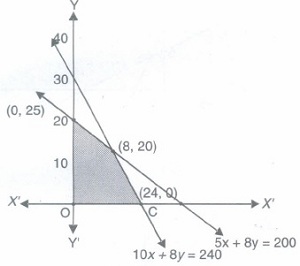
5x + 8y\(\le\) 200
10x + 8y \(\le\)240
From figure, possible points for maximum value of
Z are at (24, 0), (8, 20), (0, 25).
At (24, 0), Z = 120
At (8, 20), Z = 40 + 120 = 160 (Maximum)
At (0, 25), Z = 150
2.
Let x and y units of packet of mixes are purchased from 5 and T respectively. If Z is the total cost, then
Z = 10x + 4y ...(i)
is objective function which we have to minimize
Here constraints are:
4x + y \(\ge\)80..(ii)
2x + y \(\ge\)60.(iii)
Also, x \(\ge\) 0...(iv)
y \(\ge\)0
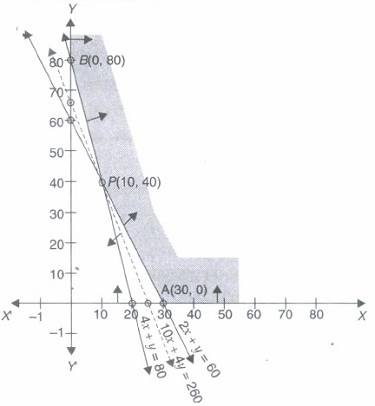
On plotting the graph of above constraints or inequalities (ii), (iii), (iv) and (v),
we get shaded region having corner point A, P, B as feasible region. For co-ordinate of P
Point of intersection of
2x + y = 60...(vi)
and 4x + y = 80....(vii)
From (vi) - (vii),
2x + y - 4x - y = 60 - 80
\(\Rightarrow\) -2x = -20
\(\Rightarrow\) x = 10
\(\Rightarrow\) y = 40
\(\because\) Co-ordinate of P = (10, 40)
Now the value of Z is evaluated at corner point the following table:
| Corner Points | Z = 10x + 4y |
| A(30, 0) | 300 |
| P(10, 40) | 260(Min.) |
| B(0, 80) | 320 |
Since feasible region is unbounded. Therefore we have to draw the graph of the inequality.
10x + 4y < 260 ...(viii)
Since the graph of inequality (viii) does not have any point common.
So the minimum value of Z is 260 at (10, 40). i.e., minimum cost of each bottle is ~ 260 if the company purchases 10 packets of mixes from 5 and 40 packets of mixes from supplier T.
3.
Let x kg and y kg of food X and Y be mixed for the minimum cost of mixture, then LPP is
Minimise,
Z = 6x + 10 y
Subject to :
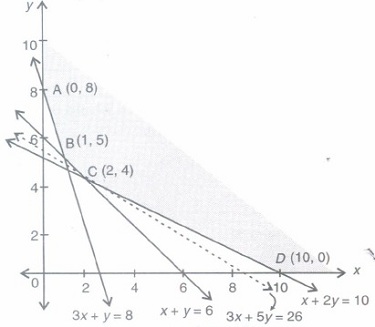
x + 2y \(\ge \) 10
2x + 2y \(\ge \) 12 \(\Rightarrow\) x + y \(\ge \) 6
3x + y \(\ge \) 8
x, y \(\ge \) 0
Correct graph
| Corner | Values of Z |
| (0, 8) | Rs. 80 |
| (1, 5) | Rs. 56 |
| (2, 4) | Rs. 52 (Minimum) |
| (10, 0) | Rs. 60 |
Region is unbounded
Rs. 52 i.e., 6x + 10y < 52 or 3x + 5y < 26 has no point common with feasible region.
\(\therefore\) The LPP has optimum solution at (2, 4) and least cost of the mixture = Rs. 52
Value: Balanced diet is essential for healthy body.
4.
Let the investment in bond A be Rs. x and in bond B Rs. y.
Obective function is
\(Z=\frac { x }{ 10 } +\frac { 9 }{ 100 } y\)
Subject to constraints
x + y \(\le \) 50,000; x \(\ge \) 20,000;
y \(\ge \) 10,000, x\(\ge \) y(*)
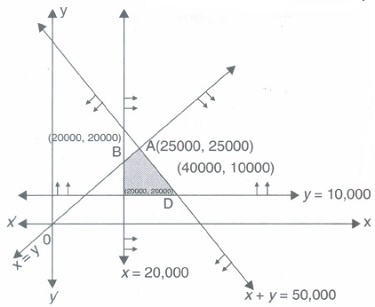
Vertices of feasible region are A, B, C and D.
| Corner Points | \(Z=\frac { x }{ 10 } +\frac { 9 }{ 100 } y\) | Value |
| A(25,000, 25,000) | 2,500 + 2,250 | 4,750 |
| B(20,000, 20,000) | 2,000 + 18,00 | 3,800 |
| C(20,000, 10,000) | 2,000 + 900 | 2,900 |
| D(40,000, 10,000) | 4,000 + 900 | 4,900 |
Return is maximum when Rs. 40,000 are invested in Bond A and Rs. 10,000 in Bond B maximum return is Rs. 4,900.
Since there are more than 3 constraints, student may be given full 6 marks even if reaches upto (*).
5.
Let the mixture contain x kg of food I and y kg of food II.
Getting the objective function as
Z = 5x + 7y
Getting the constraints
2x + y \(\ge \) 8
x + 2y \(\ge \)10
x, y \(\ge \) 0
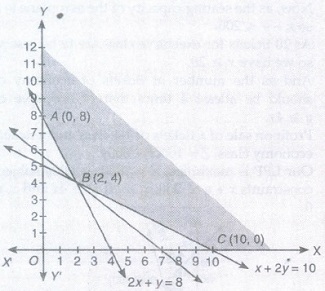
Getting the corners of feasible region as A(0, 8), B(2, 4), C(10, 0).
ZA = 5 \(\times\) 10 + 7 \(\times\) 8
= 56
ZB = 5 \(\times\) 2 + 7 \(\times\) 4
= 38 (minimum)
Zc = 5 \(\times\) 10 + 7 \(\times\) 10
= 50
Since 5x + 7y < 38 has no common region with the feasible region.
\(\therefore\) For minimum cost x = 2 kg and y = 4 kg.
6.
Let x be the number of pieces of item A and y be the number of pieces of item B.
The total profit in (Rs) = P = 50x + 28y...(i)
So, we have to maximize P with following constraints :
300x + 150y \(\le \) 15,000..(ii)
(investment constraint)
x + y\(\le \) 80 ...(iii)
(Storage constraint)
x \(\ge \) 0 (non-negative constraint)
y \(\ge \)0 ..........(iv)
300x + 150y = 15,000
\(\Rightarrow\) 2x + y = 100
Solving 2x + y = 100
and x + y = 80,
we get x = 20, y = 60
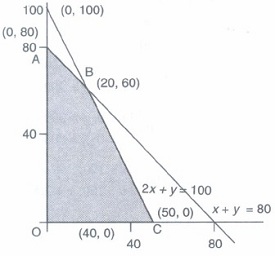
The feasible shaded region (OABC) is shown in graph, then four points O, A, B and C are critical points. Substituting the values of these points in profit equation, we get
| Corner Point | Profit P = 50x + 28y |
| O(0, 0) | Rs. 0 |
| A(0, 80) | Rs. 2240 |
| B(20, 60) | Rs. 2680 \(\leftarrow\) (Maximum) |
| C(50, 0) | Rs. 2500 |
The maximum profit of Rs. 2,680 is for 20 pieces of A and 60 pieces of B.
7.
Let the company manufactures sweaters of type A = x, type B = y, daily.
\(\therefore\) LPP is maximize. P = 200x + 20y s.t.
360x + 120y \(\le \) 72000
\(\Rightarrow\) 3x + y \(\le \) 300
x + y \(\le \) 300
x - y \(\le \) 100
\(3x+y=600,\begin{cases} x=0,y=600 \\ y=0,x=200 \end{cases}\)
\(x+y=300,\begin{cases} x=0,y=300 \\ y=0,x=300 \end{cases}\)
\(x-y=100,\begin{cases} x=100,\quad y=0 \\ y=100,\quad x=200 \end{cases}\)
\(\\ x\ge 0\)
\(y\ge 0\)
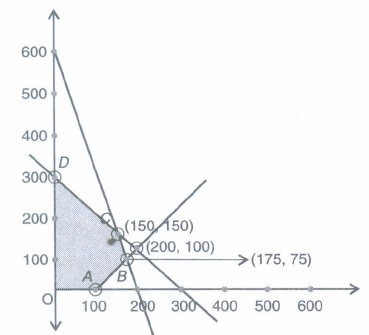
Getting vertices of feasible region as, O(0, 0), A(100, 0), B(175, 75), C(150, 150) and D(0, 300)
Maximum profit is P = 200(175) + 20(75)
= 35000 + 1500 = Rs. 36500
8.
Given inequations are
\(2 x+4 y \leq 8 \text { or } \ x+2 y \leq 4 \)
\(3 x+y \leq 6, x+y \leq 4, \ x \geq 0, \ y \geq 0
\)
Maximise Z = 2x + 5y on plotting the graph of the inequations we notice shaded portion as feasible solution
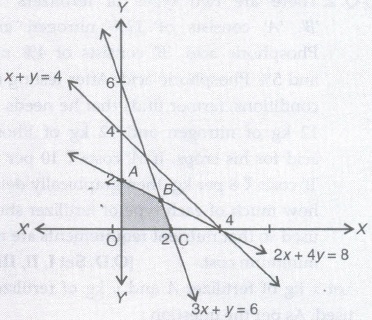
Possible points for maximum Z are A(2, 0),\(B\left(\frac{8}{5}, \frac{6}{5}\right)\) C (0,2)
| Points | Z= 2x + 5y | Values |
| A(2,0) | 4 + 0 | 4 |
| \(B\left(\frac{8}{5}, \frac{6}{5}\right)\) | \(\frac{16}{5}+\frac{30}{5}\) | \(\frac{46}{5}=9 \frac{1}{5}\) |
| C(0,2) | 0 + 10 | 10 \(\leftarrow\) Maximum |
Z is maximum at qo, 2), i.e. x = 0, y = 2, maximum value = 10
9.
Let x and y be nut packages and bolt packages produced each day, respectively.
\(\therefore\) LPP is Maximize Z = 24x + 18y
Subject to 2x + 3y \(\le \) 10
3x + 2y \(\le \) 10
x, y \(\ge \) 0
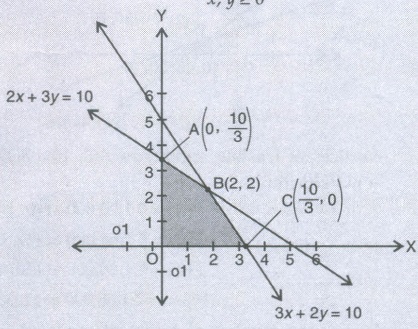
Vertices are
\(A\left( 0,\frac { 10 }{ 3 } \right) ,B(2,2)\quad and\quad C\left( \frac { 10 }{ 3 } ,0 \right) \)
| Points | Z = 24x + 18y |
| \(0,\frac { 10 }{ 3 } \) | z = 0+ 60 = Rs. 60 |
| (2, 2) | z = 48 + 36 = Rs. 84 (Max) |
| \(\left( \frac { 10 }{ 3 } ,0 \right) \) | z = 80 + 0 = Rs. 80 |
Hence, 2 nuts & 2 bolts to be produced to get max. profit of Rs. 84.
10.
Let the manufacturer produces the products A and B be x and y units, respectively.
We construct the following table
\(\begin{array}{c|c|c|c|c} \hline \text { Products } & \begin{array}{c} \text { Produce } \\ \text { (in units) } \end{array} & \begin{array}{c} \text { Time on } \\ \text { Machine I } \\ \text { (in hours) } \end{array} & \begin{array}{c} \text { Time on } \\ \text { Machine II } \\ \text { (in hours) } \end{array} & \begin{array}{c} \text { Profit } \\ \text { (in Rs.) } \end{array} \\ \hline \begin{array}{c} A \\ B \end{array} & \begin{array}{c} x \\ y \end{array} & \begin{array}{c} 3 x \\ 2 y \end{array} & \begin{array}{c} 3 x \\ 7 y \end{array} & \begin{array}{c} 7 x \\ 4 y \end{array} \\ \hline \text { Total } & x+y & 3 x+2 y & 3 x+y & 7 x+4 y \\ \hline \text { Availability } & & 12 & 9 & \\ \hline \end{array}\)
Here, total profit z = 7x + 4y
i.e. maximise Z = 7x + 4y
subject to the constraints
\(3 x+2 y \leq 12\)
\(3 x+y \leq 9\)
and \(x \geq 0, y \geq 0\)
Now, consider the given inequations as equations
\(3 x+2 y=12\) ...(i)
3x + y = 9 ...(ii)
Table for line \(3 x+2 y=12 \text { or } y=\frac{12-3 x}{2}\) is
\(\begin{array}{c|c|c} \hline x & 0 & 4 \\ \hline y & 6 & 0 \\ \hline \end{array}\)
It psses through the points (0, 6) and (4, 0).
On putting (0, 0) in the inequality \(3 x+2 y \leq 12\), we get
\(0+0 \leq 12 \Rightarrow 0 \leq 12\)
So, the half plane is towards the origin.
Table for line 3x + y = 9 or y = 9 - 3x is
\(\begin{array}{c|c|c} \hline x & 0 & 3 \\ \hline y & 9 & 0 \\ \hline \end{array}\)
It passes through the points (0, 9) and (3, 0).
On putting (0, 0) in the inequality \(3 x+y \leq 9\), we get
\(0+0 \leq 9 \Rightarrow 0 \leq 9\)
So, the half plane is towards the origin
Also, \(x \geq 0 \text { and } y \geq 0\) so the region lies in 1st quadrant.
Now, the intersection point oflines (i) and (ii) is
\((3 x+2 y)-(3 x+y)=12-9\)
\(\Rightarrow y=3\)
\(\text { and } \quad 3 x=12-2 \times 3\)
\(\Rightarrow 3 x=12-6\)
\(\Rightarrow x=2\)
Thus, the point of intersection is B (2, 3).
The graph of inequations is shown below
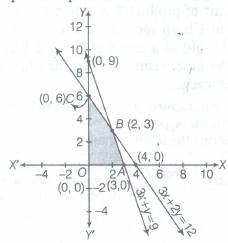
Here, we see that OABC is a required feasible region, whose corner points are 0(0, 0), A(3, 0), B(2,3) and C{0, 6).
The values of Z at these corner points are as follows
\(\begin{array}{c|l} \hline \text { Corner points } & z=7 x+4 y \\ \hline O(0,0) & z=0+0=0 \\ A(3,0) & Z=7 \times 3+0=21 \\ B(2,3) & z=7 \times 2+4 \times 3=26 \text { (maximum) } \\ C(0,6) & Z=7 \times 0+4 \times 6=24 \end{array}\)
Hence, for maximum profit, manufacturer produce 2 units of product A 3 units of product B.

12th Standard CBSE Syllabus & Materials
12th Standard CBSE
CBSE 12th Computer Science Python Revision Tour I - New Previous year Question Papers Study Material - QB365 Set A
NEW12th Standard CBSE
CBSE 12th Business Studies Planning Important Questions And Answers Study Material - QB365 Set A
NEW12th Standard CBSE
CBSE 12th Business Studies Business Environment Important Questions And Answers Study Material - QB365 Set A
NEW12th Standard CBSE
CBSE 12th Business Studies Principles of Management Important Questions And Answers Study Material - QB365 Set A



CBSE 12th Standard CBSE Subjects
CBSE Standards










