
 100% FREE ACCESS
12th Standard CBSE Syllabus & Materials
12th Standard CBSE
CBSE 12th Economics Government Budget and the Economy Previous year Question Papers Study Material - QB365 Set A
NEW12th Standard CBSE
CBSE 12th Computer Science Interface Python with MySQL - New Previous year Question Papers Study Material - QB365 Set A
NEW12th Standard CBSE
CBSE 12th Computer Science Database Concept - New Previous year Question Papers Study Material - QB365 Set A
NEW12th Standard CBSE
CBSE 12th Computer Science Data Communication - New Previous year Question Papers Study Material - QB365 Set A
NEW12th Standard CBSE
CBSE 12th Computer Science Data Structures - New Previous year Question Papers Study Material - QB365 Set A
NEW12th Standard CBSE
CBSE 12th Computer Science Functions - New Previous year Question Papers Study Material - QB365 Set A

Published on: 18/01/2020
Download CBSE Class 12th Standard CBSE Maths question papers, sample papers, important questions, and previous year solved papers in PDF format. Get free study materials, NCERT solutions, and exam preparation resources for Class 12th Standard CBSE Maths
Questions + Answers key
Take MCQ Maths Test
1.
Prove that \(\tan ^{-1}\left(\frac{\sqrt{1+x^{2}}+\sqrt{1-x^{2}}}{\sqrt{1+x^{2}}-\sqrt{1-x^{2}}}\right)=\frac{\pi}{4}+\frac{1}{2} \cos ^{-1} x^{2}\)
2.
If \(\overrightarrow { a } ,\overrightarrow { b } ,\overrightarrow { c } \) are unit vectors such that \(\overrightarrow { a } .\overrightarrow { b } =\overrightarrow { a } .\overrightarrow { c } =0\) and the angle between \(\overrightarrow { b } \) and \(\overrightarrow { c } \) is \(\frac{\pi}{6}\) , then prove that:
(i) \(\overrightarrow { a } =\pm 2\left( \overrightarrow { b } \times \overrightarrow { c } \right) \)
(ii) \(\left[ \overrightarrow { a } +\overrightarrow { b } ,\overrightarrow { b } +\overrightarrow { c } ,\overrightarrow { c } +\overrightarrow { a } \right] =\pm 1\)
3.
Evaluate : \(\int _{ \frac { \pi }{ 6 } }^{ \frac { \pi }{ 3 } }{ \frac { dx }{ 1+\sqrt { \cot { x } } } } \)
4.
Differentiate \(\log(x^{sin x}+\cot ^{2}x)\) w.r.t x
5.
Determine the product \(\left[ \begin{matrix} -4 & 4 & 4 \\ -7 & 1 & 3 \\ 5 & -3 & -1 \end{matrix} \right] \left[ \begin{matrix} 1 & -1 & 1 \\ 1 & -2 & -2 \\ 2 & 1 & 3 \end{matrix} \right] ,\) and use it to solve the system of equations: x - y + z = 4, x - 2y - 2z = 9, 2x + y + 3z = 1.
6.
Find the area of the greatest rectangle that can be inscribed in an ellipse \(\frac{x^2}{a^2}+\frac{y^2}{b^2}=1\)
7.
There are three coins. First is a biased that comes up tails 60% of the times, second is also a biased coin that comes up heads 75% of the times and third is an unbiased coin. One of the three coins is chosen at random and tossed, it shows heads, what is the probability that it was the first coin?
8.
Let * be a binary operation defined on Q x Q by (a, b) * (c, d) = (ac, b + ad). where Q is the set of rational numbers. Determine, whether * is commutative and associative. Find the identity element for * and the invertible elements of Q x Q.
9.
Prove that: \(2ta{ n }^{ -1 }\left( \frac { 1 }{ 2 } \right) +{ tan }^{ -1 }\left( \frac { 1 }{ 7 } \right) ={ sin }^{ -1 }\left( \frac { 31 }{ 25\sqrt { 2 } } \right) \)
10.
If \(A=\left[ \begin{matrix} 1 & 1 & 1 \\ 1 & 1 & 1 \\ 1 & 1 & 1 \end{matrix} \right] \) then prove that \({ A }^{ n }=\left[ \begin{matrix} { 3 }^{ n-1 } & { 3 }^{ n-1 } & { 3 }^{ n-1 } \\ { 3 }^{ n-1 } & { 3 }^{ n-1 } & { 3 }^{ n-1 } \\ { 3 }^{ n-1 } & { 3 }^{ n-1 } & { 3 }^{ n-1 } \end{matrix} \right] ,\) then \(n\epsilon N\).
11.
Find X and Y, if X + Y =\(\begin{bmatrix} 5 & 2 \\ 0 & 9 \end{bmatrix}\) and X - Y =\(\begin{bmatrix} 3 & 6 \\ 0 & -1 \end{bmatrix}\)
12.
Find the particular solution of the differential equation x (1 + y2) dx - y (1 + x2)dy = 0, given that y = 1, when x = 0.
13.
Draw the graph of the following LLP:\(3x+y\le 17,x,y\ge 0\)
14.
Find a particular solution of the differential equation : \(\left( x+1 \right) \frac { dy }{ dx } =2{ e }^{ -y }-1\) given that \(y=0,\)when x = 0
15.
Show that \(A-A\prime \) is skew-symmetric when \(A=\begin{bmatrix} 1 & 4 \\ 3 & 7 \end{bmatrix}.\)
16.
Choose the correct answer:
Area lying between the curves y2 = 4x and y = 2x is :
(A) \(\frac { 2 }{ 3 } \)
(B) \(\frac { 1 }{ 3 } \)
(C) \(\frac { 1 }{ 4 } \)
(D) \(\frac { 3 }{ 4 } \)
17.
Solve the system of linear equations, using matrix method in
4x-3y = 3
3x-5y = 7
18.
Find \(\frac { dy }{ dx }\) , if \(x=a\ cos\theta ,\ y=a\ sin\theta \)
19.
Show that :
\({ sin }^{ -1 }\frac { 3 }{ 5 } -{ sin }^{ -1 }\frac { 8 }{ 17 } ={ cos }^{ -1 }\frac { 84 }{ 85 } \)
20.
Find the vector and Cartesian equations of the line passing through the point P (1,2,3) and parallel to the planes \(\vec { r } .(\hat { i } -\hat { j } +2\hat { k } )=5\) and \(\vec { r } .(3\hat { i } +\hat { j } +\hat { k } )=6\).
21.
A letter is known to have come either from TATANAGAR or from CALCUTTA. On the envelope just two consecutive letters TA are visible. What is the probability that the letters came from TATANAGAR?
22.
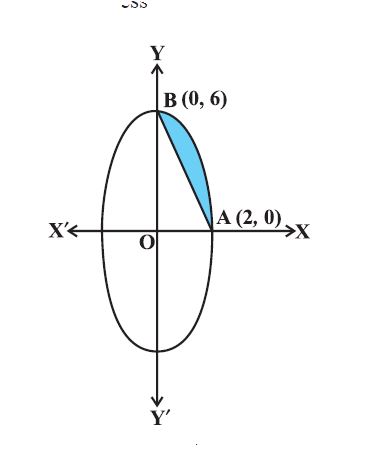
AOBA is a part of the ellipse 9x2 + y2 = 36 in the first quadrant, such that OA = 2 and OB = 6. Find the area between the arc AB and the chord AB. A and B are points on the x-axis and the y-axis respectively.
23.
Evaluate the integral: \(\int{\sqrt {1+x^2}\over x}dx.\)
24.
If ey (x+1) = 1, show that dy/dx = -ey
25.
Find the distance between the point (5, ,4, - 6) and its image in xy-plane.
26.
Find the projection of \(\overset\rightarrow a+\overset\rightarrow b\) on \(\overset\rightarrow a-\overset\rightarrow b,\)\(\overset\rightarrow a=i+2j+k,\overset\rightarrow b=3\overset\wedge i+\overset\wedge j-\overset\wedge k\).
27.
A couple has 2 children. Find the probability that both are boys, if it is known that (a) one of them is a boy (b) the older child is boys.
28.
Find the general solution of differential equation \(\log { \left( \frac { dy }{ dx } \right) } =x+1\)
29.
Let f and g be real valued functions defined as \(f(x)=x^{ 2 }+1,x\in R\)and g(x) = 2x + 1, \(x\in R\) Find the value of fog and gof
30.
\(\int { \frac { dx }{ 1+sinx } } \)
31.
Show that : \({ tan }^{ -1 }\left( \frac { 3a^{ 2 }x-{ x }^{ 3 } }{ { a }^{ 3 }-3a{ x }^{ 2 } } \right) =3tan^{ -1 }\left( \frac { x }{ a } \right) \)
32.
If \(A=\left| \begin{matrix} 6 & 0 & 1 \\ 0 & 1 & 2 \\ 0 & 0 & 4 \end{matrix} \right| \), then show that |2A| = 8|A|:
33.
Distance between the two planes: 2x + 3y + 4z = 4 and 4x + 6y + 8z = 12 is
2 units
4 units
8 units
\(\frac{2}{\sqrt{29}}\)
34.
The area bounded by the curve y = x |x| , x-axis and the ordinates x = – 1 and x = 1 is given by
0
\(\frac13\)
\(\frac23\)
\(\frac43\)
35.
If the curves ay + x2 = 7 and x3 = y cut orthogonally at (1,1), then the value of a is
1
0
-6
6
36.
Given set A ={1, 2, 3} and a relation R = {(1, 2), (2, 1)}, the relation R will be
reflexive if (1, 1) is added
symmetric if (2, 3) is added
transitive if (1, 1) is added
symmetric if (3, 2) is added
1.
\(\mathrm{LHS}=\tan ^{-1}\left(\frac{\sqrt{1+x^{2}}+\sqrt{1-x^{2}}}{\sqrt{1+x^{2}}-\sqrt{1-x^{2}}}\right) \)
\(\text { Put } x^{2}=\cos 2 \theta, \text { then } \)
\(\mathrm{LHS}=\tan ^{-1}\left(\frac{\sqrt{1+\cos 2 \theta}+\sqrt{1-\cos 2 \theta}}{\sqrt{1+\cos 2 \theta}-\sqrt{1-\cos 2 \theta}}\right)\)
\( \tan ^{-1}\left(\frac{\sqrt{2} \cos \theta+\sqrt{2} \sin \theta}{\sqrt{2} \cos \theta-\sqrt{2} \sin \theta}\right)\)
\(\tan ^{-1}\left(\frac{\cos \theta+\sin \theta}{\cos \theta-\sin \theta}\right)=\tan ^{-1}\left(\frac{1+\tan \theta}{1-\tan \theta}\right)\)
[divide numerator and denominator inside the bracket by \(cos \theta]\)
2.
As given \(\overrightarrow { a } .\overrightarrow { b } =\overrightarrow { a } .\overrightarrow { c } =0=\overrightarrow { a } \bot \)both \(\overrightarrow { b } \) and \(\overrightarrow { c } \)
⇒ \(\overrightarrow { a } \parallel \left( \overrightarrow { b } \times \overrightarrow { c } \right) \)
Let \(\overrightarrow { a } =\lambda \left( \overrightarrow { b } \times \overrightarrow { c } \right) \)
then \(\left| \overrightarrow { a } \right| =\left| \lambda \right| \left| \left( \overrightarrow { b } \times \overrightarrow { c } \right) \right| \)
⇒ \(\frac { \left| \overrightarrow { a } \right| }{ \left| \left( \overrightarrow { b } \times \overrightarrow { c } \right) \right| } =\left| \lambda \right| \)
⇒ \(\left| \lambda \right| =\frac { 1 }{ sin\frac { \pi }{ 6 } } =2\)
λ = 士2
\(\overrightarrow { a } =\pm 2\left( \overrightarrow { b } \times \overrightarrow { c } \right) \)
Hence proved
(ii) Now \(\left[ \overrightarrow { a } +\overrightarrow { b } ,\overrightarrow { b } +\overrightarrow { c } ,\overrightarrow { c } +\overrightarrow { a } \right] \)
= \(\left[ \left( \overrightarrow { a } +\overrightarrow { b } \right) \times \left( \overrightarrow { b } \times \overrightarrow { c } \right) \right] .\left( \overrightarrow { c } +\overrightarrow { a } \right) \)
= \(\left( \overrightarrow { a } \times \overrightarrow { b } \right) .\overrightarrow { c } +\left( \overrightarrow { b } \times \overrightarrow { c } \right) .\overrightarrow { a } \)
(As the scalar triple product = 0, if any two vectors are equal)
Hence, \(\overrightarrow { a } .\left( \overrightarrow { b } \times \overrightarrow { c } \right) +\left( \overrightarrow { a } \times \overrightarrow { b } \right) .\overrightarrow { c } \) = \(\overrightarrow { a } .\left( \overrightarrow { b } \times \overrightarrow { c } \right) +\overrightarrow { c } \left( \overrightarrow { b } \times \overrightarrow { c } \right) \)
= 2\(\overrightarrow { a } \left( \overrightarrow { b } \times \overrightarrow { c } \right) \)
= \(2\overrightarrow { a } \left( \pm \frac { 1 }{ 2 } \overrightarrow { a } \right) \)
= 士1
Hence proved
3.
\(I=\int _{ \frac { \pi }{ 6 } }^{ \frac { \pi }{ 3 } }{ \frac { dx }{ 1+\sqrt { \cot { x } } } } \)
\(=\int _{ \frac { \pi }{ 6 } }^{ \frac { \pi }{ 3 } }{ \frac { \sqrt { \sin { x } } }{ \sqrt { \sin { x } } +\sqrt { \cos { x } } } } dx\)
Apply property \(\int _{ a }^{ b }{ f\left( x \right) } =\int _{ a }^{ b }{ f\left( a+b-x \right) } \)
\(=\int _{ \frac { \pi }{ 6 } }^{ \frac { \pi }{ 3 } }{ \frac { \sqrt { \sin { \frac { \pi }{ 3 } +\frac { \pi }{ 6 } -x } } }{ \sqrt { \sin { \frac { \pi }{ 3 } +\frac { \pi }{ 6 } -x } } +\sqrt { \cos { \frac { \pi }{ 3 } +\frac { \pi }{ 6 } -x } } } } dx\)
\(\therefore I=\int _{ \frac { \pi }{ 6 } }^{ \frac { \pi }{ 3 } }{ \frac { \sqrt { \cos { x } } }{ \sqrt { \cos { x } } +\sqrt { \sin { x } } } } dx\)
Adding, we get \(2I=\int _{ \frac { \pi }{ 6 } }^{ \frac { \pi }{ 3 } }{ dx } =\left[ x \right] _{ \frac { \pi }{ 6 } }^{ \frac { \pi }{ 3 } }\)
4.
\(\frac{dy}{dx}=\frac{1}{x^{ \sin x }+cot^{ 2 }x}\frac{d}{dx}(x^{ \sin x}+\cot^{ 2 }x)\)
Let \(u=x^{\sin x}and v=\cot^{2}x\)
\(\frac{dv}{dx}=2\cot x[-cosec^{2}x]\)
\(\therefore \log u=\sin x.\log x\)
\(\frac{1}{u}\frac{du}{dx}=\frac{\sin x}{x}+\log x.\cos x\)
\(\Rightarrow \frac{du}{dx}=x^{\sin x}[\frac{\sin x}{x}+\cos x\log x]\)
\(\therefore \frac{dy}{dx}=\frac{1}{x^{\sin x}+\cot^{2}x}[x^{\sin x}(\frac{\sin x}{x}+\cos x\log x)-2\cot xcosec^{2}x]\)
5.
\(\left[ \begin{matrix} -4 & 4 & 4 \\ -7 & 1 & 3 \\ 5 & -3 & -1 \end{matrix} \right] \left[ \begin{matrix} 1 & -1 & 1 \\ 1 & -2 & -2 \\ 2 & 1 & 3 \end{matrix} \right] \)
\(=\left[ \begin{matrix} -4+4+8 & 4-8+4 & -4-8+12 \\ -7+1+6 & 7-2+3 & -7-2+9 \\ 5-3-2 & -5+6-1 & 5+6-3 \end{matrix} \right] \)
\(=\left[ \begin{matrix} 8 & 0 & 0 \\ 0 & 8 & 0 \\ 0 & 0 & 8 \end{matrix} \right] =8I\)
where I is the identity matrix
Let \(A=\left[ \begin{matrix} -4 & 4 & 4 \\ -7 & 1 & 3 \\ 5 & -3 & -1 \end{matrix} \right] \)
and \(B=\left[ \begin{matrix} 1 & -1 & 1 \\ 1 & -2 & -2 \\ 2 & 1 & 3 \end{matrix} \right] \)
\(\Rightarrow AB=8I\)
Post Multiplyingbith sides by B -1, we get
\(AB{ B }^{ -1 }=8I{ B }^{ -1 }\)
\(\Rightarrow A=8{ B }^{ -1 }\)
\(\Rightarrow { B }^{ -1 }=\frac { A }{ 8 } \)
Given Equations are:
x - y + z = 4
x - 2y - 2z = 9
and 2x + y + 3z = 1
\(\left[ \begin{matrix} 1 & -1 & 1 \\ 1 & -2 & -2 \\ 2 & 1 & 3 \end{matrix} \right] \left[ \begin{matrix} x \\ y \\ z \end{matrix} \right] =\left[ \begin{matrix} 4 \\ 9 \\ 1 \end{matrix} \right] \)
\(\Rightarrow BX=C\)
where \(X=\left[ \begin{matrix} x \\ y \\ z \end{matrix} \right] \ and\ C=\left[ \begin{matrix} 4 \\ 9 \\ 1 \end{matrix} \right] \)
\(\Rightarrow X={ B }^{ -1 }C\)
Using \({ B }^{ -1 }=\frac { A }{ 8 } \)
\(\Rightarrow X=\frac { A }{ 8 } C\)
\(=\frac { 1 }{ 8 } \left[ \begin{matrix} -4 & 4 & 4 \\ -7 & 1 & 3 \\ 5 & -3 & -1 \end{matrix} \right] \left[ \begin{matrix} 4 \\ 9 \\ 1 \end{matrix} \right] \)
\(=\frac { 1 }{ 8 } \left[ \begin{matrix} -16+36+4 \\ -28+9+3 \\ 20-27-1 \end{matrix} \right] \)
\(=\frac { 1 }{ 8 } \left[ \begin{matrix} 24 \\ -16 \\ -8 \end{matrix} \right] =\left[ \begin{matrix} 3 \\ -2 \\ -1 \end{matrix} \right] \)
(x, y, z) = (3, -2, -1)
6.
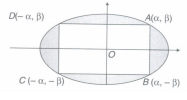
Let ABCD be a rectangle having area A inscribed in an ellipse \(\frac{x^2}{a^2}+\frac{y^2}{b^2}=1\)
Let the co-ordinate of A be \((\alpha, \beta)\)
ஃ Coordinate of \(B\equiv(\alpha,- \beta)\)
\(C\equiv(-\alpha,- \beta)\)
\(D\equiv(-\alpha, \beta)\)
Now A = Length x Breadth
\(=2\alpha\times 2\beta\)
\(\Rightarrow A=4\alpha\beta\)
\(\Rightarrow A=4\alpha\sqrt{b^2(1-\frac{\alpha^2}{a^2})}\)
\(\Rightarrow A^2=16a^2\{{b^2(1-\frac{\alpha^2}{a^2})}\}\)
\(\Rightarrow A^2=\frac{16b^2}{a^2}(a^2\alpha^2-\alpha^4)\)
\(\Rightarrow \frac{d(A^2)}{d\alpha}=\) \(\frac{16b^2}{a^2}(2a^2\alpha^2-4\alpha^3)\)
For maximum or minimum value
\(\frac{d(A^2)}{d\alpha}=0\)
\(\Rightarrow 2a^2\alpha-4\alpha^3=0\)
\(\Rightarrow 2\alpha(a^2-2\alpha^3)=0\)
\(\Rightarrow \alpha=0, \ \ a=\frac{a}{\sqrt2}\)
Again \(\Rightarrow\frac{d(A^2)}{d\alpha}=\)\(\frac{16b^2}{a^2}(2a^2-12\alpha^2)\)
⇒ For \(\alpha=\frac{a}{\sqrt2}\) A is maximum.
i.e., for greatest area A \(\alpha=\frac{a}{\sqrt2}\) and \(\beta=\frac{b}{\sqrt2}\)
ஃ Greatest are a = \(4\alpha\cdot\beta=4\frac{a}{\sqrt2}\times\frac{b}{\sqrt2}=2ab\)
7.
Let the events be:
E1 = Choosing 1st coin
E2 = Choosing 2nd coin
E3 = Choosing 3rd coin
A: Getting Heads
\(P({ E }_{ 1 })=P({ E }_{ 2 })=P(E_{ 3 })=\frac { 1 }{ 3 } \)
\(P(A/{ E }_{ 1 })=\frac { 40 }{ 100 } ,P(A/{ E }_{ 2 })=\frac { 75 }{ 100 } ,\)
\(P(A/{ E }_{ 3 })=\frac { 1 }{ 2 } \)
\(P({ E }_{ 1 }/A)\)
\(=\frac { P({ E }_{ 1 })P(A/{ E }_{ 1 }) }{ P({ E }_{ 1 })P(A/{ E }_{ 1 })+P({ E }_{ 2 })P(A/{ E }_{ 2 })+P({ E }_{ 3 })P(A/{ E }_{ 3 }) } \)
\(=\frac { \frac { 1 }{ 3 } .\frac { 40 }{ 100 } }{ \frac { 1 }{ 3 } .\frac { 40 }{ 100 } +\frac { 1 }{ 3 } .\frac { 75 }{ 100 } +\frac { 1 }{ 3 } .\frac { 1 }{ 2 } } =\frac { 8 }{ 33 } \)
8.
Let (a, b), (c, d) E Q x Q. Then b + ad may not be mequal to d + cd. We find that (1, 2) * (2, 3) = (2, 5), (2,3) * (1,2) = (2,7) '*(2, 5) Hence, * is not commutative.
Let, (a, b), (c, d), (e,f> E Q x Q, {(a, b) * (c, d) * (e,f)
= (ace, b + ad + acf)
= (a, b) * {(c, d) * (e, f)
Hence * is associative. 1
(x, y) Q x Q is the identity element for * if 2
(x, y) Q x Q is the inverse of (a, b) E Q x Q if (c, d) * (a, b) = (a, b) * (c, d) = (1,0),
i.e., (ac, b + ad) = (ca, d + cb) = (1,0)
\(\Rightarrow c=\frac { 1 }{ a } ,d=\frac { -b }{ a } \)
The inverse of (a,b) \(\in Q\) XQ \(a\neq 0\quad \left( \frac { 1 }{ a } ,\frac { -b }{ a } \right) \)
9.
\(LHS=2{ tan }^{ -1 }\left( \frac { 1 }{ 2 } \right) +{ tan }^{ -1 }\left( \frac { 1 }{ 7 } \right) \)
\(={ tan }^{ -1 }\frac { 2\times \frac { 1 }{ 2 } }{ 1-\frac { 1 }{ 4 } } +tan^{ -1 }\frac { 1 }{ 7 } \)
\(={ tan }^{ -1 }\left( \frac { 4 }{ 3 } \right) +{ tan }^{ -1 }\left( \frac { 1 }{ 7 } \right) \)
\(={ tan }^{ -1 }\frac { \frac { 4 }{ 3 } +\frac { 1 }{ 7 } }{ 1-\frac { 4 }{ 3 } .\frac { 1 }{ 7 } } \)
\(={ tan }^{ -1 }\frac { 31 }{ 17 } \)
Using the above triangle, we get
\({ tan }^{ -1 }\frac { 31 }{ 17 } ={ sin }^{ -1 }\left( \frac { 31 }{ 25\sqrt { 2 } } \right) \)
=RHS
Hence LHS = RHS
10.
We shall prove the result by using principle of mathematical induction.
Let \(P\left( n \right) { :A }^{ n }=\left[ \begin{matrix} { 3 }^{ n-1 } & { 3 }^{ n-1 } & { 3 }^{ n-1 } \\ { 3 }^{ n-1 } & { 3 }^{ n-1 } & { 3 }^{ n-1 } \\ { 3 }^{ n-1 } & { 3 }^{ n-1 } & { 3 }^{ n-1 } \end{matrix} \right] \)
Now, \(P\left( 1 \right) { :A }^{ 1 }=\left[ \begin{matrix} { 3 }^{ 0 } & { 3 }^{ 0 } & { 3 }^{ 0 } \\ { 3 }^{ 0 } & { 3 }^{ 0 } & { 3 }^{ 0 } \\ { 3 }^{ 0 } & { 3 }^{ 0 } & { 3 }^{ 0 } \end{matrix} \right] =\left[ \begin{matrix} 1 & 1 & 1 \\ 1 & 1 & 1 \\ 1 & 1 & 1 \end{matrix} \right] \)
The result is true for n = 1.
Let the result be true for n = k.
So, \({ A }^{ k }=\left[ \begin{matrix} { 3 }^{ k-1 } & { 3 }^{ k-1 } & { 3 }^{ k-1 } \\ { 3 }^{ k-1 } & { 3 }^{ k-1 } & { 3 }^{ k-1 } \\ { 3 }^{ k-1 } & { 3 }^{ k-1 } & { 3 }^{ k-1 } \end{matrix} \right] \)
Now, we prove that P(k + 1) is true.
Now, Ak+1 = A. Ak
\(=\left[ \begin{matrix} 1 & 1 & 1 \\ 1 & 1 & 1 \\ 1 & 1 & 1 \end{matrix} \right] \left[ \begin{matrix} { 3 }^{ k-1 } & { 3 }^{ k-1 } & { 3 }^{ k-1 } \\ { 3 }^{ k-1 } & { 3 }^{ k-1 } & { 3 }^{ k-1 } \\ { 3 }^{ k-1 } & { 3 }^{ k-1 } & { 3 }^{ k-1 } \end{matrix} \right] \)
\(=\left[ \begin{matrix} { 3.3 }^{ k-1 } & { 3.3 }^{ k-1 } & { 3.3 }^{ k-1 } \\ { 3.3 }^{ k-1 } & { 3.3 }^{ k-1 } & { 3.3 }^{ k-1 } \\ { 3.3 }^{ k-1 } & { 3.3 }^{ k-1 } & { 3.3 }^{ k-1 } \end{matrix} \right] \)
\(=\left[ \begin{matrix} { 3 }^{ k } & { 3 }^{ k } & { 3 }^{ k } \\ { 3 }^{ k } & { 3 }^{ k } & { 3 }^{ k } \\ { 3 }^{ k } & { 3 }^{ k } & { 3 }^{ k } \end{matrix} \right] \)
= Ak+1
Hence, it is true n = k + 1.
Hence, by principle of mathematical induction P(n) is true for all \(n\epsilon N\)
11.
We have: \((\mathrm{X}+\mathrm{Y})+(\mathrm{X}-\mathrm{Y}) =\left[\begin{array}{ll}
5 & 2 \\
0 & 9
\end{array}\right]+\left[\begin{array}{cc}
3 & 6 \\
0 & -1
\end{array}\right] \)
or \((\mathrm{X}+\mathrm{X})+(\mathrm{Y}-\mathrm{Y}) =\left[\begin{array}{ll}
8 & 8 \\
0 & 8
\end{array}\right] \Rightarrow 2 \mathrm{X}=\left[\begin{array}{ll}
8 & 8 \\
0 & 8
\end{array}\right] \)
or \(\mathrm{X} =\frac{1}{2}\left[\begin{array}{ll}
8 & 8 \\
0 & 8
\end{array}\right]=\left[\begin{array}{ll}
4 & 4 \\
0 & 4
\end{array}\right] \)
Also \((\mathrm{X}+\mathrm{Y})-(\mathrm{X}-\mathrm{Y}) =\left[\begin{array}{ll}
5 & 2 \\
0 & 9
\end{array}\right]-\left[\begin{array}{rr}
3 & 6 \\
0 & -1
\end{array}\right] \)
or \((\mathrm{X}-\mathrm{X})+(\mathrm{Y}+\mathrm{Y}) =\left[\begin{array}{cc}
5-3 & 2-6 \\
0 & 9+1
\end{array}\right] \Rightarrow 2 \mathrm{Y}=\left[\begin{array}{ll}
2 & -4 \\
0 & 10
\end{array}\right] \)
or \(\mathrm{Y} =\frac{1}{2}\left[\begin{array}{rr}
2 & -4 \\
0 & 10
\end{array}\right]=\left[\begin{array}{rr}
1 & -2 \\
0 & 5
\end{array}\right]
\)
12.
Given, differential equation is (x(1 + y2) dx - y(1 + x2) dy = 0
\(\Rightarrow\) x(1 + y2)dx = y(1 + x2) dy
On separating the variables, we get
\(\frac{y}{\left(1+y^2\right)} d y=\frac{x}{\left(1+x^2\right)} d x\)
On integrating both sides, we get
\(\begin{aligned}
\int \frac{y}{1+y^2} d y & =\int \frac{x}{\left(1+x^2\right)} d x
\end{aligned}\)
\(\begin{aligned}
\Rightarrow \quad \frac{1}{2} \log \left|1+y^2\right| & =\frac{1}{2} \log \left|1+x^2\right|+C
\end{aligned}\) ...(i)
\(\left[\begin{array}{l}
\text { put } 1+y^2=u \Rightarrow 2 y d y=d u \\
\text { then } \int \frac{y}{1+y^2} d y=\int \frac{1}{2 u} d u=\frac{1}{2} \log |u| \\
\text { and put } 1+x^2=v \Rightarrow 2 x d x=d v \\
\text { then } \int \frac{x}{1+x^2} d x=\frac{1}{2} \int \frac{1}{v} d v=\frac{1}{2} \log |v|
\end{array}\right]\)
Also, given that y = 1, when x = 0.
On substituting the values of x and y in Eq. (i), we get
\(\begin{aligned}
\quad \frac{1}{2} \log \left|1+(1)^2\right| & =\frac{1}{2} \log \left|1+(0)^2\right|+C \\
\end{aligned}\)
\(\begin{aligned}
\Rightarrow \quad \frac{1}{2} \log 2 & =C
\end{aligned}\) [\(\because\) log 1 = 0]
On putting C = \(\frac{1}{2}\) log 2 in Eq. (i), we get
\(\begin{array}{cc}
& \frac{1}{2} \log \left|1+y^2\right|=\frac{1}{2} \log \left|1+x^2\right|+\frac{1}{2} \log 2
\end{array}\)
\(\begin{array}{cc}
\Rightarrow & \log \left|1+y^2\right|=\log \left|1+x^2\right|+\log 2 \\
\end{array}\)
\(\begin{array}{cc}
\Rightarrow & \log \left|1+y^2\right|-\log \left|1+x^2\right|=\log 2 \\
\end{array}\)
\(\begin{array}{cc}
\Rightarrow & \log \left|\frac{1+y^2}{1+x^2}\right|=\log 2
\end{array}\)
\(\begin{aligned}
{\left[\because \log m-\log n=\log \frac{m}{n}\right] }
\end{aligned}\)
\(\begin{aligned}
\Rightarrow \quad & \frac{1+y^2}{1+x^2}=2 \Rightarrow 1+y^2=2+2 x^2
\end{aligned}\)
\(\Rightarrow\) y2 - 2x2 -1 = 0
which is the required particular solution of given differential equation.
13.
200 at (50,0)
14.
The given equation is:
\(\left( x+y \right) \frac { dy }{ dx } =2{ e }^{ -y }-1\)
\(\Rightarrow\) \(\frac { dy }{ 2{ e }^{ -y }-1 } =\frac { dx }{ x+1 } \)
Variables Separable
Integrating, \(\int { \frac { dy }{ 2{ e }^{ -y }-1 } } =\int { \frac { dx }{ x+1 } +C } \)
\(\Rightarrow\) \(\int { \frac { dy }{ 2{ e }^{ -y }-1 } =log|x+1|+C } \) .(1)
Now \(I=\int { \frac { dy }{ 2{ e }^{ -y }-1 } } =\int { \frac { { e }^{ y } }{ 2-{ e }^{ y } } } dy\)
Put \({ e }^{ y }=t\) so that \({ e }^{ y }\quad dy=dt.\)
\(\therefore\) \(I=\int { \frac { dt }{ 2-t } =- } log|2-t|=-log|2-{ e }^{ y }|.\)
From(1), \(-log2-{ e }^{ y }|=log|x+1|+C\)...(2)
When \(x=0,y=0,\)
\(\therefore\) \(log|2-1|=log|0+1|+C\)
\(\Rightarrow\) \(log|1|=log|1|+C\)
\(\Rightarrow\) \(0=0+C\Rightarrow C=0.\)
Putting in (2), \(-log|2-{ e }^{ y }|=log|x+1|\)
\(\Rightarrow\) \(log|2-{ e }^{ y }|=log|\frac { 1 }{ x+1 } |\)
\(\Rightarrow\) \(2-{ e }^{ y }=\frac { 1 }{ x+1 } \)
\(\Rightarrow\) \({ e }^{ y }=2-\frac { 1 }{ x+1 } =\frac { 2x+1 }{ x+1 } \)
\(\Rightarrow\) \(y=log|\frac { 2x+1 }{ x+1 } |,x\neq -1.\)
Which is the requored solution.
15.
We have: \(A=\begin{bmatrix} 1 & 4 \\ 3 & 7 \end{bmatrix}.\)
\(\therefore\ A\prime =\begin{bmatrix} 1 & 3 \\ 4 & 7 \end{bmatrix}\)
\( \therefore \ A-A\prime =\begin{bmatrix} 1 & 4 \\ 3 & 7 \end{bmatrix}+\begin{bmatrix} 1 & 3 \\ 4 & 7 \end{bmatrix}\)
\(=\begin{bmatrix} 1 & 4 \\ 3 & 7 \end{bmatrix}+\begin{bmatrix} -1 & -3 \\ -4 & -7 \end{bmatrix}\)
\(=\begin{bmatrix} 1-1 & 4-3 \\ 3-4 & 7-7 \end{bmatrix}=\begin{bmatrix} 0 & 1 \\ -1 & 0 \end{bmatrix} ...(1)\)
Now \((A-A\prime )\prime =\begin{bmatrix} 0 & -1 \\ 1 & 0 \end{bmatrix}=-\begin{bmatrix} 0 & 1 \\ -1 & 0 \end{bmatrix}\)
Hence, \(A-A\prime \) is skew-symmetric matrix.
16.
Part (B) is the correct answer.
Reason: The parabola y2 = 4x
intersects the line y = 2x
at. O(0,0) and A (1,2)
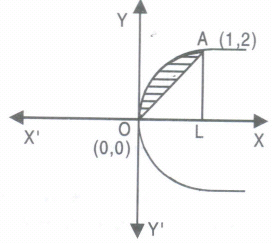
\(\therefore \ Reqd.area=\overset { 1 }{ \underset { 0 }{ \int { } } } \sqrt { 4x } dx-\overset { 1 }{ \underset { 0 }{ \int { } } } (2x)dx\)
\(=2\left[ \frac { { x }^{ \frac { 3 }{ 2 } } }{ \frac { 3 }{ 2 } } \right] _{ 0 }^{ 1 }-2\left[ \frac { { x }^{ 2 } }{ 2 } \right] _{ 0 }^{ 1 }\)
\(=\frac { 4 }{ 3 } [1-0]-\frac { 2 }{ 2 } [1-0]=\frac { 4 }{ 3 } -1\)
\(=\frac { 1 }{ 3 } sq.unit.\)
17.
the given system of equations is:
4x-3y = 3
3x-5y = 7
These can be written as AX = B
\(\Rightarrow\) X = A-1B ...(1)
where \(A\begin{bmatrix} 4&-3\\3&-5\end{bmatrix}, X=\begin{bmatrix} x\\y\end{bmatrix}\ and\ B=\begin{bmatrix} 3\\7\end{bmatrix}\)
\(\therefore\ |A|=\begin{bmatrix} 4&-3\\3&-5\end{bmatrix}=-20+9=-11\neq0\)
\(\Rightarrow A^{-1}\) exists
Now \(adj\ A=\begin{bmatrix}-5&-3\\3&4 \end{bmatrix}'=\begin{bmatrix}-5&3\\-3&4 \end{bmatrix}\)
\(\therefore\ A^{-1}={1\over|A|}(adj\ A)={1\over-11}\begin{bmatrix}-5&3\\-3&4 \end{bmatrix}\)
From (1), \(X={1\over-11}\begin{bmatrix} -5&3\\-3&4\end{bmatrix}\begin{bmatrix} 3\\7\end{bmatrix}\)
\(={1\over-11}\begin{bmatrix}-15+21\\-9+28 \end{bmatrix}={1\over-11}\begin{bmatrix}6\\19 \end{bmatrix}\)
\(\Rightarrow\begin{bmatrix}x\\y \end{bmatrix}=\begin{bmatrix}-6/11\\-19/11 \end{bmatrix}\)
Hence, \(x={-6\over11}, y={-19\over11}\)
18.
Given that
\(x=a\ cos\theta ,\ y=a\ sin\theta \)
\(\frac { dx }{ d\theta } =-a\ sin\theta \ and\ \frac { dy }{ d\theta } =a\ cos\theta \)
\(Hence,\ \frac { dy }{ dx } =\frac { { dy }/{ d\theta } }{ { dx }/{ d\theta } } =\frac { a\ cos\theta }{ -a\ sin\theta } =-cot\theta \)
19.
\(\text {Let } \sin ^{-1} \frac{3}{5}=x \text { and } \sin ^{-1} \frac{8}{17}=y\)
\( \sin x=\frac{3}{5} \text { and } \sin y=\frac{8}{17}\)
\(\text {Now }\cos x=\sqrt{1-\sin ^{2} x}=\sqrt{1-\frac{9}{25}}=\frac{4}{5}\)
\(\text {and }\cos y=\sqrt{1-\sin ^{2} y}=\sqrt{1-\frac{64}{289}}=\frac{15}{17}\)
We have cos(x−y) = cos x cos y + sin x siny
\(=\frac{4}{5} \times \frac{15}{17}+\frac{3}{5} \times \frac{8}{17}=\frac{84}{85}\)
\( x-y=\cos ^{-1} \frac{84}{85}\)
\(\text {Hence } \ \sin ^{-1} \frac{3}{5}-\sin ^{-1} \frac{8}{17}=\cos ^{-1} \frac{84}{85}\)
20.
line is \(\vec { r } .(\hat { i } -2\hat { j } +3\hat { k } )+\lambda (-3\hat { i } +5\hat { j } +4\hat { k } )\)
In Cartesian from : \(\frac { x-1 }{ -3 } =\frac { y-2 }{ 5 } =\frac { z-3 }{ 4 } \)
21.
Let EI = Letter has come from CALCUITA
E2 = Letter has come from TATANAGAR
and E = Two consecutive letters (i.e. alphabets) TA are visible on envelope
\(\therefore P\left(E_{1}\right)=\frac{1}{2}, P\left(E_{2}\right)=\frac{1}{2}, P\left(\frac{E}{E_{1}}\right)=\frac{n\left(E \cap E_{1}\right)}{n\left(E_{1}\right)}=\frac{1}{7}\)
[\(\therefore\) pairs of consecutive letters are CA, AL, LC, CU, UT, TT, TA]
and \(P\left(\frac{E}{E_{2}}\right)=\frac{n\left(E \cap E_{2}\right)}{n\left(E_{2}\right)}=\frac{2}{8}\)
[\(\therefore\)8 pairs of consecutive letters are TA, AT, TA;AN, NA, AG, GA, AR]
\(\therefore P\left(\frac{E_{2}}{E}\right)=\frac{P\left(E_{2}\right) \cdot P\left(\frac{E}{E_{2}}\right)}{P\left(E_{1}\right) \cdot P\left(\frac{E}{E_{1}}\right)+P\left(E_{2}\right) \cdot P\left(\frac{E}{E_{2}}\right)}\)
[using Baye's theorem]
\(=\frac{\frac{1}{2} \times \frac{2}{8}}{\frac{1}{2} \times \frac{1}{7}+\frac{1}{2} \times \frac{2}{8}}=\frac{\frac{2}{16}}{\frac{8+14}{2 \times 7 \times 8}}=\frac{2 \times 7}{22}=\frac{7}{11}\)
Hence, the probability that the letter TA came from TATANAGAR is \(\frac{7}{11}\).
22.
Given equation of ellipse is \(9 x^{2}+y^{2}=36\) which can be expressed as \(\frac{x^{2}}{4}+\frac{y^{2}}{36}=1 \text { or } \frac{x^{2}}{2^{2}}+\frac{y^{2}}{6^{2}}=1\) and hence, its shape
\(y-0=\frac{6-0}{0-2}(x-2)\)
or y = – 3(x – 2)
or y = – 3x + 6
Area of the shaded region
\(=3 \int_{0}^{2} \sqrt{4-x^{2}} d x-\int_{0}^{2}(6-3 x) d x\)
\(=3\left[\frac{x}{2} \sqrt{4-x^{2}}+\frac{4}{2} \sin ^{-1} \frac{x}{2}\right]_{0}^{2}-\left[6 x-\frac{3 x^{2}}{2}\right]_{0}^{2}\)
\(=3\left[\frac{2}{2} \times 0+2 \sin ^{-1}(1)\right]-\left[12-\frac{12}{2}\right]=3 \times 2 \times \frac{\pi}{2}-6=3 \pi-6\)
23.
\(=\sqrt{(1+x^2)}+{1\over2}log|{\sqrt{1+x^2}-1\over\sqrt{1+x^2}+1}|+c\)
24.
On differentiating ey (x+1) = 1
ey+(x+1)eydy/dx = 0
\(\Rightarrow { e }^{ y }+\frac { dy }{ dx } =0\)
\(\Rightarrow \frac { dy }{ dx } ={ -e }^{ y }\)
25.
Let A be the point (5, 4, - 6)
Image A' be the point (5, 4, - 6)
\(\therefore\) A'(5, 4, - 6)
Distance between AA'
\(=\sqrt { (5-5)^{ 2 }+(4-4)^{ 2 }+(6+6)^{ 2 } } \)
\(=\sqrt { 0+0+12^{ 2 } } \)
=123 units
26.
\(\overset\rightarrow c=\overset\rightarrow a+\overset\rightarrow b\)
\(=\overset\wedge i+2\overset\wedge j+\overset\wedge k+3\overset\wedge i+\overset\wedge j-\overset\wedge k\)
\(\Rightarrow \overset\rightarrow c=4\overset\wedge i+3\overset\wedge j\)
\(\Rightarrow \overset\rightarrow d=\overset\rightarrow a-\overset\rightarrow b\)
=(i+2j+k)-(3i+j-k)
\(\Rightarrow\overset\rightarrow d =-2\overset\wedge i+\overset\wedge j+2\overset\wedge k\)
Projection \(\overset\rightarrow c \) on \(\overset\rightarrow d\)\(=\frac{\overset\rightarrow c.\overset\rightarrow d}{\left| \overset\rightarrow d \right| }\)
\(=\frac{(4\overset\wedge i+3\overset\wedge j).(-2\overset\wedge i+\overset\wedge j+2\overset\wedge k)}{\left|-2\overset\wedge i+\overset\wedge j+2\overset\wedge k \right| }\)
\(=\frac{-8+3}{\sqrt{4+1+4}}=-\frac{5}{3}\)
27.
Sample space ={B1B2, B1G2, G1B2, G1G2}, B1 and G1 are the older boy and girl respectively.
Let E1 = both the children are boys;
E2 = one of the children are boys;
E3 = the older child is a boy
Then, (a) P(E1/E2) = \(P\left( \frac { { E }_{ 1 }\cap { E }_{ 2 } }{ { E }_{ 2 } } \right) =\frac { \frac { 1 }{ 4 } }{ \frac { 3 }{ 4 } } =\frac { 1 }{ 3 } \)
(b) P(E1/E3) = \(P\left( \frac { { E }_{ 1 }\cap { E }_{ 3 } }{ { E }_{ 3 } } \right) =\frac { \frac { 1 }{ 4 } }{ \frac { 2 }{ 4 } } =\frac { 1 }{ 2 } \)
28.
\(\log { \left( \frac { dy }{ dx } \right) } =x+1\)
\(\Rightarrow \frac { dy }{ dx } ={ e }^{ x+1 }\)
\(\Rightarrow dy={ e }^{ x+1 }dx\)
Integrating both the sides,
\(\int { dy } =\int { { e }^{ x+1 }dx } \)
\(\Rightarrow y={ e }^{ x+1 }+C\)
29.
\(f(x)=x^{ 2 }+1,g(x)=2x+1\)
\(fog=f[(g(x)\} =f(2x+1)\)
\(=4x^{ 2 }+4x+1+1\)
\(=4x^{ 2 }+4x+2\)
\(gof=g(f(x)=g(x^{ 2 }+1)\)
\(=2(x^{ 2 }+1)+1\)
\(=2x^{ 2 }+2+1\)
\(=2x^{ 2 }+3\)
30.
\(\int { \frac { dx }{ 1+sinx } } \times \frac { (1-sinx }{ (1-sinx) } \)
\(=\int { \frac { (1-sinx) }{ 1-sin^{ 2 }x } } dx\)
\(=\int { \frac { dx }{ { cos }^{ 2 }x } -\int { \frac { sinx }{ { cos }^{ 2 }x } dx } } \)
\(=\int { { sec }^{ 2 }xdx } -\int { tanx\quad secx\quad dx } \)
\(=tanx-secx+C\)
31.
\(L.H.S.={ tan }^{ -1 }\left( \frac { 3{ a }^{ 2 }x-{ x }^{ 3 } }{ { a }^{ 3 }-3a{ x }^{ 2 } } \right) \)
\(Divide\quad by\quad a^{ 3 },\)
\(={ tan }^{ -1 }\left( \frac { 3\frac { x }{ a } -\frac { { x }^{ 3 } }{ { a }^{ 3 } } }{ 1-3\left( \frac { { x }^{ 2 } }{ { a }^{ 2 } } \right) } \right) \)
\(={ tan }^{ -1 }\left[ \frac { 3\left( \frac { x }{ a } \right) -{ \left( \frac { x }{ a } \right) }^{ 3 } }{ 1-3{ \left( \frac { x }{ a } \right) }^{ 2 } } \right] \)
\(Put,\frac { x }{ a } =tan\theta ,\quad \theta ={ tan }^{ -1 }\frac { x }{ a } \)
\(={ tan }^{ -1 }\left[ \frac { 3tan\theta -{ tan }^{ 3 }\theta }{ 1-3{ tan }^{ 2 }\theta } \right] \)
\(={ tan }^{ -1 }(tan\quad 3\theta )\)
\(3\theta =3{ tan }^{ -1 }\left( \frac { x }{ a } \right) =R.H.S.\)
32.
We have, \(A=\left| \begin{matrix} 6 & 0 & 1 \\ 0 & 1 & 2 \\ 0 & 0 & 4 \end{matrix} \right| \)
|A| = 6(4-0)-0(0-0)+1(0-0)
|2A| = \(\left| \begin{matrix} 12 & 0 & 2 \\ 0 & 2 & 4 \\ 0 & 0 & 8 \end{matrix} \right| \)
= 12(16-0)-0(0-0)+2(0-0)
= 192
|2A| = 8 x 24 = 8|A|
33.
(d)
\(\frac{2}{\sqrt{29}}\)
34.
(c)
\(\frac23\)
35.
As for curve ay + x2 = 7
⇒ a\(\frac { dy }{ dx } \) + 2x =0
⇒ \(\frac { dy }{ dx } \) = \(-\frac { 2x }{ a } \Rightarrow \frac { dy }{ dx } \)](1,1) = -\(\frac2a\)
and for curve x3 = y, 3x2 = \(\frac { dy }{ dx } \)
⇒ \(\frac { dy }{ dx } \) ](1,1) = 3
If curves cut orthogonally then
\(\left( -\frac { 2 }{ a } \right) \) x 3 = -1 ⇒ a = 6
36.
Here (1,2) e R, (2,1) € R, if transitive (1,1) should belong to R.

12th Standard CBSE Syllabus & Materials
12th Standard CBSE
CBSE 12th Computer Science Python Revision Tour I - New Previous year Question Papers Study Material - QB365 Set A
NEW12th Standard CBSE
CBSE 12th Business Studies Planning Important Questions And Answers Study Material - QB365 Set A
NEW12th Standard CBSE
CBSE 12th Business Studies Business Environment Important Questions And Answers Study Material - QB365 Set A
NEW12th Standard CBSE
CBSE 12th Business Studies Principles of Management Important Questions And Answers Study Material - QB365 Set A



CBSE 12th Standard CBSE Subjects
CBSE Standards










