
 100% FREE ACCESS
12th Standard CBSE Syllabus & Materials
12th Standard CBSE
CBSE 12th Economics Government Budget and the Economy Previous year Question Papers Study Material - QB365 Set A
NEW12th Standard CBSE
CBSE 12th Computer Science Interface Python with MySQL - New Previous year Question Papers Study Material - QB365 Set A
NEW12th Standard CBSE
CBSE 12th Computer Science Database Concept - New Previous year Question Papers Study Material - QB365 Set A
NEW12th Standard CBSE
CBSE 12th Computer Science Data Communication - New Previous year Question Papers Study Material - QB365 Set A
NEW12th Standard CBSE
CBSE 12th Computer Science Data Structures - New Previous year Question Papers Study Material - QB365 Set A
NEW12th Standard CBSE
CBSE 12th Computer Science Functions - New Previous year Question Papers Study Material - QB365 Set A

Published on: 10/12/2018
The National Council of Education Research and Training (NCERT) sets the curriculum for all schools that follow the Central Board of Secondary Education (CBSE) across the nation. NCERT solutions for class 12 Maths has been written to help students understand all the problems in the textbooks prescribed by NCERT. The class 12 maths NCERT solutions help students solve the exercises given in the textbooks and get good marks in their board exam.
Class 12 Maths Chapter 11 - Three Dimensional Geometry solved by Expert Teachers as per NCERT (CBSE) Book guidelines. All Three Dimensional Geometry Exercise Questions with Solutions to help you to revise complete Syllabus and Score More marks.
Get 100 percent accurate NCERT Solutions for Class 12 Maths Chapter 11 (Three Dimensional Geometry) solved by expert Maths teachers. We provide step by step solutions for questions given in Class 12 maths text-book as per CBSE Board guidelines from the latest NCERT book for Class 12 maths. The topics and sub-topics in Chapter 11 Three Dimensional Geometry
11.1 Introduction
11.2 Direction Cosines and Direction Ratios of a Line
11.2.1 Relation between the direction cosines of a line
11.2.2 Direction cosines of a line passing through two points
11.3 Equation of a Line in Space
11.3.1 Equation of a line through a given point and parallel to a given vector
11.3.2 Equation of a line passing through two given points
11.4 Angle between Two Lines
11.5 Shortest Distance between Two Lines
11.5.1 Distance between two skew lines
11.5.2 Distance between parallel lines
11.6 Plane
11.6.1 Equation of a plane in normal form
11.6.2 Equation of a plane perpendicular to a given vector and passing through a given point
11.6.3 Equation of a plane passing through three non collinear points
11.6.4 Intercept form of the equation of a plane
11.6.5 Plane passing through the intersection of two given planes
11.7 Coplanarity of Two Lines
11.8 Angle between Two Planes
11.9 Distance of a Point from a Plane
11.10 Angle between a Line and a Plane.
Download CBSE Class 12th Standard CBSE Maths question papers, sample papers, important questions, and previous year solved papers in PDF format. Get free study materials, NCERT solutions, and exam preparation resources for Class 12th Standard CBSE Maths
Questions + Answers key
Take MCQ Maths Test
1.
Find the coordinates of the point, where the line through (5, 1, 6) and (3, 4, 1) crosses the ZX-plane.
2.
Find the equation of the plane with intercept 3 on the y-axis and parallel to ZOX plane.
3.
Show that the line through the points(1, -1, 2), (3, 4, -2) is perpendicular to the line through the points(0, 3, 2) and (3, 5, 6)
4.
Find the angle between two planes: 2x + y - 2z = 5 and 3x - 6y - 2z = 7, using vector method.
5.
If a line makes angle 90°,60°and 30° with the positive direction of x,y and z-axis respectively, fond its direction-cosines.
6.
Find the length and the foot of the perpendicular from the point P (7, 14, 5) to the plane 2x + 4y - z = 2. Also find the image of point P in the plane.
7.
Find the coordinates of the foot of the perpendicular and the perpendicular distance of the point P(3, 2, 1) from the plane 2x - y + z + 1 = 0. Find also the image of the point in the plane.
8.
Find the angle between the line \(\frac { x+1 }{ 2 } =\frac { 3y+5 }{ 9 } =\frac { 3-z }{ -6 } \) and the plane 10x + 2y - 11z = 3.
9.
A plane meets the co-ordinate axes in A, B, and C such that the centroid of \(\triangle\)ABC is the point \((\alpha,\beta,\gamma).\) Show that the equation of the plane is \({{x}\over{\alpha}}+{{y}\over{\beta}}+{{z}\over{\gamma}}=3.\)
10.
Find the vector equation of the plane which is at a distance of 5 units from the origin and normal to the plane is \(3\check { i } -2\check { j } +6\check { k } \)
11.
Find the length of the perpendicular drawrt from the origin to the plane 2x - 3y + 6z + 21 = 0
12.
If the equation of a line \(\frac { x-2 }{ 2 } =\frac { 2y-5 }{ -3 } ,z=-1\) then find the ratio of the line and a point on the line.
13.
Let \(I_{ e }m_{ i }n_{ i }i=1,2,3\) be the direction cosines of three mutually perpendicular vector ion space
\( \left[ \begin{matrix} { l }_{ 4 } & { m }_{ 1 } & { n }_{ 1 } \\ { l }_{ 2 } & { m }_{ 2 } & { n }_{ 2 } \\ { l }_{ 3 } & { m }_{ 3 } & { n }_{ 3 } \end{matrix} \right] \)
Show that AA'= l3, where A =
14.
If a lines makes angle 60° and 45° with the positive directions of x-axis and z-axis respectively, then find the angle that it makes with the y-axis.
15.
What is the distance of the point (p,q,r) from the x-axis?
16.
Find the angle between the line \(\vec { r } =(2\hat { i } -\hat { j } +3\hat { k } )+\lambda (3\hat { i } -\hat { j } +2\hat { k } )\) and the plane \(\vec { r } .(\hat { i } +\hat { j } +\hat { k } )=3.\)
17.
Find the direction ratios of the line \(\frac { x+2 }{ 1 } =\frac { 2y-1 }{ 3 } =\frac { 3-z }{ 5 } .\)
18.
Find the vector and cartesian forms of the equation of the plane passing through the point (1, 2, - 4) and parallel to the lines \(\\ \vec { r } =\left( \hat { i } +2\hat { j } -4\hat { k } \right) +\lambda \left( 2\hat { i } +3\hat { j } +6\hat { k } \right) \)
and \(\vec { r } =\left( \hat { i } -3\hat { j } +5\hat { k } \right) +\mu \left( \hat { i } +\hat { j } -\hat { k } \right) \)
Also, find the distance of the point (9, -8, -10) from the plane thus obtained.
1.
It is known that the equation of the line passing through the points, \( \left(x_{1}, y_{1}, z_{1}\right) \text { and }\left(x_{2},\right.\left.y_{2}, z_{2}\right), \text { is } \frac{x-x_{1}}{x_{2}-x_{1}}=\frac{y-y_{1}}{y_{2}-y_{1}}=\frac{z-z_{1}}{z_{2}-z_{1}}\)
The line passing through the points, (5,1,6) and (3,4,1), is given by,
\(\frac{x-5}{3-5}=\frac{y-1}{4-1}=\frac{z-6}{1-6} \)
\(\Rightarrow \frac{x-5}{-2}=\frac{y-1}{3}=\frac{z-6}{-5}=k(\text { say }) \)
\(\Rightarrow x=5-2 k, y=3 k+1, z=6-5 k \)
Any point on the line is of the form \((5-2 k, 3 k+1,6-5 k) \)
Since the line passes through ZX-plane,
\(3 k+1=0 \)
\(\Rightarrow k=-\frac{1}{3} \)
\(\Rightarrow 5-2 k=5-2\left(-\frac{1}{3}\right)=\frac{17}{3} \)
\(6-5 \mathrm{k}=6-5\left(-\frac{1}{3}\right)=\frac{23}{3} \)
Therefore, the required point is \( \left(\frac{17}{3}, 0, \frac{23}{3}\right) . \)
2.
Clearly, the plane passes through the point (0, 3, 0)
The direction cosines of the normal to the plane are <0, 1, 0>
The equation of the plane is:
0.(x-0)+1.(y-3) + 0.(z-0) = 0
\(\Rightarrow\) y - 3 = 0
\(\Rightarrow\)y = 3.
3.
If A(1, -1, 2) and B(3, 4, -2) be the given points, then the direction-ratios of AB are:
(3-1, 4-(-1),-2-2) i.e. (2, 5, -4)
Again if C(0, 3, 2) and D(3, 5, 6) be the given points, then the direction ratios of CD are:
(3-0, 5-3, 6-2) i.e.(3, 2, 4)
Now AB is perp. to CD are:
(2) (3)+(5)(2)+(-4)(4) = 0 [ a1a2 + b1b2 + c1c2 = 0]
i.e. if 6 +10-16 = 0, which is true.
Hence, AB is perpendicular to CD.
4.
The angle between two planes is the angle between their normals. From the equation of the planes, the normal vectors are
\(\overrightarrow{\mathrm{N}}_{1}=2 \hat{i}+\hat{j}-2 \hat{k} \text { and } \overrightarrow{\mathrm{N}}_{2}=3 \hat{i}-6 \hat{j}-2 \hat{k}\)
\(\text {Therefore } \cos \theta=\left|\frac{\overrightarrow{\mathrm{N}}_{1} \cdot \overrightarrow{\mathrm{N}}_{2}}{\left|\overrightarrow{\mathrm{N}}_{1}\right|\left|\overrightarrow{\mathrm{N}}_{2}\right|}\right|=\left|\frac{(2 \hat{i}+\hat{j}-2 \hat{k}) \cdot(3 \hat{i}-6 \hat{j}-2 \hat{k})}{\sqrt{4+1+4} \sqrt{9+36+4}}\right|=\left(\frac{4}{21}\right)\)
\(\text {Hence }\theta=\cos ^{-1}\left(\frac{4}{21}\right) \)
5.
Direction cosines are: \(\left< \cos { 90° } ,\cos { 60° } ,\cos { 30° } \right> (i.e.,<0,\frac { 1 }{ 2 } ,\frac { \sqrt { 3 } }{ 2 } >)\)
6.
Equation of line PR is \(\frac { x-7 }{ 2 } =\frac { y-14 }{ 4 } =\frac { z-5 }{ -1 } =\lambda \)
General point on line is R \((2\lambda +7,4\lambda +14,-\lambda +5)\)
If this point lies in plane 2x + 4y - z = 2,
then \(2(2\lambda +7)+4(4\lambda +14)-(-\lambda +5)=2\Rightarrow 21\lambda =-63\Rightarrow \lambda =-3\)
Substituting in (i), Foot of perpendicular is R (1,2,8).
\(PR=\sqrt { { (7-1) }^{ 2 }+{ (14-2) }^{ 2 }+{ (5-8) }^{ 2 } } =\sqrt { 36+144+9 } =\sqrt { 189 } \) units
From (i) and (iii), we get
\(\left( \frac { 7+\alpha }{ 2 } ,\frac { 14+\beta }{ 2 } ,\frac { 5\gamma }{ 2 } \right) =(1,2,8)\)
\(\Rightarrow \frac { 7+\alpha }{ 2 } =1,\frac { 14+\beta }{ 2 } =2,\frac { 5+\gamma }{ 2 } =8\Rightarrow \alpha =-5,\beta =-10,\gamma =11.\)
Image of point P (7,14,5) in plane 2x + 4y - z= 2 is Q (-5, -10, 11).
7.
The given plane is 2x - y + z + 1 = 0 ...(1}
Let P (3, 2, 1) be the given point.
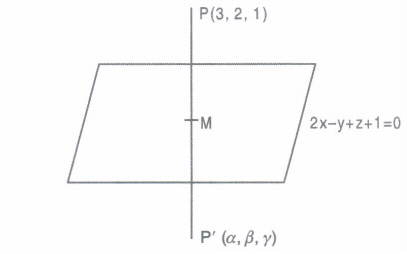
Let M be the foot of perpendicular from P on plane (1).
Let P' be the image of P in the plane (1).
The equations of PM are
\(\frac { x-3 }{ 2 } =\frac { y-2 }{ -1 } =\frac { z-1 }{ 1 } ...(2)\)
Any point on (2) is (3 + 2k, 2 - k, 1 + k) ...(3)
This point is M if it lies on (1)
if 2 (3 + 2k) - (2 - k) + (1 + k) + 1 = 0
if 6k = -6 if k = -1.
Putting in (3), the point M is :
(3 + 2 (- 1), 2 - (- 1), 1 - 1) i.e. (1, 3, 0). ,
Hence, the co-ordinates of M, the foot of perpendicular are (1, 3, 0).
And perpendicular distance = IPMI
\(\sqrt { { \left( 3-1 \right) }^{ 2 }+{ \left( 2-3 \right) }^{ 2 }+{ \left( 1-0 \right) }^{ 2 } } \)
\(=\sqrt { 4+1+1 } =\sqrt { 6 } units\)
If P' \(\left( \alpha ,\beta ,\gamma \right) \) is then:
\(\sqrt { { \left( 3-1 \right) }^{ 2 }+{ \left( 2-3 \right) }^{ 2 }+{ \left( 1-0 \right) }^{ 2 } } \)
\(=\sqrt { 4+1+1 } =\sqrt { 6 } units\)
Hence, the required image is P'(-1, 4, -1)
8.
\(\sin { \theta } =\frac { 2\times 10+3\times 2+6\times (-11) }{ \sqrt { 4+9+36 } \sqrt { 100+4+121 } } =\frac { 20+6-66 }{ 7\times 15 } =\frac { -8 }{ 21 }\)
\( \Rightarrow \theta ={ sin }^{ -1 }\left( \frac { -8 }{ 21 } \right) \)units
9.
We know that the equation of the plane having intercepts a, band c on the three
co-ordinate axes is
\({{x}\over{a}}+{{y}\over{b}}+{{y}\over{c}}=1\)
Here, the co-ordinates of A, Band C are (a, 0, 0), (0, b, 0) and (0, 0, c) respectively.
The centroid of \(\triangle \)ABC is \(\left({{a}\over{3}},{{b}\over{3}},{{c}\over{3}}\right).\)
Equating \(\left( {{a}\over{3}},{{b}\over{3}},{{c}\over{3}} \right)\) to \((\alpha,\beta,\gamma),\) we get a = \(3\alpha,\) b = \(3\beta\) and c = \(3\gamma\)
Thus, the equation of the plane is
\({{x}\over{3\alpha}}+{{y}\over{3\beta}}+{{z}\over{3\gamma}}=1\)
or \({{x}\over{\alpha}}+{{y}\over{\beta}}+{{z}\over{\gamma}}=3\)
10.
Normal vector of the plane is
\(\overset { \rightarrow }{ x } =3\check { i } -2\check { j } +6\check { k } \)
\(\left| \overset { \rightarrow }{ x } \right| =\sqrt { 3^{ 2 }+2^{ 2 }+6^{ 2 } } \)
\( =\sqrt { 9+4+36 } =\sqrt { 49 } =7\)
\(\overset { \rightarrow }{ x } =\frac { \overset { \rightarrow }{ x } }{ \left| \overset { \rightarrow }{ x } \right| } =\frac { 3\check { i } -2\check { j } +6\check { k } }{ 7 } \)
The required equation of plane
\(\Rightarrow \overset { \rightarrow }{ r } \frac { (3\check { i } +2\check { j } +6\check { k } ) }{ 7 } =5\)
\(\Rightarrow \check { r } .(3\check { i } +2\check { j } +6\check { k } )=35\)
11.
The length of the perpendicular drawn from the origin to the plane 2x - 3y + 6z + 21 = 0
\(\frac { x }{ 5/2 } +\frac { y }{ 5 } +\frac { z }{ -5 } \)
\(=\frac { 21 }{ 7 } =3units\)
12.
\(\frac { x-2 }{ 2 } =\frac { 2y-5 }{ -3 } ,z=-1\)
\(\Rightarrow \frac { x-2 }{ 2 } =\frac { 2y-5 }{ -3 } =\lambda ,z=-1+0\lambda \)
\(\frac { x-2 }{ 2 } =\frac { 2y-5 }{ -3 } ,z=-1\)
\(\Rightarrow \frac { x-2 }{ 2 } =\frac { y-5/2 }{ -3/2 } =\lambda ,z=-1+0\lambda \)
\(\Rightarrow \frac { x-2 }{ 2 } =\frac { y-5/2 }{ -3/2 } =\lambda ,\frac { z+1 }{ 0 } =\lambda \)
ratios are (2, - 3/2, 0) and the point on the given line is(2, 5/2, -1).
13.
\( \left[ \begin{matrix} { l }_{ 4 } & { m }_{ 1 } & { n }_{ 1 } \\ { l }_{ 2 } & { m }_{ 2 } & { n }_{ 2 } \\ { l }_{ 3 } & { m }_{ 3 } & { n }_{ 3 } \end{matrix} \right] \left[ \begin{matrix} { l }_{ 1 } & { l }_{ 2 } & { l }_{ 3 } \\ { m }_{ 1 } & { m }_{ 2 } & { n }_{ 2 } \\ { n }_{ 1 } & { n }_{ 2 } & { n }_{ 3 } \end{matrix} \right] \)
\(\left[ \begin{matrix} 1 & 0 & 0 \\ 0 & 1 & 0 \\ 0 & 0 & 1 \end{matrix} \right] ={ l }_{ 2 }\)
because
\({ l }_{ 1 }^{ 2 }+{ m }_{ 1 }^{ 2 }+{ n }_{ 1 }^{ 2 }=1\) for each i = 1, 2, 3
\(l_{ i }l_{ 1 }+m_{ 1 }m_{ j }+n_{ i }n_{ j }=0(i=1)\quad for\quad each\quad i,j=1,2,3\)
14.
\(\alpha =60^{ \circ },\beta =?,\gamma =45^{ \circ }\)
Let \(\alpha \) makes with x-axis, y makes with z-axis and \(\beta \) makes with y-axis
\(\alpha =cos\quad 60^{ \circ },m=cos\quad \beta ,y=cos45^{ \circ }\)
\(\alpha ^{ 2 }+\beta ^{ 2 }+\gamma ^{ 2 }=1\)
\(\Rightarrow cos^{ 2 }60^{ \circ }+cos^{ 2 }\beta +cos^{ 2 }45^{ \circ }\)
\(\Rightarrow \frac { 1 }{ 4 } +cos^{ 2 }\beta +\frac { 1 }{ 2 } =1\)
\(\Rightarrow cos^{ 2 }\beta =1-\frac { 1 }{ 4 } -\frac { 1 }{ 2 } \)
\(=\frac { 4-1-2 }{ 4 } \)
\(=\frac { 1 }{ 4 } \)
\(\Rightarrow cos \beta =\pm \frac { 1 }{ 2 } \)
\(\beta =\frac { \pi }{ 3 } or\ \frac { 2\pi }{ 3 } \)
But angle between two lines in the interval \(\left( 0,\frac { \pi }{ 2 } \right) \)
Hence required angles is \(\frac { \pi }{ 3 } \)
15.
()
Distance of the point (p, q, r) from the x-axis
= Distance of the point (p, q, r) from the point (p,0,0)
\(=\sqrt { q^{ 2 }+r^{ 2 } } \)
16.
\(\theta=\sin ^{-1}\left(\frac{4}{\sqrt{42}}\right)\)
17.
\(\frac { x+2 }{ 1 } =\frac { 2y-1 }{ 3 } =\frac { 3-z }{ 5 } .\)
18.
Let equation of plane through (1, 2, -4) be a(x-1) + b(y-2) + c(z+4) = 0.
The plane is parallel to the given lines
\(\therefore\) 2a + 3b + 6c = 0; a + b - c = 0
Solving: \(\frac { a }{ -9 } =\frac { b }{ 8 } =\frac { c }{ -1 } =k\left( say \right) \)
\(\therefore\) a = -9k, b = 8k, c = -k
From (i), -9k(x-1) + 8k(y-2) - k(z+4) = 0
\(\therefore\) Equation of plane in cartesian form is 9x - 8y + z+11 = 0
Vector form of plane is: \(\Rightarrow \vec { r } .\left( 9\hat { i } -8\hat { j } +\hat { k } \right) =-11\)
Distance of (9, -8, -10) from the plane = \(\left| \frac { 9.9-8\left( -8 \right) +1\left( -10 \right) +11 }{ \sqrt { 81+64+1 } } \right| =\sqrt { 146 } \)

12th Standard CBSE Syllabus & Materials
12th Standard CBSE
CBSE 12th Computer Science Python Revision Tour I - New Previous year Question Papers Study Material - QB365 Set A
NEW12th Standard CBSE
CBSE 12th Business Studies Planning Important Questions And Answers Study Material - QB365 Set A
NEW12th Standard CBSE
CBSE 12th Business Studies Business Environment Important Questions And Answers Study Material - QB365 Set A
NEW12th Standard CBSE
CBSE 12th Business Studies Principles of Management Important Questions And Answers Study Material - QB365 Set A



CBSE 12th Standard CBSE Subjects
CBSE Standards










