
 100% FREE ACCESS
12th Standard CBSE Syllabus & Materials
12th Standard CBSE
CBSE 12th Economics Government Budget and the Economy Previous year Question Papers Study Material - QB365 Set A
NEW12th Standard CBSE
CBSE 12th Computer Science Interface Python with MySQL - New Previous year Question Papers Study Material - QB365 Set A
NEW12th Standard CBSE
CBSE 12th Computer Science Database Concept - New Previous year Question Papers Study Material - QB365 Set A
NEW12th Standard CBSE
CBSE 12th Computer Science Data Communication - New Previous year Question Papers Study Material - QB365 Set A
NEW12th Standard CBSE
CBSE 12th Computer Science Data Structures - New Previous year Question Papers Study Material - QB365 Set A
NEW12th Standard CBSE
CBSE 12th Computer Science Functions - New Previous year Question Papers Study Material - QB365 Set A

Published on: 16/09/2019
Atoms and Nuclei
Download CBSE Class 12th Standard CBSE Physics question papers, sample papers, important questions, and previous year solved papers in PDF format. Get free study materials, NCERT solutions, and exam preparation resources for Class 12th Standard CBSE Physics
Questions + Answers key
Take MCQ Physics Test
1.
A neutron is absorbed by a 6Li3 nucleus with the subsequent emission of an alpha particle.
i) Write the corresponding nuclear reactions.
ii) Calculate the energy released in MeV, in this reaction.
Given mass 6Li3 = 6.0151264; mass (neutron) = 1.00966544
Mass (alpha particle) = 4.00260444 and mass(triton) = 3.01000004
2.
Write nuclear equations for
a) The \(\alpha\)-decay of 226Ra88
b) The \(\beta\)- -decay of 32P15
c) The \(\beta\)+ decay of 32P15
3.
Calculate the de-Broglie wavelength of the electron orbiting in the n = 2 states of hydrogen atom
4.
Derive the expression for the law of radioactive decay of a given sample having initially No decaying to the number N present at any subsequent time t.
Plot a graph showing the variation of the number of nuclei versus the time lapsed. Mark a point on the plot in terms of T1/2 value the number present N = No / 16.
5.
Show that the density of nucleus over a wide range of nuclei is constant independent of mass number.
6.
The radius of the innermost electron orbit of a H-atom is 5.3 x 10⁻¹¹ m. What are the radii of the n = 2 and n = 3 orbits?
7.
Are the nucleons fundamental particles, or do they consist of still smaller parts? One way to find out is to probe a nucleon just as Rutherford probed an atom. What should be the kinetic energy of an electron for it to be able to probe a nucleon? Assume the diameter of a nucleon to be approximately \({ 10 }^{ -15 }m.\)
8.
Why is neutron so effective as a bombarding particle?
9.
Why is \(_{ 92 }{ { U }^{ 238 } }\) not suitable for chain reaction?
10.
Give the order of magnitude of nuclear mass density and average atomic mass density. Compare these densities with the typical mass density of solids, liquids, and gases (at ordinary temperature and pressure).
11.
How many electrons, protons, and neutrons are there in a nucleus of atomic number 11 and mass number 24?
12.
If elements with principal quantum number n > 4 did not exist in nature, what would be the possible number of elements?
13.
The electron in the hydrogen atom passes from the n = 4 energy level to the n = 1 level.What is the maximum number of photons that can be emitted? and minimum number?
1.
(i) 6Li3 + 1no \(\rightarrow\)3H1 + 4He2 +Q (energy)
(ii) Q = \(\triangle\)mx931 MeV
Where \(\triangle\)m = 6.01512+1.0086654-4.0026044-3.0100000
2.
a) 226Ra88-----------------\(\rightarrow\)-222Rn86 + 4He2
b) 32P15------------------ \(\rightarrow\)32S16 + 0e-1 + \(\gamma \)
c) 32p15------------------- \(\rightarrow\)11B5+0e+1+ \(\gamma \)
3.
Energy of electron at n = 2 states is
\(E=\frac { -13.6 }{ { n }^{ 2 } } =\frac { -13.6 }{ \left( { 2 }^{ 2 } \right) } =-3.4ev\)
Now, de-Broglie wavelength of electron is given by
\(\lambda =\frac { h }{ p } =\frac { h }{ \sqrt { 2mk } } \)
\(=\frac { h }{ \sqrt { 2mE } } [\because \left| k \right| =\left| E \right| ]\)
\(=\frac { 6.62\times { 10 }^{ -34 } }{ \sqrt { 2\times 9.1\times { 10 }^{ -31 }\times 3.4\times 1.6\times { 10 }^{ -19 } } } \)
\(=\frac { 6.62\times { 10 }^{ -34 } }{ 10\times { 10 }^{ -25 } } \)
\(=0.662\times { 10 }^{ -9 }\)
\(=6.62\times { 10 }^{ -10 }=6.62\mathring { A } \)
4.
Let N be the number of undecayed nuclei in the sample at time I and t. N nuclei undergo decay in time \(\Delta t\) .
Then \(\frac { -\Delta N }{ \Delta t } \propto N,\frac { -\Delta N }{ \Delta t } =\lambda N\)
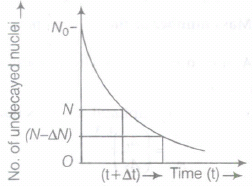
where, λ is disintegration constant.
The rate of change in N in time ∆t⇢0, can be expressed as \(\frac { dN }{ N } =-\lambda dt\)
On integrating both sides \(\int _{ { N }_{ 0 } }^{ N }{ \frac { dN }{ N } } =-\int _{ 0 }^{ t }{ \lambda dt } \)
where N0 is in initial undecayed nuclei.
In \(\frac { N }{ { N }_{ 0 } } =-\lambda t\)
N = N0e-λt
mark of N = \(\frac { { N }_{ 0 } }{ 16 } \) in terms of T1/2 is shown in the figure.
.png)
5.
We have
\(R={ R }_{ 0 }{ A }^{ \frac { 1 }{ 3 } }\)
\(\therefore \) Density \(\rho \) = \(\frac { mA }{ \frac { 4 }{ 3 } \pi \left( { R }_{ 0 }{ A }^{ \frac { 1 }{ 3 } } \right) ^{ 3 } } \)
=\(\frac { m }{ \frac { 4 }{ 3 } \pi { R }_{ 0 }^{ 3 } } \)
Hence is independent of A. (Here m is the mass of the nucleus).
6.
\(2.12\times { 10 }^{ -10 }\ m\ and\ 4.47\times { 10 }^{ -10 }\ m\)
7.
Yes, the nucleons (neutrons and protons) are fundamentals particles. To resolve two objects, say nucleons separated by distance d, the wavelength \(\lambda \) of probing signal must be less than or equal to d. As \(d={ 10 }^{ -15 }m.\) therefore to detect separate parts, if any, inside a nucleon, the electron must have a wavelength \(\lambda \le { 10 }^{ -15 }m.\) Now, \(\lambda =\frac { h }{ p } \ or \ p=\frac { h }{ \lambda } \) and Kinetic energy,
\(K=pc=\frac { hc }{ \lambda } =\frac { 6.63\times { 10 }^{ -34 }\times 3\times { 10 }^{ 8 } }{ { 10 }^{ -15 } } joule\)
\(K=\frac { 19.89\times { 10 }^{ -11 } }{ 1.6\times { 10 }^{ -19 } } eV\ \simeq { 10 }^{ 9 }eV=1GeV\)
8.
This is primarily because neutron carries no charge. It is neither attracted nor repelled by nucleus and electrons. Therefore, neutron is best projectile.
9.
This is because only fast moving neutrons of 12 MeV energy can cause fission of \(_{ 92 }{ { U }^{ 238 } }\) nuclei. Such neutrons have less chance of interaction. They escape the fissionable material without causing fission.
10.
Nuclear mass density is of the order of \(PFP-V-II-91/11\). This is \({ 10 }^{ 13 }\) to \({ 10 }^{ 14 }\) times the average atomic mass density, which is of the order of \({ 10 }^{ 3 }\) to \({ 10 }^{ 4\ }kg{ m }^{ -3 }\). Typical mass densities of solids and liquids are of the same order as the atomic mass densities. This is because the atoms are tightly packed in these phases. The typical densities of gases at S.T.P are of the order of \({ 10 }^{ -1 }\ kg{ m }^{ -3 }\) to \(1\ kg{ m }^{ -3 }\).
11.
No.of electrons in the nucleus = 0,
No.of protons = atomic number = 11,
No.of (protons+neutrons) = mass number = 24
\(\therefore \) No.of neutrons = 24-11 = 13
12.
Up to quantum number 4, an atom has K, L, M and N shells.In any shell, max.no.of.of electrons is \(2{ n }^{ 2 }\).Therefore,
in K shell, max no.of electrons = \(2{ \left( 1 \right) }^{ 2 }=2\)
in L shell, max no.of electrons = \(2{ \left( 2 \right) }^{ 2 }=8\)
in M shell, max no.of electrons = \(2{ \left( 3 \right) }^{ 2 }=18\)
in N shell, max no.of electrons = \(2{ \left( 4 \right) }^{ 2 }=32\)
Total max.no.of electrons in these shells
= 2 + 8 + 18 + 32 = 60
Hence, number of elements would be 60.
13.
When an electron in hydrogen atom passes from n=4 energy level to n=1 level, max. a number of photons =6, corresponding to transitions \(4\rightarrow 3;3\rightarrow 2;2\rightarrow 1;4\rightarrow 2,3\rightarrow 1,4\rightarrow 1.\) The minimum number of photons can be one only corresponding to the transition \(4\rightarrow 1.\)

12th Standard CBSE Syllabus & Materials
12th Standard CBSE
CBSE 12th Computer Science Python Revision Tour I - New Previous year Question Papers Study Material - QB365 Set A
NEW12th Standard CBSE
CBSE 12th Business Studies Planning Important Questions And Answers Study Material - QB365 Set A
NEW12th Standard CBSE
CBSE 12th Business Studies Business Environment Important Questions And Answers Study Material - QB365 Set A
NEW12th Standard CBSE
CBSE 12th Business Studies Principles of Management Important Questions And Answers Study Material - QB365 Set A



CBSE 12th Standard CBSE Subjects
CBSE Standards










