
 100% FREE ACCESS
12th Standard CBSE Syllabus & Materials
12th Standard CBSE
CBSE 12th Economics Government Budget and the Economy Previous year Question Papers Study Material - QB365 Set A
NEW12th Standard CBSE
CBSE 12th Computer Science Interface Python with MySQL - New Previous year Question Papers Study Material - QB365 Set A
NEW12th Standard CBSE
CBSE 12th Computer Science Database Concept - New Previous year Question Papers Study Material - QB365 Set A
NEW12th Standard CBSE
CBSE 12th Computer Science Data Communication - New Previous year Question Papers Study Material - QB365 Set A
NEW12th Standard CBSE
CBSE 12th Computer Science Data Structures - New Previous year Question Papers Study Material - QB365 Set A
NEW12th Standard CBSE
CBSE 12th Computer Science Functions - New Previous year Question Papers Study Material - QB365 Set A

Published on: 30/11/2018
In this post, Class 12 Physics Chapter 15 - Communication Systems solved by Expert Teachers as per NCERT (CBSE) Book guidelines. All Chapter 15 - Communication Systems Exercise Questions with Solutions to help you to revise complete Syllabus and Score More marks.
Get 100 percent accurate NCERT Solutions for Class 12 Physics Chapter 15 (Communication Systems) solved by expert Physics teachers. We provide solutions for questions given in Class 12 Physics text-book as per CBSE Board guidelines from the latest NCERT book for Class 12 Physics.
NCERT Grade 12 Physics Chapter 15, Communication Systems is from Unit 10, Communication Systems. The aim of this chapter is to introduce the concepts of communication, namely the mode of communication, the need for modulation, production and detection of amplitude modulation.
Introduction to Communication System, Elements of a Communication System, Basic Terminology Used in Electronic Communication Systems, Bandwidth of Signals, Bandwidth of Transmission Medium, Propagation of Electromagnetic Waves, Groundwave, Sky waves, Space wave, Modulation and its Necessity, Size of the antenna or aerial, Effective power radiated by an antenna, Mixing up of signals from different transmitters, Amplitude Modulation, Production of Amplitude Modulated Wave and Detection of Amplitude Modulated Wave are the topics studied through this chapter.
Diagrams, graphs, illustrations and examples associated with daily life make this chapter very interesting and easy to learn. Solved numeral problems and unsolved ones for practice make the students understand the concept better and develop a strong grip on the subject.
NCERT Grade 12 Physics Chapter 15, Communication Systems is from Unit 10, Communication Systems. Unit 10 holds a total weightage of 5 marks in the final examination.
Download CBSE Class 12th Standard CBSE Physics question papers, sample papers, important questions, and previous year solved papers in PDF format. Get free study materials, NCERT solutions, and exam preparation resources for Class 12th Standard CBSE Physics
Questions + Answers key
Take MCQ Physics Test
1.
The fraction of world's human population using the services of internet is
1/2
1/3
1/4
1/5
2.
A device that connects one computer to another across ordinary telephone lines is called
transducer
fax
modem
none of the above
3.
Out of the following, which is not an essential element of a communication system?
Transmitter
Transducer
Receiver
Communication Channel
4.
A basic communication system consists of
(a) transmitter
(b) information source
(c) user of information
(d) channel
(e) receiver
Choose the correct sequence in which these are arranged in a basic communication system:
ABCDE
BADEC
BDACE
BEADC
5.
Frequencies in the UHF range normally propagate by means of:
Ground waves
sky waves
surface waves
space waves
6.
Distinguish between 'sky waves' and 'space waves' modes of propagation in communication system.
(a) Why is sky wave mode propagation restricted to frequencies upto 40 MHz?
(b) Give two examples where space wave mode of propagation is used.
7.
Define modulation index.Why is its value kept, in practice, less than one? A carrier wave of frequency 1,5 MHz and amplitude 50 V is modulated by a sinusoidal wave of frequency 10 kHz producing 50% amplitude modulation.Calculate the amplitude of the AM wave and frequencies of side bands produced.
8.
Estimate the fastest bit rate capable of being carried by light of wavelength 1.3 \(\mu m\). How many phone calls could be carried at this bit rate? Bandwidth of optical fibre = 2 GHz.
9.
Explain why T.V. transmission towers are usually made high.
10.
Rita was studying in 10th class, one day she asked her father to explain the working of remote control of TV. Her father was not knowing the answer, but he made up his mind to understand the working of remote control. He found one shop where remote controls were repaired. The shopkeeper showed to Rita's father the inside of the remote control and explained her the working. Rita's father explained her the working of remote control, Rita was happy and satisfied.
(a) What are the values Rita's father displayed in his act?
(b) Name the diode used in remote control.
11.
What is the meaning of the term 'attenuation' used in communication system?
12.
Two waves A and B of frequencies 2 MHz to 3 MHz, respectively are beamed in the same direction for communication via sky wave. Which one of these is likely to travel longer distance in the ionosphere before suffering total internal reflection?
13.
What is meant by skip distance?
14.
Which factor decides the quality of reproduced document sent by a FAX?
15.
Attenuation refers to -------------- during propagation.
16.
In the famous conversation, Rakesh Sharma, the first Indian Astronaut in space, was asked by the Prime Minister Indira Gandhi as to how India looked from space.To which he replied,'Sare Jahan Se Achcha' (better than the whole world).
Read the above passage and answer the following questions:
(i) Which scientific mode of communication enabled the Prime Minister to speak to the Astronaut?
(ii) Name the scientific values displayed in this anecdote.
(iii) Which values are being reflected in the reply given by the astronaut?
(iv) Give one more example of this scientific mode of communication in everyday life situations.
17.
A TV transmitting antenna is tall. How much service area this transmitting antenna cover, if the receiving antenna is at the ground level? Radius of earth = 6400 km.
18.
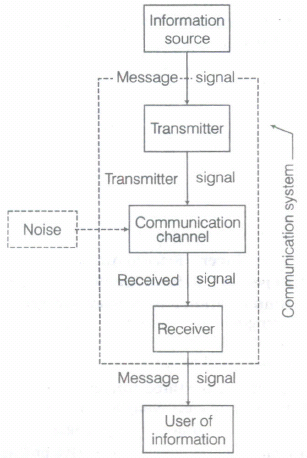
Draw a block diagram showing the important component in a communication system. What is the function of a transducer?
19.
(i) Define modulation index.
(ii) Why is the amplitude of modulating signal kept less than the amplitude of carrier wave?
20.
Distinguish between 'Analog and Digital signals'.
21.
A TV transmission tower antenna is at a height of 20 m. How much service area can it cover if the receiving antenna is
(i) at ground level,
(ii) at a height of 25 m?
Calculate the percentage increase in area covered in case (i) relative to case.
1.
(b)
1/3
2.
(c)
modem
3.
(b)
Transducer
4.
(b)
BADEC
5.
(d)
space waves
6.
Long distance communication between two points on the earth is achieved through reflection of electromagnetic waves by ionosphere. Such waves are called sky waves. Sky wave propagation takes place up to frequency of about 40 MHz. A space wave travels in a straight line from transmitting antenna to the receiving antenna. It is used for line of sight (LOS) communication as well as satellite communication.
(a) The ionospheric layer acts as reflector for a certain range of frequencies (3 to 30 MHz). Electro-magnetic waves of frequencies higher than 30 MHz (upto 40 MHz) penetrate the ionosphere and escape.
(b) In television broadcast, microwave links and satellite communication, space wave mode of propagation is used.
7.
Amplitude modulation index is the ratio of the modulating signal to the maximum amplitude of carrier wave.
Given, frequency of carrier wave,
vc = 1.5 MHz = 1500 kHz
Frequency of sinusoidal (modulated) wave,
vm = 10 kHz
Amplitude of carrier wave, AC = 50 V
Modulated index, \(\mu \) = 50%
= \(\frac { 50 }{ 100 } =\frac { 1 }{ 2 } \)
Modulation index, \(\mu \) = \(\frac { { A }_{ m } }{ { A }_{ C } } \)
\(\frac { 1 }{ 2 } =\frac { { A }_{ m } }{ 50 } \)
Am = 25 V
So, the amplitude of AM wave, Am =25 V
As, we know, the sidebands are
USB = vc + vm = 1500 + 10 = 1510kHz
LSB = vc - vm = 1500 -10 = 1490 kHz
There are the required frequencies of the sidebands produced.
8.
Here, \(\lambda =1.3\times { 10 }^{ -6 }m\) \(v=\frac { c }{ \lambda } =\frac { 3\times { 10 }^{ 8 } }{ 1.3\times { 10 }^{ -6 } } =2.3\times { 10 }^{ 14 }Hz\)
Max bit rate = 2 v = 2 x 2.3 x 1014 = 4.6 x 10¹⁴ Hz
For optical fibre, bandwidth = 2 GHz = 2 x 10⁹ Hz
No of phone calls = \(\frac { 4.6\times { 10 }^{ 14 } }{ 2\times { 10 }^{ 9 } } =2.3\times { 10 }^{ 5 }\)
9.
AS the range of T.V. transmission, \(d=\sqrt { 2hr } \)so by increasing height of tower \(h\) the distance \(d\) upto which T.V. coverage can be done will increase. That is why to have greater T.V. coverage transmission has to be made using tall antennas.
10.
(a) Rita's father takes interest to understand the working of the mind of his daughter and make effort to satisfy her desire for knowledge.
(b) The diode used are LED(Light Emitting Diode).
11.
()
Loss of strength of a signal while propagating through a medium.
12.
()
We know that refractive index \(\mu\) of a medium is related with wavelength of wave according to relation
\(\mu =A+\frac { B }{ { \lambda }^{ 2 } } +\frac { C }{ { \lambda }^{ 4 } } =\frac { \sin { i } }{ \sin { r } } \ and \ \lambda =\frac { c }{ v } \)
Therefore, the value of refractive index \(\mu\) of a medium increases with the decrease in wavelength or increase in frequency of wave travelling through medium. For higher frequency wave, angle of refraction r is less, i.e., bending of wave is less in medium. Due to it, the condition for total internal reflection is attained after travelling longer distance by higher frequency wave. Hence 3 MHz wave will travel longer distance in the ionosphere before suffering total internal reflection.
13.
()
It is the smallest distance between the transmitting antenna and the receiving point, where the sky wave of a fixed frequency,but not more than critical frequency is first received after reflection from ionosphere.
14.
()
The quality of reproduced document is determined by the resolution capacity of the scanner of the machine.
15.
()
loss of strength of a signal
16.
(i) Radio wave communication system.
(ii) Use of scientific and technological advancement in service to mankind.
(iii) Patriotism and love for the country, presence of mind.
(iv) Television communication system.
17.
Here, h = 125 m ;
R = 6400 km = 6.4 x 10⁶ m.
Area covered = \(\pi { d }^{ 2 }=\pi \times 2hR\ \left[ \because \ \sqrt { 2hR } \right] \)
= 3.14 x 2 x 125 x 6.4 x 106
= 5024 x 106 m2 = 5024 km2
18.
Range of frequency suitable for space wave propagation is 100 MHz to 220 MHz.
19.
Modulation index is defined as the ratio of amplitude of modulating signal and amplitude of carrier wave
Alternatively,
\(\mu =\frac { { A }_{ m } }{ { A }_{ c } } \)
The amplitude of modulating signal is kept less than amplitude of carrier wave to avoid/ minimize distortion/noise.
20.
1. Analog signals are continuous variations of voltage or current.
2. Digital signals are those which can take only discrete (stepwise) values.
21.
Here, h1 = 20 m, h2 = 25 m
(i) \(d=\sqrt { 2{ h }_{ 1 }R } =\sqrt { 2\times 20\times \left( 6.4\times { 10 }^{ 6 } \right) } =16\times { 10 }^{ 3 }m=16km\)
Area covered, \(A=\pi { d }^{ 2 }=\frac { 22 }{ 7 } \times { \left( 16 \right) }^{ 2 }\simeq 804.6{ km }^{ 2 }\)
(ii) Range, \({ d }_{ 1 }=\sqrt { 2{ h }_{ 1 }R } +\sqrt { 2{ h }_{ 2 }R } =\sqrt { 2\times 20\times \left( 6.4\times { 10 }^{ 6 } \right) } +\sqrt { 2\times 25\times 6.4\times { 10 }^{ 6 } } \)
\(=16km+17.9km=33.9km\)
Area covered, \({ A }_{ 1 }=\pi { d }_{ 1 }^{ 2 }=\frac { 22 }{ 7 } \times { \left( 33.9 \right) }^{ 2 }=3611.8{ km }^{ 2 }\)
% increase in area = \(\frac { { A }_{ 1 }-A }{ A } \times 100=\left( \frac { 3611.8-804.6 }{ 804.6 } \right) \times 100=\) 348.9%

12th Standard CBSE Syllabus & Materials
12th Standard CBSE
CBSE 12th Computer Science Python Revision Tour I - New Previous year Question Papers Study Material - QB365 Set A
NEW12th Standard CBSE
CBSE 12th Business Studies Planning Important Questions And Answers Study Material - QB365 Set A
NEW12th Standard CBSE
CBSE 12th Business Studies Business Environment Important Questions And Answers Study Material - QB365 Set A
NEW12th Standard CBSE
CBSE 12th Business Studies Principles of Management Important Questions And Answers Study Material - QB365 Set A



CBSE 12th Standard CBSE Subjects
CBSE Standards










