
 100% FREE ACCESS
12th Standard CBSE Syllabus & Materials
12th Standard CBSE
CBSE 12th Economics Government Budget and the Economy Previous year Question Papers Study Material - QB365 Set A
NEW12th Standard CBSE
CBSE 12th Computer Science Interface Python with MySQL - New Previous year Question Papers Study Material - QB365 Set A
NEW12th Standard CBSE
CBSE 12th Computer Science Database Concept - New Previous year Question Papers Study Material - QB365 Set A
NEW12th Standard CBSE
CBSE 12th Computer Science Data Communication - New Previous year Question Papers Study Material - QB365 Set A
NEW12th Standard CBSE
CBSE 12th Computer Science Data Structures - New Previous year Question Papers Study Material - QB365 Set A
NEW12th Standard CBSE
CBSE 12th Computer Science Functions - New Previous year Question Papers Study Material - QB365 Set A

Published on: 26/09/2019
Electromagnetic Waves
Download CBSE Class 12th Standard CBSE Physics question papers, sample papers, important questions, and previous year solved papers in PDF format. Get free study materials, NCERT solutions, and exam preparation resources for Class 12th Standard CBSE Physics
Questions + Answers key
Take MCQ Physics Test
1.
Police came to know that were some valuable articles which got stolen from the museum. In a search operation, police arrested the thief with stolen articles. Now the police wanted to prove the case, so police contacted Raman who helped and confirmed that the stolen articles belong to the museum using UV light.
(a) What are the values exhibited by Raman?
(b) How does he prove such case?
2.
Chirag was at the restaurant chatting with his cousins. The restaurant was clean and free of files and insects to his relief. His cousin was curious to know about the UV lamp in the corner and asked Chirag about it. Chirag explained that inside the fluorescent lamp, the electrical energy is converted into UV radiation. The inside of the tubes is coated with a fluorescent powder which absorbs the UV and emits violet light in the visible region. These attract the insects which are electrocuted by high-voltage wires near the lamp, so that don't fall on the food and contaminate them.
(a) Name the main source of UV rays?
(b) Why are they considered harmful to us?
(c) What impressed you about chirag?
3.
Saurabh reads in his text book that if the distance from the bulb is double then intensity is reduced to one-fourth. But then he notices that as a laser beam travel across the length of a room, its intensity is essentially constant. So he wants to know what geometrical characteristic of laser beam is responsible for the constant intensity, which is missing in the case of light from the bulb. His friend Samir explained him such things properly.
(a) What value are displayed by Samir?
(b) How does Samir explain such things properly?
4.
Draw a labelled diagram of Hertz's experiment. Explain how electromagnetic radiations are produced using this set-up.
5.
Four persons went on an excursion on a hilltop where the temperature was quite low. one of them fell sick. The other persons put a blanket on him, collected the pieces of dry wood and ignited a fire in his vicinity. After some time the sick person felt better
Read the above passage and answer the following question
(i) What is the type of rays coming from fire?
(ii) Why did the sick person feel better while seating near the fire?
(iii) What basic values do you learn from this study?
6.
A radio can be tuned to any station in the 6 MHz to MHz band. What is the corresponding wavelength between 6 MHz and 9 MHz?
7.
A parallel plate capacitor made of circular plates each of radius R = 5.0 cm has a capacitance C = 96 pF. The capacitor is connected to a 220 V a.c supply with (argular) frequency of 300 rad \({ s }^{ -1 }\) .
8.
What are the uses of electromagnetic waves?
9.
Discuss the quantitative production of electromagnetic waves when a charge is accelerated.
10.
Sea water at frequency \(v=4\times { 10 }^{ 8 }\)Hz has permittivity \(\varepsilon \ \approx \ 80 \ { \varepsilon }_{ 0 }\), permeability \(\mu ={ \mu }_{ 0 }\) and resistivity \(\rho =0.25 \ \Omega -m\) Imagine a parallel plate capacitor immersed in sea water and driven by an alternating voltage source \(v(t) \ = \ { V }_{ 0 } \ sin \ (2\pi vt)\) . What fraction of the conduction current density is the displacement current density?
1.
(a) The values exhibited by Raman are:
(i) presence of mind,
(ii) high degree of general awareness,
(iii) thinking skills, and
(iv) social responsibility.
(b) Raman told that normally post codes on valuable articles of the museum are mostly written with security marker pens which are not seen. As the security pens carries chemicals which fluoresce in ultraviolet light by changing it to visible light, so it is easy for police to read such post and confirm the belongings of the articles. Finally, they return the articles to the museum.
2.
(a) Sun is the main source of UV rays.
(b) They can cause skin cancer when exposed for a longer time.
(c) Clarity in explaining, health, awareness, knowledge.
3.
(a) The value displayed by Samir are:
(i) Presence of mind
(ii) High order of general awareness
(iii) Helping and caring nature.
(b) The light beam spreads, as it propagates into spherical region.So its intensity is reduced to one-fourth in such gives case. But laser beam does not spread so its intensity remains constant.
4.
Hertz Experiment: Hertz's experiment was based on the fact that an oscillating electric charge radiates electromagnetic waves and these waves carry energy which is being supplied at the cost of K.E.of the oscillating charge.
Hertz Apparatus: The experimental arrangement used by Hertz for the production and detection of electromagnetic waves in the laboratory, is shown in fig. His experimental arrangement consists of two metal sheets P1 and P2 These sheets are connected to a source of very high voltage (i.e. an induction coil, which can supply a potential difference of several thousand volts). S1 and S2 are o metal spheres connected to the metal sheets P1 and P2 The distance between the metal sheets is kept nearly 60 cm and that between the sphere is normally from 2 cm to 2.5cm.
The two plates PI and P2 form a capacitor of very low capacitance (C). The circuit containing P1 and P2 (being completed by conducting wire), has also some low value of inductance L. It thus forms an LC-circuit. Detector (D) consisting of a coil to the ends of which two other small metal spheres S1 and S2 are connected.
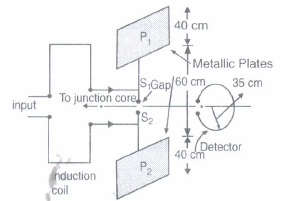
Working of Hertz apparatus: Due to existence of very high voltage, air present in the gap across the plates or spheres S1 and S2 gets ionised. Due to presence of the ions or charged particles, the path between the spheres S1 and S2 become conducting. As a result of this, very high time-varying current flows across the gap between S1 and S2 (as plates P1 and P2 from an LC circuit). Due to this a spark is produced. Since, sheets P1, P2 from an LC-circuit, hence, electromagnetic waves of frequency
\(f=\frac { 1 }{ 2\pi } \sqrt { \frac { 1 }{ LC } } \) are radiated.
Function of the detector D: Hertz detected the electromagnetic waves by means of a detector D, kept suitable distance from the conducting spheres S1, S2 . Detector D is made of two similar conducting spheres and joined to the ends of a coil to form another LC circuit. The frequency of this LC circuit is made equal to the frequency of electromagnetic waves reaching it. The frequency can be adjusted by changing the diameter of the coil of the detector and by changing the distance between S1 and S2 are normal to the plane of coil (C). When magnetic lines of force cut the detector coil, an emf is inducd in it.Hence, air in between ga gets ionised. A conducting path becomes available for the induced current to flow across the gap. Thus, the spark is produced between S1 and S2. Hertz also observed that the spark across the gap was the greatest when S1, S2 were parallel to each other. This clearly established that electromagnetic waves produced were polarised i.e.
\(\vec { E } \) and \(\vec { B } \) always lie in one plane.
5.
(i) The rays coming from fire are yellow, red and infrared rays
(ii) The infrared rays coming from fire provide soothing effect to the body muscles of the sick person sitting near the fire, Due to it, the sick person feel better after some time
(iii) From the above study we learn that presence of mind and proper use of the things available help ton save a difficult situation
6.
Since \(v=\frac { c }{ \lambda } \ \therefore \ \lambda =\frac { c }{ v } \)
(1) For \(v=6MHz=6\times { 10 }^{ 6 }Hz\)
\(\lambda =\frac { 3\times 10^{ 8 } }{ 6\times 10^{ 6 } } =50 \ m\)
For \(v=9MHz=9\times 10^{ 6 }Hz\)
\(\lambda =\frac { 3\times 10^{ 8 } }{ 9\times 10^{ 6 } } =66.7 \ m.\)
7.
Given
\(\omega =300 \ rad \ { s }^{ -1 }\)
\( E_{ rms }=220V \ C=90\times 10^{ -12 }F\)
So \( I_{ rms }=E_{ rms }\quad \omega C \)
\(=220\times 300\times 90\times 10^{ -12 }\)
\( =5.94\times 10^{ -6 }A\)
or \(I_{ rms }=5.94\mu A\).
8.
Uses of electromagnetic waves
Following are some important uses of electromagnetic waves:
1. Radio waves. Radio waves are electromagnetic waves and are used in radio and television communication systems.
2. Microwaves. Microwaves are used in radar and other communication systems.
3. Infrared radiations. Infrared rays are used in:
(a) solar water heater and solar cooker.
(b) weather forecasting
(c) taking photographs during fog, smoke etc.
(d) dehydrating fruits.
(e) the treatment of muscular strain.
(f) greenhouse to keep the plants warm.
4. Ultraviolet rays. ultraviolet rays are used:
(a) for checking mineral samples by making use of its property of causing fluorescence and also used for the study of molecular structure.
(b) for sterilizing the surgical instruments because U.V.-rays destroy bacteria.
(c) in food preservations
(d) in detection of invisible writing
5. X-rays. X-rays are used:
(a) in surgery
(b) in radiotherapy.
(c) in medical diagnosis to detect the fracture in bones etc.
(d) in detective departments to detect gold, diamond etc concealed in bags etc without opening them.
(e) in scientific research to study the crystal structure etc.
6. \(\gamma \)-rays. Gamma rays are used to get information of structure of atomic nucleus.
9.
Consider an electric charge at rest so that at a point P some distance away, we have electric field but no magnetic field. Let, at time \(t=0\) , an impulse be given to the charge such that it starts moving with some finite velocity. For a moving charge, we expect at P both electric and magnetic fields, but we cannot immediately decide whether the magnetic field at P will change from zero to finite value instantaneously at \(t=0\) or after some time.
Instantaneous change means infinite rate of change. If the change is instantaneous at all points then considering any loop, we will conclude from Faraday's law that an infinite e.m.f. and infinite electric field is set up. This in turn would imply an infinite magnetic field as seen from the result. Fields are always finite away from charges and clearly the situation just described is inconsistent with known laws of electricity and magnetism.
\(\oint { \overset { \rightarrow }{ B } } .\overset { \rightarrow }{ dl } ={ \mu }_{ 0 }{ \varepsilon }_{ 0 }\frac { d\phi _{ e } }{ dt } \)
The moving charge sets up a magnetic field in its neighbourhood which in turn creates an electric field in the neighbourhood. The process continues since both time-varying electric and magnetic fields act as sources of each other. Thus an electromagnetic wave is started when a charge is accelerated. It is only when the wave reaches the point P that the magnetic field at P changes.
This shows that an accelerated charge emits an electromagnetic wave. It can also be shown that the electromagnetic wave and the oscillator will have the same frequency.
10.
Let \(d\) be the distance between the plates of the capacitor.
Applied electic field \(E=\frac { V(t) }{ d } =\frac { { V }_{ 0 } }{ d } \ sin \ (2\pi vt)\)
\({ J }_{ C }=\frac { E }{ \rho } =\frac { { V }_{ 0 } }{ \rho d } \ sin \ 2\pi \lambda t={ J }_{ OC } \ sin \ 2\pi vt\)
Where, \({ J }_{ OC }=\frac { { V }_{ 0 } }{ \rho d } \) is max. conduction current density. The displacement
\({ J }_{ D }=\frac { I_{ D } }{ A } =\frac { { \varepsilon }_{ 0 }{ \varepsilon }_{ r } }{ A } \frac { d\phi _{ e } }{ dt } ={ \varepsilon }_{ 0 }{ \varepsilon }_{ r }\frac { dE }{ dt } \)
\(\left[ \therefore \phi _{ e }=AE \right]\)
\(={ \varepsilon }_{ 0 }{ \varepsilon }_{ r }\frac { d }{ dt } \left[ \frac { { V }_{ 0 } }{ d } sin(2\pi vt \right] \)
\(={ \varepsilon }_{ 0 }{ \varepsilon }_{ r }\frac { { V }_{ 0 } }{ d } 2\pi r \ cos \ 2\pi vt\)
\( ={ J }_{ OD } \ cos \ 2\pi vt\)
Where \(={ J }_{ OD }=\frac { 2\pi v{ \varepsilon }_{ 0 }\varepsilon _{ r }V_{ 0 } }{ d } \) is max. displacement current density
\(So\quad \frac { { J_{ OD } } }{ J_{ OC } } =\frac { { \varepsilon }_{ 0 }{ \varepsilon }_{ r }{ V }_{ 0 }2\pi v }{ d } \frac { \rho d }{ V_{ d } } =2\pi v{ \varepsilon }_{ 0 }{ \varepsilon }_{ r }\rho \)
\( =4\pi { \varepsilon }_{ 0 }{ \varepsilon }_{ r }\frac { \rho }{ 2 } \)
\(\\ =\frac { 1 }{ 9\times 10^{ 9 } } \times 4\times 10^{ 8 }\times 80\times \frac { 0.25 }{ 2 } =\frac { 4 }{ 9 } \)

12th Standard CBSE Syllabus & Materials
12th Standard CBSE
CBSE 12th Computer Science Python Revision Tour I - New Previous year Question Papers Study Material - QB365 Set A
NEW12th Standard CBSE
CBSE 12th Business Studies Planning Important Questions And Answers Study Material - QB365 Set A
NEW12th Standard CBSE
CBSE 12th Business Studies Business Environment Important Questions And Answers Study Material - QB365 Set A
NEW12th Standard CBSE
CBSE 12th Business Studies Principles of Management Important Questions And Answers Study Material - QB365 Set A



CBSE 12th Standard CBSE Subjects
CBSE Standards










