
 100% FREE ACCESS
12th Standard CBSE Syllabus & Materials
12th Standard CBSE
CBSE 12th Economics Government Budget and the Economy Previous year Question Papers Study Material - QB365 Set A
NEW12th Standard CBSE
CBSE 12th Computer Science Interface Python with MySQL - New Previous year Question Papers Study Material - QB365 Set A
NEW12th Standard CBSE
CBSE 12th Computer Science Database Concept - New Previous year Question Papers Study Material - QB365 Set A
NEW12th Standard CBSE
CBSE 12th Computer Science Data Communication - New Previous year Question Papers Study Material - QB365 Set A
NEW12th Standard CBSE
CBSE 12th Computer Science Data Structures - New Previous year Question Papers Study Material - QB365 Set A
NEW12th Standard CBSE
CBSE 12th Computer Science Functions - New Previous year Question Papers Study Material - QB365 Set A

Published on: 23/09/2019
Electrostatics
Download CBSE Class 12th Standard CBSE Physics question papers, sample papers, important questions, and previous year solved papers in PDF format. Get free study materials, NCERT solutions, and exam preparation resources for Class 12th Standard CBSE Physics
Questions + Answers key
Take MCQ Physics Test
1.
How rubbing of the two bodies produces electricity?
2.
The equivalent capacitance of the combination between A and B in the given figure is 15 \(\mu F\). Calculate the capacitance of capacitor C.

3.
Define electric field at a point. An electron moves a distance of 6.0 cm when accelerated from rest by an electric field of strength \(2\times {{10}^{4}} N{{C}^{-1}}\). Calculate the times of travel.
4.
(a) Define electric flux. Write its S.1.unit.
(b) A small metal sphere carrying charge +Q is located at the centre of a spherical cavity inside a large uncharged metallic spherical shell as shown in the figure. Use Gauss's law to find the expressions for the electric field at points P1 and P2
.png)
(c) Draw the pattern of electric field lines in this arrangement
5.
Sweta goes to physics laboratory in her practical class. Her teacher reaches late. In the mean time she notices that a student handles a circuit containing capacitor carelessly. She advises him not to handle the capacitor in such way otherwise he may get a severe shock.
(a) According to you what values are displayed by Sweta?
(b) Why does she advise him not to handle capacitor carelessly? Explain.
6.
A dipole is made up of two charges + q and - q separated by a distance 2a. Derive an expression for the electric field E\(\overrightarrow{e}\) due to this dipole at a point distance r from the centre of the dipole on the equatorial plane. Draw the shape of the graph, between |Ee| and r when r > >a.
If this dipole were to be put in a uniform external electric field \(\overrightarrow{E}_e\) , obtain an expression for the torque acting on the dipole.
7.
(i) Three equal charges, each equal to q are placed at the three corners of square of side \(\alpha \). Find the electric field at the fourth corner.
(ii) Find the electric field at the point P in figure given below.
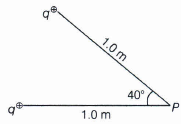
8.
The electric field at a point on the axial line at a distance of 10 cm from the center of an electric dipole is 3.75\(\times\) N/C. Calculate the length of an electric dipole.
9.
(i) Explain, using suitable diagram, the difference in the behaviour of a
(a) conductor
(b) dielectric in the presence of external electric field. Define the terms polarisation of a dielectric and write its relation with susceptibility.
(ii) A thin metallic spherical shell of radius R carries a charge Q on its surface. A point charge Q/2 is placed at its centre C and an another charge +2Q is placed outside the shell at a distance x from the centre as shown in figure. Find
(a) the force on the charge at the centre of the shell and at point A,
(b) the electric flux through the shell.
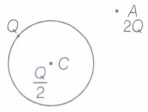
1.
When we rub two bodies, due to friction, some electrons are transferred from one body to another. The body which gains electrons becomes negatively charged and which loses electrons becomes positively charged by equal amount.
2.
\(60\mu F\)
3.
\(5.8\times {{10}^{-9}} s\)
4.
(a) Electric flux over an area in an electric field represents the total number of electric field lines crossing this area and is given by theproduct of surface area and the component of electric field intensity normal to the area.
The S.1.unit of flux is Nm2 C-1
(b) Let point P1 is at a distance R from the centre O. S1 is the Gaussian surface, then according to Gauss's theorem
\(\oint_s \overrightarrow{E}.\overrightarrow{ds}= \oint_s\overrightarrow{E}.\hat{n}ds=\frac{q}{\epsilon_0}\)
or \( {E}\oint_s {ds}= \frac{q}{\epsilon_0}\)
or \( {E} = \frac{q}{\epsilon_0\times \oint_s {ds}}\)
= \( \frac{q}{4\pi\epsilon_0R^2}\) [As\(\oint{s} ds = 4\pi r^2\)]
Inside the shell the net charge is zero, so the field is also zero.
5 marks).png)
(c) The direction of electric field is shown in figure.
5 marks).png)
5.
(a) (i) Ability to take prompt decision.
(ii) Knowledge of subject matter.
(iii) Proper responsibility.
(b) If there is no current in the circuit, the capacitor may have charge. So, by handling a charged capacitor a person may get a severe shock. Thus, the circuit containing a capacitor must be handled carefully.
6.
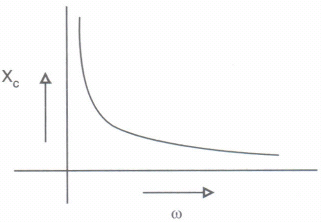
The magnitudes of the electric fields due to the two charges + q and - q are given by
\(E_{+q} = \frac{q}{4\pi\epsilon_0}\frac{1}{r^2+2a^2}\)
\(E_{-q} = \frac{q}{4\pi\epsilon_0}\frac{1}{r^2+2a^2}\)
and both are equal The directions of E+q and E-q are as shown in fig. Clearly, the components normal to the dipole axis cancel away. The components along the dipole axis add up. The total electric field is opposite to \(\hat{p}\) . We have
E = - (E+q+ E-q) cos \(\theta\) \(\hat{p}\)
\(= \frac{-2qa}{4\pi\epsilon_0(r^2+a^2)^\frac{3}{2}} \hat{p}\)
At large diatances (r > > a), this reduces to
\(= \frac{-2qa}{4\pi\epsilon_0(r^3)} \hat{p}\) (r > > a)
Thus, the graph takes the form as shown below:
.png)
Electric dipole of charges +q and -q separated by distance 2a is shown in figure. It is placed in uniform electric field at an angle \(\theta\) with it.
.png)
Torque on dipole= force x perpendicular distance
= qE x 2a sin\(\theta\)
= 2 qa E sin \(\theta\)
= pEsin \(\theta\)
\(\overrightarrow\tau = \overrightarrow{p}\times\overrightarrow{E}\)
7.
(i) \(\frac { \left( 2\sqrt { 2 } +1 \right) q }{ 8\Pi \varepsilon { \alpha }^{ 2 } } \)
(ii) 19.4 N , 21.80 above X-axis
8.
\(We \ know \ that,{ E }_{ axial }=\frac { 1 }{ 4\pi { \varepsilon }_{ 0 } } .\frac { 2\rho r }{ { ({ r }^{ 2 }-{ r }^{ 2 }) }^{ 2 } } \)
\(CaseI,\)
\( When \ r=10cm=0.1m\)
\(\\ { E }_{ axial }=3.75\times { 10 }^{ 5 }N/C\)
\(\\ 3.75\times { 10 }^{ 5 }=9\times { 10 }^{ 5 }\times \frac { 2\rho \times 0.1 }{ { { [(0.1) }^{ 2 }-{ a }^{ 2 }] }^{ 2 } } \ .....(i)\)
\(Case \ II,\)
\( When \ r=20cm=0.2m\)
\(\\ { E }_{ axial }=3\times { 10 }^{ 4 }\times \frac { 2\rho \times 0.2 }{ { { [(0.2) }^{ 2 }-{ a }^{ 2 }] }^{ 2 } } \ .......(ii)\)
Solving the Eqs. (i) and (ii), we get
a = 0.05 m
Therefore, lemgth of the dipole is 2z.
So, 2a = 2 x 0.05
or 2a = 0.1 m
9.
(i) (a) When a capacitor is placed in an external electric field, the free charges present inside the conductor redistribute themselves in such a manner that electric field within the conductor. This happens until a static situation is achieved,i.e. when the two fields cancel each other and the net electrostatic field in the conductor becomes zero.
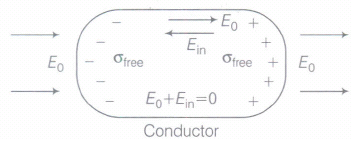
(b) In contrast to conductors, dielectrics are non-conducting substance, i.e. they have no charge carriers.Thus, in a dielectric, free movement of charges in not possible.It turns out that the external field induces dipole moment by stretching molecules of the dielectric.
The collective effect of all the molecular dipole moments is the net charge on the surface of the dielectric which produces a field that opposes the external field. However, the opposing field is so induced, that does not exactly cancel the extent of the effect depends on the nature of dielectric.
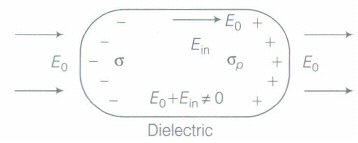
Both polar and non-polar dielectrics develop net dipole moment in the presence of an external field. The dipole moment per unit volume is called polarisation and is denoted by P for linear isotropic dielectrics.
P = XE
Where, X is constant of proportionality and is called electric susceptibility of the electric slab.
(ii) (a) At point C, inside the shell. Electric field inside a spherical shell is zero.
Thus, the force experienced by charge at centre C will also be zero.
\(\because \) Fc = qE (Einside the shell = 0)
\(\therefore \) Fc = 0
At point A, | FA | = 2Q \(\left[ \frac { 1 }{ { 4\pi \varepsilon }_{ 0 } } .\frac { 3Q/2 }{ { x }^{ 2 } } \right] \\.\)
\( F \ = \ \frac { { 3Q }^{ 2 } }{ { { 4\pi \varepsilon }_{ 0 } }{ x }^{ 2 } } ,\) away from shell
Electric flux through the shell,
\(\Phi =\frac { 1 }{ { \varepsilon }_{ 0 } } \) x magnitude of charge enclosed by shell
\(=\frac { 1 }{ { \varepsilon }_{ 0 } } \times \frac { Q }{ 2 } \Rightarrow \Phi =\frac { Q }{ { 2\varepsilon }_{ 0 } } \)

12th Standard CBSE Syllabus & Materials
12th Standard CBSE
CBSE 12th Computer Science Python Revision Tour I - New Previous year Question Papers Study Material - QB365 Set A
NEW12th Standard CBSE
CBSE 12th Business Studies Planning Important Questions And Answers Study Material - QB365 Set A
NEW12th Standard CBSE
CBSE 12th Business Studies Business Environment Important Questions And Answers Study Material - QB365 Set A
NEW12th Standard CBSE
CBSE 12th Business Studies Principles of Management Important Questions And Answers Study Material - QB365 Set A



CBSE 12th Standard CBSE Subjects
CBSE Standards










