
 100% FREE ACCESS
12th Standard CBSE Syllabus & Materials
12th Standard CBSE
CBSE 12th Economics Government Budget and the Economy Previous year Question Papers Study Material - QB365 Set A
NEW12th Standard CBSE
CBSE 12th Computer Science Interface Python with MySQL - New Previous year Question Papers Study Material - QB365 Set A
NEW12th Standard CBSE
CBSE 12th Computer Science Database Concept - New Previous year Question Papers Study Material - QB365 Set A
NEW12th Standard CBSE
CBSE 12th Computer Science Data Communication - New Previous year Question Papers Study Material - QB365 Set A
NEW12th Standard CBSE
CBSE 12th Computer Science Data Structures - New Previous year Question Papers Study Material - QB365 Set A
NEW12th Standard CBSE
CBSE 12th Computer Science Functions - New Previous year Question Papers Study Material - QB365 Set A

Published on: 24/09/2019
Magnetic Effects of Current
Download CBSE Class 12th Standard CBSE Physics question papers, sample papers, important questions, and previous year solved papers in PDF format. Get free study materials, NCERT solutions, and exam preparation resources for Class 12th Standard CBSE Physics
Questions + Answers key
Take MCQ Physics Test
1.
(i) Draw a schematic sketch of a cyclotron. Explain clearly the role of crossed electric and magnetic field in accelerating the charge. Hence, derive the expression for the kinetic energy acquired by the particles.
2.
(a) Draw a labelled diagram of a moving coil galvanometer. Describe briefly its principle and working.
(b) Answer the following:
(i) Why is it necessary to introduce a cylindrical soft iron core inside the coil of a galvanometer?
(ii) Increasing the current sensitivity of a galvanometer may not necessarily increase its voltage sensitivity. Explain, giving reason.
3.
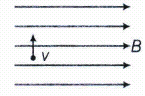
A monoenergetic(18kev) electron beam initially in the horizontal direction is subjected to a horizontal magnetic field of 0.4 passes normal to the initial direction.Estimate the up or down deflection of the beam over a distance of 30 cm.
\((mc=9.11\times 10-19C).\)
4.
(i) Using Ampere's circuital law, derive the expression for the magnetic field in the vector from at a point on the axis of solenoid.
(ii) What does a toroid consist of? Find out the expression for the magnetic field inside a toroid for N turns of the coil having the average radius r and carrying a current I.Show that the magnetic field in the open space interior and exterior to the toroid is zero.
5.
Explain using a labelled diagram, the principle and working of a moving coil galvanometer. What is the function of
(i) uniform radial magnetic field
(ii) soft iron core?
Also, define the terms
(iii) current sensitivity and
(iv) voltage sensitivity of a galvanometer.
Why does increasing the current sensitivity not necessarily increase voltage sensitivity?
6.
Find the expression for maximum energy of a charged particle accelerated by a cyclotron.
7.
Discuss the sensitivity of a moving coil galvanometer.
8.
How are materials classified according to their behaviour in magnetic field?
9.
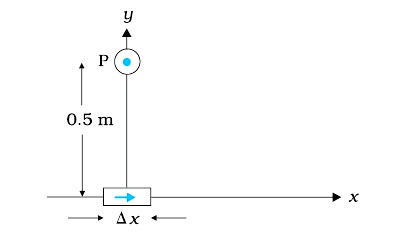
An element Δl = Δx \(\hat i\) is placed at the origin and carries a large current I = 10 A (Figure). What is the magnetic field on the y-axis at a distance of 0.5 m. Δ x = 1 cm.
1.
(ii) (a) Let the mass of proton = m; charge of proton = q, mass of a-particle = 4m
Charge of α-particle = 2q
Cyclotron frequency,
\(v=\frac{Bq}{2\pi m} \Rightarrow v \propto \frac{q}{m}\)
For proton frequency, vp\(\propto \frac{q}{m}\)
For α-particle,
Frequency, va \(\propto \frac{2q}{4m}\)
or va \(\propto \frac{q}{2m}\)
Thus, particles will not accelerate with same cyclotron frequency. The frequency of proton is twice than the frequency of α-particle.
(b) Velocity, \(v=\frac{Bqr}{m} \Rightarrow v \propto \frac{q}{m}\)
For proton velocity, \(v_p \propto \frac{q}{m}\)
For α-particle,
Velocity, v a \(\propto \frac{2q}{4m}\) or v a \(\propto \frac{q}{2m}\)
Thus, particles will not exit the dees with same velocity. The velocity of proton is twice than the velocity of α-particles.
2.
Principle and working: A current carrying coil, placed in a uniform magnetic field, (can) experience a torque.
Consider a rectangular coil for which no. of turns = N
rea of cross-section = 1 x b = A,
Intensity of the uniform magnetic field = B,
Current through the coil = I
∴ Deflecting torque = \(BIl \times b=BIA\)
For N turns \(\tau\) = NBIA
Restoring torque in the spring = k\(\theta\)
(k = restoring torque per unit twist)
\(\therefore NBIA=k\theta\)
\(\therefore I=(\frac{k}{NBA})\theta\)
\(\therefore I\alpha \theta\)
The deflection of the coil, is therefore, proportional to the current flowing through it.
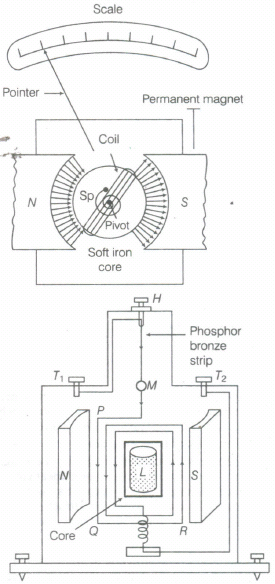
(b) the soft iron core not only makes the field radial but also increase the strength of the magnetic field
(ii) We have
\(Current sensitivity =\frac{\theta}{I}=NBA/k\)
Voltage sensitivity =\(\frac{\theta}{V}=\frac{\theta}{IR}=(\frac{NBA}{K}).\frac{1}{R}{ 1/2}\)
It follows that an increase in current sensitivity may not necessarily increase the voltage sensitivity.
3.
\(E=18keV=18\times { 10 }^{ 3 }\times 1.6\times { 10 }^{ -19 }J\)
[eV = 1.6 x10⁻¹⁹J]
\( =8\times 1.6\times { 10 }^{ -16 }\)
Let velocity of an electron be v.
Magnetic field, B = 0.4 gauss =\(0.4\times { 10 }^{ -4 } \ T\)
Distance = 30 cm =0.3
Mass of electron, \({ m }_{ e }=9.1\times { 10 }^{ -31 }kg\)
Energy of electron, \(E=\frac { 1 }{ 2 } m{ v }^{ 2 }\)
\(18\times 1.6\times { 10 }^{ -16 }=\frac { 1 }{ 2 } \times 9.1\times { 10 }^{ -31 }{ v }^{ 2 }\)
\(v=0.795\times { 10 }^{ 8 }\quad m/s\)
Let the electron beam defects along a circular path of radius r.The magnetic force applied on the electron provides the centripetal force.
\(evB=\frac { { mv }^{ 2 } }{ r } \left[ { B }_{ y }F=q\left( v\times B \right) \right] \); between \(\left( v\times B \right) \) 900
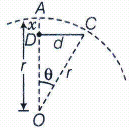
OA = r = OC;DC = d = 30cm
\(r=\frac { mv }{ Be } =\frac { 9.1\times { 10 }^{ -31 }\times 0.795\times { 10 }^{ 8 } }{ 0.4\times { 10 }^{ -4 }\times 1.6\times { 10 }^{ -19 } } =11.3m\)
Let the deflection be AD = x.
From\(\Delta DCO, \ sin\theta =\frac { DC }{ OC } =\frac { d }{ r } =\frac { 0.3 }{ 11.3 }\Rightarrow \ \theta ={ 1.521 }^{ 0 }\)
and \(cos\theta =\frac { OD }{ OC } =\frac { OD }{ r } \quad or\quad OD=rcos\theta \)
Deflection at the end of the path,
\(AD=x=AO-OD=r-rcos\theta =r\left( 1-cos\theta \right) \)
or x = 11.3(1-cos1.5210) = 0.0039m = 3.9mm
x = 4 mm
Thus, the up or down deflection of the beam is approximately 4 mm.
4.
(i) Figure shows, the longitudinal sectional View of long current carrying solenoid.
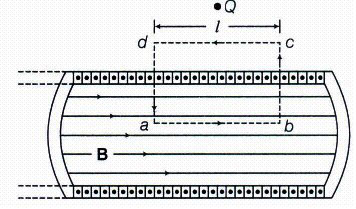
The current comes out of the plant of paper at point marked.B is the magnetic field at any point inside the solenoid.
Considering the rectangular closed path abcd.
applying Ampere's circuital law over loop abcd.
\(\oint { B } .dI={ \mu }_{ 0 }\times (total\ current\ passes\ through\ loop\ abcd)\)
\(\\ \int _{ a }^{ b }{ B } .D1+\int _{ b }^{ c }{ B } .d1+\int _{ c }^{ d }{ B } .d1+\int _{ d }^{ a }{ B } .d1={ \mu }_{ 0 }[(\frac { N }{ L } )li]\)
\(\\ where,\frac { N }{ L } =number\ of\ turns\ per\ unit\ length,\)
\(\\ ab=cd=l=length\ of\ rectangle\)
\(\\ \int _{ a }^{ b }{ Bdl } \cos { { 0 }^{ 0 } } +\int _{ b }^{ c }{ Bdl } Cos{ 90 }^{ 0 }+0+\int _{ b }^{ a }{ Bdl } cos{ 90 }^{ 0 }={ { \mu } }_{ 0 }(\frac { N }{ L } )li\)
\(\\ [\because cos{ 0 }^{ 0 }=1\quad and\quad cos{ 90 }^{ 0 }=0]\)
\(\\ B\int _{ a }^{ b }{ dl } ={ \mu }_{ 0 }(\frac { N }{ l } )li\)
\(\\ \Rightarrow B={ \mu }_{ 0 }(\frac { N }{ l } )i\quad or\quad B={ \mu }_{ 0 }ni\)
Where, a n = number of turns per unit length.
This is a required expression for magnetic field inside the long current carrying solenoid.
(ii)A solenoid bent into the form of closed loop is called toroid. The magnetic field B has a constant magnitude everywhere inside the toroid.
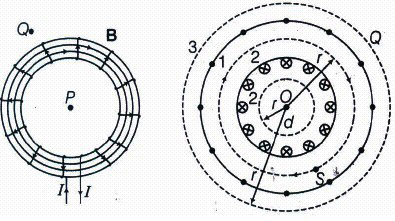
(a) Let magnetic field inside the toroid be B along the consider loop 1 as shown in the figure.
Applying ampere's circuital law,
\(\oint { B } .dI={ \mu }_{ 0 }(NI)\)
since, toroid of N turns, therads the loop 1, N times, each carrying current / inside the loop. Therefore, total current threading the loop.Therefore, total current threading the loop 1 is Ni
\(\Rightarrow { \oint { loop1 } }B.d1={ \mu }_{ 0 }\quad NI\Rightarrow B\oint { loop1 } d1={ \mu }_{ 0 }\quad NI\)
\(\\ B\times 2\pi r={ \mu }_{ 0 } \ NI \ or \ B=\frac { { \mu }_{ 0 }NI }{ 2\pi r } \)
(b)The magnetic field inside the open space interior of the toroid Let the loop 2 be which in the open space inside the toroid.
\( \therefore \) By Ampere's circuital law,
\(\oint { loop2 } B.dl={ \mu }_{ 0 }(\theta )=0\)
\(\\\Rightarrow d B=0\)
the magnetic field in the open space exterior of the toroid Let us consider a coplanar loop 3 in the open space of exterior of the toroid. Here, each turn of toroid threads the loop two times in opposite direction
therefore, net current threading the loop
\(=NI-NI=0\)
\(\\ \oint { loop3 } B.dl={ \mu }_{ 0 }(NI-NI)=0\)
\(\\ \Rightarrow B=0\)Thus, there is no magnetic field in the open space interior and exterior of the toroid.
5.
Current sensitivity, \({ I }_{ s }=\frac { NAB }{ k } \) and
Voltage sensitivity, \(V_{ s }=\frac { NAB }{ kR } \)
Since, the resistance of the coil may vary, it implies an increase in current sensitivity may not necessarily increase voltage sensitivity.
Thus, the trajectory of both the particles will be same.
6.
Let \({ r }_{ 0 }=\) Maximum radius of circular path followed by charged particle (Equal to the radius of the Dees)
\({ v }_{ 0 }=\) Maximum velocity
Since the necessary centripetal force is provided by the Lorentz magnetic force, therefore,
\( \frac { { m{ v }_{ 0 } }^{ 2 } }{ { r }_{ 0 } } =Bq{ v }_{ 0 }\)
\({ v }_{ 0 }=\frac { Bqr_{ 0 } }{ m }\)
\( \\ \therefore \ { K.E }_{ maxi }=\frac { 1 }{ 2 } \times m\times { \left( \frac { Bqr_{ 0 } }{ m } \right) }^{ 2 }\)
\(=\frac { { b }^{ 2 }{ q }^{ 2 }{ r_{ 0 } }^{ 2 } }{ 2m } \)
This is the required result.
7.
A galvanometer is said to be sensitive, if it gives a large deflection, even when a small voltage is applied cross its coil.
Current sensitivity. It is defined as the deflection produced in the galvanometer on passing unit current through its coil. Therefore,
Current sensitivity \(=\frac { \theta }{ 1 } =\frac { nBA }{ k } \)
Voltage sensitivity. It is defined as the deflection produced in produced in the galvanometer when a unit voltage is applied across its coil. Therefore V, then Voltage sensitivity \(=\frac { \theta }{ V } \)
If R is resistance of coil and I is current that passes through coil on applying voltage V, then \(V=IR\)
\(\therefore \) Voltage sensitivity \(=\frac { \theta }{ IR } =\frac { nBA }{ kR } \)
Thus, a galvanometer will be highly sensitive, if (i) n is large ; (ii) B is large ; (iii) A is large ; (iv) R is small and (v) k is small.
However, n and A cannot be increased beyond certain limit otherwise, the sixe of the galvanomert and the resistance of the instrument will become large. Therefore, B is made as large as possible. To increase B, very strong permanent magnet is used. The suspension wire is made of phosphor bronze, as for this material, k is very small. The value of k further decreases, if the wire is hammered into flat strip. In very sensitive galvanometers, quartz k, is still smaller.
8.
On the basis of their in a magnetic field, the various materials can be classified in three classes.
(i) Diamagnetic: Those materials, which when placed in a magnetic field, are feebly magnetised in a direction opposite to the magnetising field are called diamagnetic substances.A few examples of diamagnetic materials are copper, zinc, bismuth, water, sodium chloride, helium, argon etc.
When a diamagnetic substance is suspended in a magnetic field, it arranges itself in the direction of the magnetic field.
(ii) Paramagnetic: Those materials, which when placed in a magnetic field, are feebly magnetised in the direction of magnetic field, are called paramagnetic substances.A few examples of paramagnetic substances are aluminium, sodium, antimony, platinum, copper chloride, liquid oxygen etc.
When a paramagnetic substance is suspended in a magnetic field it arranges itself to the direction of magnetic field.
(iii) Ferromagnetic: Those materials which when placed in a magnetic field are strongly magnetised in the direction of the magnetising field, are ferromagnetic substances.A few examples of ferromagnetic substances are iron, nickel, cobalt, alnico, mercury etc.
9.
\(|\mathrm{dB}|=\frac{\mu_{0}}{4 \pi} \frac{I \mathrm{~d} l \sin \theta}{r^{2}}\)
dl = Δx = 10−2m , I = 10 A, r = 0.5 m = y, \(\mu_{0} / 4 \pi=10^{-7} \frac{\mathrm{T} \mathrm{m}}{\mathrm{A}}\) θ = 90° ; sin θ = 1
\(|\mathrm{dB}|=\frac{10^{-7} \times 10 \times 10^{-2}}{25 \times 10^{-2}}=4 \times 10^{-8} \mathrm{~T}\)
The direction of the field is in the +z-direction. This is so since
\(\mathrm{d} \mathbf{l} \times \mathbf{r}=\Delta x \hat{\mathbf{i}} \times y \hat{\mathbf{j}}=y \Delta x(\hat{\mathbf{i}} \times \hat{\mathbf{j}})=y \Delta x \hat{\mathbf{k}}\)
We remind you of the following cyclic property of cross-products
\(\hat{\mathbf{i}} \times \hat{\mathbf{j}}=\hat{\mathbf{k}} ; \hat{\mathbf{j}} \times \hat{\mathbf{k}}=\hat{\mathbf{i}} ; \hat{\mathbf{k}} \times \hat{\mathbf{i}}=\hat{\mathbf{j}}\)
Note that the field is small in magnitude.

12th Standard CBSE Syllabus & Materials
12th Standard CBSE
CBSE 12th Computer Science Python Revision Tour I - New Previous year Question Papers Study Material - QB365 Set A
NEW12th Standard CBSE
CBSE 12th Business Studies Planning Important Questions And Answers Study Material - QB365 Set A
NEW12th Standard CBSE
CBSE 12th Business Studies Business Environment Important Questions And Answers Study Material - QB365 Set A
NEW12th Standard CBSE
CBSE 12th Business Studies Principles of Management Important Questions And Answers Study Material - QB365 Set A



CBSE 12th Standard CBSE Subjects
CBSE Standards










