
 100% FREE ACCESS
12th Standard CBSE Syllabus & Materials
12th Standard CBSE
CBSE 12th Economics Government Budget and the Economy Previous year Question Papers Study Material - QB365 Set A
NEW12th Standard CBSE
CBSE 12th Computer Science Interface Python with MySQL - New Previous year Question Papers Study Material - QB365 Set A
NEW12th Standard CBSE
CBSE 12th Computer Science Database Concept - New Previous year Question Papers Study Material - QB365 Set A
NEW12th Standard CBSE
CBSE 12th Computer Science Data Communication - New Previous year Question Papers Study Material - QB365 Set A
NEW12th Standard CBSE
CBSE 12th Computer Science Data Structures - New Previous year Question Papers Study Material - QB365 Set A
NEW12th Standard CBSE
CBSE 12th Computer Science Functions - New Previous year Question Papers Study Material - QB365 Set A

Published on: 17/01/2020
Download CBSE Class 12th Standard CBSE Physics question papers, sample papers, important questions, and previous year solved papers in PDF format. Get free study materials, NCERT solutions, and exam preparation resources for Class 12th Standard CBSE Physics
Questions + Answers key
Take MCQ Physics Test
1.
The resolving power of telescope whose lens has a diameter of 1.22 m for a wavelength of 5000 A is
2 x 10⁵
2 x 10⁶
2 x 10²
2 x 10⁴
2.
A galvanometer of resistance \(25\Omega \) is connected to a battery of 2 volt along with a resistance in series. When the value of this resistance is \(3000\Omega ,\) a full scale deflection of 30 units is obtained in the galvanometer. In order to reduce this deflection 10 20 units, the resistance in series will be
\(4514\Omega \)
\(5413\Omega \)
\(2000\Omega \)
\(6000\Omega .\)
3.
A condenser is charged to double its initial potential. The energy stored in the condenser becomes x times, where x =
2
4
1
1/2
4.
A long straight wire of radius a carries a steady current i. The current is uniformly distributed across its cross-section. The ratio of the magnetic field at a/2 and 2 a is
1/2
1/4
4
1
5.
The de-Broglie wavelength of electron in ground state of hydrogen atom is:[The radius of the first orbit of hyfrogen atom is 0.53 \(\overset { \circ }{ A } \)
0.52\(\overset { \circ }{ A } \)
1.06\(\overset { \circ }{ A } \)
1.67\(\overset { \circ }{ A } \)
3.33\(\overset { \circ }{ A } \)
6.
Which of the following cannot be polarized?
X-rays
radio waves
sound waves
light waves
7.
Electric dipole moment is
scalar
neither scalar vector
a vector directed from -q to +q
a vector directed from +q to -q
8.
Given the value of Rydberg constant is \({ 10 }^{ 7 }{ m }^{ -1 }.\) The wave number of the last line of Balmer series in hydrogen spectrum will be
\(0.5\times { 10 }^{ 7 }{ m }^{ -1 }\)
\(0.25\times { 10 }^{ 7 }{ m }^{ -1 }\)
\(2.5\times { 10 }^{ 7 }{ m }^{ -1 }\)
\(0.025\times { 10 }^{ 4 }{ m }^{ -1 }\)
9.
For transistor amplifier,the voltage gain
remains constant for all frequencies
is high at high and low frequencies and constant in the middle frequency range
is low at high and low frequencies and constant at mid frequencies
None of the above
10.
Q factor of resonance is given by
\(\frac { 1 }{ R } \sqrt { \frac { L }{ C } } \)
\(\frac { 1 }{ R } \sqrt { \frac { C }{ L } } \)
\(\frac { 1 }{ L } \sqrt { \frac { R }{ C } } \)
\(\frac { 1 }{ C } \sqrt { \frac { L }{ R } } \)
11.
If \(\overset { \rightarrow }{ E } \) and \(\overset { \rightarrow }{ B } \) represent electric and magnetic field vectors of the electromagnetic wave the direction of propagation of electromagnetic wave is along
\(\overset { \rightarrow }{ E } \)
\(\overset { \rightarrow }{ B } \)
\(\overset { \rightarrow }{ B } \times \overset { \rightarrow }{ E } \)
\(\overset { \rightarrow }{ E } \times \overset { \rightarrow }{ B } \)
12.
A lens forms a real image of an object. The distance of the object to the lens is 4 cm and the distance of the image from the lens is v cm. The given graph shows the variation of v with u.
(i) What is the nature of the lens?
(ii) Using this graph, find the focal length of this lens.
13.
Mention the law, that which asserts that the electric field lines cannot form close loops?
14.
Two Capacitors of capacitace 6\(\mu \)F and 12\(\mu \)F ae connnected in series with tha battery the volatage across the 6\(\mu \)F capacitor is 2 volt, Compute the total battery voltage.
15.
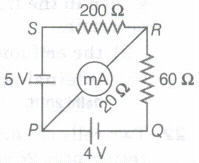
The network PQRS, shown in the circuit diagram, has the batteries of 4 V and 5 V and negligible internal resistance. A milliammeter of 20 Ω resistance is connected between P and R. Calculate the reading in the Millimetre.
16.
Draw the transfer characteristic curve of a base biased transistor in CE configuration. Explain 'clearly how the active region of the V0 versus V i curve in a transistor is used as an amplifier.
17.
How does a charge q oscillating at certain frequency produce electromagnetic waves?
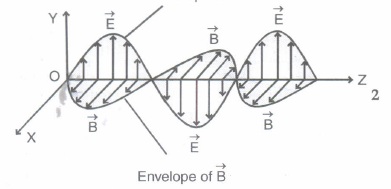
Sketch a schematic diagram depicting electric and magnetic fields for an electromagnetic wave propagating along the Z-direction.
18.
Can we give as much charge to a capacitor as we wish?
19.
Explain, why should the current be not passed through potentiometer wire for long time?
20.
Name the principle which is mathematical equivalent of coulomb's law and superposition principle.
21.
A voltmeter, an ammeter and a resistance are connected in series with a lead accumulator. The voltmeter gives some deflection but the deflection of ammeter is zero. comment
22.
Why is FM signal less suspectable to noise than an AM signal?
23.
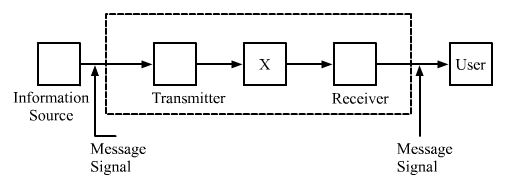
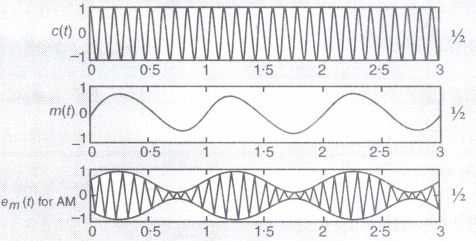
Write three important factors which justify the need of modulating a message signal. Show diagrammatically how an amplitude modulated wave is obtained when a modulating signal is superimposed on a carrier wave.
24.
Monochromatic light of frequency \(6.0\times { 10 }^{ 14 }Hz\) is produced by a laser.The power emitted is \(2.0\times { 10 }^{ -3 }W\).
(a) What is the energy of a photon in the light beam?
(b) How many photons per second, on the average, are emitted by the source?
Given \(h=6.63\times { 10 }^{ -34 }Js\)
25.
An electric field in an electromagnetic wave is given by \(E=200sin\frac { 2\pi }{ \lambda } (ct-x)N{ C }^{ -1}.\) Find the energy contained in a cylinder of cross section \(20 \ { cm }^{ 2 }\) length 40 cm along the x-axis
26.
What should be the distance between the object in Exercise and the magnifying glass if the virtual image of each square in the figure is to have an area of 6.25 mm2 . Would you be able to see the squares distinctly with your eyes very close to the magnifier?
27.
(i) If f = 0.5 m for a glass lens, what is the power of the lens?
(ii) The radii of curvature of the faces of a double convex lens are 10 cm and 15 cm. Its focal length is 12 cm. What is the refractive index of glass?
(iii) A convex lens has 20 cm focal length in air. What is focal length in water? (Refractive index of air-water = 1.33, refractive index for air-glass = 1.5.)
28.
(a) A point object is placed in front of a double convex lens (of refractive index n =n2/n1 with respect air) with its spherical faces of radii of curvature R1 and R2.. Show the path of rays due to surface to obtain the formation of the real image of the object.
Hence obtain the lens maker's formula for a thin lens.
(b) A double convex lens having both faces of the same radius of curvature has refractive index 1.55. Find out the radius of curvature of the lens required to get the focal length of 20 cm.
29.
A resistor of 12\(\Omega \), a capacitor of reactance 14 ohm and a pure inductor of inductance 0.1H are joined in series and placed across 200V, 50Hz a.c. supply. Calculate
(i) current in the circuit
(ii) phase angle between current and voltage. Take \(\pi\) = 3
30.
Two waves A and B of frequencies 2 MHz to 3 MHz, respectively are beamed in the same direction for communication via sky wave. Which one of these is likely to travel longer distance in the ionosphere before suffering total internal reflection?
1.
(b)
2 x 10⁶
2.
(a)
\(4514\Omega \)
3.
(b)
4
4.
(d)
1
5.
(d)
3.33\(\overset { \circ }{ A } \)
6.
(c)
sound waves
7.
(c)
a vector directed from -q to +q
8.
(b)
\(0.25\times { 10 }^{ 7 }{ m }^{ -1 }\)
9.
(c)
is low at high and low frequencies and constant at mid frequencies
10.
(a)
\(\frac { 1 }{ R } \sqrt { \frac { L }{ C } } \)
11.
(a)
\(\overset { \rightarrow }{ E } \)
12.
(i) As the lens forms a real iamge, it must be a convex lens.
(ii) From the graph, when u = 20 cm , we have v = 20 cm.
For the convex lens forming a real iamge, u is negative and v and f are positive.
U = -20 cm v = +20cm
Using this lens formula,
1/f = 1/v – 1/u = 1/20 – 1/-20 = 1/10 or f = + 10 cm
13.
Gauss’s law
14.
V = V1 + V2
Q = C1V = 6 x 10-6 x 2 = 12\(\mu \)C
As C2 is in series same amount of charge will also flow through it now V2 = Q/C2 = (12 x 10-6) /(12 x 10-6) = 1 volt
Total Battery voltage, V = 2 + 1 = 3 Volt
15.
Let us redraw circuit as shown.
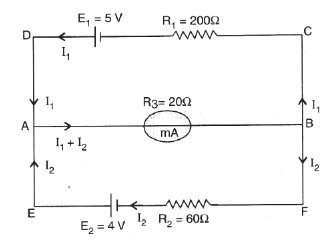
Using Kirchoff's voltage law in closed loop DABCD
\(\left( { I }_{ 1 }+{ I }_{ 2 } \right) { R }_{ 3 }+{ I }_{ 1 }{ R }_{ 1 }-{ E }_{ 1 }=0\) ..........(1)
In a closed loop ABFEA
\(\left( { I }_{ 1 }+{ I }_{ 2 } \right) { R }_{ 3 }+{ I }_{ 2 }{ R }_{ 2 }-{ E }_{ 2 }=0\) .........(2)
Multiplying (1) by (R2 + R3) and (2) by R3 and subtracting, we get
\({ I }_{ 1 }=\frac { { E }_{ 1 }{ R }_{ 2 }+{ E }_{ 1 }{ R }_{ 1 }-{ E }_{ 2 }{ R }_{ 3 } }{ { R }_{ 1 }{ R }_{ 2 }+{ R }_{ 2 }{ R }_{ 3 }+{ R }_{ 1 }{ R }_{ 3 } } \)
\(=\frac { 5\times 60+5\times 20-4\times 20 }{ 200\times 60+60\times 20+200\times 20 } \)
\(=\frac { 300+100-80 }{ 12000+1200+4000 } \)
\(=\frac { 320 }{ 17200 } A\)
Similarly,I2 =\(\frac { { E }_{ 2 }{ R }_{ 1 }+{ E }_{ 2 }{ R }_{ 3 }-{ E }_{ 1 }{ R }_{ 3 } }{ { R }_{ 1 }{ R }_{ 2 }+{ R }_{ 2 }{ R }_{ 3 }+{ R }_{ 1 }{ R }_{ 3 } } \)
= \(\frac { 4\times 200\times 4\times 20-5\times 20 }{ 200\times 60+60\times 20+200\times 20 } \)
= \(\frac { 800+80-100 }{ 17200 } =\frac { 780 }{ 17200 } A\)
\(\therefore\) Total current in mA
= \({ I }_{ 1 }+{ I }_{ 2 }\)
= \(\frac { 320 }{ 17200 } +\frac { 780 }{ 17200 } =\frac { 1100 }{ 17200 } \)
= \(\frac { 11 }{ 172 } A=0.06395A\)
= 63.95mA
= 64 mA (approx)
16.

In the active region, a (small) increase of Vi results in a (large, almost linear) increase in lc, This results in an increase in the voltage drop across Rc.
17.
An electric charge at rest has an electric field in the region around it, but no magnetic field. A moving charge, however, produces both electric and magnetic fields. If the charge is moving with constant velocity (that is, the current is not changing with time), the fields will not change with time and no electromagnetic wave can be produced. If, however, the motion of the charge is accelerated, the electric and the magnetic fields will change with space and time; then it produces electromagnetic waves. Hence we conclude that an accelerated charge emits electromagnetic waves.
In an oscillatory L-C circuit, charge oscillates across the capacitor plates. An oscillating charge has a non-zero acceleration; hence it emits electromagnetic wave of frequency same as that of the oscillating charge.
Shows the graphical representation of an electromagnetic wave in which the electric field.
vector \(\vec { E } \) and the magnetic field vector \(\vec { B } \) are vibrating along Y and X-directions respectively, and the wave is propagating along Z-direction. Both E and B vary with time and space and have the same frequency.
18.
No, the maximum charge that can be given to a capacitor is determined by the capacity of the condenser.
19.
If the current in potentiometer wire is passed for long time, the potentiometer wire will get heated. Its resistance will change. Due to it, the potential gradient per unit length of the wire will also change.
20.
Gauss's theorem of electrostatics.
21.
Voltmeter and resistance being very high when connected in series, makes the effective resistance of the circuit very high. Due to this, current in the circuit becomes extremely small.
22.
In amplitude modulation, the instaneous voltage of carrier waves is varied by the instaneous voltage of modulating waves. On transmission through a channel, noise signals can also added, resulting in changes in the amplitude of modulated wave. Due to it the receiver receives the modulating signal having a part of noise.
However, in frequency modulation, the frequency of carrier waves is changed as per instaneous voltage of modulating waves.This can only be done at the mixing or modulating stage and not while signal is transmitted in channel. Hence, noise does not affect FM signal. That is why FM signal is less susceptible to noise than an AM signal.
23.
(i) Practical Size of the antenna or aerial
(ii) Effective power radiated by an antenna
(iii) Mixing up of signals from different transmitters
24.
(a) Each photon has an energy
\(E=hv=6.63\times { 10 }^{ -34 }J s\times 6.0\times { 10 }^{ 14 }Hz\)
(b) If N is the number of photons emitted by the source per second, the power P transmitted in the beam equals N times the energy per photon E, so that P = N E. Then
\(n=\frac { P }{ E } =\frac { 2.0\times { 10 }^{ -3 }W }{ 3.98\times { 10 }^{ -19 }J } \)
\(=5.0\times { 10 }^{ 15 }\) photons per second.
25.
\(Here\ { E }_{ 0 }=200 \ N{ C }^{ -1 }\)
\( A=20 \ { cm }^{ 2 }=20\times { 10 }^{ -4 }{ m }^{ 2 };l=0.10 \ m\)
Vol. of cylinder, \(V=Al=(20\times { 10 }^{ -4 })\times 0.40=8\times { 10 }^{ -4 }{ m }^{ 2 }\)
Energy contained in cylinder is
U = volume × energy density
\(=v\times \frac { 1 }{ 2 } { \epsilon }_{ 0 }{ E }_{ 0 }^{ 2 }\)
\( =(8\times { 10 }^{ -4 })\times \frac { 1 }{ 2 } (8.85\times { 10 }^{ -12 })\times { (200) }^{ 2 }\)
\( =1.42\times { 10 }^{ -10 }J\)
26.
Area of the virtual image of each square, A = 6.25 mm2
Area of each square, A0 = 1 mm2
Hence, the linear magnification of the object can be calculated as:
\(m=\sqrt { \frac { A }{ { A }_{ o } } } \)
\(\sqrt { \frac { 6.25 }{ 1 } } =2.5\)
But m = \(\frac{Image \ distance \ (v)}{Object \ distance \ (u)}\)
∴ v = mu
= 2.5 u ....(1)
Focal length of the magnifying glass, f = 10 cm
According to the lens formula, we have the relation:
\(\frac { 1 }{ { f } } =\frac { 1 }{ { v } } -\frac { 1 }{ { u } } \)
\(\frac { 1 }{ 10 } =\frac { 1 }{ 2.5u } -\frac { 1 }{ u } =\frac { 1 }{ u } \left( \frac { 1 }{ 2.5 } -\frac { 1 }{ 1 } \right) =\frac { 1 }{ u } \left( \frac { 1-2.5 }{ 2.5 } \right) \)
\(\therefore u=-\frac { 1.5\times 10 }{ 2.5 } =-6\)
And v = 2.5u
= 2.5 x 6 = -15 cm
The virtual image is formed at a distance of 15 cm, which is less than the near point (i.e., 25 cm) of a normal eye. Hence, it cannot be seen by the eyes distinctly.
27.
(i) Power = +2 dioptre.
(ii) Here, we have f = +12 cm, R1 = +10 cm, R2 = -15 cm.
Refractive index of air is taken as unity.
We use the lens formula. The sign convention has to be applied for f, R1 and R2.
Substituting the values, we have
\(\frac { 1 }{ 12 } =(n-1)\left( \frac { 1 }{ 10 } -\frac { 1 }{ 15 } \right) \)
This gives n = 1.5.
(iii) For a glass lens in air, n2 = 1.5, n1 = 1, f = +20 cm. Hence, the lens formula gives
\(\frac { 1 }{ 20 } =0.5\left( \frac { 1 }{ { R }_{ 1 } } -\frac { 1 }{ { R }_{ 2 } } \right) \)
For the same glass lens in water, n2 = 1.5, n1 = 1.33. Therefore \(\frac { 1.33 }{ f } =(1.5-1.33)\left[ \frac { 1 }{ { R }_{ 1 } } -\frac { 1 }{ { R }_{ 2 } } \right] \)
Combining these two equations, we find f = + 78.2 cm.
28.
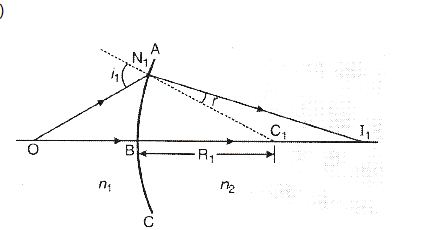
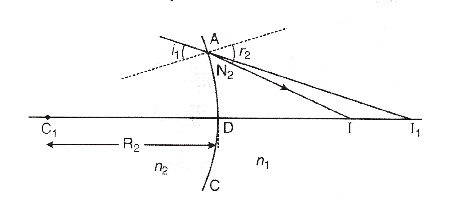
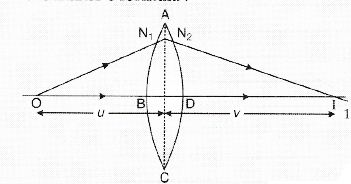
The first refracting ABC forms the image I1 of the object O. The image I1 acts as virtual object for the second refracting surface ADC, which forms the real image I as shown in the diagram
For refraction at ABC
\(\frac { { n }_{ 2 } }{ { v }_{ 1 } } -\frac { { n }_{ 1 } }{ u } =\frac { { n }_{ 2 }-{ n }_{ 1 } }{ { R }_{ 1 } } \)
For refraction at ADC
\(\frac { { n }_{ 1 } }{ v } -\frac { { n }_{ 2 } }{ { v }_{ 1 } } =\frac { { n }_{ 1 }-{ n }_{ 2 } }{ { R }_{ 2 } } \)
Adding equation (i) and equation (ii)
\(\frac { { n }_{ 1 } }{ v } -\frac { { n }_{ 2 } }{ u } =\left( { n }_{ 2 }-{ n }_{ 1 } \right) \left( \frac { 1 }{ { R }_{ 1 } } -\frac { 1 }{ { R }_{ 2 } } \right) \)
\(\frac { 1 }{ v } -\frac { 1 }{ u } =\left( \frac { { n }_{ 2 } }{ { n }_{ 1 } } -1 \right) \left( \frac { 1 }{ { R }_{ 1 } } -\frac { 1 }{ { R }_{ 2 } } \right) \)
We know, If \(u=\infty ,v=f\)
\(\frac { 1 }{ v } -\frac { 1 }{ u } =\frac { 1 }{ f } \)
\(\frac { 1 }{ f } =\left( \frac { { n }_{ 2 } }{ { n }_{ 1 } } -1 \right) \frac { 1 }{ { R }_{ 1 } } -\frac { 1 }{ { R }_{ 2 } } \)
\(\frac { 1 }{ f } =\left( { \mu }_{ 21 }-1 \right) \left( \frac { 1 }{ { R }_{ 1 } } -\frac { 1 }{ { R }_{ 2 } } \right) \)
\(\frac { 1 }{ f } =\left( { \mu }_{ 21 }-1 \right) \left( \frac { 1 }{ { R }_{ 1 } } -\frac { 1 }{ { R }_{ 2 } } \right) \)
\(\frac { 1 }{ f } =\left( 1.55-1 \right) \left( \frac { 1 }{ R } -\frac { 1 }{ -R } \right) \)
\(=0.55\times \frac { 2 }{ R } \)
\(R=0.55\times 2\times 20=22 \ cm\)
29.
\(Here, \ R=12\Omega , \ { X }_{ C }=14ohm, \ L=0.1H\)
\({ E }_{ v }=20V, \ v=50hz, \ { I }_{ v }=?, \ \phi =?\)
\( { X }_{ L }=\omega L=2\pi vL=2\times 3\times 50\times 0.1=30 \ ohm\)
\(Z=\sqrt { { R }^{ 2 }+\left( X_{ L }-{ X }_{ C } \right) ^{ 2 } } =\sqrt { { 12 }^{ 2 }+\left( 30-14 \right) ^{ 2 } } =20ohm\)
\({ I }_{ v }=\frac { { E }_{ v } }{ Z } =\frac { 200 }{ 20 } =10A\)
\(tan\phi =\frac { { X }_{ L }-{ X }_{ C } }{ R } =\frac { 30-14 }{ 12 } =1.33\)
\( \phi ={ tan }^{ -1 }\left( 1.33 \right) =53.13^{ \circ }\)
30.
()
We know that refractive index \(\mu\) of a medium is related with wavelength of wave according to relation
\(\mu =A+\frac { B }{ { \lambda }^{ 2 } } +\frac { C }{ { \lambda }^{ 4 } } =\frac { \sin { i } }{ \sin { r } } \ and \ \lambda =\frac { c }{ v } \)
Therefore, the value of refractive index \(\mu\) of a medium increases with the decrease in wavelength or increase in frequency of wave travelling through medium. For higher frequency wave, angle of refraction r is less, i.e., bending of wave is less in medium. Due to it, the condition for total internal reflection is attained after travelling longer distance by higher frequency wave. Hence 3 MHz wave will travel longer distance in the ionosphere before suffering total internal reflection.

12th Standard CBSE Syllabus & Materials
12th Standard CBSE
CBSE 12th Computer Science Python Revision Tour I - New Previous year Question Papers Study Material - QB365 Set A
NEW12th Standard CBSE
CBSE 12th Business Studies Planning Important Questions And Answers Study Material - QB365 Set A
NEW12th Standard CBSE
CBSE 12th Business Studies Business Environment Important Questions And Answers Study Material - QB365 Set A
NEW12th Standard CBSE
CBSE 12th Business Studies Principles of Management Important Questions And Answers Study Material - QB365 Set A



CBSE 12th Standard CBSE Subjects
CBSE Standards










