
 100% FREE ACCESS
12th Standard CBSE Syllabus & Materials
12th Standard CBSE
CBSE 12th Economics Government Budget and the Economy Previous year Question Papers Study Material - QB365 Set A
NEW12th Standard CBSE
CBSE 12th Computer Science Interface Python with MySQL - New Previous year Question Papers Study Material - QB365 Set A
NEW12th Standard CBSE
CBSE 12th Computer Science Database Concept - New Previous year Question Papers Study Material - QB365 Set A
NEW12th Standard CBSE
CBSE 12th Computer Science Data Communication - New Previous year Question Papers Study Material - QB365 Set A
NEW12th Standard CBSE
CBSE 12th Computer Science Data Structures - New Previous year Question Papers Study Material - QB365 Set A
NEW12th Standard CBSE
CBSE 12th Computer Science Functions - New Previous year Question Papers Study Material - QB365 Set A

Published on: 11/10/2019
Ray Optics and Optical Instruments
Download CBSE Class 12th Standard CBSE Physics question papers, sample papers, important questions, and previous year solved papers in PDF format. Get free study materials, NCERT solutions, and exam preparation resources for Class 12th Standard CBSE Physics
Questions + Answers key
Take MCQ Physics Test
1.
A Cassegrain telescope uses two mirrors as shown in Fig.Such a telescope is built with the mirrors 20mm apart. If the radius of curvature of the large mirror is 220mm and the small mirror is 140mm, where will the final image of an object at infinity be?
2.
An angular magnification (magnifying power) of 30X is desired using an objective of focal length 1.25cm and an eyepiece of focal length 5cm. How will you set up the compound microscope?
3.
What should be the distance between the object in Exercise and the magnifying glass if the virtual image of each square in the figure is to have an area of 6.25 mm2 . Would you be able to see the squares distinctly with your eyes very close to the magnifier?
4.
An object of size 3.0cm is placed 14cm in front of a concave lens of focal length 21cm. Describe the image produced by the lens. What happens if the object is moved further away from the lens?
5.
A small bulb is placed at the bottom of a tank containing water to a depth of 80cm. What is the area of the surface of water through which light from the bulb can emerge out? Refractive index of water is 1.33. (Consider the bulb to be a point source.)
6.
A 4.5 cm needle is placed 12 cm away from a convex mirror of focal length 15 cm. Give the location of the image and the magnification. Describe what happens as the needle is moved farther from the mirror.
7.
Suppose while sitting in a parked car, you notice a jogger approaching towards you in the side view mirror of R = 2 m. If the jogger is running at a speed of 5 m s-1, how fast the image of the jogger appear to move when the jogger is (a) 39 m, (b) 29 m, (c) 19 m, and (d) 9 m away.
8.
A small pin fixed on a table top is viewed from above from a distance of 50cm. By what distance would the pin appear to be raised if it is viewed from the same point through a 15cm thick glass slab held parallel to the table? Refractive index of glass = 1.5. Does the answer depend on the location of the slab?
9.
A small telescope has an objective lens of focal length 144cm and an eyepiece of focal length 6.0cm. What is the magnifying power of the telescope? What is the separation between the objective and the eyepiece?
10.
What is the focal length of a convex lens of focal length 30cm in contact with a concave lens of focal length 20cm? Is the system a converging or a diverging lens? Ignore thickness of the lenses.
11.
Double-convex lenses are to be manufactured from a glass of refractive index 1.55, with both faces of the same radius of curvature. What is the radius of curvature required if the focal length is to be 20cm?
12.
A screen is placed 90cm from an object. The image of the object on the screen is formed by a convex lens at two different locations separated by 20cm. Determine the focal length of the lens.
1.
The following figure shows a Cassegrain telescope consisting of a concave mirror and a convex mirror.
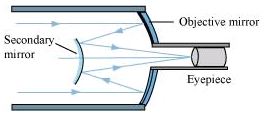
Distance between the objective mirror and the secondary mirror, d = 20 mm
Radius of curvature of the objective mirror, R1 = 220 mm
Hence, focal length of the objective mirror, \({ f }_{ 1 }=\frac { { R }_{ 1 } }{ 2 } =110\)
Radius of curvature of the secondary mirror, R1 = 140 mm
Hence, focal length of the secondary mirror, \({ f }_{ 2 }=\frac { { R }_{ 2 } }{ 2 } =\frac { 140 }{ 2 } \) = 70 mm
The image of an object placed at infinity, formed by the objective mirror, will act as a virtual object for the secondary mirror.
Hence, the virtual object distance for the secondary mirror, u = f1 - d
= 110 - 20
= 90 mm
Applying the mirror formula for the secondary mirror, we can calculate image distance (v) as:
\(\frac { 1 }{ v } +\frac { 1 }{ u } =\frac { 1 }{ { f }_{ 2 } } \)
\(\frac { 1 }{ v } =\frac { 1 }{ { f }_{ 2 } } -\frac { 1 }{ u } \)
\(\frac { 1 }{ 70 } -\frac { 1 }{ 90 } =\frac { 9-7 }{ 630 } =\frac { 2 }{ 630 } \)
∴ v = \(\frac{630}{2}\) = 315 mm
Hence, the final image will be formed 315 mm away from the secondary mirror.
2.
Focal length of the objective lens, fo = 1.25 cm
Focal length of the eyepiece, fe = 5 cm
Least distance of distinct vision, d = 25 cm
Angular magnification of the compound microscope = 30X
Total magnifying power of the compound microscope, m = 30
The angular magnification of the eyepiece is given by the relation:
\({ m }_{ e }=\left( 1+\frac { d }{ { f }_{ e } } \right) \)
\(=\left( 1+\frac { 25 }{ 5 } \right) =6\)
The angular magnification of the objective lens (mo) is related to me as:
mo me = m
mo = \(\frac { m }{ { m }_{ c } } \)
\(=\frac { 30 }{ 6 } \) = 5
We also have the relation:
mo = \(\frac{Image \ distance \ for \ the \ objective \ lens (v_o)}{ Object \ distace \ for \ the \ objective \ lens (u_o)}\)
\(5=\frac { { v }_{ o } }{ -{ u }_{ o } } \)
∴ vo = -5uo .........(1)
Applying the lens formula for the objective lens:
\(\frac { 1 }{ { f }_{ o } } =\frac { 1 }{ { v }_{ o } } -\frac { 1 }{ { u }_{ o } } \)
\(\frac { 1 }{ 1.25 } =\frac { 1 }{ -5{ u }_{ o } } -\frac { 1 }{ { u }_{ o } } =\frac { -6 }{ 5{ u }_{ 0 } } \)
\(\therefore { u }_{ o }=\frac { -6 }{ 5 } \times 1.25=-1.5\) cm
And vo = -5uo
= -5 x (-1.5) = 7.5 cm
The object should be placed 1.5 cm away from the objective lens to obtain the desired magnification.
Applying the lens formula for the eyepiece:
\(\frac { 1 }{ { v }_{ e } } -\frac { 1 }{ { u }_{ e } } =\frac { 1 }{ { f }_{ e } } \)
Where,
ve = Image distance for the eyepiece = -d = -25 cm
ue = Object distance for the eyepiece
\(\frac { 1 }{ { u }_{ e } } =\frac { 1 }{ { v }_{ e } } -\frac { 1 }{ { f }_{ e } } \)
\(=\frac { -1 }{ 25 } -\frac { 1 }{ 5 } =-\frac { 6 }{ 25 } \)
∴ ue = -4.17 cm
Separation between the objective lens and the eyepiece = |ue| + |vo|
= 4.17 + 7.5
=11.67 cm
Therefore, the separation between the objective lens and the eyepiece should be 11.67 cm.
3.
Area of the virtual image of each square, A = 6.25 mm2
Area of each square, A0 = 1 mm2
Hence, the linear magnification of the object can be calculated as:
\(m=\sqrt { \frac { A }{ { A }_{ o } } } \)
\(\sqrt { \frac { 6.25 }{ 1 } } =2.5\)
But m = \(\frac{Image \ distance \ (v)}{Object \ distance \ (u)}\)
∴ v = mu
= 2.5 u ....(1)
Focal length of the magnifying glass, f = 10 cm
According to the lens formula, we have the relation:
\(\frac { 1 }{ { f } } =\frac { 1 }{ { v } } -\frac { 1 }{ { u } } \)
\(\frac { 1 }{ 10 } =\frac { 1 }{ 2.5u } -\frac { 1 }{ u } =\frac { 1 }{ u } \left( \frac { 1 }{ 2.5 } -\frac { 1 }{ 1 } \right) =\frac { 1 }{ u } \left( \frac { 1-2.5 }{ 2.5 } \right) \)
\(\therefore u=-\frac { 1.5\times 10 }{ 2.5 } =-6\)
And v = 2.5u
= 2.5 x 6 = -15 cm
The virtual image is formed at a distance of 15 cm, which is less than the near point (i.e., 25 cm) of a normal eye. Hence, it cannot be seen by the eyes distinctly.
4.
Size of the object, h1 = 3 cm
Object distance, u = -14 cm
Focal length of the concave lens, f = -21 cm
Image distance = v
According to the lens formula, we have the relation:
\(\frac { 1 }{ v } -\frac { 1 }{ u } =\frac { 1 }{ f } \)
\(\frac { 1 }{ v } =-\frac { 1 }{ 21 } -\frac { 1 }{ 14 } =\frac { -2-3 }{ 42 } =\frac { -5 }{ 42 } \)
\(\therefore v=-\frac { 42 }{ 5 } =-84cm\)
Hence, the image is formed on the other side of the lens, 8.4 cm away from it. The negative sign shows that the image is erect and virtual.
The magnification of the image is given as:
\(m=\frac { Image \ height({ h }_{ 2 }) }{ Object \ height({ h }_{ 1 }) } =\frac { -8.4 }{ -14 } \)
\(\therefore { h }_{ 2 }=\frac { -8.4 }{ -14 } \times 3=0.6\times 3=1.8\) cm
Hence, the height of the image is 1.8 cm
If the object is moved further away from the lens, then the virtual image will move toward the focus of the lens, but not beyond it. The size of the image will decrease with the increase in the object distance.
5.
Actual depth of the bulb in water, d1 = 80 cm = 0.8 m
Refractive index of water, μ = 1.33
The given situation is shown in the following figure:
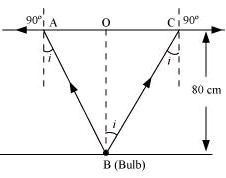
Where,
i = Angle of incidence
r = Angle of refraction = 90°
Since the bulb is a point source, the emergent light can be considered as a circle of radius, \(R=\frac { AC }{ 2 } =OA=OB\)
Using Snell’ law, we can write the relation for the refractive index of water as:
\({ \mu }=\frac { sin \ i }{ sin \ r } \)
\(1.33=\frac { sin{ 90 }^{ o } }{ sini } \)
\(\therefore i={ sin }^{ -i }\left( \frac { 1 }{ 1.33 } \right) =48.{ 75 }^{ o }\)
Using the given figure, we have the relation:
\(tan \ i=\frac { OC }{ OB } =\frac { R }{ { d }_{ 1 } } \)
∴ R = tan 48.75° × 0.8 = 0.91 m
∴ Area of the surface of water = πR2 = π (0.91)2 = 2.61 m2
Hence, the area of the surface of water through which the light from the bulb can emerge is approximately 2.61 m2.
6.
Height of the needle, h1 = 4.5 cm
Object distance, u = -12 cm
Focal length of the convex mirror, f = 15 cm
Image distance = v
The value of v can be obtained using the mirror formula:
\(\frac { 1 }{ u } +\frac { 1 }{ v } =\frac { 1 }{ f } \)
\(\frac { 1 }{ v } =\frac { 1 }{ f } -\frac { 1 }{ u } \)
\(\frac { 1 }{ 15 } +\frac { 1 }{ 12 } =\frac { 4+5 }{ 60 } =\frac { 9 }{ 60 } \)
∴ v = \(\frac { 60 }{ 9 } \) = 6.7 cm
Hence, the image of the needle is 6.7 cm away from the mirror. Also, it is on the other side of the mirror.
The image size is given by the magnification formula:
\(m=\frac { { h }_{ 2 } }{ { h }_{ 1 } } =-\frac { u }{ v } \)
\(\therefore { h }_{ 2 }=-\frac { v }{ u } \times { h }_{ 1 }\)
\(=\frac { -6.7 }{ -12 } \times 4.5=+2.5\)cm
Hence, magnification of the image, \(m=\frac { { h }_{ 2 } }{ { h }_{ 1 } } =\frac { 2.5 }{ 4.5 } =0.56\)
The height of the image is 2.5 cm. The positive sign indicates that the image is erect, virtual, and diminished.
If the needle is moved farther from the mirror, the image will also move away from the mirror, and the size of the image will reduce gradually.
7.
From the mirror equation, Eq., we get \(v=\frac{f u}{u-f}\)
For convex mirror, since \(R=2 \mathrm{~m}, f=1 \mathrm{~m}\). Then for \(u=-39 \mathrm{~m}, v=\frac{(-39) \times 1}{-39-1}=\frac{39}{40} \mathrm{~m}\)
Since the jogger moves at a constant speed of \(5 \mathrm{~m} \mathrm{~s}^{-1}\), after 1 s the position of the image v (for \(u=-39+5=-34)\) is (34 / 35) m.
The shift in the position of image in 1 s is \(\frac{39}{40}-\frac{34}{35}=\frac{1365-1360}{1400}=\frac{5}{1400}=\frac{1}{280} \mathrm{~m}\)
Therefore, the average speed of the image when the jogger is between 39 m and 34 m from the mirror, is (1/280) m s–1 Similarly, it can be seen that for u = –29 m, –19 m and –9 m, the speed with which the image appears to move is
\(\frac{1}{150} \mathrm{~m} \mathrm{~s}^{-1}, \frac{1}{60} \mathrm{~ms}^{-1} \text { and } \frac{1}{10} \mathrm{~ms}^{-1} \text {, respectively. }\)
Although the jogger has been moving with a constant speed, the speed of his/her image appears to increase substantially as he/she moves closer to the mirror. This phenomenon can be noticed by any person sitting in a stationary car or a bus. In case of moving vehicles, a similar phenomenon could be observed if the vehicle in the rear is moving closer with a constant speed.
8.
Actual depth of the pin, d = 15 cm
Apparent dept of the pin = d'
Refractive index of glass, μ = 1.5
Ratio of actual depth to the apparent depth is equal to the refractive index of glass, i.e.
μ = \(\frac { d }{ { d }^{ ' } } \)
∴ d' = \(\frac { d }{ \mu } \)
= \(\frac{15}{1.5}\) = 10 cm
The distance at which the pin appears to be raised = d' - d
= 15 - 10 = 5 cm
For a small angle of incidence, this distance does not depend upon the location of the slab.
9.
Focal length of the objective lens, fo = 144 cm
Focal length of the eyepiece, fe = 6.0 cm
The magnifying power of the telescope is given as:
m = \(\frac{f_o}{f_c}\)
= \(\frac{144}{6}\) = 24
The separation between the objective lens and the eyepiece is calculated as:
fo + fe
= 144 + 6 = 150 cm
Hence, the magnifying power of the telescope is 24 and the separation between the objective lens and the eyepiece is 150 cm.
10.
Given, focal length of convex lens, f1 = 30 cm
Focal length of the concave lens, f2 = -20 cm
Using the formula of combination of lenses,
\(\frac{1}{f}=\frac{1}{f_{1}}+\frac{1}{f_{2}}=\frac{1}{30}-\frac{1}{20}=\frac{2-3}{60}=-\frac{1}{60}\)
\(\Rightarrow\) f = -60 cm
Since, the focal length of combination is negative in nature. so, the combination behaves like a diverging lens, i.e. as a concave lens.
11.
Refractive index of glass, μ
Focal length of the double-convex lens, f = 20 cm
Radius of curvature of one face of the lens = R1
Radius of curvature of the other face of the lens = R2
Radius of curvature of the double-convex lens = R The value of R can be calculated as:
∴ R1 = R and R2 = -R
The value of R can be calculated as:
\(\frac { 1 }{ f } =(\mu -1)\left[ \frac { 1 }{ { R }_{ 1 } } -\frac { 1 }{ { R }_{ 2 } } \right] \)
\(\frac { 1 }{ 20 } =(1.55)\left[ \frac { 1 }{ R } +\frac { 1 }{ R } \right] \)
\(\frac { 1 }{ 20 } =0.55\times \frac { 2 }{ R } \)
∴ R = 0.55 x 2 x 20 = 22 cm
Hence, the radius of curvature of the double-convex lens is 22 cm.
12.
Distance between the image (screen) and the object, D = 90 cm
Distance between two locations of the convex lens, d = 20 cm
Focal length of the lens = f
Focal length is related to d and D as:
f = \(\frac { { D }^{ 2 }-{ d }^{ 2 } }{ 4D } \)
= \(\frac { { (90) }^{ 2 }-({ 20) }^{ 2 } }{ 4\times 90 } =\frac { 770 }{ 36 } =21.3\) cm
Therefore, the focal length of the convex lens is 21.39 cm.

12th Standard CBSE Syllabus & Materials
12th Standard CBSE
CBSE 12th Computer Science Python Revision Tour I - New Previous year Question Papers Study Material - QB365 Set A
NEW12th Standard CBSE
CBSE 12th Business Studies Planning Important Questions And Answers Study Material - QB365 Set A
NEW12th Standard CBSE
CBSE 12th Business Studies Business Environment Important Questions And Answers Study Material - QB365 Set A
NEW12th Standard CBSE
CBSE 12th Business Studies Principles of Management Important Questions And Answers Study Material - QB365 Set A



CBSE 12th Standard CBSE Subjects
CBSE Standards










