
 100% FREE ACCESS
12th Standard CBSE Syllabus & Materials
12th Standard CBSE
CBSE 12th Economics Government Budget and the Economy Previous year Question Papers Study Material - QB365 Set A
NEW12th Standard CBSE
CBSE 12th Computer Science Interface Python with MySQL - New Previous year Question Papers Study Material - QB365 Set A
NEW12th Standard CBSE
CBSE 12th Computer Science Database Concept - New Previous year Question Papers Study Material - QB365 Set A
NEW12th Standard CBSE
CBSE 12th Computer Science Data Communication - New Previous year Question Papers Study Material - QB365 Set A
NEW12th Standard CBSE
CBSE 12th Computer Science Data Structures - New Previous year Question Papers Study Material - QB365 Set A
NEW12th Standard CBSE
CBSE 12th Computer Science Functions - New Previous year Question Papers Study Material - QB365 Set A

Published on: 30/08/2019
Electrostatics
Download CBSE Class 12th Standard CBSE Physics question papers, sample papers, important questions, and previous year solved papers in PDF format. Get free study materials, NCERT solutions, and exam preparation resources for Class 12th Standard CBSE Physics
Questions + Answers key
Take MCQ Physics Test
1.
Two metal spheres, one of radius R and the other of radius 2R, both have same surface charge density \(\sigma \). They are brought in contact and separated. What will be new surface charge densities on them?
2.
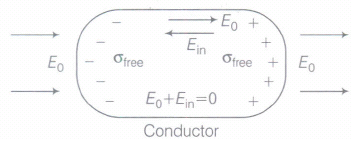
(i) Explain, using suitable diagram, the difference in the behaviour of a
(a) conductor
(b) dielectric in the presence of external electric field. Define the terms polarisation of a dielectric and write its relation with susceptibility.
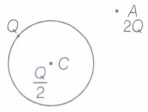
(ii) A thin metallic spherical shell of radius R carries a charge Q on its surface. A point charge Q/2 is placed at its centre C and an another charge +2Q is placed outside the shell at a distance x from the centre as shown in figure. Find
(a) the force on the charge at the centre of the shell and at point A,
(b) the electric flux through the shell.
3.
A 600 pF capacitor is charged by a 200 V supply. It is then disconnected from the supply and is connected to another uncharged 600 pF capacitor. How much electrostatic energy is lost in the process?
4.
A parallel plate capacitor with air between the plates has a capacitance of 8 pF (1pF = 10-12F). What will be the capacitance if the distance between the plates is reduced by half, and the space between them is filled with a substance of dielectric constant 6?
5.
Why do we obtain a neutral point in the space between two like charges ?
6.
State superposition principle for electrostatic force on a charge due to a number of charges.
7.
Give four properties of electric charges.
8.
Is the total charge of the universe conserved?
9.
What do you mean by additivity of electric charge?
10.
What is meant by quantization of charge?
11.
In a parallel plate capacitor with air between the plates, each plate has an area of 6\(\times\)10-3m2 and the distance between the plates is 3 mm. Calculate the capacitance if this capacitor. If this capacitor is connected to a 100 V supply, what is the charge on each plate of the capacitor?
12.
At a given distance from the centre of electic dipole, field intensity on axial line is k times the field intensity on equatorial line, where K =
2
3
4
1
13.
Electric field intensity (E) due to an electric dipole varies with distance (r) of the point from the centre of dipole as:
\(E\alpha {1\over r}\)
\(E\alpha{1\over r^4}\)
\(E\alpha{1\over r^2}\)
\(E\alpha {1\over r^3}\)
14.
At a particular point, electric field depends upon
Source charge Q only
test charge qo only
both Q and q0
neither Q nor qo
1.
Radius of sphere A = R
Surface charge density on sphere A = \(\sigma \)
Radius of sphere B = 2R
Surface charge density on sphere B = \(\sigma \)
Before contact, the charge on sphere A is
Q1 = Surface charge density x Surface area
\(\Rightarrow\) Q1 = \(\sigma \). \({ 4\pi R }^{ 2 }\quad \quad ...(i)\quad \quad \quad { }\)
Before contact, the charge on sphere B is
Q2 = Surface charge density x Surface area
Q2 = \(\sigma 4\pi { (2R) }^{ 2 }\ =\ \sigma .{ 16\pi R }^{ 2 } ...(ii)\quad \quad \quad { }\)
Let after the contact, the charge on A be Q'1 and the charge on B Q'2 .
According to the conservation of charge, the charge before contact is equal to charge after contact.
Q'1 + Q'2 = Q1 + Q2
Putting the values of Q1 and Q2 from Eqs. (i) and (ii), we get
Q'1 + Q'2 = \(4\pi { R }^{ 2 }\sigma +{ 16\pi R }^{ 2 }\sigma ={ 20\pi R }^{ 2 }\sigma \quad ...(iii)\quad \quad { }\)
As they are in contact. So, they have same potential.
Potential on sphere A is VA = \(\frac { 1 }{ { 4\pi \varepsilon }_{ 0 } } .\frac { { Q' }_{ 1 } }{ R } \)
Potential on sphere B is VB = \(\frac { 1 }{ { 4\pi \varepsilon }_{ 0 } } .\frac { { Q' }_{ 2 } }{ 2R } \)
So, VA = VB
\(\Rightarrow \ \frac{1}{4 \pi \varepsilon_{0}} \cdot \frac{Q_{1}^{\prime}}{R}=\frac{1}{4 \pi \varepsilon_{0}} \cdot \frac{Q_{2}^{\prime}}{2 R}\)
\(\Rightarrow \ \frac{Q_{1}^{\prime}}{R}=\frac{Q_{2}^{\prime}}{2 R}\)
\(\Rightarrow \ 2 Q_{1}^{\prime}=Q_{2}^{\prime}\) .......(iv)
Putting the value of Q'2 in Eq. (iii), we get
\(Q_{1}^{\prime}+2 Q_{1}^{\prime}=20 \pi R^{2} \sigma \Rightarrow 3 Q_{1}^{\prime}=20 \pi R^{2} \sigma\)
\(\Rightarrow \ Q_{1}^{\prime}=\frac{20}{3} \pi R^{2} \sigma\)
and \(Q_{2}^{\prime}=\frac{40}{3} \pi R^{2} \sigma\) [from eq.(iv)]
Let the new charge densities be \(\sigma\) 1and \(\sigma\) 2
\(\sigma_{1}=\frac{Q_{1}^{\prime}}{4 \pi R^{2}}=\frac{20 \pi R^{2} \sigma}{3 \times 4 \pi R^{2}}=\frac{5}{3} \sigma\)
\(\sigma_{2}=\frac{Q_{2}^{\prime}}{4 \pi(2 R)^{2}}=\frac{40 \pi R^{2} \sigma}{3 \times 4 \pi \times 4 R^{2}}=\frac{40 \sigma}{16 \times 3}\)
\(\sigma_{2}=\frac{10 \sigma}{4 \times 3}=\frac{5}{6} \sigma\)
Thus, the surface charge densities on spheres after contact are \(\frac { 5 }{ 3 } \sigma \ and \ \frac { 5 }{ 6 } \sigma .\)
2.
(i) (a) When a capacitor is placed in an external electric field, the free charges present inside the conductor redistribute themselves in such a manner that electric field within the conductor. This happens until a static situation is achieved,i.e. when the two fields cancel each other and the net electrostatic field in the conductor becomes zero.
(b) In contrast to conductors, dielectrics are non-conducting substance, i.e. they have no charge carriers.Thus, in a dielectric, free movement of charges in not possible.It turns out that the external field induces dipole moment by stretching molecules of the dielectric.
The collective effect of all the molecular dipole moments is the net charge on the surface of the dielectric which produces a field that opposes the external field. However, the opposing field is so induced, that does not exactly cancel the extent of the effect depends on the nature of dielectric.
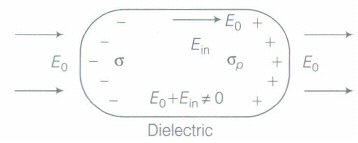
Both polar and non-polar dielectrics develop net dipole moment in the presence of an external field. The dipole moment per unit volume is called polarisation and is denoted by P for linear isotropic dielectrics.
P = XE
Where, X is constant of proportionality and is called electric susceptibility of the electric slab.
(ii) (a) At point C, inside the shell. Electric field inside a spherical shell is zero.
Thus, the force experienced by charge at centre C will also be zero.
\(\because \) Fc = qE (Einside the shell = 0)
\(\therefore \) Fc = 0
At point A, | FA | = 2Q \(\left[ \frac { 1 }{ { 4\pi \varepsilon }_{ 0 } } .\frac { 3Q/2 }{ { x }^{ 2 } } \right] \\.\)
\( F \ = \ \frac { { 3Q }^{ 2 } }{ { { 4\pi \varepsilon }_{ 0 } }{ x }^{ 2 } } ,\) away from shell
Electric flux through the shell,
\(\Phi =\frac { 1 }{ { \varepsilon }_{ 0 } } \) x magnitude of charge enclosed by shell
\(=\frac { 1 }{ { \varepsilon }_{ 0 } } \times \frac { Q }{ 2 } \Rightarrow \Phi =\frac { Q }{ { 2\varepsilon }_{ 0 } } \)
3.
Given, C1 = C2 = 600 pF
= 600 \(\times\)10-12F
= 6 \(\times\)10-10 F
V1 = 200 V, V2 = 0
\(\begin{aligned} \therefore \text { Energy lost } & =\frac{C_1 C_2\left(V_1-V_2\right)^2}{2\left(C_1+C_2\right)} \\ \end{aligned}\)
\(\begin{aligned} =\frac{\left(6 \times 10^{-10}\right)^2(200-0)^2}{2 \times 12 \times 10^{-10}} \end{aligned}\)
= 6 \(\times\)10-6 J
4.
Given,
Capacitance, C = 8pF.
In the first case, the parallel plates are at a distance ‘d’ and is filled with air.
Air has dielectric constant, k = 1
Capacitance, C\(=\frac{k \times \epsilon_{o} \times A}{d}=\frac{\epsilon_{o} \times A}{d}\) .......(i)
Here,
A = area of each plate
ϵo = permittivity of free space.
Now, if the distance between the parallel plates is reduced to half, then d1 = d/2
Given, dielectric constant of the substance, k1 = 6
Hence, the capacitance of the capacitor,
\(\mathrm{C}_{1}=\frac{k_{1} \times \epsilon_{o} \times A}{d_{1}}=\frac{6 \epsilon_{0} \times A}{d / 2}=\frac{12 \epsilon_{o} A}{d}\) .......(ii)
Taking ratios of eqns. (1) and (2), we get,
C1 = 2 x 6 C = 12 C = 12 x 8 pF = 96pF.
Hence, the capacitance between the plates is 96pF.
5.
This is because net electric field intensity at this point is zero, the field intensities due to two charges being equal and opposite
6.
The principle of superposition states that total force on a given charge is the vector sum of the individual forces exerted on it by all other charges, the force between two charges being exerted in such a manner as if all other charges were absent
\(\overrightarrow { F } =\overrightarrow { F_{ 12 } } +\overrightarrow { F_{ 13 } } +....+\overrightarrow { F_{ 1N } } \)
7.
(i) Like charges repel and unlike charges attract each other.
(ii) Charge is quantized
(iii) Charge is conserved
(iv) Charge on a body is not affected by its motion.
8.
Yes, charge conservation is a global phenomenon.
9.
Additivity of charge means the total charge on a system is the algebraic sum (with proper signs) of all individual charges in the system.
10.
Charge on any body or particle can be integral multiple of charge on an electron (-e), i.e.,
q = \(\pm ne\), where n = 1, 2, 3,....
11.
Given,
The area of plate of the capacitor, A = 6 x 10⁻³ m2
Distances between the plates, d = 3mm = 3 x 10⁻³ m
Voltage supplied, V = 100V
Capacitance of a parallel plate capacitor is given by, \(C=\frac{\epsilon \times A}{d}\)
Here,
ε = permittivity of free space = 8.854 x10⁻¹² N-1 m -2 C-2
\(C=\frac{8.854 \times 10^{-12} \times 6 \times 10^{-3}}{3 \times 10^{-3}}=17.81 \times 10^{-12} \mathrm{~F}=17.71 \mathrm{pF}\)
Therefore, each plate of the capacitor is having a charge of
q = VC = 100 x 17.81 x 10-12 C = 1.771 x 10⁻⁹ C
12.
(a)
2
13.
(d)
\(E\alpha {1\over r^3}\)
14.
(a)
Source charge Q only

12th Standard CBSE Syllabus & Materials
12th Standard CBSE
CBSE 12th Computer Science Python Revision Tour I - New Previous year Question Papers Study Material - QB365 Set A
NEW12th Standard CBSE
CBSE 12th Business Studies Planning Important Questions And Answers Study Material - QB365 Set A
NEW12th Standard CBSE
CBSE 12th Business Studies Business Environment Important Questions And Answers Study Material - QB365 Set A
NEW12th Standard CBSE
CBSE 12th Business Studies Principles of Management Important Questions And Answers Study Material - QB365 Set A



CBSE 12th Standard CBSE Subjects
CBSE Standards










