
 100% FREE ACCESS
12th Standard CBSE Syllabus & Materials
12th Standard CBSE
CBSE 12th Economics Government Budget and the Economy Previous year Question Papers Study Material - QB365 Set A
NEW12th Standard CBSE
CBSE 12th Computer Science Interface Python with MySQL - New Previous year Question Papers Study Material - QB365 Set A
NEW12th Standard CBSE
CBSE 12th Computer Science Database Concept - New Previous year Question Papers Study Material - QB365 Set A
NEW12th Standard CBSE
CBSE 12th Computer Science Data Communication - New Previous year Question Papers Study Material - QB365 Set A
NEW12th Standard CBSE
CBSE 12th Computer Science Data Structures - New Previous year Question Papers Study Material - QB365 Set A
NEW12th Standard CBSE
CBSE 12th Computer Science Functions - New Previous year Question Papers Study Material - QB365 Set A

Published on: 24/07/2019
Current Electricity
Download CBSE Class 12th Standard CBSE Physics question papers, sample papers, important questions, and previous year solved papers in PDF format. Get free study materials, NCERT solutions, and exam preparation resources for Class 12th Standard CBSE Physics
Questions + Answers key
Take MCQ Physics Test
1.
Why manganin is used for making standard resistor?
2.
Two wire of equal length one copper and manganin have same resistance , which wire is thicker?
3.
Give any two applications super conductors
4.
Three resistance 3Ω, 6Ω and 9Ω are connected to a battery. In which of them will the power dissipation be maximum if
a) They are all connected in parallel
b) They are all connected in series Give reason.
5.
You are given 8 \(\Omega \) resistor. What length of wire of resistance 120 Ωm-1 should be joined in parallel with it to get a value of 6 \(\Omega \) ?
6.
A 10Ω thick wire is stretched so that its length becomes three times. Assuming that there is no change in its density on stretching. Calculate the resistance of new wire
7.
If p.d.v applied across a conductor is increased to 2v, how will the draft velocity of the electrons change?
8.
The temperature of the filament of an electric bulb is 2700oC when it glows. It is not burnt up at such a high temperature. Why?
9.
There is an impression among many people that a person touching a high power line gets stuck with the line. Is that true? Explain.
10.
If the resistance of our body is so large (\(\approx 10 \ k\Omega\) ) why does one experience a strong shock when one accidently touches the line wire, say a 240 volt supply?
11.
How is the current conducted in metals? Explain.
12.
How does the drift velocity of electrons in a metal conductor vary with the increase in temperature?
13.
How can you keep a constant current inside a conductor?
14.
A steady current is flowing in a cylindrical conductor. Is there any electric field within the conductor?
15.
If the electric current is passed through a nerve, the man is excited, why?
16.
Is electric current a vector or scalar quantity? Explain.
17.
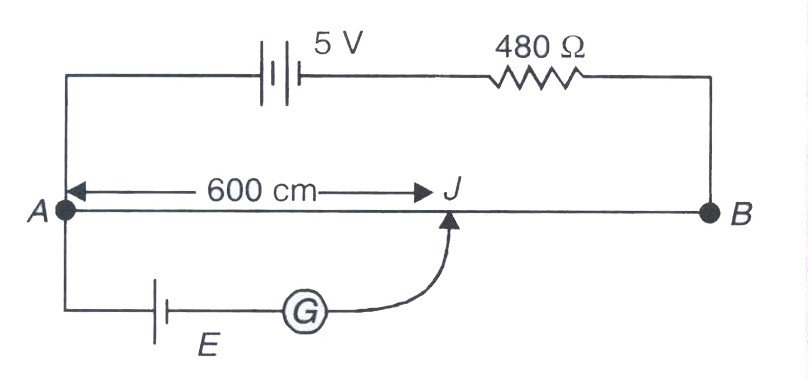
A 10 m long wire AB of uniform area of cross-section and 20\(\Omega\) resistance is used as a potentiometer wire. This wire is connected in series with a battery of 5V and a resistor o 480\(\Omega\). An unknown e.m.f. is balanced at 600cm of the wire as shown in the figure. Calculate
(i) the potential gradient for the potentiometer wire.
(ii) the value of unknown e.m.f. E.
18.
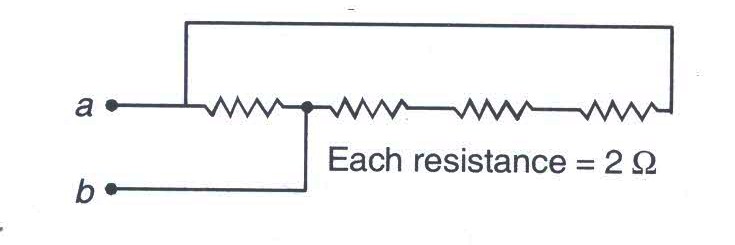
Calculate Rab in the following circuit:
19.
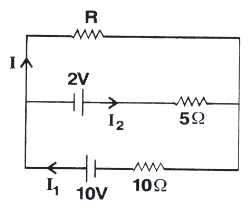
Two cells of voltages 10V and 2V and internal resistances \(10\Omega\ and\ 5\Omega \) respectively are connected in parallel with the positive end of 10V battery connected to negative pole of 2V battery. Find the effective voltage and effective resistance of the combination.
20.
Four identical cells, each of emf 2V are joined in parallel providing supply of current to external circuit consisting of two 15\(\Omega\) resistors joined in parallel. The terminal voltage of the cells as read by an ideal voltmeter is 1.6V Calculate the internal resistance of each cell.
21.
Calculate the conductance and conductivity of a wire of resistance 0.01 \(\Omega\), area of cross-section 10-4m2 and length 0.1 m.
22.
A conductor of length l is connected to a DC source of potential V. If the length of the conductor is tripled by gradually stretching it, keeping V constant, how will
(i) drift speed of electrons and
(ii) resistance of the conductor be affected? Justify your answer
23.
Choose the correct alternative:
(a) Alloys of metals usually have (greater/less) resistivity than that of their constituent metals.
(b) Alloys usually have much (lower/higher) temperature coefficients of resistance than pure metals.
(c) The resistivity of alloy manganin (is nearly independent of/increases rapidly) with increases of temperature.
(d) The resistivity of a typical insulator (e.g. amber) is greater than that of a metal by a factor of the order of \(\ ({ 10 }^{ 22 }/{ 10 }^{ 23 })\) .
1.
High value of resistivity and low value of temperature coefficient
2.
Resistivity of Copper is less, hence mangain wire is thicker
3.
Superconductors are the materials that lose all its resistance at very low temperature = 0 K
Applications of Super conductor are used
a) In making very strong electromagnets
b) In producing veru high speed computers
4.
a) in parallel, power dissipation \(\alpha\) 1/R
Therefore 3\(\Omega \) wire will dissipate more power
b) In series, power dissipation \(\alpha\) R
Therefore 9\(\Omega \) wire will dissipate more power
5.
Now, 1/R = 1R1 + 1R2
Because 1 = 48/240 = 0.2 m
6.
\(\mathrm{R}=\rho(1 / \mathrm{A})\)
\(
=\rho\left(1^2 / \mathrm{A} 1\right) \\
=\rho 12 / \mathrm{V}
\)
Since \(\rho\) and V are constans therefore
\(\rightarrow\left(R_2 / R_1\right)=\left(12 / l_1\right)^2=9\)
Because R2 = 9R1
\(=9 \times 10=90 \Omega\)
7.
As Vd V
The different velocity will be doubled
8.
It is so because the filament of the electric bulb has high melting point and it remains safe in an atmosphere of inert gases which protect its oxidation.
9.
This impression is misleading. In fact, there is no special attractive force that keeps a person stuck with a high power line while touching that wire, whereas a current of few milliampere is enough to disorganise our nervous system. As a result of it, the affected person loses temporarily his ability to exercise his nervous control to get himself free from the high power line.
10.
When a person accidently touches the line wire of a 240 V supply, a current I = 240/10000 = 0.024 A = 24 mA, flows through the body of the person. This current interferes with the nerve process related to our heart beating, which is basically electrical in nature, this, in turn, accounts for a strong shock.
11.
Every metal conductor has a large number of free electrons which move at random at room temperature. Their average thermal velocity at any instant is zero. When a pot. diff. is applied across the ends of the conductor, an electric field is set up in the conductor. Due to it, the free electrons of the conductor experience force due to the electric field and drift towards the positive end of the conductor, causing the electric current in the conductor. The direction of conventional current is opposite to the direction of motion of the free electrons in the conductor.
12.
With the increase in temperature, the drift velocity of free electrons in a metal conductor decreases due to increase in collision frequency of free electrons with the atom/ions of the conductor.
13.
A constant current can be kept inside a conductor by maintaining a constant potential difference across the two ends of conductor.
14.
Yes. A steady current in a cylindrical conductor if electric force is acting on free electrons which make the electrons to move in a particular direction. It is possible due to electric field within the conductor.
15.
The man is excited due to the transfer of electric energy to his body.
16.
Electric current is a scalar quantity because it does not follow the laws of vectors addition, i.e., the angle between the wires carrying the current does not affect the total current in the circuit.
17.
0.02V m-1
0.12V
18.
1.5\(\Omega\)
19.
From Kirchhoff's junction rule, we have
\( { I }_{ 1 }={ I }+{ I }_{ 2 }\) ...........(i)
Applying Kirchhoff's loop rule to outer loop containing 10V cell, we get
\(10=IR+{ 10I }_{ 1 }\) ............(ii)
Applying Kirchhoff's loop rule to outer loop containing 2V cell, we get
\(2={ 5I }_{ 2 }-RI\)
\(2=5\left( { I }_{ 1 }-I \right) -RI\)
\(4={ 10I }_{ 1 }-10I-2RI\)
Subtracting eq (ii) from eq (i), we get
\(6=3RI+10I\)
\(2=I\left( R+\frac { 10 }{ 3 } \right) \)
From Ohm's law, we have
\(V=I\left( R+{ R }_{ off } \right) \)
Comparing eq (iii) and (iv), we get
\({ R }_{ ef }=\frac { 10 }{ 3 } \Omega \)
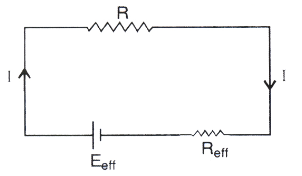
If \({ E }_{ eff }\) and \({ R }_{ eff }\) are the effective voltage and effective internal resistance of the combination, then the equivalent circuit is shown.
20.
According to the question, the circuit can be drawn as shown in the figure
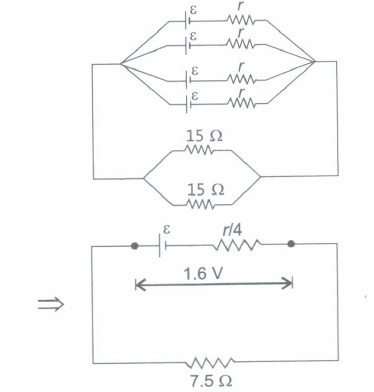
where ε = 2 V, and r = internal resistance of each cell
An equivalent circuit can be redraw as shown.
\(
\frac{r}{4} =\left[\frac{E-V}{V}\right] \times R
\)
\(=\left[\frac{2-1.6}{1.6}\right] \times 7.5
\)
\(r =7.5 \Omega
\)
21.
Conductance,
G = \(\frac{1}{R}=\frac{1}{0.01}\)= 100 S
conductivity,
\(\sigma =\frac{1}{\rho}=\frac{l}{RA}=\frac{0.1}{0.01 \times 10^{-4}}\)
= 105 S m-1
22.
The potential, V = constant, l' = 3l
(i) Drift speed of electrons, \(v_d=\frac{V}{n e l \rho}\)
\(v_d \propto \frac{1}{l}\) [\(\because\) other factors are constant]
So, when length is tripled, drift velocity gets one-third.
(ii) Resistance of conductor is \(R=\rho \frac{l}{A} .\)
Here, wire is tretched to triple its length, that means the mass of the wire remains same in both conditions.
Before stretching mass = After stretching mass
M1 = M2
\(\begin{aligned}
& \Rightarrow \quad V_1 \rho_1=V_2 \rho_2 \quad\left[\because \rho_1=\rho_2\right] \\
\end{aligned}\)
or \(\begin{aligned}
\quad A_1 l_1=A_2 l_2
\end{aligned}\)
Since, length is tripled after stretching.
\(\therefore \quad A_1 l=A_2(3 l) \text { or } A_2=\frac{A_1}{3}\)
Hence, \(R_2=\rho \frac{l_2}{A_2}=\rho \frac{3 l}{A_1 / 3}=\frac{9 \rho l}{A_1} \Rightarrow R_2=9 R_1\)
Thus, new resistance is 9 times of its original value.
23.
(a) Alloys of metals usually have greater resistivity than that of their constituent metals.
(b) Alloys usually have much lower temperature coefficients of resistance than pure metals.
(c) The resistivity of the alloy manganin is nearly independent of increase of temperature.
(d) The resistivity of a typical insulator is greater than that of a metal by a factor of the order of 1022.

12th Standard CBSE Syllabus & Materials
12th Standard CBSE
CBSE 12th Computer Science Python Revision Tour I - New Previous year Question Papers Study Material - QB365 Set A
NEW12th Standard CBSE
CBSE 12th Business Studies Planning Important Questions And Answers Study Material - QB365 Set A
NEW12th Standard CBSE
CBSE 12th Business Studies Business Environment Important Questions And Answers Study Material - QB365 Set A
NEW12th Standard CBSE
CBSE 12th Business Studies Principles of Management Important Questions And Answers Study Material - QB365 Set A



CBSE 12th Standard CBSE Subjects
CBSE Standards










