
 100% FREE ACCESS
12th Standard CBSE Syllabus & Materials
12th Standard CBSE
CBSE 12th Economics Government Budget and the Economy Previous year Question Papers Study Material - QB365 Set A
NEW12th Standard CBSE
CBSE 12th Computer Science Interface Python with MySQL - New Previous year Question Papers Study Material - QB365 Set A
NEW12th Standard CBSE
CBSE 12th Computer Science Database Concept - New Previous year Question Papers Study Material - QB365 Set A
NEW12th Standard CBSE
CBSE 12th Computer Science Data Communication - New Previous year Question Papers Study Material - QB365 Set A
NEW12th Standard CBSE
CBSE 12th Computer Science Data Structures - New Previous year Question Papers Study Material - QB365 Set A
NEW12th Standard CBSE
CBSE 12th Computer Science Functions - New Previous year Question Papers Study Material - QB365 Set A

Published on: 31/07/2019
Wave Optics
Download CBSE Class 12th Standard CBSE Physics question papers, sample papers, important questions, and previous year solved papers in PDF format. Get free study materials, NCERT solutions, and exam preparation resources for Class 12th Standard CBSE Physics
Questions + Answers key
Take MCQ Physics Test
1.
(a) A point object is placed in front of a double convex lens (of refractive index n =n2/n1 with respect air) with its spherical faces of radii of curvature R1 and R2.. Show the path of rays due to surface to obtain the formation of the real image of the object.
Hence obtain the lens maker's formula for a thin lens.
(b) A double convex lens having both faces of the same radius of curvature has refractive index 1.55. Find out the radius of curvature of the lens required to get the focal length of 20 cm.
2.
Light of wavelength \(5000\overset { \circ }{ A } \) falls on a plane reflecting surface. What are the wavelength and frequency of reflected light? For what angle of incidence is the reflected ray normal to the incident ray?
3.
Distinguish between interference and diffraction.
4.
A ray of light passes through an equilateral glass prism, such that the angle of incidence is equal to the angle of emergence. If the angle of emergence is ¾ times the angle of the prism, Calculate the refractive index of the glass prism
5.
A beam of white light on passing through a hollow prism gives no spectrum. Why?
6.
A microscope is focused on a dot at the bottom of a beaker. Some oil is poured into the beaker to a height of y cm and it is found necessary to raise the microscope through a vertical distance of x cm to bring the dot again into focus. Express refractive index of oil in terms of x and y
7.
What happens to the fringe pattern when YDS experiment is performed in water instead of air?
8.
What is the colour of the interference fringe nearest to the white central maximum incase of white light?
9.
For double refracting crystal the refractive indices , for the ordinary and extraordinary denoted by µo and µe. What is the relation valid along the optical axis of the crystal.
10.
What is the difference between hypermetropia and presbyopia?
11.
Give one possible cause of hypermetropia.
12.
Where does a myopic eye focus the parallel rays falling on it?
13.
What is the least distance of distinct vision for a normal eye? Is it the same as the distance of near point?
14.
What is range of vision?
15.
What is the meant by accommodation of the eye?
16.
What is yellow spot?
17.
The correct mirror equation is
\(\frac { 1 }{ f } =\frac { 1 }{ \upsilon } +\frac { 1 }{ u } \)
\(\frac { 1 }{ f } =\frac { 1 }{ \upsilon } -\frac { 1 }{ u } \)
\(\frac { 1 }{ f } =\frac { 1 }{ u } -\frac { 1 }{ \upsilon } \)
none of these
18.
The relation between focal length \(f\) and radius of curvature \(R\) of a spherical mirror is
\(f=R\)
\(f=R/2\)
\(f=2 R\)
none of these
19.
The ratio of the speed of an object to the speed of its real image of magnification m in the case of a convex mirror is
\(-\frac { 1 }{ { m }^{ 2 } } \)
\({ m }^{ 2 }\)
-xm
\(\frac { 1 }{ { m } } \)
1.
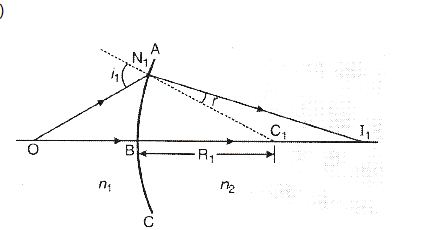
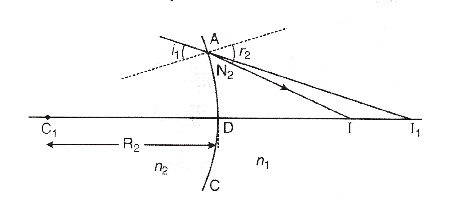
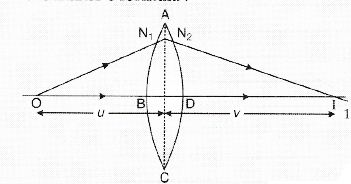
The first refracting ABC forms the image I1 of the object O. The image I1 acts as virtual object for the second refracting surface ADC, which forms the real image I as shown in the diagram
For refraction at ABC
\(\frac { { n }_{ 2 } }{ { v }_{ 1 } } -\frac { { n }_{ 1 } }{ u } =\frac { { n }_{ 2 }-{ n }_{ 1 } }{ { R }_{ 1 } } \)
For refraction at ADC
\(\frac { { n }_{ 1 } }{ v } -\frac { { n }_{ 2 } }{ { v }_{ 1 } } =\frac { { n }_{ 1 }-{ n }_{ 2 } }{ { R }_{ 2 } } \)
Adding equation (i) and equation (ii)
\(\frac { { n }_{ 1 } }{ v } -\frac { { n }_{ 2 } }{ u } =\left( { n }_{ 2 }-{ n }_{ 1 } \right) \left( \frac { 1 }{ { R }_{ 1 } } -\frac { 1 }{ { R }_{ 2 } } \right) \)
\(\frac { 1 }{ v } -\frac { 1 }{ u } =\left( \frac { { n }_{ 2 } }{ { n }_{ 1 } } -1 \right) \left( \frac { 1 }{ { R }_{ 1 } } -\frac { 1 }{ { R }_{ 2 } } \right) \)
We know, If \(u=\infty ,v=f\)
\(\frac { 1 }{ v } -\frac { 1 }{ u } =\frac { 1 }{ f } \)
\(\frac { 1 }{ f } =\left( \frac { { n }_{ 2 } }{ { n }_{ 1 } } -1 \right) \frac { 1 }{ { R }_{ 1 } } -\frac { 1 }{ { R }_{ 2 } } \)
\(\frac { 1 }{ f } =\left( { \mu }_{ 21 }-1 \right) \left( \frac { 1 }{ { R }_{ 1 } } -\frac { 1 }{ { R }_{ 2 } } \right) \)
\(\frac { 1 }{ f } =\left( { \mu }_{ 21 }-1 \right) \left( \frac { 1 }{ { R }_{ 1 } } -\frac { 1 }{ { R }_{ 2 } } \right) \)
\(\frac { 1 }{ f } =\left( 1.55-1 \right) \left( \frac { 1 }{ R } -\frac { 1 }{ -R } \right) \)
\(=0.55\times \frac { 2 }{ R } \)
\(R=0.55\times 2\times 20=22 \ cm\)
2.
Here, \(\lambda =5000\quad \overset { \circ }{ A } =5\times 10^{ -7 }m\)
\(v=\frac { c }{ \lambda } =\frac { 3\times 10^{ 8 } }{ 5\times 10^{ -7 } } =6\times 10^{ 14 }\) hertz
On reflection, there is no change in wavelength or frequency. Therefore,
\(\lambda '=\lambda =5000\quad \overset { \circ }{ A } \quad ;\quad v'=v=6\times 10^{ 14 }Hz.\)
For reflected ray to be normal to incident ray,
\(i+r=90°\) or \(i+i=90°\) \((\because r=i)\)
\(\therefore \) \(i=90/2=45°\)
3.
Differences between interference and diffraction
| Interference | Diffraction |
| 1. Interference takes place when light from two different wavefronts coming from two coherent sources superimpose on each other. | 1. Diffraction is due to superposition of secondary wavelets from various points on the same wave-front. |
| 2. Bright fringes are of the same intensity. | 2. Intensity of secondary maximas goes on decreasing. |
| 3. Fringes are equispaced |
3. Fringes are not equispaced. |
| 4. Intensity of light is zero at minima. | 4. Intensity of light at minima is not zero. |
4.
A = 600 , \(\delta \)m = 300
i = e = ¾ A = 450
as A + \(\delta \) = i + e
60 + \(\delta \) = 45 +45
or \(\delta \) = 300
Refractive index,
\(\mu \) = sin a + \(\delta \)m /2/sin A/2 = sin 600+300/2/sin 600/2
= sin 450/sin300 = 1\(\surd 2\) 1/2 = \(\surd 2\) = 1.414
5.
A hollow prism contains air which does not cause dispersion. The faes AB and AC of the hollow prism behave like parallel sides of glass plates. The beam is laterally deviated at each of the two refracting faces. However, the rays of different colours emerge parallel to each other. So there is no dispersion.
6.
Real depth = y cm
Apparent depth = y- x cm
Refractive index of oil,
\({ \mu }\) = real depth/ apparent depth = y / y-x
7.
Shrinks
8.
Violet
9.
\({ \mu }_{ 0 }={ \mu }_{ e }\)
10.
Hypermetropia is long sightedness.It may be due to contraction in size of the eye ball or increase in focal length of eye lens, when fully relaxed.Presbyopia is long sightedness due to old age when eye ball has normal length.Only the focal length of eye lens in fully relaxed position has increased.
11.
Increase in focal length of eye lens when eye is fully relaxed.
12.
These rays are focussed in front of the retina.
13.
d = 25c.Yes
14.
Range of the vision is the distance between near point and far point of eye.
15.
It is the ability of the eye to observe distinctly the objects situated at widely different distance from the eye.
16.
It is a spot at about the centre of the retina, which is most sensitive to light.
17.
(a)
\(\frac { 1 }{ f } =\frac { 1 }{ \upsilon } +\frac { 1 }{ u } \)
18.
(b)
\(f=R/2\)
19.
(a)
\(-\frac { 1 }{ { m }^{ 2 } } \)

12th Standard CBSE Syllabus & Materials
12th Standard CBSE
CBSE 12th Computer Science Python Revision Tour I - New Previous year Question Papers Study Material - QB365 Set A
NEW12th Standard CBSE
CBSE 12th Business Studies Planning Important Questions And Answers Study Material - QB365 Set A
NEW12th Standard CBSE
CBSE 12th Business Studies Business Environment Important Questions And Answers Study Material - QB365 Set A
NEW12th Standard CBSE
CBSE 12th Business Studies Principles of Management Important Questions And Answers Study Material - QB365 Set A



CBSE 12th Standard CBSE Subjects
CBSE Standards










