
 100% FREE ACCESS
12th Standard CBSE Syllabus & Materials
12th Standard CBSE
CBSE 12th Economics Government Budget and the Economy Previous year Question Papers Study Material - QB365 Set A
NEW12th Standard CBSE
CBSE 12th Computer Science Interface Python with MySQL - New Previous year Question Papers Study Material - QB365 Set A
NEW12th Standard CBSE
CBSE 12th Computer Science Database Concept - New Previous year Question Papers Study Material - QB365 Set A
NEW12th Standard CBSE
CBSE 12th Computer Science Data Communication - New Previous year Question Papers Study Material - QB365 Set A
NEW12th Standard CBSE
CBSE 12th Computer Science Data Structures - New Previous year Question Papers Study Material - QB365 Set A
NEW12th Standard CBSE
CBSE 12th Computer Science Functions - New Previous year Question Papers Study Material - QB365 Set A

Published on: 26/09/2019
Wave Optics
Download CBSE Class 12th Standard CBSE Physics question papers, sample papers, important questions, and previous year solved papers in PDF format. Get free study materials, NCERT solutions, and exam preparation resources for Class 12th Standard CBSE Physics
Questions + Answers key
Take MCQ Physics Test
1.
(i) How does one demonstrate, using a suitable diagram, that unpolarised light when passed through a polaroid gets polarised?
(ii) A beam of unpolarised light is incident on a glass-air interface. Show, using a suitable ray diagram, that light reflected from the interface is totally polarised, when \(\mu =tan{ i }_{ B }\) where \(\mu \) is the refractive index of glass with respect to air and \({ i }_{ B }\) is the Brewster's angle.
2.
A child is observing a thin film such as a layer of oil on water showing beautiful colours, when illuminated by white light. He feels happy and surprised to see this.His teacher explains him example of spreading of kerosene oil on water to prevent malaria and dengue.
Read the above passage and answer the following questions:
(i) What values are displayed by his teacher?
(ii) Name the phenomenon involved.
3.
Ravi wanted to buy a gift for his sister and so he entered inside a gift shop. The gift shop had many glass items. On looking closely, he found many of the beverage glasses used for cold drinks had big thick glass walls. He decided not to buy these glasses because he knows that this gives a false impression that there is more amount of liquid inside the glass.
Read the above passage and answer the following questions:
(i) How does Ravi know about the false impression given by the beverage glasses made with very thick glass walls?
(ii) What values can you associate with Ravi decision?
4.
How is the working of telescope different from that of a microscope?
The focal lengths of the objective and eyepiece o a microscope are 1.25 cm and 5 cm, respectively. Find the position of the object relative to the objective in order to obtain an angular magnification of 30 in normal adjustment.
5.
Use the mirror equation to deduce that, The virtual image produced by a convax mirror is always diminished in size and is located between the focus and the pole.
6.
A refracting telescope has an objective of focal length 1m and an eye of the sun 10 cm in diameter is formed at a distance of 24cm from eye piece. What angle does the sun subtend at the objective?
7.
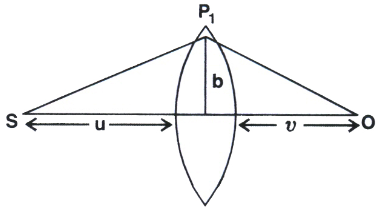
(i) Consider a thin lens placed between a source (S) and an observer (O). Let the thickness of the lens vary as \(\omega (b)={ \omega }_{ 0 }-\frac { { b }^{ 2 } }{ a } ,\) where b is the vertical distance from the pole. \({ \omega }_{ 0 }\) is a constant. using Fermat's principle i.e., the time of transit for a ray between the source and observer is an extremum, find the condition that all paraxial rays starting from the source will converge at a point O on the axis. find the focal length
(ii) A gravitational lens may be assumed to have a varying width of the form show that an observer will see an image of a point object as a ring about the centre of the lens with an angular radius \(\beta =\sqrt { \frac { (n-1){ k }_{ 1 }\frac { u }{ v } }{ u+v } } \)
8.
The mixture a pure liquid and a solution in a long vertical column (i.e., horizontal dimensions << vertical dimensions) produces diffusion of solute particles and hence a refractive index gradient along the vertical dimension. A ray of light entering the column at right angles to the vertical deviates from its original path. find the deviation in travelling a horizontal distance d<
9.
Distinguish between interference and diffraction.
10.
Explain the terms interference of light and define constructive and destructive interference. Is law of conservation of energy obeyed?
1.
The components of electric vector associated with light wave, along the direction of aligned molecules of a polaroid, get absorbed. As a result after passing through it, the components perpendicular to the direction of aligned molecules will be obtained in the form of plane polarised light.
(b) When unpolarised light is incident on the boundary between two transperent media, the reflected light is polarised, with electric vector perpendicular to the plane of incidence when the reflected and refracted light rays make a right angle, as shown in the figure below.
Since, \(\angle CBQ+\angle QBD={ 90 }^{ o }\)
(90 - iB) + (90 - r) = 90o
iB + r = 90
r = 90 - iB
Using Snell's law,
\(\mu =\frac { sin{ i }_{ B } }{ sinr } \)
\(=\frac { sin{ i }_{ B } }{ sin\left( 90-{ i }_{ B } \right) } \)
\(=\frac { sin{ i }_{ B } }{ { cosi }_{ B } } \)
\(\mu =tan{ i }_{ B }\).
2.
(i) The teacher displays the qualities of deep knowledge of the phenomenon and eagerness to explain it to the child.
(ii) The phenomenon involved in a thin film is interference. Different colours of light interfere at different points in space and hence, child is able to see different colours.
3.
(i) Being a phtsics student, he knows that light rays from inside the glass bends away from the normal and appear to diverge. So, it gives false impression that ther is more amount of liquid in bottle.
(ii) Affection, patience and knowledge about refraction.
4.
For microscope f0 = 1.25cm, fe = 5cm
When final image forms at infinity, then mangnification produced by eye lens is given by
\(m=-\cfrac { L }{ f_{ 0 } } .\cfrac { D }{ { f }_{ e } } \)
\(\Rightarrow \) \(-30=-\cfrac { L }{ 1.25 } \times \cfrac { 25 }{ 5 } \)
\(L=\cfrac { 30\times 1.25 }{ 5 } \)
\(\Rightarrow \) \(L=7.50cm\)
For objective lens,v0 = L = 7.5 cm, f0 = 1.25 cm
Applying lens formula,
\(\cfrac { 1 }{ f_{ 0 } } =\cfrac { 1 }{ { v }_{ 0 } } -\cfrac { 1 }{ { u }_{ 0 } } \)
\(\Rightarrow \) \(\cfrac { 1 }{ 1.25 } =\cfrac { 1 }{ 7.5 } -\cfrac { 1 }{ { u }_{ 0 } } \)
\(\cfrac { 1 }{ { u }_{ 0 } } =\cfrac { 1 }{ 7.5 } -\cfrac { 1 }{ 1.25 } \)
\(=\cfrac { 1.25-7.5 }{ 7.5\times 1.25 } =-\cfrac { 6.25 }{ 7.5\times 1.25 } \)
\(\Rightarrow \) \({ u }_{ 0 }=\cfrac { 7.5\times 1.25 }{ 6.25 } =-1.5cm\)
The object must be at a distance of 1.5 cm from objective lens.
5.
For convex mirror, f>0, u<0
From mirror formula, \((\frac { 1 }{ v } =\frac { 1 }{ f } -\frac { 1 }{ u } ,so\frac { 1 }{ v } >\frac { 1 }{ f } orv\)
Also \(\frac { 1 }{ v } >\frac { -1 }{ u } or\frac { -v }{ u } <1\quad i.e.\quad m<1\)
Thus, image is always located between pole and focus of the mirror and is always dimished in size.
6.
here, f0=1 m=100cm, fe=20cm.
If h1=size of image formed by objective lens and
h2=size of image formed by eye piece
\(tan\alpha={h_1\over f_0}={h_1\over 100}\)
\(m_e={h_2\over h_1}=1+{d\over f_e}\)
\({10\over h_1}=1+{24\over14}={44\over20}\ \ h_1={200\over44}={50\over11}cm\)
\(\alpha\simeq tan\ \alpha ={h_1\over100}={50\over1100}={1\over22}rad\)
= 0.0455 rad
7.
(i) The time elapsed to travel from S to \({ P }_{ 1 }\)
\(i_{ 1 }=\frac { { SP }_{ 1 } }{ C } =\frac { \sqrt { { u }^{ 2 }+{ b }^{ 2 } } }{ c }\)
\(or \ \frac { u }{ c } \left( 1+\frac { 1 }{ 2 } \frac { { b }^{ 2 } }{ { u }^{ 2 } } \right) \ assuming \ b<<{ u }_{ o }\)
Time required to travel from \({ p }_{ 1 }\) to O is
\(t_{ 2 }=\frac { { p }_{ 1 }o }{ c } =\frac { \sqrt { { v }^{ 2 }+{ b }^{ 2 } } }{ c } =\frac { v }{ c } \left( 1+\frac { 1 }{ 2 } \frac { { b }^{ 2 } }{ { v }^{ 2 } } \right) \)
Time required to travel through the lens is
\(t_{ 1 }=\frac { { \left( n-1 \right) \omega (b) } }{ c } \)
where n is the refractive index
Thus, the total time is
\(t=\frac { { 1 } }{ c } u+v+\frac { 1 }{ 2 } { b }^{ 2 }\left( \frac { 1 }{ u } +\frac { 1 }{ v } \right) +(n-1)w(b)\)
\(put\ \frac { 1 }{ D } =\frac { 1 }{ u } +\frac { 1 }{ v } \)
\( Then, t=\frac { { 1 } }{ c } \left( u+v+\frac { 1 }{ 2 } \frac { { b }^{ 2 } }{ D } +(n-1)\left( { \omega }_{ 0 }+\frac { { b }^{ 2 } }{ \alpha } \right) \right) \)
Fermat's principle gives the time taken should be minimum
For that first derivative should be zero.
\(\frac { dt }{ db } =0=\frac { b }{ CD } -\frac { 2(n-1)b }{ c\alpha }\)
\( \\ \ \alpha \ =\ 2(n-1)D\)
Thus, a convergent lens is formed if \(\alpha \ =\ 2(n-1)D\)
This is independent of and hence, all paraxial rays from S will converge at O i.e., for rays and (b<
\(since,\ \frac { 1 }{ D } =\frac { 1 }{ u } +\frac { 1 }{ v } ,\ \) the focal length is D
(ii) In this case, differentiating the expression of time taken t w,r,t,b.
\(t=\frac { 1 }{ c } \left( u+v+\frac { 1 }{ 2 } \frac { { b }^{ 2 } }{ D } +(n-1){ k }_{ 1 }In\left( \frac { { k }_{ 2 } }{ b } \right) \right) \)
\( \frac { dt }{ db } =0=\frac { b }{ D } -(n-1)\frac { { k }_{ 2 } }{ b } \)
\( { b }^{ 2 }=(n-1){ k }_{ 1 }D\)
\(\therefore \quad b=\sqrt { (n-1){ k }_{ 1 }D } \)
Thus, all rays passing at a height b shall contribute to the image. The ray paths make an angle
\( \beta =\frac { b }{ v } =\sqrt { \frac { (n-1){ k }D }{ { v }^{ 2 } } }\)
\(={ \left[ \frac { (n-1) \ { k }_{ 1 }uv }{ { v }^{ 2 }(u+v) } \right] }^{ 1/2 }\)
\( i.e., \beta ={ \left[ \frac { (n-1)ku }{ (u+v)\theta } \right] }^{ 1/2 }\)
8.
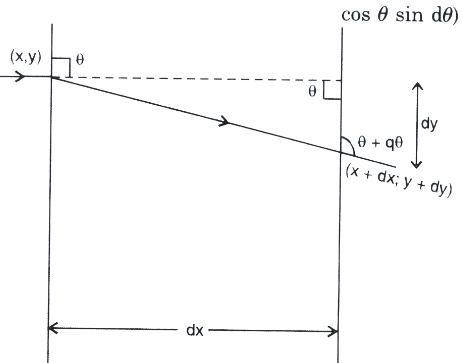
Here ray of light at (x, y) enters at 90°. consider a portion of the ray between x and x+dx inside the liquid. the ray deviates at an angle \(d\theta \) between x and x+dx. emerging at (x+dx, y+dy) at an angle \(\theta +d\theta \) while entering at \(\theta \), at height ay and y + dy. from snell's law
\( \mu (y) \ sin \ \theta \ = \ \mu (y+dy) \ sin \ (\theta +d\theta )\)
\( or\ \mu (y) \ sin\ = \ \left( \mu (y)+\frac { d\mu }{ dy } dy \right) (sin \ \theta \ cos \ d\theta +cos \ \theta \ sin \ d\theta )\)
As \(d\theta \) is small, cos \(d\theta \) = 1 and sin \(d\theta \) = \(d\theta \)
\(\therefore \mu (y) \ sin \ \theta \ = \mu (y) \ sin \ \theta + \ \mu (y) \ cos \ \theta \ d\theta +\frac { d\mu }{ dy } dy \ sin \ \theta \)
( the fourth term is negligibly small hence neglected)
\(or \ \mu (y) \ cos \ \theta d\theta \ =-\frac { d\mu }{ dy } dy \ sin \ \theta \)
\(o d\theta \ =-\frac { 1 }{ \mu } \frac { d\mu }{ dy } dy \ tan \ \theta \)
but from the figure, we find \(tan \ \theta =\frac { dx }{ dy } \)
\(\Rightarrow \ dy \ tan \ \theta =dx\)
\(sod\theta =-\frac { 1 }{ \mu } \frac { d\mu }{ dy } dx\)
\( or\theta =-\frac { 1 }{ \mu } \frac { d\mu }{ dy } \int _{ 0 }^{ d }{ dx } =-\frac { 1 }{ \mu } \frac { d\mu }{ dy } (d)\)
This is the deviation in travelling a horizontal distance d.
9.
Differences between interference and diffraction
| Interference | Diffraction |
| 1. Interference takes place when light from two different wavefronts coming from two coherent sources superimpose on each other. | 1. Diffraction is due to superposition of secondary wavelets from various points on the same wave-front. |
| 2. Bright fringes are of the same intensity. | 2. Intensity of secondary maximas goes on decreasing. |
| 3. Fringes are equispaced |
3. Fringes are not equispaced. |
| 4. Intensity of light is zero at minima. | 4. Intensity of light at minima is not zero. |
10.
Interference of Light. The phenomenon of redistribution of energy in a medium due to superimposition of waves from two coherent source of light is called Interference of Light.
Constructive Interference. At points, where the crest of one wave falls the crest of the other or a through of one falls on the through of the other, the amplitude of the resulting wave becomes maximum. Hence the energy or the intensity of light at such points becomes maximum. This is called Constructive Interference.
Destructive Interference. At some other points where the through of one falls on the crest of the other or crest of one falls on the through of the other, the amplitude of the resulting waves becomes minimum. Hence the energy or intensity becomes minimum. This is called Destructive Interference.
Law of conservation of energy is obeyed. It should be clearly understood that in interference of light no light energy is destroyed. The loss of energy at the points of destructive interference appears as the increase of energy at the points of constructive interference.

12th Standard CBSE Syllabus & Materials
12th Standard CBSE
CBSE 12th Computer Science Python Revision Tour I - New Previous year Question Papers Study Material - QB365 Set A
NEW12th Standard CBSE
CBSE 12th Business Studies Planning Important Questions And Answers Study Material - QB365 Set A
NEW12th Standard CBSE
CBSE 12th Business Studies Business Environment Important Questions And Answers Study Material - QB365 Set A
NEW12th Standard CBSE
CBSE 12th Business Studies Principles of Management Important Questions And Answers Study Material - QB365 Set A



CBSE 12th Standard CBSE Subjects
CBSE Standards










